Irrigation & river projects · Atlas of Telangana
Dams & reservoirs of Telangana
Storages on the Godavari and the Krishna
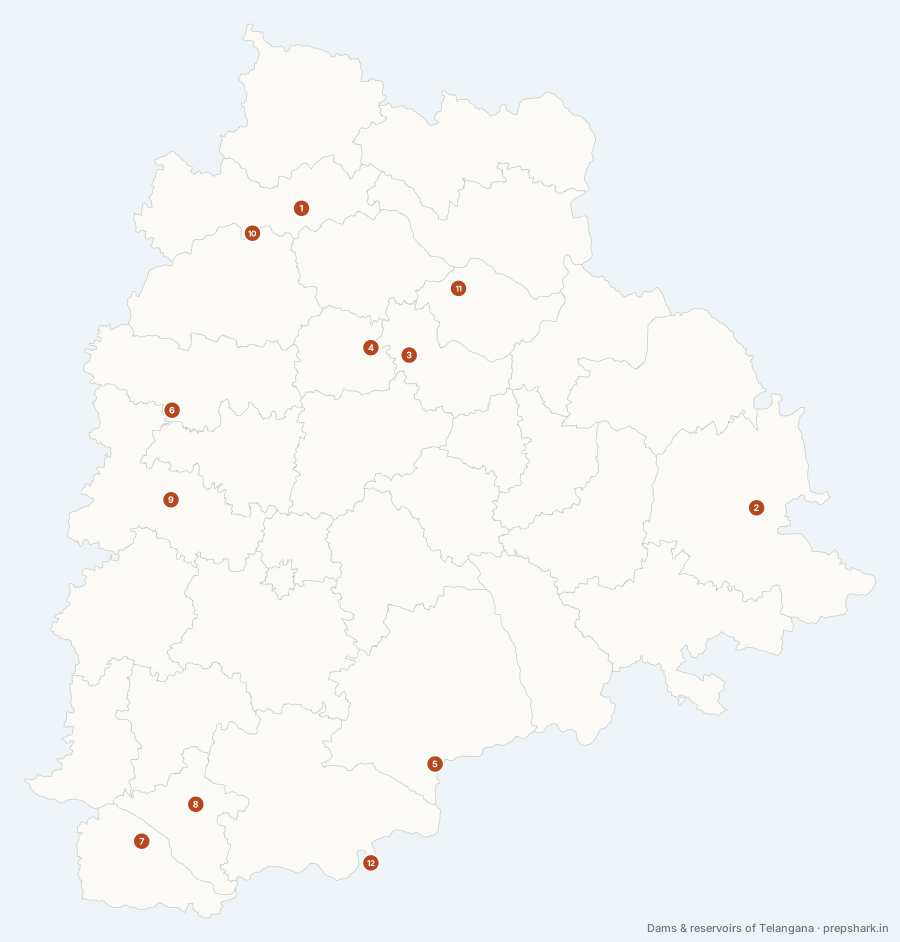
Numbered as on the map
The 12 on the map
1. Kadem Narayana Reddy project
Nirmal
Known forAn early hill-tributary storage in the north.
One of the earliest post-independence works in the region, on a short hill tributary rather than on the Godavari itself — which is what a project looks like when it is built before anybody could raise water and had to take it where gravity already put it.
SettingKadem impoundment · Northern hill catchment · Teak forest
2. Kinnerasani project
Bhadradri Kothagudem
Known forThe reservoir that cools Kothagudem, inside a sanctuary.
Built to cool the Kothagudem thermal station rather than to irrigate, which is the opposite reason from almost everything else on this layer. The reservoir it made became the centre of a wildlife sanctuary, so one small dam is simultaneously an industrial utility and a protected area.
SettingKinnerasani impoundment · Moist deciduous forest · Industrial cooling water
3. Lower Manair Dam
Karimnagar
Known forThe Manair storage at the end of the Kakatiya canal.
Built to hold what the Kakatiya canal delivers from the Sri Ram Sagar, which makes it a storage fed by a canal rather than by its own river — and that is why the Kaleshwaram system could be plugged into it without building anything new downstream. It is also Karimnagar’s water supply.
SettingManair impoundment · Granite plateau · Canal-fed storage
4. Mid Manair
Rajanna Sircilla
Known forWhere the Sri Ram Sagar canal and the Kaleshwaram lift meet.
The junction of the whole northern water system: Sri Ram Sagar water arrives here down the Kakatiya canal from the west, Kaleshwaram water arrives here lifted from the Godavari in the east, and from this reservoir it is handed south to Siddipet and beyond. It is a reservoir whose importance is entirely about what connects to it.
SettingManair impoundment · Central plateau · Two-source storage
For the examThe node that makes Kaleshwaram a system rather than a pump: water raised at Medigadda reaches the south by way of Mid Manair.
5. Nagarjuna Sagar
Nalgonda
Known forThe masonry dam on the Krishna, shared between two states.
A masonry dam across the Krishna begun in 1955 and for a time the tallest of its kind in the world. It sits exactly on the boundary: the left bank and its canal are Telangana’s, the right bank and its canal are Andhra Pradesh’s, and the reservoir is managed jointly. The Buddhist remains of Nagarjunakonda were moved to an island in it before it filled.
SettingKrishna impoundment · Nallamala edge · Interstate reservoir
For the examShared with Andhra Pradesh and operated under the Krishna River Management Board. The left bank canal waters Nalgonda and Suryapet; the right bank canal is in Andhra Pradesh.
6. Nizam Sagar
Kamareddy
Known forThe 1920s Manjira dam — the oldest big storage in the state.
Built across the Manjira in the 1920s under the seventh Nizam, and for a generation the largest work of its kind in the Deccan. It is the oldest major storage in the state still in service, and the masonry aqueduct across its face is the reason it is recognisable.
SettingManjira impoundment · Western plateau · Canal command
For the examIn Kamareddy district since 2016, not Nizamabad — the commonest reorganisation trap on this layer.
7. Priyadarshini Jurala
Jogulamba Gadwal
Known forThe first Krishna project inside the state, below the Tungabhadra.
The first work on the Krishna after it enters Telangana, just below the Tungabhadra confluence — which is the only reason it can exist, because above the confluence there is not enough water to be worth taking. It is the head of the Palamoor irrigation chain that Wanaparthy and Gadwal depend on.
SettingKrishna impoundment · Southern dry plateau · Palamoor command
8. Sarala Sagar
Wanaparthy
Known forOne of the very few siphon-operated dams in Asia.
Built by the Wanaparthy samsthan and notable for how it works rather than for its size: it discharges by siphon, with no gates and no motors, which is a design that exists in only a handful of places anywhere. It is a reminder that the princely estates built water works of their own before the state did.
SettingSouthern dry plateau · Siphon spillway · Samsthan-era work
For the examThe siphon spillway is the examinable point — it releases automatically at a set level without any gate being opened.
9. Singur dam
Sangareddy
Known forHyderabad’s Manjira supply, above a crocodile sanctuary.
Built upstream of the Nizam Sagar to supply Hyderabad rather than to irrigate, which makes it the point at which the Manjira stopped being a farming river and became a municipal one. The islands below it are the Manjira Wildlife Sanctuary, so the same water is a drinking supply and a crocodile habitat.
SettingManjira impoundment · Drinking water catchment · Crocodile habitat
10. Sri Ram Sagar Project
Nirmal
Known forPochampad, the first big dam on the Telangana Godavari.
The first large storage built on the Godavari inside the state, at Pochampad where the plateau rim gives the river banks to be dammed against. For forty years it was the answer to north Telangana’s water question, and its silting up is most of the reason a second answer — Kaleshwaram — had to be built downstream.
SettingGodavari impoundment · Plateau rim · Kakatiya canal command
For the examIts canal is the Kakatiya canal, which runs east across the northern districts. Silting reduced its live capacity substantially, which is the standing argument for the barrages below it.
11. Sripada Yellampalli
Peddapalli
Known forThe Godavari barrage at Ramagundam, and Kaleshwaram’s fourth link.
A barrage on the Godavari built to supply Ramagundam’s power stations and the Singareni mines, and then repurposed as the fourth link of the Kaleshwaram chain. Water lifted from Medigadda passes through here before it turns inland, which is why a project designed for industry became the hinge of an irrigation scheme.
SettingGodavari impoundment · Coalfield · Industrial water supply
12. Srisailam
Nagarkurnool
Known forThe Krishna gorge dam — Andhra Pradesh’s, with a Telangana left bank.
A hydroelectric dam across the Krishna in the Nallamala gorge, upstream of Nagarjuna Sagar. The dam and the temple town are in Andhra Pradesh; the reservoir backs up the gorge into Nagarkurnool, and the left bank power station is Telangana’s. It is the clearest case on this layer of a project that belongs to both states in different parts.
SettingKrishna gorge · Nallamala quartzite · Hydroelectric reservoir
For the examThe dam site is in Andhra Pradesh. What is in Telangana is the reservoir’s upper reach and the left bank hydel station — a distinction papers ask about directly.
Keep going