Start hereAbout 1 min
Chapter Overview Map
- Literary, archaeological, inscriptional, numismatic and foreign sources together rebuild ancient Andhra.
- The Andhras appear first as a people in the Aitareya Brahmana and in Ashoka’s Rock Edict XIII.
1.2 and 1.3 Satavahana rise and state
- Simuka is the founder named in the Nanaghat list; Gautamiputra Satakarni restored the dynasty by defeating Nahapana.
- Districts called aharas, tax-free land grants, guild banking and coin-based trade marked the state.
- Dates are debated, so learn the standard framework and know the alternative.
1.4 Satavahana faith, language and art
- Vedic sacrifice and Buddhist monasteries were patronised side by side.
- Gaha Sattasai in Prakrit, and Amaravati, Karle and Nasik monuments, are the main cultural marks.
1.5 and 1.6 Ikshvakus of Vijayapuri
- Four kings ruled from Vijayapuri (Nagarjunakonda): Chamtamula I, Virapurushadatta, Ehuvula Chamtamula and Rudrapurushadatta.
- Kings performed Vedic rites, while royal women built Buddhist monuments.
1.7 Comparison and significance
- Both dynasties joined Deccan politics, trade and Buddhism with Vedic kingship.
- The Satavahanas held a wide Deccan empire; the Ikshvakus held the lower Krishna valley.
Don’t confuse
- Andhra Ikshvakus of Vijayapuri are a historical dynasty; the Ikshvakus of Ayodhya are a legendary solar line.
- Andhra is the Puranic label for the Satavahanas; their own records say Satavahana or Satakarni.
Read the six branches in order: sources, Satavahana history, Satavahana culture, Ikshvakus, comparison, then the two warnings.
1.1Section 1 of 7About 8 min
Historical Background and Sources of Ancient Andhra
Andhra: Land and Early Identity
- Andhra was first the name of a people and later of their country, Andhradesa, centred on the Godavari and Krishna valleys.
- Older names include Andhrapatha, Andhramandala and Andhrabhumi.
- The Puranas call the Satavahanas Andhra, Andhrabhritya or Andhra-jatiya; the dynasty’s own records use Satavahana or Satakarni.
- The popular Trilinga (“three lingas”) explanation of the word Telugu is doubted by many scholars.
| Term | Meaning | Where it appears |
|---|---|---|
| Andhra | A people, and later their country | Aitareya Brahmana, Ashoka’s Rock Edict XIII, Puranas |
| Andhrabhritya | Puranic label for the dynasty; its exact meaning is debated | Puranas |
| Satavahana | The dynasty’s name for itself | Inscriptions and coins |
| Asmaka (Assaka) | A kingdom on the Godavari, one of the sixteen great states (mahajanapadas) of early Buddhist lists | Anguttara Nikaya, Sutta Nipata, Jatakas |
- Asmaka was the only one of the sixteen great states in South India; its capital Potana (Potali) is usually identified with Bodhan in Nizamabad district, Telangana.
- The Jatakas show Asmaka as a neighbour of Kalinga, whose capital was Dantapura.
Literary and Foreign Sources
| Source | Kind | What it tells us |
|---|---|---|
| Aitareya Brahmana | Vedic text | Lists the Andhras among peoples outside the Aryan fold, said to descend from the sons cursed by Vishvamitra |
| Mahabharata and Puranas | Epic and Puranic | Mention Andhras as a people; the Matsya, Vayu, Brahmanda, Vishnu and Bhagavata Puranas list Satavahana kings |
| Buddhist texts | Canon and Jatakas | Anguttara Nikaya names Assaka among the sixteen states; Sutta Nipata places the Brahmin Bavari on the Godavari |
| Megasthenes (through Pliny) | Greek envoy’s account | The Andarae, usually taken as Andhras, had walled towns and a large army |
| Periplus of the Erythraean Sea | Sailors’ guide, mid-1st century CE | Names trade centres of the Deccan such as Paethana (Paithan) and Tagara |
| Ptolemy’s Geography | Greek geographer, 2nd century CE | Lists east-coast places such as Maisolia and Kantakossyla, often identified with Ghantasala |
| Gaha Sattasai, Brihatkatha | Satavahana-period literature | Village life and court tradition (see Section 1.4) |
- The Puranas were compiled long after the events and disagree on numbers, so they give names and traditions rather than firm dates.
- The Matsya Purana is read as listing thirty kings over about 460 years, but manuscripts name only 17 to 19 kings with different totals.
Archaeological, Inscriptional and Numismatic Sources
Excavated sites show how people lived, built and traded, and they fix the places where kings and monasteries stood.
| Site | District today | What it gives |
|---|---|---|
| Kotilingala | Jagtial | Mud fort of about 100 acres on the Godavari; punch-marked coins and early coins naming Chimuka, Gobhada and Samagopa |
| Peddabankur | Peddapalli | Township of the Satavahana age; coin moulds, inscribed seals and an iron-working area |
| Dhulikatta | Peddapalli | Buddhist stupa and monastery of about the 2nd century BCE |
| Kondapur | Sangareddy | Over 2,000 Satavahana coins, coin moulds, brick stupa and chaitya hall |
| Nelakondapalli | Khammam | Buddhist stupa site |
| Jaggayyapeta | NTR | Ancient Buddhist stupa site |
| Amaravati and Dharanikota | Palnadu | The great stupa (Mahachaitya) and the ancient town of Dhanyakataka |
| Nagarjunakonda | Palnadu | Capital of the Ikshvakus, called Vijayapuri |
| Ghantasala | Krishna | Buddhist Mahachaitya; probably Ptolemy’s Kantakossyla, though this is debated |
| Bhattiprolu | Bapatla | Relic caskets with some of the earliest Brahmi writing in the south |
| Chandavaram | Prakasam | Hilltop stupa, small stupas, monasteries and carved slabs |
| Thotlakonda and Bavikonda | Visakhapatnam | Buddhist monasteries and stupas; Satavahana lead coins and Roman silver coins at Thotlakonda |
| Salihundam | Srikakulam | Hilltop Buddhist site on the Vamsadhara river |
| Phanigiri | Suryapet | Buddhist complex with Ikshvaku-period records and a coin hoard |
District names follow present usage after the 2022 reorganisation of Andhra Pradesh districts.
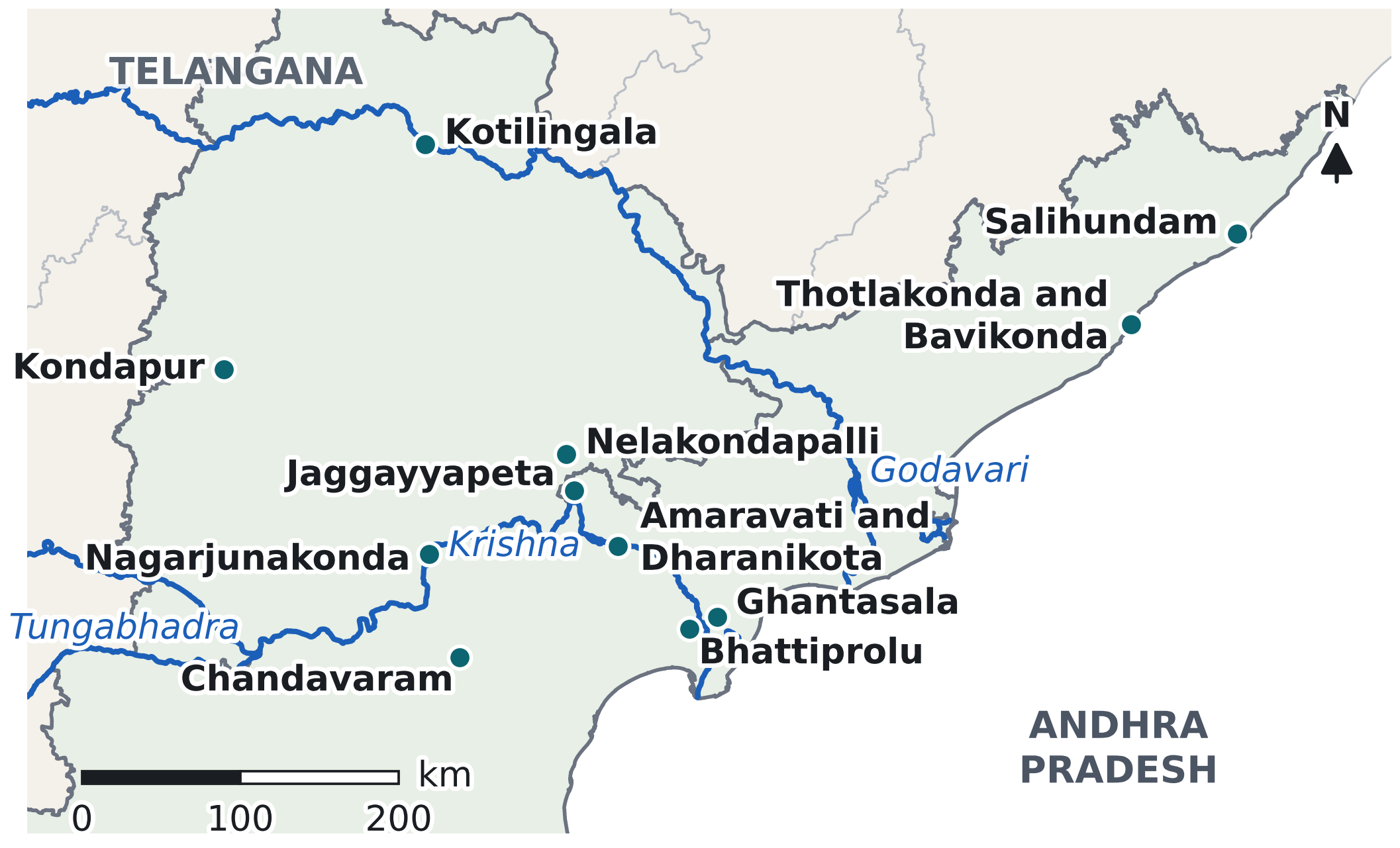
Notice that the Telangana sites lie on or near the Godavari, while Amaravati, Nagarjunakonda and Ghantasala cluster on the Krishna.
Source: Boundaries: Local Government Directory states layer (compiled by Datameet); rivers: India-WRIS. Site positions are village or town points from published coordinates. Peddabankur, Dhulikatta and Phanigiri are not plotted because reliable coordinates were not confirmed.
Inscriptions
- Ashoka’s edicts in the Rayalaseema region, at Yerragudi, Rajula Mandagiri and Jonnagiri, mark the Mauryan frontier in the south.
- The Bhattiprolu relic caskets carry an early Brahmi script; Bühler argued the writing is not later than about 200 BCE.
- Satavahana records come mostly from Maharashtra and Karnataka, while Ikshvaku records come from Nagarjunakonda, Phanigiri and nearby sites.
| Inscription | Ruler or donor | What it records |
|---|---|---|
| Hathigumpha (Odisha) | Kharavela of Kalinga | Sent an army to the west “disregarding Satakamni”; the king is usually taken as a Satakarni, but readings differ |
| Kanaganahalli (Karnataka) | Chimuka (Simuka) | A year-16 slab, the oldest dated Satavahana record in the usual claim |
| Nanaghat | Queen Naganika (Nayanika) | Vedic sacrifices of Satakarni I and a royal list beginning with Simuka |
| Nasik Cave 19 | Kanha | Cave gift made through an officer called a mahamatra |
| Nasik Cave 3 | Queen mother Gautami Balasri | Praise of Gautamiputra Satakarni, dated in year 19 of Pulumavi |
| Junagadh | Rudradaman I | Says he twice defeated the “lord of Dakshinapatha” but spared him (about 150 CE) |
| Nasik (Nahapana’s cave) | Ushavadata | Gifts and guild deposits by Nahapana’s son-in-law |
| Nagarjunakonda pillars | Ikshvaku kings and royal women | Gifts to the Mahachaitya and monasteries |
| Patagandigudem plates | Ehuvula Chamtamula | The only Ikshvaku copper-plate grant known so far |
| Phanigiri | Rudrapurushadatta, year 18 | Gift of a wheel (cakra), with Sanskrit verses and Prakrit prose |
Coins
- Punch-marked coins are the oldest local currency; Kotilingala yielded hundreds of coins, including many punch-marked pieces.
- Lead, potin, copper and a few silver coins carry Satavahana names, and some bear the Ujjain symbol.
- The Jogalthembi hoard near Nashik held silver coins of Nahapana restruck by Gautamiputra Satakarni.
- Ship coins of Pulumavi and Yajna Sri point to sea trade; the Ikshvakus issued lead coins.
Early Political Developments
- About 6th century BCEAsmaka (Assaka) on the Godavari is one of the sixteen great states of early Buddhist lists
- 4th century BCEThe Nandas of Magadha are said in the Hathigumpha text to have dug a canal in Kalinga; Nanda rule south of the Vindhyas is uncertain
- 3rd century BCEAshoka conquers Kalinga; Rock Edict XIII counts the Andhras among peoples who follow his Dhamma instruction
- 3rd–2nd century BCELocal rulers such as Gobhada and Samagopa issue coins at Kotilingala; Bhattiprolu and early Amaravati rise
- 2nd–1st century BCEThe Satavahanas emerge (dates debated); Kharavela rules in Kalinga
- 1st century BCE–3rd century CESatavahana rule; recent research also places a local Sada dynasty at Dhanyakataka
- About 210–325 CEThe Ikshvakus rule from Vijayapuri in the Krishna valley
Read top to bottom: oldest to newest. Dates for the Satavahanas and Ikshvakus are approximate and differ among scholars.
- Ashoka’s Rock Edict XIII lists the Andhras with the Bhojas, Pitinikas and Pulindas among peoples near his frontier who followed his Dhamma instruction.
- This places the Andhras within or beside Mauryan influence, though how firmly the Mauryas ruled the far south is not clear.
- After the Mauryas, Kalinga became independent and Kharavela of Kalinga recorded a campaign towards the west in the Hathigumpha inscription.
1.2Section 2 of 7About 9 min
The Satavahanas: Origin, Chronology and Political History
Origin and Name
- The dynasty’s own records use Satavahana and the royal title Satakarni; Andhra is the label used by the Puranas.
- The meaning of Satavahana is debated: “one with a swift horse”, a Sanskrit form meaning “driven by seven”, and a Munda-language derivation for “horse” and “son” have all been proposed.
- Kings took names from their mothers, such as Gautamiputra and Vasishthiputra; this is the matronymic custom.
| View | Supported by | Basis |
|---|---|---|
| Eastern Deccan (Andhra) | E. J. Rapson, R. G. Bhandarkar | The Puranic name Andhra |
| Kotilingala (Telangana) | Ajay Mitra Shastri, D. R. Reddy and others | Coins reading “Rano Siri Chimuka Satavahanasa” |
| Western Deccan (Maharashtra) | V. V. Mirashi | Early inscriptions are found mainly in Maharashtra |
| Junnar first, then Pratishthana | M. K. Dhavalikar | Early cave inscriptions at Junnar |
| Bellary region (Satavahanihara) | V. S. Sukthankar | A territorial name; critics note few early Satavahana records there |
Varna claims
- The Puranas call the founder a vrishala, meaning low-born.
- Gautamiputra’s Nasik record calls him ekabrahmana, read as “peerless Brahmana”, “protector of Brahmanas” or “champion of Brahmanism”.
- Mirashi and Raychaudhuri take the dynasty as Brahmana, while Sircar argues that they were non-Brahmanas who later claimed Brahmana rank.
Chronology
- The Puranas give about 30 kings and 450 to 460 years, but their numbers conflict, so modern work leans on inscriptions and coins.
- Inscriptions use the regnal year of a king, not a fixed era, so calendar dates are inferred from outside links such as the Junagadh record.
| Point | Standard (textbook) framework | Alternative frameworks |
|---|---|---|
| Start of the dynasty | Late 1st century BCE, or from the 2nd century BCE in some books | From about 271 BCE (Puranic count) to about 30 BCE (Sircar); the Kanaganahalli slab favours about 110 BCE for Chimuka |
| Gautamiputra Satakarni | About 106–130 CE | About 60–85 CE (Bhandare, Ollett); 86–110 CE (Sinopoli, Ray); 103–127 CE (Higham) |
| Vasishthiputra Pulumavi | About 130–159 CE | About 85–125 CE in the newer scheme |
| Yajna Sri Satakarni | About 174–203 CE | About 152–181 CE or 170–199 CE |
| End of the dynasty | About 225 CE | Up to about 300 CE for the late branch (Bhandare) |
- About 110 BCEKanaganahalli slab records year 16 of King Chimuka (Simuka), the oldest dated Satavahana record in the usual claim
- About 150 CE (Saka year 72)Rudradaman’s Junagadh inscription says he twice defeated the “lord of Dakshinapatha” but did not destroy him
- Years 18 and 24 of GautamiputraNasik grants by Gautamiputra to Buddhist ascetics
- Year 19 of PulumaviNasik Cave 3 prasasti of Gautami Balasri praises her son Gautamiputra
- Year 7 of Yajna SriNasik Cave 20 record of Yajna Sri Satakarni
Read top to bottom. These regnal years and the Junagadh date are firmer than any calendar date for the kings.
Important Rulers
| Ruler | Period (approximate) | What to remember |
|---|---|---|
| Simuka | Before 100 BCE in several schemes | Founder; first in the Nanaghat list; Puranic reign of 23 years; the Puranas say he overthrew the Kanvas, which inscriptions do not confirm |
| Kanha (Krishna) | Brother and successor of Simuka in the Puranas | Nasik Cave 19 records a gift through the officer (mahamatra) Samana; extended rule towards Nasik |
| Satakarni I | Debated; several kings bore this name | Husband of Naganika; performed Ashvamedha and Rajasuya; styled “lord of Dakshinapatha”; said to have won Malwa, Anupa and Vidarbha |
| Hala | Date uncertain | Traditional compiler of Gaha Sattasai; his authorship is traditional only |
| Gautamiputra Satakarni | About 106–130 CE | Defeated Nahapana; granted land at Nasik; praised in the Nasik Cave 3 prasasti |
| Vasishthiputra Pulumavi | About 130–159 CE | Nasik and Karle records; ship coins; bilingual coin legends; Amaravati inscription |
| Vasishthiputra Satakarni | Mid-2nd century CE | Brother of Pulumavi; married a daughter of Rudradaman I (Kanheri record) |
| Yajna Sri Satakarni | About 174–203 CE | Last great king; ship coins; Nasik Cave 20 and Kanheri records; said to have recovered some western lands |
| Later kings | Early 3rd century CE | Vijaya, Chandra Sri and the last main-line king Pulumavi IV ruled a shrinking realm |
Periods follow the standard framework where it gives dates; elsewhere they are left open because scholars disagree.
Gautamiputra Satakarni, restorer of the dynasty
- His achievements are known from the Nasik Cave 3 prasasti, composed by his mother Gautami Balasri in year 19 of Pulumavi.
- Titles include Rajaraja (king of kings), ekabrahmana, khatiya-dapa-mana-madana (crusher of Kshatriya pride) and Tisamuda-toya-pita-vahana (whose horses drank the waters of three seas).
- The “three seas” title is a poetic claim; there is no evidence that he conquered the far south.
- The prasasti lists lands he claimed: Asika, Asaka, Mulaka, Suratha, Kukura, Aparanta, Anupa, Vidarbha and Akara-Avanti.
- It also says he “restored the glory of the Satavahana family” and stopped the mixing of the four varnas, a phrase that one scholar reads as “social disorder”.
- Gautamiputra’s year 18 Nasik grant calls him lord of Benakataka; scholars place Benakataka near Nasik or at Pauni in Bhandara district.
- Whether he held coastal Andhra and Telangana is debated, because no Satavahana records from there are known before Pulumavi.
Pulumavi and Yajna Sri
- Pulumavi has Nasik Cave 3 records of years 19 and 22 and a Karle record of year 7, and issued ship-type lead coins.
- His bilingual coins use Prakrit on one side and a Dravidian language on the other; scholars differ on whether it is Old Telugu or closer to Tamil.
- Yajna Sri Satakarni issued ship coins and silver coins modelled on Kshatrapa issues; many scholars credit him with recovering part of the west.
- Towards the end of his reign the Abhiras seized the Nasik region.
Territory, Capitals and Relations
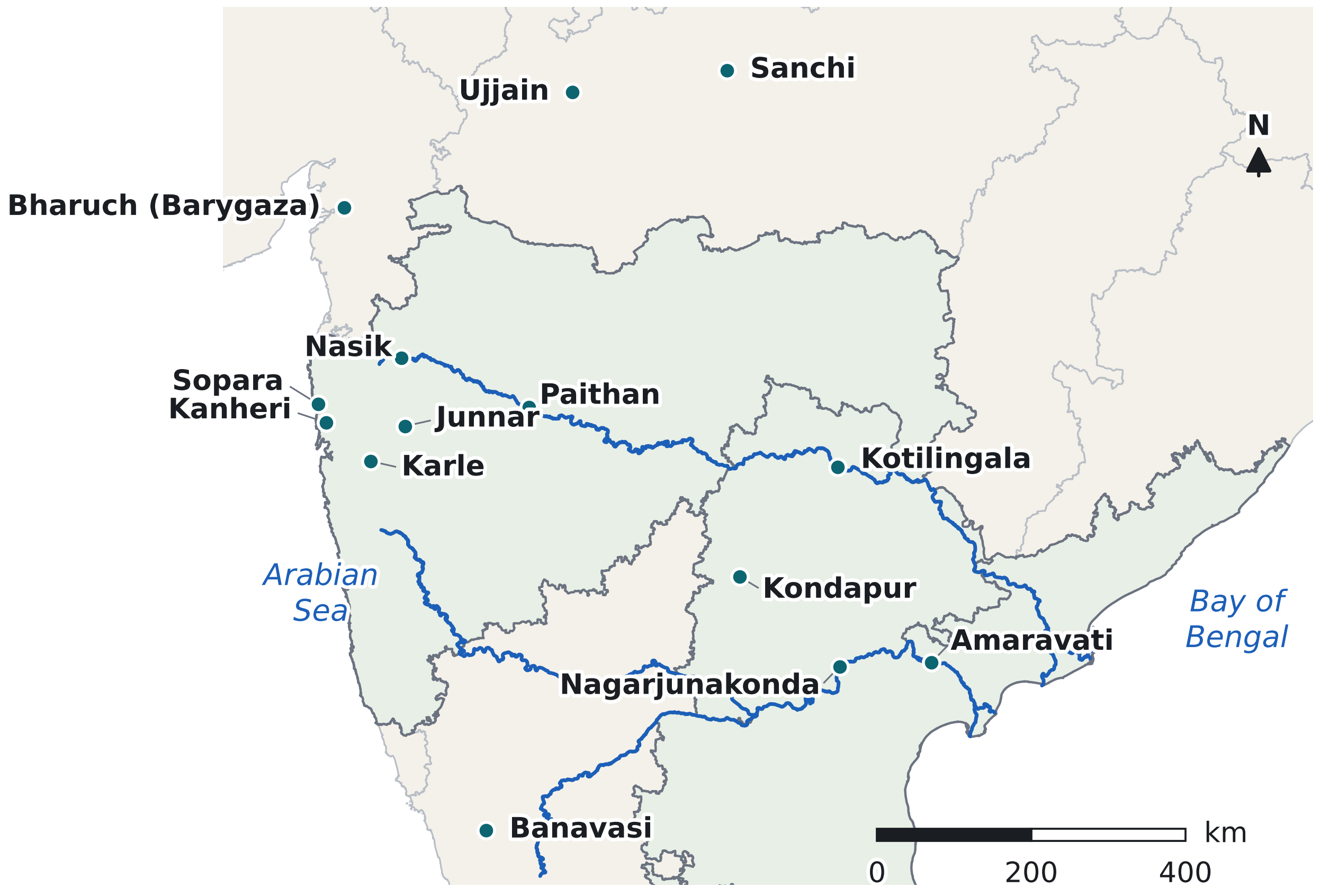
Notice the line from the Konkan ports through the Naneghat pass to Paithan, and then across the Deccan to the Krishna valley.
Source: Present-day state boundaries are shown for orientation only and do not mark the extent of any kingdom. Boundaries: Local Government Directory states layer (compiled by Datameet); rivers: India-WRIS. Site positions are village or town points from published coordinates.
- The main early centres lay in the western Deccan: Pratishthana (Paithan) on the Godavari, and possibly Junnar before it.
- Dhanyakataka (Dharanikota near Amaravati) is a later centre in the east; whether Pulumavi ruled from there is debated.
- The Satavahana capital is described as shifting between the two regions, but the evidence for each phase is incomplete.
| Power | Relation with the Satavahanas | Evidence |
|---|---|---|
| Kanvas of Magadha | The Puranas say Simuka overthrew them | Puranic prophecy only; inscriptions do not confirm it |
| Kalinga (Kharavela) | Kharavela sent an army west “disregarding Satakamni” | Hathigumpha line 4; readings range from war to tribute to friendship |
| Western Kshatrapas: Nahapana | Defeated by Gautamiputra | Jogalthembi restruck coins; Nasik Cave 3 prasasti |
| Western Kshatrapas: Rudradaman I | Twice defeated a Satakarni but spared him as a close relation | Junagadh inscription; Kanheri marriage record |
| Abhiras | Took the Nasik region late in the dynasty | Late-dynasty records of Abhira rule at Nasik |
| Chutus of Banavasi | Close ties with the Satavahanas; a successor power in the south-west | Reported close links; an Ikshvaku princess later married a Chutu prince |
Read top to bottom: earlier events first.
Decline
- After about 225 CE the realm broke into regional powers: a late Satavahana branch, the Abhiras in the west, the Ikshvakus in the Krishna valley, the Chutus at Banavasi and the Pallavas in the south-east.
- Feudatories rose when the central power weakened after Yajna Sri.
1.3Section 3 of 7About 7 min
Satavahana Administration, Society and Economy
Administration
King and court
- Hereditary monarchy; kings used raja, and Rajaraja or Maharaja for stronger rulers.
- Queens such as Naganika and Gautami Balasri issued records of their own.
Districts and towns
- The kingdom was divided into aharas, such as Govardhana ahara near Nasik.
- Settlements ranged from nagara (city) and nigama (market town) to gama (village).
Officers
- Amatyas administered aharas; the early officer title was mahamatra.
- A mahasenapati could also draft royal orders, as Medhuna did for Pulumavi.
Feudatories
- Maharathis were hereditary lords who could grant villages, as at Karle.
- Other ranks include mahabhoja and mahasenapati, listed by scholars from the records.
Camps
- Military camps called kataka and skandhavara served as bases and administrative centres.
Notice that the early title mahamatra gives way to amatya in later records.
| Term | Meaning | Evidence |
|---|---|---|
| Ahara | District | Often named after its centre, as in Govardhana ahara in the Nasik grants |
| Amatya | Minister or officer of an ahara | Nasik orders name amacha Vinhupalita and Sivagupta |
| Mahamatra | Early senior officer, in Mauryan style | Nasik Cave 19 names the mahamatra Samana, in charge of ascetics |
| Mahasenapati | Senior military officer | Mahasenapati Medhuna wrote Pulumavi’s order; Bhavagopa appears in a Nasik gift |
| Maharathi | Hereditary feudatory chief | Maharathi Somadeva granted a village at Karle; Naganika’s father was a Maharathi |
Only titles found in inscriptions are listed. Other titles that appear in coaching notes are left out because no inscription could be traced.
- The use of mahamatra in the early records suggests Mauryan influence on Satavahana administration.
- Scholars describe the state as less centralised than the Mauryan one, relying on feudatories and religious donors.
Land Grants
- Gautamiputra’s year 18 Nasik grant gave the Ajakalakiya field of 200 nivartanas (a land measure) to ascetics at Tiranhu hill; a year 24 order exchanged it for other land.
- Gautami Balasri gave the village Pisajipadaka to Bhadayaniya monks (Nasik Cave 3).
- Pulumavi exchanged the village Sudasana for Samalipada (year 22) and Maharathi Somadeva gave a village to the Valuraka community at Karle (year 7).
| Term in the record | Meaning (Senart’s translation) |
|---|---|
| Apavesa | Not to be entered by royal officers or soldiers |
| Anomasa | Not to be touched |
| Alonakhadaka | Not to be dug for salt |
| Arathasavinayika | Free from interference by district officials |
Some books print the general label “aparihara”; the Prakrit text uses parihara for exemption.
- The Naneghat record mentions villages given as sacrificial fees, but whether this is a land grant or a revenue grant is debated.
- So the Nasik year-18 grant is the safer example of the first clear royal grant with immunities.
Society and Women
- Matronymics (Gautamiputra, Vasishthiputra) show that a king’s mother held high status; the reason for the custom is not explained in the records.
- Gautamiputra boasted of stopping the mixing of varnas, yet he formed a marriage alliance with Rudradaman’s kin.
- Kings took several wives, and marriage within a group (endogamy) was common, unlike the Brahmanical ideal.
| Woman | Role | Record |
|---|---|---|
| Naganika (Nayanika) | Widow of Satakarni I and daughter of the Maharathi Tranakayiro | Naneghat cave record of royal sacrifices |
| Gautami Balasri | Mother of Gautamiputra, grandmother of Pulumavi | Nasik Cave 3 prasasti, cave gift and gift of a village |
| Wife of the merchant Samudra | Lay donor | Coping stone at Amaravati |
Women of the Ikshvaku age appear in Section 1.6.
- Artisans and merchants also appear as donors: Ananda, foreman of the artisans of King Satakarni, at Sanchi, and Yavana (Greek) donors at Karle.
- Whether Gautami Balasri governed in her son’s late years is debated; Sircar thinks so and Mirashi rejects it.
Agriculture, Guilds and Coinage
- The Gaha Sattasai shows farming as the main livelihood of village life.
- Scholars suggest the growth of the Satavahana economy involved wider farming, forest clearance and water storage, though the evidence is indirect.
- Excavations at Kotilingala and Peddabankur found iron tools, beads and a forge, so crafts supported town life.
| Guild | Deposit | Interest per month | Purpose |
|---|---|---|---|
| Weavers’ guild (kolika nikaya) at Govardhana | 2,000 kahapanas | 1 padika for every hundred | Cloth money for monks |
| A second weavers’ guild (aparakolika nikaya) | 1,000 kahapanas | Three-quarters of a padika for every hundred | Other needs of the monks |
Rates follow the standard translation of the inscription; some books give only the total of 3,000 kahapanas.
| Coin type | Metal and design | What it tells us |
|---|---|---|
| Early local issues | Punch-marked pieces and copper coins at Kotilingala | Local rulers and a money economy before the Satavahanas |
| Satavahana lead and potin | Elephant, Ujjain symbol and the legend Raño siri Satavahanasa on an early lead coin | Lead coins were the common small change of the Deccan |
| Restruck Nahapana silver | Nahapana’s portrait with Gautamiputra’s symbol and name | Proof of the defeat of Nahapana |
| Ship coins | Two-masted ship on lead coins of Pulumavi and Yajna Sri | Sea trade along the east coast |
| Bilingual coins | Prakrit on one side, a Dravidian language on the other (Pulumavi) | Dravidian speech in Satavahana lands |
Inland and Overseas Trade
Read left to right: the Periplus describes goods flowing from Tagara and Paethana to Barygaza.
- The Naneghat pass linked the Konkan ports of Sopara and Kalyan with Paithan and Nasik.
- In the Periplus period (mid-1st century CE) Barygaza was ruled by Nambanus, usually identified with Nahapana, so the port was under the Kshatrapas, not the Satavahanas.
- On the east coast, Ptolemy’s Maisolia is the Masulipatnam region and Kantakossyla is often identified with Ghantasala.
- A wooden wharf at Dharanikota and Roman amphorae and glass show port trade there in the Satavahana age.
Agriculture
- Village life centred on farming, shown in the Gaha Sattasai.
- Land measured in nivartanas in the Nasik grants.
Crafts and guilds
- Weavers’ guilds took deposits and paid interest.
- Iron working and bead making are found at Peddabankur and Kotilingala.
Coinage
- Lead, potin and copper were common; silver was rarer.
- Ship coins show maritime links.
Inland trade
- Paithan and Tagara linked the interior to Barygaza.
- The Naneghat pass joined Konkan ports to Paithan.
Overseas trade
- Roman coins and pottery turn up at Kondapur, Thotlakonda and Dharanikota.
- Pliny complained of Rome’s loss of wealth to India.
Notice that guilds and coins connect farming to long-distance trade.
1.4Section 4 of 7About 6 min
Satavahana Religion, Language, Literature and Art
Religion
This section covers only what is specific to the Satavahanas; Chapter 4 compares religion, language, literature and art across all ancient Andhra dynasties.
| Faith | Patrons | Evidence |
|---|---|---|
| Vedic and Brahmanical | Satakarni I and Queen Naganika | Naneghat record: Ashvamedha, Rajasuya and rich fees; invocation of Dharma, Indra, Samkarshana and Vasudeva, Chandra, Surya and the world-guardians (Yama, Varuna, Kubera and Vasava) |
| Buddhism | Kanha, Gautami Balasri, Gautamiputra, Pulumavi, Yajna Sri, and lay donors | Nasik Cave 3, Cave 19 and Cave 20; Karle; grants to Bhadayaniya monks; gifts at Amaravati |
| Jainism | Tradition about Simuka | A later Jain tradition says Simuka turned to Jainism; no inscription supports it |
| Saka donors | Ushavadata and his wife Dakhamitra | Gifts to Buddhist monks and to Brahmanas at Nasik |
- Buddhist patronage went to named schools such as the Bhadayaniya monks at Nasik; Karle is linked with the Mahasamghika school.
- Early Buddhist worship at Nasik was without images of the Buddha, which suits the older schools (often called Hinayana).
- The kings supported Vedic rites and Buddhist monasteries together; this is best described as patronage of both, not conversion.
Language and Literature
- Prakrit, a Middle Indo-Aryan language written in Brahmi, was the language of Satavahana inscriptions and coin legends.
- Sanskrit was rare; the Nasik cave record of Ushavadata is among the earliest uses of Sanskrit in western India, in a mixed form.
- Some Telugu and other Dravidian words appear in names and coin legends, but this does not show that Telugu was already a written literary language.
| Work | Tradition | Points of caution |
|---|---|---|
| Gaha Sattasai (Gathasaptasati) | Collection of about 700 Prakrit verses on love and village life, credited to Hala; language is Maharashtri Prakrit | Hala’s authorship is traditional; scholars date the text between the 1st and 4th centuries CE; many poets are named |
| Brihatkatha | Tale collection in Paisachi by Gunadhya, said to have worked under a Satavahana king at Pratishthana | Original is lost; it survives through the Kathasaritsagara and other retellings |
| Katantra | Simplified Sanskrit grammar credited to Sarvavarman | Tradition links him with a Satavahana king; evidence is traditional |
| Suhrllekha (Letter to a Friend) | Advice letter tradition-linked to Nagarjuna and a Satavahana king | The king’s identity and Nagarjuna’s authorship are both uncertain |
Art and Architecture
Stupa, chaitya and vihara
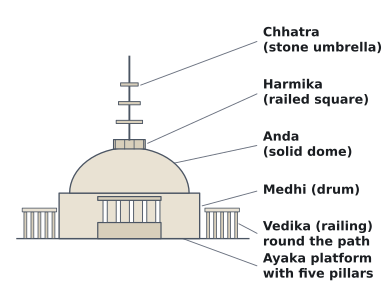
Notice that the ayaka platform with five pillars projects from the drum, as at Amaravati and Nagarjunakonda.
Source: Schematic; not to scale. Drawn for this chapter from standard descriptions of early Buddhist stupas.
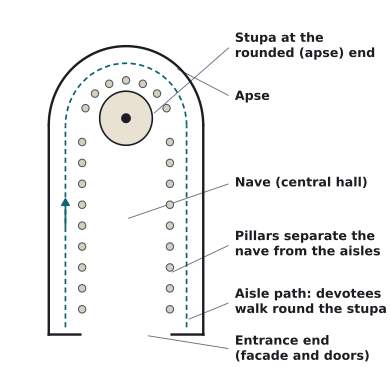
Notice how the aisle path lets worshippers walk round the stupa at the rounded end.
Source: Schematic; not to scale. Drawn for this chapter from standard descriptions of rock-cut chaitya halls such as Karle.
Amaravati
- The Mahachaitya at Amaravati was probably founded in the Mauryan age, according to the Archaeological Survey of India (ASI), which says it is believed to have been founded by the monk Mahadeva, an emissary of Ashoka; no inscription shows this.
- The earliest remains of the stupa belong to about the 2nd century BCE; railing slabs of limestone with Jataka scenes, the Buddha’s life and lotus medallions belong to the later phases.
- Ayaka platforms project at the four directions, each with five pillars; they are found at Amaravati, Bhattiprolu, Ghantasala and Nagarjunakonda.
- Colin Mackenzie visited Amaravati in 1797; sculptures were later taken to Madras (the Elliot Marbles) and some reached London in 1859.
Cave sites of the western Deccan
| Site | Satavahana link | Remember |
|---|---|---|
| Nasik (Pandavleni) | Cave 19 of Kanha, Cave 3 of Gautamiputra (gift of Gautami Balasri), Cave 20 of Yajna Sri | Early Buddhist caves of the older schools, without Buddha images |
| Karle | Great chaitya; records of Ushavadata, Gautamiputra and Pulumavi | The largest rock-cut chaitya hall in India |
| Junnar | Many caves and early cave inscriptions | Possibly an early Satavahana base |
| Kanheri | Records of Yajna Sri in Chaitya Cave 3 and Cave 81 | Cave site near the Konkan coast |
| Naneghat | Cave of Naganika with the royal list and sacrifice record | A trade pass from the coast to Paithan |
| Sanchi | Southern gateway inscription of Ananda, foreman of the artisans of King Satakarni | Which Satakarni is meant is debated |
| Amaravati | Great stupa; rails and slabs of the Satavahana age, though the patrons are debated | Source of the Amaravati style (see below) |
- Karle is dated by some to the closing years of the 1st century BCE and by others to the early 2nd century CE; a dedication of the first quarter of the 2nd century CE is recorded.
- Ajanta is not attributed to the Satavahanas by the ASI; its earliest caves belong to about the 2nd century BCE.
Contributions and Significance
| Field | Satavahana contribution |
|---|---|
| Politics | First Deccan power to build a wide empire in the south (Dakshinapatha); restored by Gautamiputra after Saka pressure |
| Administration | Ahara districts, officers drawn from Mauryan practice, feudatory ranks, tax-free land grants |
| Economy | Guild banking, lead and silver coinage, ship coins and links with the Roman trade |
| Religion | Patronage of Vedic rites and of Buddhist caves and stupas side by side |
| Culture | Prakrit literature such as Gaha Sattasai; cave architecture; the Amaravati tradition |
1.5Section 5 of 7About 5 min
The Ikshvakus: Origin, Rulers and Administration
Origin and Chronology
- The Andhra Ikshvakus, or Ikshvakus of Vijayapuri, ruled the lower Krishna valley from Vijayapuri, modern Nagarjunakonda, in the 3rd and 4th centuries CE.
- The name separates them from the legendary Ikshvakus of Kosala (Ayodhya), whose link to this dynasty is not known.
- They rose in the Krishna–Guntur region as Satavahana power faded; whether they began as Satavahana feudatories is debated.
- The Matsya Purana’s Sriparvatiya Andhras may be the same people, but scholars differ on whether Sriparvatiya was their own name.
- Satavahana coins of Pulumavi and Yajna Sri, and a record of Vijaya Satakarni (year 6), were found at the site, so Vijayapuri was already a town in the late Satavahana age.
- The Ikshvakus kept using the same style of lead coins.
| Scholar | Range for the dynasty |
|---|---|
| K. Krishna Murthy | About 227–309 CE |
| Upinder Singh | About 210–325 CE |
| K. R. Subramanian | About 225–340 CE |
Inscriptions give regnal years, not an era, so every range is an estimate.
The four rulers follow in a clear father-to-son order, even where calendar dates differ.
Rulers
| Ruler | Approximate period | What to remember |
|---|---|---|
| Vasishthiputra Chamtamula I | About 210–250 CE | Founder; Rentala pillar (year 5) and Kesanapalli pillar (year 13); performed the Ashvamedha; his sisters Chamtisiri and Hammasiri |
| Mathariputra Virapurushadatta | About 250–275 CE | Known to year 24; married daughters of his father’s sisters and a Saka princess of Ujjain; Mahachaitya renovated in year 6; Sihala vihara gift in year 14 |
| Vasishthiputra Ehuvula Chamtamula | About 275–300 CE | Peak of the kingdom; Patagandigudem plates; monasteries founded by royal women in his reign |
| Vasishthiputra Rudrapurushadatta | About 300–325 CE | Last known king; the Phanigiri record of year 18 pushes his reign beyond the year 11 known at Nagarjunakonda |
Periods follow Upinder Singh’s scheme as commonly reported; Krishna Murthy’s scheme ends the dynasty earlier.
Read left to right: each king succeeded his father.
Administration and Territory
- The core of the kingdom was the lower Krishna valley around Vijayapuri; records at Phanigiri in Telangana suggest wider influence.
- The state is described as a group of allied ruling families held together by marriage, not a tightly centralised empire.
- Titles in the records include Mahasenapati, Mahatalavara and Dandanayaka, and kings used the royal title maharaja.
| Family or dynasty | Marriage link |
|---|---|
| Pukiya family | A sister of Chamtamula I is reported to have married the Mahatalavara Skandashri |
| Dhanaka family | Chamtamula I’s daughter Adavi Chamtisiri married Khamdavishakha, titled Mahasenapati and Mahatalavara |
| Western Kshatrapas of Ujjain | Virapurushadatta married Rudradhara-bhattarika, probably a daughter of Rudrasena II |
| Chutus of Vanavasa (Banavasi) | His daughter Kodabalisiri married a Chutu prince |
Several names rest on one or two records; treat the finer details as reported rather than settled.
- The Saka marriage may have helped against the Abhiras; this motive is an inference.
- A hoard of Saka coins found at Petluripalem near Vijayapuri supports contact with the Western Kshatrapas.
Society and Economy
- Virapurushadatta married three daughters of his father’s sisters, a form of cross-cousin marriage that kept power within a small circle of families.
- Succession passed from father to son, yet royal women were prominent donors in the records.
- Coins were mostly lead, in the Satavahana style, and a lead-coin hoard was found at Phanigiri (see Section 1.1).
- The Krishna river and the Ujjain alliance gave access to wider trade, and Roman gold coins are reported from Nagarjunakonda.
Decline
- Around the 270s CEVasusena, an Abhira, records a year-30 inscription at the Ashtabhujasvamin temple; Sircar reads it as a brief Abhira hold on the valley
- Late 3rd century CEThe Brihatphalayana king Jayavarman is said to have thrown off Ikshvaku control in a nearby region
- Early 4th century CEThe Pallavas, under Simhavarman, are inferred to have replaced the Ikshvakus in the Krishna–Guntur area
- By the mid-4th century CEPallava authority is established over former Ikshvaku lands
Read top to bottom: earlier events first. Each step is an inference from a few records.
1.6Section 6 of 7About 5 min
Ikshvaku Religion, Royal Women and Nagarjunakonda
Religion
- The Ikshvaku kings followed Vedic and Brahmanical rites: Chamtamula I performed the Ashvamedha, and later records name other sacrifices.
- Temples on the site include those of Pushpabhadraswamin (a form of Shiva), Kartikeya and Ashtabhuja Narayana (Vishnu).
- Buddhism flourished through the patronage of royal women and lay donors, so the royal house supported both traditions.
| School | Evidence at Nagarjunakonda |
|---|---|
| Aparamahavinaseliya | Named in records at sites 1 and 9 |
| Bahusrutiya | Site 5; monastery founded by Queen Bhattidevi in the reign of Ehuvula |
| Mahisasaka | Sites 7 and 8; linked with Kodabalisiri |
| Mahaviharavasin | Site 38, a slab with the Buddha’s footprints |
| Sri Lankan monks (Tambapannaka) | Site 43 records a gift to a Sihala vihara in year 14 of Virapurushadatta |
Older studies list more sects such as Caityikas and Purvaselas; the four named schools above are the safest for exams.
- Records show contact with Sri Lanka: a Sihala vihara and an apsidal shrine built by the lay donor Bodhisiri for Sri Lankan monks.
- Claims that Nagarjunakonda influenced Sri Lankan Buddhism or script rest on a single source and are left out.
Royal Women as Patrons
| Woman | Who she was | Patronage |
|---|---|---|
| Chamtisiri | Sister of Chamtamula I; aunt and probably mother-in-law of Virapurushadatta | Renovated the Mahachaitya in year 6 under the monk Ananda; her gifts appear on many ayaka pillars |
| Bhattidevi | Royal lady of the court, called Mahadevi | Founded the Bahusrutiya monastery |
| Kodabalisiri | Royal lady, Mahadevi | Founded a monastery for Mahisasaka monks |
| Bodhisiri | Lay woman (upasika), not a queen | Built an apsidal shrine for Sri Lankan monks; gave for her husband and father |
Relationships follow the inscriptions as read by scholars; details of some names are debated.
- Women are prominent among the donors in the Nagarjunakonda records, while kings mostly appear in Vedic and political roles.
- A common pattern is that kings supported Brahmanical shrines and royal women supported Buddhist monuments.
Nagarjunakonda
- Konda means hill; the valley held more than a hundred ancient sites before the dam, and many monasteries and shrines stood on the plain and on the hill.
- The Mahachaitya had a wheel-shaped plan, with ayaka platforms and pillars at the four cardinal directions; it probably held a relic of the Buddha.
- 1926Ancient remains in the Nagarjuna valley are reported and first recognised
- 1927–31A. H. Longhurst carries out systematic excavation for the Archaeological Survey of India
- 1938T. N. Ramachandran excavates
- 1954–60R. Subrahmanyam leads large salvage excavations before the dam
- 10 December 1955Jawaharlal Nehru inaugurates the Nagarjuna Sagar project
- 1966The Nagarjunakonda museum opens, built like a vihara with five galleries
- 4 August 1967The dam is dedicated by Indira Gandhi
Read top to bottom: earliest to latest. Early years come from secondary accounts.
- Monuments were rebuilt on the hilltop and at Anupu, where a brick amphitheatre and two large monastic units were also found.
- The sculpture is a late phase of the Amaravati style, in carved limestone slabs; activity at Amaravati faded as Nagarjunakonda rose.
Other Centres and Cultural Contributions
| Centre | Ikshvaku link |
|---|---|
| Phanigiri (Suryapet) | Buddhist complex with a large stupa and two apsidal halls; a year-18 record of Rudrapurushadatta in Sanskrit verse and Prakrit prose; a 2024 hoard of lead coins |
| Patagandigudem plates | A grant of Ehuvula Chamtamula; the only Ikshvaku copper-plate grant known; kept in the Telangana State Museum |
| Rentala and Kesanapalli | Pillar inscriptions of Chamtamula I |
| Amaravati | Long-lived stupa whose activity shifted to Nagarjunakonda in the 3rd century |
- Early Nagarjunakonda records are in Prakrit in Brahmi script, while Sanskrit appears in later Ikshvaku-period records; the Phanigiri record mixes both.
- Telugu-looking words and names are reported in the Nagarjunakonda records, though they are scattered.
Significance
- Nagarjunakonda was among the largest Buddhist centres in South India, with many monasteries and several Buddhist schools.
- The Ikshvakus joined Vedic kingship with generous support for Buddhism through royal women.
- Their records show Sanskrit coming into use beside Prakrit, and include a copper-plate grant.
- The rescue of the valley is a landmark of salvage archaeology in India.
1.7Section 7 of 7About 4 min
Comparative Study, Chronology and Historical Significance
Comparison of the Two Dynasties
| Feature | Satavahanas | Ikshvakus |
|---|---|---|
| Region | Deccan, from Maharashtra to the Andhra coast | Lower Krishna valley, with reach into Telangana |
| Capital | Pratishthana (Paithan); Dhanyakataka | Vijayapuri (Nagarjunakonda) |
| Period | About 1st century BCE to early 3rd century CE (debated) | About 210–325 CE (debated) |
| Founder | Simuka | Chamtamula I |
| Greatest ruler | Gautamiputra Satakarni; later Yajna Sri | Ehuvula Chamtamula at the peak |
| Royal names | Matronymics such as Gautamiputra; title Satakarni | Matronymics such as Vasishthiputra; prefix Siri |
| Kings’ rites | Ashvamedha and Rajasuya (Satakarni I) | Ashvamedha (Chamtamula I); temples of Shiva, Kartikeya and Vishnu |
| Buddhist patrons | Kings, queen mothers, officers, merchants | Mostly royal women and lay donors |
| Records | Prakrit; very little Sanskrit | Prakrit first, Sanskrit later |
| Coins | Lead, potin, copper, some silver; ship coins | Lead coins; Phanigiri hoard |
| Land grants | Nasik grants with immunities | Patagandigudem copper plates |
| Trade | Paithan, Tagara and Barygaza; Roman contact | Krishna valley; Ujjain alliance; Roman gold coins reported |
| Main monuments | Nasik, Karle and Naneghat caves; Amaravati | Nagarjunakonda Mahachaitya and monasteries; Phanigiri |
| Western Kshatrapas | War, restruck coins and marriage | Marriage alliance with Ujjain |
| End | Split into Abhira, Ikshvaku, Chutu and Pallava powers | Replaced by the Pallavas (inferred), after Abhira pressure |
Chronological Sequence
Read left to right: earlier events first.
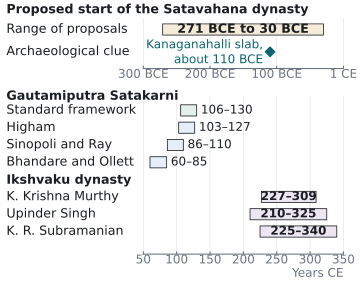
Notice that the Gautamiputra bars sit nearly 50 years apart, and the Ikshvaku ranges overlap but end between 309 and 340 CE.
Source: Ranges as reported by the scholars named; bars show the span each scholar gives, not firm dates.
Contributions
Satavahanas
- Built the first wide Deccan state and linked inland and coastal trade.
- Began tax-free land grants with immunities for religious groups.
- Gave Prakrit literature, cave architecture and the Amaravati tradition.
Ikshvakus
- Made Nagarjunakonda a great Buddhist centre through royal women.
- Joined Vedic kingship with Buddhist patronage and links to Sri Lanka.
- Left early Sanskrit records and the only known Ikshvaku copper-plate grant.
Causes, Consequences and Significance
| Cause | Consequence |
|---|---|
| Weak Mauryan successors and control of passes and ports | The Satavahanas built a Deccan power and gained trade wealth |
| Land grants with immunities | Monasteries gained secure income; the effect on royal authority is debated |
| Roman trade and guild banking | Funds for caves, stupas and coins, including ship coins |
| Reliance on feudatories after Yajna Sri | Regional powers rose: Abhiras, Ikshvakus, Chutus and Pallavas |
| Marriage alliances and royal-women patronage (Ikshvakus) | Stable rule at Vijayapuri and a flowering of Buddhist monuments |
| Abhira and Pallava pressure | The end of Ikshvaku rule in the Krishna valley |
These are historians’ interpretations of the evidence, not statements found in the inscriptions.
- Both dynasties show that land, trade and religion were tied together in early Andhra and the Deccan.
- Their sites and records are the base of the later Buddhist and Brahmanical history of the Telugu country.
- They also show a shift from Prakrit towards Sanskrit and from cave sites towards free-standing temples.
RevisionAbout 1 min
Location and Map Practice
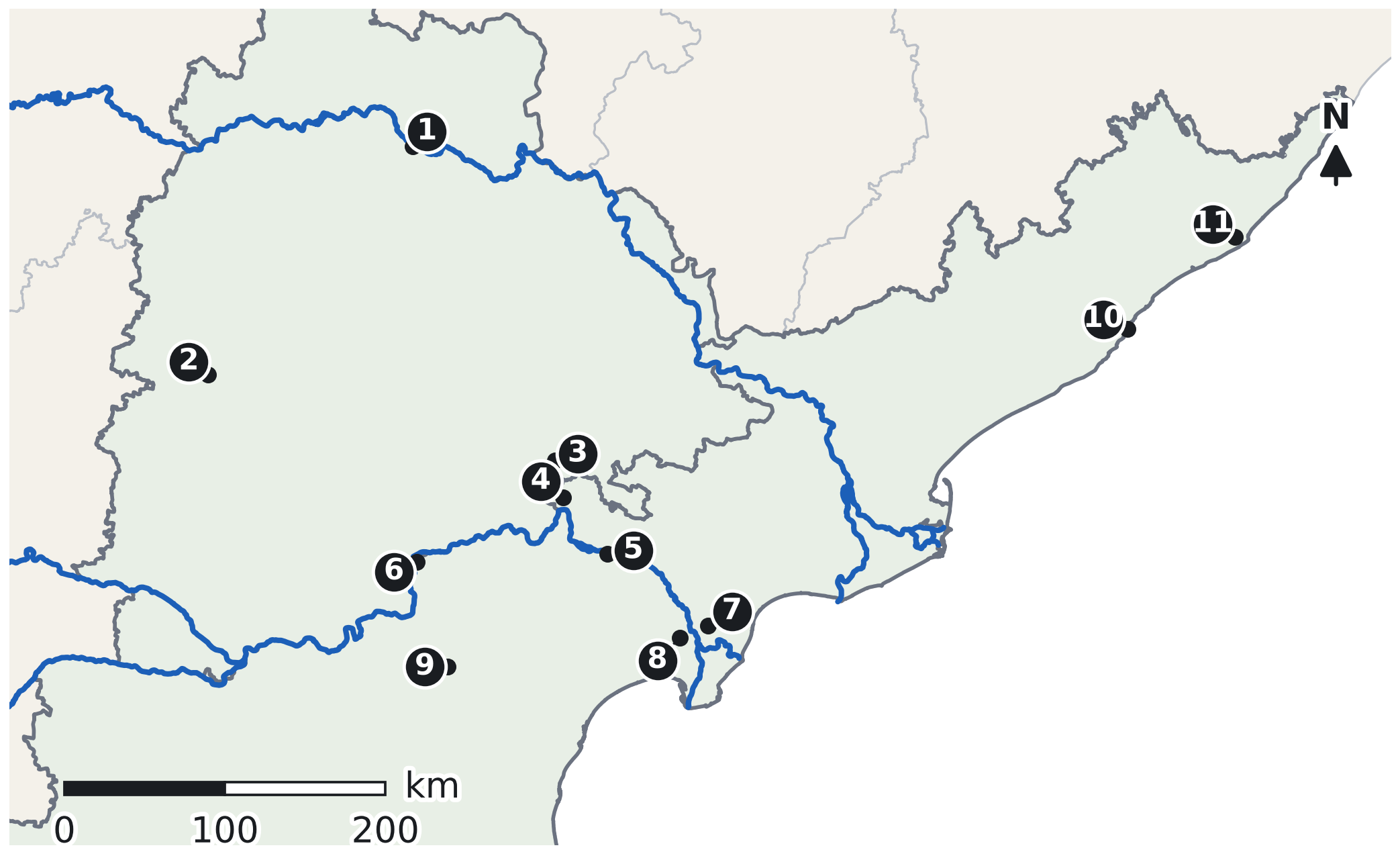
Look for the numbered points and say which river each site lies on or near before checking the answer table.
Source: Boundaries: Local Government Directory states layer (compiled by Datameet); rivers: India-WRIS. Site positions are village or town points from published coordinates.
- Name the places numbered 1 to 11 on the map above.
- Say which of them lie close to the Godavari and which to the Krishna.
- State one thing each place shows about the Satavahanas or Ikshvakus.
| No. | Site | District today | What it shows |
|---|---|---|---|
| 1 | Kotilingala | Jagtial | Early coins naming Chimuka and local rulers; mud fort on the Godavari |
| 2 | Kondapur | Sangareddy | Satavahana coins, moulds and a brick stupa |
| 3 | Nelakondapalli | Khammam | Buddhist stupa site |
| 4 | Jaggayyapeta | NTR | Ancient Buddhist stupa site |
| 5 | Amaravati and Dharanikota | Palnadu | Great stupa and the ancient town of Dhanyakataka |
| 6 | Nagarjunakonda | Palnadu | Ikshvaku capital Vijayapuri |
| 7 | Ghantasala | Krishna | Buddhist Mahachaitya; probably Kantakossyla |
| 8 | Bhattiprolu | Bapatla | Relic caskets with early Brahmi writing |
| 9 | Chandavaram | Prakasam | Hilltop stupa and carved slabs |
| 10 | Thotlakonda and Bavikonda | Visakhapatnam | Buddhist monasteries; Satavahana lead coins and Roman silver coins |
| 11 | Salihundam | Srikakulam | Hilltop Buddhist site on the Vamsadhara |
Try the map first, then check the answers here.
RevisionAbout 1 min
Memory and Recall Review
| Topic | Memory aid | What to recall |
|---|---|---|
| Five kinds of source for ancient Andhra | “Let All Ideas Nest Freely” | Literary, archaeological, inscriptions, numismatic, foreign accounts |
| Satavahana rulers in order | “Simple Kings Share Honey, Gaining Prosperity Yearly” | Simuka, Kanha, Satakarni I, Hala, Gautamiputra, Pulumavi, Yajna Sri |
| Ikshvaku kings in order | “Cats Visit Every Roof” | Chamtamula I, Virapurushadatta, Ehuvula Chamtamula, Rudrapurushadatta |
- Read the chapter once, then test yourself with the recall checks straight after the first reading.
- Repeat the three memory aids the next day, then again after about a week.
- Review the Rapid Revision Sheet after about a month, and redo the map practice.
RevisionAbout 1 min
Rapid Revision Sheet
| Item | Satavahanas |
|---|---|
| Founder | Simuka (Nanaghat list) |
| Greatest king | Gautamiputra Satakarni, who defeated Nahapana |
| Capitals | Pratishthana (Paithan) and Dhanyakataka |
| Key records | Nanaghat, Nasik Cave 3, Nasik grants, Junagadh, Kanaganahalli |
| Administration | Ahara districts, amatya and mahamatra, maharathi feudatories |
| Economy | Land grants, guild banking, lead and silver coins, ship coins |
| Trade | Paithan, Tagara, Barygaza; Naneghat pass |
| Culture | Gaha Sattasai; Nasik, Karle, Naneghat caves; Amaravati |
| Item | Ikshvakus |
|---|---|
| Capital | Vijayapuri (Nagarjunakonda) |
| Kings | Chamtamula I, Virapurushadatta, Ehuvula Chamtamula, Rudrapurushadatta |
| Period | About 210–325 CE (Upinder Singh); ranges differ |
| Key records | Nagarjunakonda pillars, Patagandigudem plates, Phanigiri year 18 |
| Alliances | Pukiya, Dhanaka, Saka of Ujjain, Chutus of Banavasi |
| Faith | Ashvamedha by the king; Buddhist patronage by royal women; Hindu temples on site |
| Women | Chamtisiri, Bhattidevi, Kodabalisiri; Bodhisiri was a lay donor |
| End | Abhira interlude and Pallava replacement (inferred) |
| Term | Meaning |
|---|---|
| Ahara | Satavahana district |
| Amatya, mahamatra | Officers of the Satavahana state |
| Maharathi | Hereditary feudatory who could grant villages |
| Matronymic | Name taken from the mother, such as Gautamiputra |
| Stupa, chaitya, vihara | Solid dome, prayer hall, monastery |
| Ayaka | Platform with five pillars projecting from a stupa drum |
| Prasasti | A praise inscription for a king |
| Upasika | Lay woman devotee |
| Event | Date to fix |
|---|---|
| Kanaganahalli year-16 slab of Chimuka | About 110 BCE |
| Gautamiputra Satakarni (standard framework) | About 106–130 CE |
| Junagadh inscription of Rudradaman I | About 150 CE |
| Yajna Sri Satakarni (standard framework) | About 174–203 CE |
| End of the Satavahana line | About 225 CE |
| Ikshvaku rule (Upinder Singh) | About 210–325 CE |
| Mackenzie at Amaravati | 1797 |
| Nagarjuna Sagar dam inaugurated and dedicated | 10 December 1955 and 4 August 1967 |
| Phanigiri coin hoard reported | April 2024 |
Notes
- 1The range runs from the Puranic reckoning (about 271 BCE) to D. C. Sircar’s date of about 30 BCE, which rests on the story of the Kanvas; the Kanaganahalli slab favours about 110 BCE.
- 2The Phanigiri record of year 18 extends the last reign beyond the year 11 once known, so ranges that end the dynasty about 309 CE may be too early.
- 3Discovery and early excavation years differ slightly between accounts; the dam dates are firmer.