Start hereAbout 1 min
Chapter Overview Map
- Land was held under Diwani, Jagir and Sarf-e-khas tenures, with heavy demands on cultivators.
- Tanks irrigated most farmland; coal, railways, mills and a State bank formed the early modern base.
- The 1956 Gentlemen's Agreement promised Telangana its own surplus revenues, jobs and college seats.
- Irrigation shifted from tanks to wells and tube wells; large industry clustered around Hyderabad.
- Committees from 1955 to 2010 measured Telangana's finances, jobs and income against other regions.
- The Srikrishna Committee (2010) found the picture changes sharply depending on whether Hyderabad is counted.
- Nine of the ten Telangana districts were covered by a central fund for backward districts.
- Drought, fluorosis, distress migration and farm distress marked the region's rural areas.
- The economic demand was summed up as water, funds and jobs.
- Many figures in the debate are claims of one side and must be read with their author.
- Telangana was formed on 2 June 2014 with 10 districts and a per capita income well above India's.
- Services led the economy; agriculture still supported over half the population and relied on groundwater.
1.1Section 1 of 6About 7 min
Telangana Economy under Hyderabad State
- Hyderabad State was the princely State ruled by the Nizams (the Asaf Jahi dynasty) until 1948.
- It had three language regions: Telugu-speaking Telangana, Marathi-speaking Marathwada and the Kannada-speaking districts.
- The 1951 Census counted 1,86,55,108 people in the State's 16 districts.
- Hyderabad was integrated into India after the police action, Operation Polo, ending Nizam's rule on 17 September 1948.
- On 1 November 1956 the Telangana districts were joined to Andhra State to form Andhra Pradesh; Marathwada went to Bombay State and the Kannada districts to Mysore State.
Agriculture
Land tenure: who held the land
Land in Hyderabad State fell into three broad tenures, which decided who collected rent and how much the cultivator paid.
| Tenure | Approximate share of land | Who controlled it |
|---|---|---|
| Diwani (also called Khalsa) | About 60% | The State government, which collected land revenue directly |
| Jagir | About 30% | Jagirdars, nobles and others granted land for service; includes paigahs and samsthans |
| Sarf-e-khas | About 10% | The Nizam's own estate; its income went to the ruler's household |
Shares are approximate and describe the period just before 1948.
Source: P. Sundarayya, Telangana People's Struggle and its Lessons (1972); John Law, Modern Hyderabad (1914)
- Diwani land followed a raiyatwari system, in which each cultivator (raiyat) paid revenue directly to the State.
- Salar Jung I, Diwan (chief minister) from 1853 to 1883, ended revenue farming, the practice of auctioning revenue collection to contractors.
- He placed salaried revenue officers called Talukdars in charge and reorganised the State into districts, a reform known as Zilabandi.
- A regular revenue survey and settlement, which measured land and fixed the revenue on it, began in the mid-1870s.
- Hereditary village revenue officials, the deshmukhs and deshpandes, were given cash allowances called vatans instead of a share of the revenue.
- After 1948 the new government changed the tenure system quickly.
- Sarf-e-khas lands were merged with Diwani land from 5 February 1949, and the Nizam received a fixed annual payment instead.
- Jagirs, including paigahs and samsthans, were abolished from 15 August 1949 by the Hyderabad (Abolition of Jagirs) Regulation, 1358 Fasli.
- The Hyderabad Tenancy and Agricultural Lands Act, 1950 then regulated tenancy; it is protected in the Ninth Schedule of the Constitution.
Irrigation: the age of tanks
- Tanks are small reservoirs made by building an earthen bund across a stream to store monsoon run-off.
- Many tanks date from the Kakatiya kings; Pakhal Lake was built under Ganapati Deva in 1213 CE.
- A count of 1879 listed about 18,089 large and 10,110 small tanks in Telangana.
- Tank-irrigated area grew about ninefold between 1875 and 1940, as the State repaired and extended old tanks.
- In 1956–57, tanks still watered 66.2% of Telangana's net irrigated area (land irrigated at least once a year).
The Nizam's government also built larger reservoirs in the early twentieth century, some for irrigation and some to protect and supply Hyderabad city.
| Reservoir | River | Where | Completed | Main purpose |
|---|---|---|---|---|
| Osman Sagar | Musi | Near Hyderabad | 1920 | Flood control and drinking water for Hyderabad |
| Pocharam | Allair, a tributary of the Manjira | Medak | 1922 | Irrigation |
| Himayat Sagar | Musi river system | Near Hyderabad | 1927 | Flood control and drinking water for Hyderabad |
| Wyra | Wyra, in the Krishna basin | Khammam | 1930 | Irrigation of about 17,391 acres |
| Nizam Sagar | Manjira, a tributary of the Godavari | Kamareddy (then Nizamabad district) | 1931 (begun 1923) | Irrigation; designed for about 2.75 lakh acres |
| Ali Sagar | Nizamabad | 1931 | Irrigation |
Source: Krishna River Management Board; Telangana district and tourism portals; LiveHistoryIndia
Crops
- In the Telangana districts paddy was grown mainly under tank irrigation.
- Cotton and oilseeds were the main commercial produce; cotton-ginning and oil mills were widespread.
- Farming depended on the south-west monsoon, so a failed season hit both food supply and land revenue.
Industry
- Modern industry in Hyderabad State grew from coal, railways and cotton, and later from State investment.
- Coal was found near Yellandu (now in Khammam district) in 1871 by Dr King of the Geological Survey of India.
- The Singareni Collieries Company Ltd (SCCL) was incorporated on 23 December 1920, and the State bought majority shares in 1945.
- The Nizam's government created an Industrial Trust Fund, mostly dated to 1929, to invest in new industries.
| Industry | Place | Year | Product |
|---|---|---|---|
| Dewan Bahadur Ramgopal (DBR) Mills | Hyderabad | 1920 | Cotton textiles |
| Vazir Sultan Tobacco (VST) | Hyderabad | 1930 | Cigarettes |
| Azam Jahi Mills | Warangal | 1934 | Cotton textiles |
| Nizam Sugar Factory | Bodhan (Nizamabad) | 1937 | Sugar |
| Sirpur Paper Mills | Sirpur-Kagaznagar | 1938 (production 1942) | Paper |
| Allwyn Metal Works | Hyderabad | 1942 | Metal products |
| Praga Tools | Hyderabad | 1943 | Machine tools |
| Hyderabad Asbestos Cement Products | Hyderabad | 1946 | Asbestos-cement sheets |
Years are of incorporation or establishment; a selected list, not a complete one.
Source: Company and Ministry of Corporate Affairs records; Telangana Today; The News Minute
Transport, money and higher education grew alongside these industries; the timeline below places them in order.
- 1871Coal found near Yellandu
- 8 Oct 1874Wadi–Secunderabad railway opens, linking Hyderabad to the main line to Bombay
- 1883Nizam's Guaranteed State Railway company formed to build and run the State's lines
- 1886Hyderabad (Deccan) Company gets coal-mining rights; the railway reaches Warangal
- 26 Apr 1917Firman (royal order) establishing Osmania University
- 1918First paper notes of the State's own currency, the Osmania sicca
- 23 Dec 1920Singareni Collieries Company Ltd incorporated
- 1930The State takes over the railway from the company
- 1932Nizam State Railway Road Transport Department starts bus services with 27 buses
- 1941Hyderabad State Bank established; it became the State Bank of Hyderabad in 1956
- 1945The State buys majority shares in Singareni
- 1949Sarf-e-khas merged (5 February) and jagirs abolished (15 August)
- 1 Apr 1955Hyderabadi currency stops being legal tender
- 1 Nov 1956Telangana districts become part of Andhra Pradesh
Read top to bottom: earliest to latest. Notice how coal, rail and finance came before most factories.
Source: SCCL; Osmania University; Telangana Today; Narayanpet district portal; Scroll (C. Tumbe); Supreme Court judgments
Trade
- Hyderabad State was landlocked, so its trade moved by road and, after 1874, mainly by rail towards Bombay and Madras.
- It exported mainly raw cotton, grains, oilseeds, hides and skins and cattle.
- It imported mill cloth and yarn, salt, sugar, kerosene and metals, largely through Bombay.
- In short, raw materials went out and manufactured goods came in.
1.2Section 2 of 6About 8 min
Telangana Economy in United Andhra Pradesh, 1956–2014
From 1956 to 2014 Telangana was one region of Andhra Pradesh, beside Coastal Andhra and Rayalaseema. Its economic story turns on safeguards, water, industry and jobs.
Agreements and Safeguards
- The States Reorganisation Commission (SRC) of 1955 noted that Andhra State had a lower per capita revenue than Telangana and faced financial difficulty.
- It recorded Telangana's fear that its educationally backward people could be swamped and exploited by the more advanced coastal areas.
- It recommended that Telangana remain a separate State for the time being, with union possible after about 1961 if two-thirds of its legislature agreed.
- The merger went ahead in 1956 on the basis of the Gentlemen's Agreement of 20 February 1956, signed by leaders of both regions.
| Area | What was promised to Telangana |
|---|---|
| Funds | Central and general administration costs to be shared proportionately; the balance of Telangana's income (the Telangana surplus) reserved for Telangana's development |
| Jobs | Domicile rules, such as 12 years' residence, to protect Telangana's share of recruitment; retrenchment to be proportionate in both regions |
| Education | Admission to Telangana's colleges, including technical institutions, reserved for Telangana students, or a statewide share of one-third |
| Land | Sale of agricultural land in Telangana to be controlled by a Regional Council |
| Planning | A Regional Council of 20 members for Telangana's development planning, irrigation and industrial development |
Source: Committee for Consultations on the Situation in Andhra Pradesh (Srikrishna Committee), Report, 2010, Chapter 1
- The Regional Council became a statutory Regional Committee through the Andhra Pradesh Regional Committee Order, 1958, made under Article 371(1).
- Telangana's job protection rested on the Mulki Rules, residence rules of the Nizam's period, and on the Public Employment (Requirement as to Residence) Act, 1957.
- 20 Feb 1956Gentlemen's Agreement: Telangana surplus, jobs, colleges and land sales protected
- 1958Regional Committee Order under Article 371(1)
- 28 Mar 1969Supreme Court strikes down the residence rule of the 1957 Act for Telangana
- 1969Committees of Kumar Lalit and Justice Vashishtha Bhargava measure the Telangana surplus
- 3 Oct 1972Supreme Court upholds the Mulki Rules
- 21 Sep 1973Six-Point Formula agreed by leaders of the regions
- 1974Constitution (32nd Amendment) inserts Articles 371D and 371E
- 18 Oct 1975Presidential Order creates local cadres and local reservation in direct recruitment
- 30 Dec 1985G.O. Ms. 610 orders the repatriation of non-locals from Telangana posts
- 30 Sep 2004Girglani Commission reports widespread violations of the Presidential Order
- 30 Dec 2010Srikrishna Committee submits its report
- 2 Jun 2014Telangana State formed
Read top to bottom: earliest to latest. Notice how each safeguard followed a dispute over the one before it.
Source: Constitution (32nd Amendment) Act, 1973; Supreme Court judgments of 1969 and 1972; Presidential Order, 1975; Srikrishna Committee Report, 2010
- The Presidential Order of 1975 reserved posts for local candidates in each cadre at three levels: 80%, 70% and 60%, depending on the type of post.
- It exempted the Secretariat, offices of Heads of Departments, State-level offices and the Hyderabad City Police, which later caused the "free zone" dispute over Hyderabad.
- The Srikrishna Committee described the implementation of G.O. 610 between 1985 and 2005 as tardy.
- After 2014 the new State reorganised its districts, so a fresh Presidential Order set out Telangana's own local-cadre system in 2018.
Irrigation and Water Sharing
- Telangana lies in the basins of two large rivers, the Krishna and the Godavari, but most of its land is upland away from their banks.
- The SRC had noted Telangana's wish to keep independent rights over Krishna and Godavari waters, naming the Nandikonda project.
- The Nandikonda project became Nagarjuna Sagar; its foundation stone was laid on 10 December 1955 and canal water was released on 4 August 1967.
- The Krishna Water Disputes Tribunal (Bachawat Tribunal) allotted 811 thousand million cubic feet (TMC) to Andhra Pradesh as a whole in its final report of 1976.
- That allocation was made to the State as a whole, not region by region, so sharing between Telangana and the Andhra regions was decided within the State.
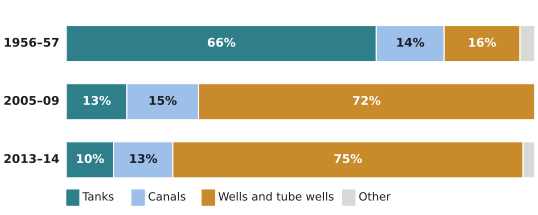
Notice how tanks and wells swapped places while canals stayed small. Shares are per cent of net irrigated area, rounded; 1956–57 and 2005–09 are for the Telangana region, 2013–14 for Telangana State.
Source: Gautam Pingle, Economic and Political Weekly, 2011 (1956–57, 2005–09); Telangana Socio Economic Outlook 2015, Table 11 (2013–14)
- Telangana's net irrigated area roughly doubled, from about 0.8 million hectares (1956–60) to about 1.7 million hectares (2006–09).
- Most of the increase came from wells and tube wells; canal-irrigated area rose only from about 1 lakh to 2.5 lakh hectares.
- Tank-irrigated area fell by about half, from about 4 lakh hectares in the mid-1950s to about 2 lakh hectares, as tanks silted and were neglected.
- One study found canals irrigated only about 6.8% of net sown area in Telangana in 2001, against about 31% in Coastal Andhra.
- After 2014 the State restored tanks under Mission Kakatiya (Telangana · Mission), launched in 2015; it is explained in Chapter 7, Section 7.4.3.
Where Industry Was Located
- After 1956, large central public sector undertakings (companies owned by the Government of India) were set up mainly in and around Hyderabad.
- Private industry, finance and later information technology also concentrated in the Hyderabad area.
| Unit | Year | Product |
|---|---|---|
| Indian Drugs and Pharmaceuticals Ltd (IDPL) | 1961 (company) | Synthetic drugs |
| Bharat Heavy Electricals Ltd (BHEL), Ramachandrapuram | 1965 | Heavy power equipment |
| Bharat Dynamics Ltd (BDL) | 1970 | Missiles and defence equipment |
A selected list; other central units in Hyderabad included the Electronics Corporation of India, the Nuclear Fuel Complex and Mishra Dhatu Nigam.
Source: BHEL; BDL; National Institute of Pharmaceutical Education and Research, Hyderabad
Education and Jobs
- The Gentlemen's Agreement reserved Telangana's college seats and set residence rules for jobs (see Table 1.4).
- The Srikrishna Committee reported that grants to government and aided colleges were about ₹93 crore in Telangana against ₹224 crore in Coastal Andhra.
- Public employment was the most disputed issue: Telangana groups argued that non-locals took posts reserved for locals, which the Girglani Commission examined from 2001 to 2004.
1.3Section 3 of 6About 2 min
Regional Disparities
- Regional disparity means a lasting gap in income, infrastructure or opportunity between regions of the same State.
- Andhra Pradesh had three regions: Telangana, Coastal Andhra and Rayalaseema.
- Several official bodies measured the gaps, each with its own question and method.
| Body | Year | Question examined | Main finding |
|---|---|---|---|
| States Reorganisation Commission | 1955 | Should Telangana join Andhra? | Telangana had higher per capita revenue; it should stay separate for now |
| Kumar Lalit, an officer of the Comptroller and Auditor General | 1969 | Telangana's surplus revenue from November 1956 to March 1968 | A surplus existed; published accounts of its size differ |
| Justice Vashishtha Bhargava Committee | 1969 | The same surplus, reviewed again | Unspent Telangana surplus of ₹28.34 crore for 1956–68 |
| Girglani Commission | 2001–2004 | Violations of the 1975 Presidential Order in jobs | Reported widespread violations of local reservation |
| Srikrishna Committee | 2010 | The whole situation in Andhra Pradesh, including regional disparities | Telangana without Hyderabad roughly on par with or slightly below Coastal Andhra; with Hyderabad, far better |
Source: SRC Report, 1955, paras 376–386; Srikrishna Committee Report, 2010; B.P.R. Vithal (2002)
- The Committee for Consultations on the Situation in Andhra Pradesh, chaired by Justice B.N. Srikrishna, was set up on 3 February 2010 and reported on 30 December 2010.
- Its chapter on regional economic and equity analysis compared income, agriculture, education and health across the three regions.
- It found that the real income of agricultural labourers had fallen in Telangana while it rose in Coastal Andhra.
- It noted that nine of Telangana's ten districts had been identified as backward by the Planning Commission (see Section 1.4).
- These figures show Telangana's income growing faster in the 2000s, even without Hyderabad.
- Critics, including C.H. Hanumantha Rao, argued that the Committee's own analysis supported statehood even though its recommendation did not.
1.4Section 4 of 6About 5 min
Deprivation and Underdevelopment
Average income can hide deprivation. Outside Hyderabad, much of rural Telangana showed signs of underdevelopment, summarised in the mind map below.
Backward districts
- Nine of ten districts, all except Hyderabad, were covered by the Backward Regions Grant Fund.
- Mahbubnagar and Nalgonda were among India's most backward districts identified in 2006.
Water
- Canals reached little of the upland; farmers relied on costly borewells.
- Old tanks silted and lost much of their irrigated area.
Drought
- About 89% of Mahbubnagar's and 81% of Nalgonda's area was classed as drought-prone in 2003.
Fluorosis
- High fluoride in groundwater left Nalgonda severely affected by fluorosis.
Migration
- Labourers from Mahbubnagar (Palamuru) left in large numbers for seasonal work elsewhere.
Farm distress
- Indebtedness and failing wells marked severe farmer distress across the region.
Notice that each branch is a different kind of deprivation; Section 1.4 gives the evidence for each.
Backward districts
- The Backward Regions Grant Fund (BRGF), launched in 2007 under the Ministry of Panchayati Raj, gave extra money to backward districts.
- It covered 13 districts of Andhra Pradesh, of which 9 were in Telangana: Adilabad, Karimnagar, Khammam, Mahbubnagar, Medak, Nalgonda, Nizamabad, Ranga Reddy and Warangal.
- Hyderabad was the only Telangana district outside the scheme.
Drought, fluoride and migration
- A 2003 classification put about 89% of Mahbubnagar's area and 81% of Nalgonda's area under drought-prone conditions.
- In Nalgonda, fluoride in groundwater ranges widely, and over 19 lakh people were reported at risk of fluorosis; 1,108 habitations were badly affected.
- Fluorosis damages teeth and bones; the remedy was safe surface water, and Krishna water was later supplied to the affected habitations.
- A field study of Akkaram village in Mahbubnagar found 57% of households sending migrants, mostly in seasonal, distress-driven work.
Farm distress
- The National Crime Records Bureau recorded 36,358 farmer suicides in undivided Andhra Pradesh between 1995 and 2013.
- It does not publish a regional split; estimates that most were in Telangana come from researchers and farmer groups, not from official data.
1.5Section 5 of 6About 2 min
Economic Issues behind the Telangana Development Debate
- The economic case for Telangana was summed up in the slogan "Neellu, Nidhulu, Niyamakalu": water, funds and jobs.
- Each side used figures; many of them are claims made in the debate, not settled findings, so the table below names whose figure each one is.
| Issue | Claim made for Telangana | Whose claim | Official finding or counter-view |
|---|---|---|---|
| Water | About 68.5% of the Krishna catchment and 79% of the Godavari catchment of undivided Andhra Pradesh lie in Telangana, yet canal irrigation stayed small | Government of Telangana (Socio Economic Outlook 2015) | The Bachawat Tribunal allotted Krishna water to the whole State; Telangana's irrigated area doubled, though mainly through wells |
| Funds | Telangana's surplus revenues were spent elsewhere, against the 1956 promise | Telangana leaders; quantified by official committees in 1969 | The Bhargava Committee put the unspent surplus at ₹28.34 crore for 1956–68 |
| Jobs | Non-locals took posts reserved for Telangana candidates | Telangana employees' groups and leaders | The Girglani Commission found widespread violations; the Srikrishna Committee called enforcement of G.O. 610 tardy |
| Hyderabad | Growth benefited the capital and outside investors more than the region | Economists such as C.H. Hanumantha Rao | The Srikrishna Committee agreed the picture is far better with Hyderabad than without it |
Read each row across: the claim, who made it, and what official evidence says.
1.6Section 6 of 6About 7 min
Economic Position of Telangana at the Time of State Formation
- Telangana was formed on 2 June 2014 under the Andhra Pradesh Reorganisation Act, 2014 (Act 6 of 2014), which received the President's assent on 1 March 2014.
- It began with 10 districts: Adilabad, Hyderabad, Karimnagar, Khammam, Mahbubnagar, Medak, Nalgonda, Nizamabad, Ranga Reddy and Warangal.
- An amendment Act of 2014 moved seven mandals of Khammam district to Andhra Pradesh for the Polavaram project, which changed the State's area and population figures.
Area and People
| Indicator | Figure | Reference |
|---|---|---|
| Area | 1,12,077 sq km | After the 2014 transfer of mandals; the first Socio Economic Outlook (2015) printed 1,14,840 sq km |
| Population | 350.04 lakh (about 3.5 crore) | Census 2011, present boundaries |
| Urban share of population | 38.88% | Census 2011 |
| Literacy rate | 66.54% | Census 2011 |
| Scheduled Castes (SC) and Scheduled Tribes (ST) | SC 15.45%; ST 9.08% | Census 2011, present boundaries |
| Rank among States | 12th by population | Telangana Socio Economic Outlook 2023 |
Figures differ slightly between publications because of the 2014 transfer of mandals; use the boundary basis given.
Source: Telangana Socio Economic Outlook 2015 and 2023; MSME-Development Institute, State Profile of Telangana
Income and Sectors
| Indicator | 2013–14 | 2014–15 | Growth in 2014–15 |
|---|---|---|---|
| Gross State Domestic Product (GSDP), current prices | ₹4,51,580 crore | ₹5,05,849 crore | 12.0% |
| GSDP, constant 2011–12 prices | ₹3,89,957 crore | ₹4,16,332 crore | 6.8% |
| Per capita income, Telangana | ₹1,12,162 | ₹1,24,104 | 10.6% |
| Per capita income, India | ₹79,118 | ₹86,647 | 9.5% |
Latest revised estimates in the 2011–12 base series; per capita income means per capita net State (or national) domestic product at current prices.
Source: Directorate of Economics and Statistics, Telangana, Telangana Economy 2023–24, Tables 2 and 4
- In 2014–15, Telangana's per capita income was about 1.43 times the national figure.
- Hyderabad and its neighbouring districts produced a large share of State income, so the State average hid wide gaps between districts.
- The first Telangana Socio Economic Outlook (2015) printed different figures, because it used the older 2004–05 base series and early estimates.
- In that edition, the 2014–15 advance estimate of GSDP was ₹4,30,599 crore, with shares of 17.9% agriculture, 25.0% industry and 57.1% services at current prices.
Agriculture and Irrigation
| Indicator | Figure |
|---|---|
| Gross cropped area | 62.88 lakh hectares |
| Net sown area | 49.61 lakh hectares (43.2% of geographical area) |
| Net irrigated area | 22.89 lakh hectares |
| Irrigated by wells and tube wells | 74.83% of net irrigated area |
| Irrigated by canals | 12.67% |
| Irrigated by tanks | 10.05% |
Source: Telangana Socio Economic Outlook 2015, Chapter 2 and Table 11
- About 55.49% of the population depended on some form of farm activity, by the Outlook's estimate based on Census 2011.
- With three-quarters of irrigation from groundwater, farming at formation remained monsoon-sensitive and costly, a legacy of the trends in Section 1.2.2.
Industry, Power and Finances
- Industry was concentrated around Hyderabad, with public sector units, pharmaceuticals and information technology.
- The new State passed the Telangana State Industrial Project Approval and Self-Certification System (TS-iPASS) Act, 2014, which received assent on 3 December 2014.
- The Outlook of 2015 described a severe shortage of power, caused by inadequate investment in the past.
- Under the Reorganisation Act, power from central stations was shared by each area's past consumption, which worked out to about 53.89% for Telangana.
- Peak power shortage in 2014–15 was about 14.3%.
- The Act divided the public debt of undivided Andhra Pradesh by population ratio, 58.32 : 41.68 between Andhra Pradesh and Telangana.
- Telangana presented its first budget on 5 November 2014, covering the ten months of 2014–15 after formation.
- Besides dividing debts and power, the Reorganisation Act asked the Centre to support industry and backward areas in both new States.
- The Government of Telangana has claimed a further ₹1,800 crore as pending for 2019-20 and 2021-22 to 2023-24; this is the State's claim, not a Union figure.
RevisionAbout 1 min
Memory and Recall Review
| Topic | Memory aid | What to recall |
|---|---|---|
| Reservoirs of the Nizam's period | "Our Ponds Hold Water Nearly Always" | Osman Sagar, Pocharam, Himayat Sagar, Wyra, Nizam Sagar, Ali Sagar in order of completion, 1920–1931 |
| Economic grievances | "Neellu Nidhulu Niyamakalu" | Water, funds and jobs |
| Land tenures | Table 1.1 and the Don't confuse box in Section 1.1.1 | Diwani about 60%, Jagir about 30%, Sarf-e-khas about 10% |
| Hyderabad State milestones | Timeline, Figure 1.2 | Coal 1871, railway 1874, Singareni 1920, State Bank 1941, jagir abolition 1949 |
| Safeguards, 1956–2014 | Timeline, Figure 1.3 | Gentlemen's Agreement 1956, Mulki judgment 1972, Article 371D 1974, Presidential Order 1975, G.O. 610 1985 |
| Irrigation change | Bar diagram, Figure 1.4 | Tanks about two-thirds in 1956–57; wells about three-quarters by 2013–14 |
| Deprivation | Mind map, Figure 1.5 | Backward districts, water, drought, fluorosis, migration, farm distress |
Revise in four rounds: answer the recall checks right after first reading, again the next day, after about a week, and after about a month, filling the gaps each time.
RevisionAbout 1 min
Rapid Revision Sheet
| Fact | Detail |
|---|---|
| Hyderabad State population, 1951 | 1,86,55,108 in 16 districts |
| Salar Jung I | Diwan 1853–1883; ended revenue farming, salaried Talukdars |
| Pakhal Lake | Built under Kakatiya Ganapati Deva, 1213 CE |
| Nizam Sagar | On the Manjira; begun 1923, completed 1931 |
| Singareni Collieries Company | Incorporated 23 December 1920; State majority 1945 |
| First railway in the State | Wadi–Secunderabad, opened 8 October 1874 |
| Hyderabad State Bank | 1941; State Bank of Hyderabad from 1956 |
| Jagir abolition | From 15 August 1949 |
| Gentlemen's Agreement | 20 February 1956 |
| Articles 371D and 371E | Inserted by the Constitution (32nd Amendment) Act, 1973; assent May 1974 |
| Presidential Order | 18 October 1975; local reservation 80%, 70% and 60% by type of post |
| G.O. Ms. 610 | 30 December 1985 |
| Bhargava Committee surplus | ₹28.34 crore, 1956–68 |
| Srikrishna Committee | Set up 3 February 2010; reported 30 December 2010 |
| Backward Regions Grant Fund | 9 of 10 Telangana districts covered; Hyderabad excluded |
| Telangana formed | 2 June 2014, 10 districts |
| GSDP 2014–15 | ₹5,05,849 crore, current prices, 2011–12 series |
| Per capita income 2014–15 | ₹1,24,104 against India's ₹86,647 |
| Irrigation by wells, 2013–14 | 74.83% of net irrigated area |
| Debt division | 58.32 (Andhra Pradesh) to 41.68 (Telangana) |
| Presidential Order, 2018 (Telangana) | 29 August 2018, under Article 371D; 95% local reservation; 7 zones, 2 multi-zones |
| Backward Regions Grant Fund | Ministry of Panchayati Raj, 2007; 9 Telangana districts; delinked from central support from 2015-16 |
| Mission Bhagiratha | Government of Telangana drinking-water mission; launched 7 August 2016 at Gajwel |
| Section 94 backward-area grant | ₹450 crore a year for 9 districts; ₹2,250 crore released by March 2021 |
| TS-iPASS (TG-iPASS) | Act 3 of 2014; launched 12 June 2015; approvals within 15 days (projects above a size limit) or 30 days |
Notes
- 1Census of India 1951, Vol. IX, Hyderabad, Part I-A (C.K. Murthy).
- 2States Reorganisation Act, 1956, sections 3, 7 and 8 (Ministry of Home Affairs).
- 3S. Ramya, "Land Revenue Reforms under the Nizams", International Journal of History and Archaeology, Vol. 5, Issue 4.
- 4Sources give different years for the Zilabandi reorganisation and for the start of revenue settlement (1874–1876); exact years are not settled.
- 5P. Sundarayya, Telangana People's Struggle and its Lessons (1972), Chapter I.
- 6International Labour Organization, Annotated bibliography on forced and bonded labour in India, citing the Hyderabad Bhagela Agreement Act, 1943.
- 7Sarf-e-khas (Merger) Regulation, 1358 Fasli; Supreme Court, Nawab Mir Osman Ali Khan v. Commissioner of Wealth Tax (1986).
- 8Supreme Court, Trinity Infraventures Ltd v. M.S. Murthy (2023), paras 13 and 30; the Regulation is entry 12 of the Ninth Schedule.
- 9Gautam Pingle, "Irrigation in Telangana: The Rise and Fall of Tanks", Economic and Political Weekly, Vol. 46, Nos. 26–27, 25 June 2011, citing Mahdi Ali (1879) for the tank count.
- 10LiveHistoryIndia, "The Musi flood"; Osman Sagar's foundation was laid on 23 March 1913.
- 11Singareni Collieries Company Ltd, Company History.
- 12Telangana Today gives 1929 and a corpus of ₹1 crore; another article in the same paper gives 1918.
- 13Y. Vaikuntham (ed.), State, Economy and Social Transformation: Hyderabad State 1724–1948 (2002), as cited in later studies; lists are selected.
- 14Chinmay Tumbe, "The gradual demonetisation of the Hyderabadi rupee in the 1950s", Scroll.in; final exchange closed on 30 June 1959.
- 15Report of the States Reorganisation Commission, 1955, paras 376–378 and 386, reproduced in Appendix 1.2 of the Srikrishna Committee Report.
- 16Andhra Pradesh Public Employment (Organisation of Local Cadres and Regulation of Direct Recruitment) Order, 1975, paras 8 and 14.
- 17Committee for Consultations on the Situation in Andhra Pradesh, Report (December 2010), Chapters 1 and 2, as quoted in later reviews.
- 18Krishna River Management Board, Nagarjuna Sagar project.
- 19Krishna Water Disputes Tribunal I: report December 1973, further report May 1976; 811 TMC at 75% dependability for Andhra Pradesh.
- 20Srikrishna Committee Report (2010), Chapter 4, as quoted by Bhim Reddy (Kafila, 2 June 2011) and Gautam Pingle (2011); figures rounded.
- 21Vamsi Vakulabharanam, "Agricultural Growth and Irrigation in Telangana: A Review of Evidence", Economic and Political Weekly, 27 March 2004; the comparison and the term are the author's.
- 22C.H. Hanumantha Rao, interview in Down To Earth, 5 October 2011; his view, not an official finding.
- 23C.H. Hanumantha Rao, "Srikrishna Committee on Telangana: Recommendations at Variance with the Analysis", Economic and Political Weekly, 29 January 2011.
- 24Press Information Bureau, Ministry of Panchayati Raj, 13 December 2012.
- 25Table 9.1 of a 2004–05 report on farmers' welfare in Andhra Pradesh, citing D. Narasimha Reddy (2004); a single source.
- 26Nalgonda district administration, fluoride monitoring; figures undated.
- 27Vijay Korra, "Labour Migration in Mahabubnagar: Nature and Characteristics", Economic and Political Weekly, 8 January 2011; a single-village study.
- 28Press Information Bureau, Jal Jeevan Mission: Progress in Telangana (8 August 2023): 53.98 lakh rural households, against 15.68 lakh on 15 August 2019.
- 29National Crime Records Bureau totals, as compiled by the Society for Promoting Participative Ecosystem Management (SOPPECOM).
- 30The slogan was used by the movement's phase from 2001; Deccan Chronicle, 31 May 2023.
- 31Andhra Pradesh Reorganisation (Amendment) Act, 2014 (Act 19 of 2014).
- 32Telangana Socio Economic Outlook 2015, Planning Department, Government of Telangana.
- 33TS-iPASS Act, 2014 (Act 3 of 2014), India Code.
- 34Prayas (Energy Group), State overview: Telangana; the 53.89% share is the result of applying the Act's consumption rule and is not written in the Act.
- 35Andhra Pradesh Reorganisation Act, 2014, sections 2(h) and 54, using Census 2011 population.
- 36Comptroller and Auditor General, State Finances Audit Report for the year ended March 2015, as reported by PTI on 30 March 2016.
- 37Representation of the Chief Minister of Telangana to the Union Finance Minister, as reported by The Siasat Daily, 14 December 2024.