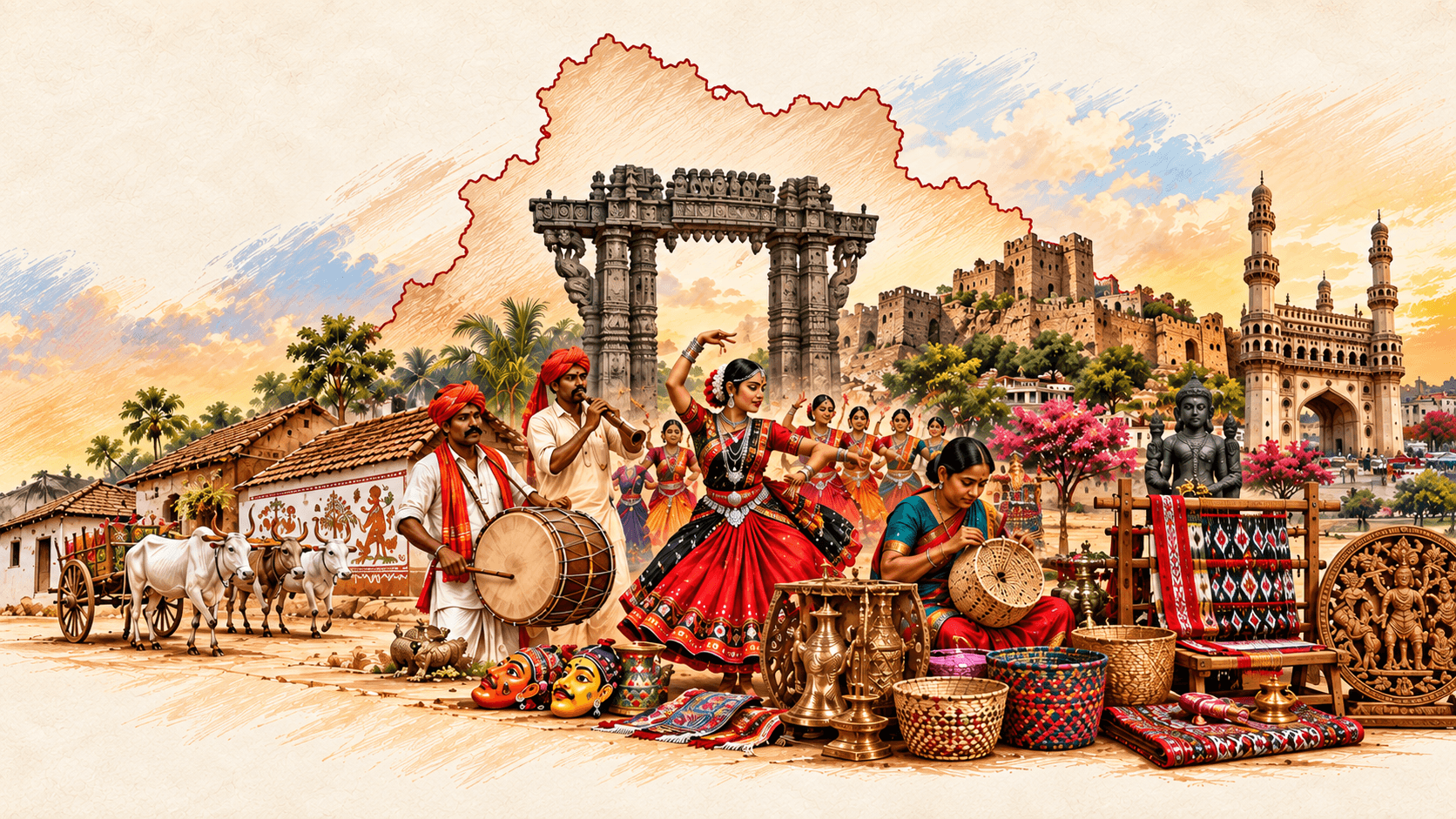
Cultural Identity of Telangana
Telangana developed a distinctive composite culture through the interaction of different social, religious and cultural traditions.
-
The cultural character of Telangana includes:
- Hyderabadi or Deccan culture
- Telangana rural culture
- Vedic traditions
- Tribal culture
-
The former Hyderabad State under the Nizams included:
- Telangana
- Marathwada
- Kannada regions
-
Major languages spoken in the former Hyderabad Province included:
- Telugu
- Marathi
- Kannada
- Urdu
-
The Asaf Jahi dynasty ruled Hyderabad State from 1724 to 1948.
-
Telangana culture has a strong association with nature worship.
- Rivers
- Trees
- Mountains and hills
- Land
- Water
- Sun
- Moon
-
Cultural values developed through the close relationship between nature and human life.
Society of Telangana
Religious traditions
Telangana historically had a multi-religious society.
-
Major religious communities included:
- Hindus
- Muslims
- Sikhs
- Parsis
- Christians
- Jains
- Buddhists
-
Hyderabad developed a strong tradition of composite culture and religious interaction.
-
Among Muslims, the two major sects were:
- Sunni
- Shia
-
Dudekula is a Telugu-speaking Muslim community associated with people who converted from Hinduism to Islam.
Caste structure
Traditional Telangana society consisted of numerous castes and occupational groups.
-
The broad traditional Varna classification included:
- Brahmins
- Kshatriyas
- Vaishyas
- Shudras
-
Actual village society was organised through numerous occupational castes and sub-castes.
| Community | Traditional association |
|---|---|
| Goud/Ediga | Toddy tapping |
| Golla/Yadava | Animal rearing |
| Kuruma | Blanket weaving |
| Chakali | Washing clothes |
| Kummari | Pottery |
| Madiga | Leather and footwear |
| Mala | Agricultural labour |
| Yerukala | Mats and baskets |
| Bestha | Fishing and fishing nets |
Village occupational structure
-
Traditional village life depended upon specialised occupational communities.
-
Different communities provided services such as:
- Agriculture
- Pottery
- Washing
- Barbering
- Metalwork
- Leatherwork
- Weaving
- Fishing
-
Many occupational relationships were hereditary.
Dependent Castes and Ashrita Tradition
During the medieval period, several sub-castes emerged around traditional hereditary occupations and community-based service relationships.
-
Such groups were known as dependent castes or Ashrita Kulam.
-
Their traditional activities included:
- Praising patron castes
- Preserving genealogies
- Narrating caste histories
- Performing traditional stories and programmes
- Receiving customary support from patron communities
-
Village servants were known as Balothadars.
-
Balothadars traditionally received agricultural produce known as Balotha.
Important Ashrita relationships
| Main caste | Ashrita caste/community |
|---|---|
| Yadavas | Mandechuvaru, Ooguvaru |
| Padmashali | Sadhanasurulu, Kunapuli |
| Madiga | Dakkali, Tappeta, Bhagavanthulu |
| Reddy, Kamma | Pichakuntla |
| Brahmins | Vipravinodulu |
| Rajakulu | Patamvaru |
| Kummari | Pekkarlu |
| Kapu | Kakipadagalavaru |
| Perikalu | Varasabattulu |
| Mala | Mushtiga |
Ashrita arts
Ashrita communities played an important role in preserving oral traditions.
- Dakkali stories → Jambapuranam
- Nulaka Chandayya → Purana Pravachanam
- Baindla/Pamba/Bhavasalu → Mandhata and Yellamma stories
- Madiga Mashti → Yakshagana
- Mala Jangalu → Chennaiah Katha
- Gurrapu Patam Katha → Bethala Puranam
- Mithilli Ayyavarlu → Ramayana stories
- Kunapuli Patam Katha → Markandeya Puranam
- Pichakuntla → Kunta Mallareddy Katha
- Sadhanasurulu → Magic shows
- Bandari Bhaktulu → Perika Puranam
Scheduled Tribes of Telangana
Telangana has a rich tribal heritage associated particularly with its forested and hilly regions.
Major tribal communities
- Gonds
- Lambadas/Banjaras
- Chenchus
- Kolams
- Koyas
- Nayakpods
- Konda Reddys
- Yanadis
- Bhils
- Pawars
- Erukalas
Important tribal characteristics
-
Tribal communities traditionally depended upon:
- Agriculture
- Forest produce
- Hunting and gathering
- Animal rearing
- Traditional crafts
-
Tribal culture is expressed through:
- Festivals
- Jataras
- Folk dances
- Oral traditions
- Traditional dress
- Nature worship
- Community institutions
Gonds
-
Major concentration:
- Adilabad
- Komaram Bheem Asifabad
-
Gonds also identify themselves as Koyathur/Koya in the Gondi language.
-
Rajgonds are an important Gond group.
-
Traditional occupation:
- Settled agriculture
-
Religious traditions include:
- Naga Devatha
- Persipen
-
Important festival:
- Dandari
-
Pradhans traditionally act as hereditary storytellers of the Gond community.
-
Pradhans perform using traditional instruments including:
- Fidel
- Trumpet
Lambadas / Banjaras
-
Also known as:
- Banjaras
- Sugalis
-
Traditionally associated with:
- Grain trade
- Salt trade
-
Their settlements are known as Thandas.
-
Traditional dress is known for:
- Colourful embroidery
- Mirrors
- Heavy ornaments
- Decorative designs
-
Important festivals include:
- Teej
- Sithla Bhavani
- Tulja Bhavani
-
Sevalal is regarded as an important guru.
-
Traditional performers are known as Dappans.
-
Traditional musical instruments include:
- Jange
- Kinjri
-
Traditional Banjara panchayat is called Nasaab.
Chenchus
-
Mainly associated with the Nallamala and Amrabad forest regions.
-
Traditional livelihood included:
- Hunting
- Gathering fruits
- Collecting roots and tubers
- Collecting honey
-
Traditional shelter:
- Penta
-
Important religious associations include:
- Bhairava
- Garela Maisamma
- Srisailam Mallikarjuna Swamy
-
Chenchus traditionally regard Srisailam Mallikarjuna Swamy as their son-in-law.
-
Important cultural events associated with the Chenchus include:
- Salleshwaram Jatara
- Mallela Tirtham
- Mannanuru Jatara
- Loddi Mallayya Jatara
Kolams
-
Mainly associated with the northern Telangana region, particularly Adilabad.
-
Also known as Kolavarlu.
-
Traditional occupations include:
- Shifting cultivation
- Settled agriculture
-
They speak the Kolam dialect.
-
Jowar is an important traditional staple.
-
The community has distinctive marriage and family customs.
Nayakpods
-
Found mainly in:
- Adilabad
- Karimnagar
- Warangal
- Maharashtra-border regions
-
Traditional food includes:
- Jowar
- Ragi
- Paddy
Nakkalas
-
Traditionally a nomadic community.
-
Also known as:
- Pittalollu
- Shikarilu
- Guvvalollu
-
Swamimuta/Maliya is associated with their hereditary religious tradition.
Telangana Festivals
Major festivals and cultural celebrations include:
- Bathukamma
- Bonalu
- Ugadi
- Dasara
- Deepavali
- Sankranti
- Sri Rama Navami
- Krishna Janmashtami
- Ramzan
- Eid-ul-Fitr
- Eid-ul-Adha
- Muharram
- Milad-un-Nabi
- Christmas
Among these, Bathukamma and Bonalu have a particularly strong Telangana regional identity.
Bathukamma is one of the most distinctive cultural festivals of Telangana.
-
Celebrated for 9 days.
-
Women play the central role.
-
Major themes include:
- Flowers
- Nature
- Water
- Community participation
-
Flowers are arranged in layers on a broad plate called Thambalam.
-
The arrangement takes a conical or spire-like form.
-
A turmeric representation of Gouramma is placed on top.
-
Important flowers include:
- Thangedu
- Gunugu
- Marigold
- Gaddi poolu
- Lotus
- Chrysanthemum
- Katla poolu
-
Women gather around Bathukamma, sing traditional songs, clap and move in a circular formation.
-
At the conclusion, Bathukamma is immersed in water.
-
After immersion, women perform Gouri puja and exchange vayanam.
Important Bathukamma days
| Day | Important feature |
|---|---|
| 1st | Engili Pula Bathukamma |
| 6th | Aligina Bathukamma; Bathukamma is not played |
| 9th | Saddula Bathukamma |
- Saddula Bathukamma is the concluding and major celebration.
- Maleeda is offered as Naivedyam on Saddula Bathukamma.
- Maleeda is prepared using roti and jaggery.
Bonalu
Bonalu is a major festival associated with Goddess Mahankali.
-
Celebrated mainly during the Ashada month.
-
Women carry decorated pots containing offerings called Bonam.
-
Important ritual associations include:
- Potharaju
- Rangam
-
Important centres include:
- Golconda
- Ujjaini Mahankali Temple
- Lal Darwaza
Islamic Cultural Traditions
Milad-un-Nabi
- Celebrates the birth anniversary of Prophet Muhammad.
Shab-e-Barat
-
Observed on the 14th day of Shaban.
-
Associated with:
- Visiting graveyards
- Offering Fateha
- Recitation of the Quran
Sufi tradition
-
Sufism contributed to Hyderabad's composite cultural tradition.
-
Important themes include:
- Spiritual devotion
- Tawhid
- Social harmony
- Interaction across communities
Urs
- The death anniversary of a Sufi saint is celebrated as Urs.
- Qawwali is associated with Urs celebrations.
- A Dargah is a shrine associated with the tomb of a Sufi saint.
Important Dargahs
| Dargah | Location |
|---|---|
| Janpahad Dargah | Suryapet |
| Jahangir Pir Dargah | Ranga Reddy |
| Pahadi Sharif Dargah | Hyderabad |
| Arvapalli Dargah | Suryapet |
| Shawali Dargah | Ranga Reddy |
| Tekmal Dargah | Medak |
| Bade Pahad Dargah | Nizamabad |
| Yousufian Dargah | Nampally, Hyderabad |
Telangana Jataras
Telangana has numerous Jataras associated with temples, village deities, tribal traditions and local religious practices.
Important Jataras include:
- Sammakka-Saralamma Jatara
- Nagoba Jatara
- Kothakonda Jatara
- Inavolu Jatara
- Kodavatancha Jatara
- Tegada Jatara
- Tirdhala Jatara
- Singaraya Jatara
- Kurumurthy Jatara
- Manyamkonda Jatara
- Saleshwaram Jatara
-
Centre:
- Medaram
-
District:
- Mulugu
-
Associated primarily with the Koya tribal tradition.
-
Important personalities:
- Sammakka
- Saralamma
- Pagididda Raju
- Govinda Raju
- Jampanna
-
The tradition is associated with resistance to oppressive taxation and the Kakatiya period.
Four-day sequence
| Day | Event |
|---|---|
| Day 1 | Saralamma brought from Kannepally |
| Day 2 | Sammakka brought from Chilakalagutta |
| Day 3 | Both deities worshipped; devotees visit Jampanna Vagu |
| Day 4 | Vanapravesham; deities return to the forest |
-
Vehicle associated with Sammakka:
- Tiger
-
Vehicle associated with Saralamma:
- Deer
-
Tribal priests conduct the traditional rituals.
-
Bangaram, traditionally jaggery, is offered by devotees.
-
The Jatara is held once every two years.
-
It was recognised as a state festival in 1996.
Nagoba Jatara
-
Centre:
- Keslapur
-
Region:
- Indravelli area of Adilabad
-
Associated mainly with:
- Gond tribes
- Mesram clan
-
Deity:
- Nagoba/Naga Devata
-
Celebrated on Bahula Amavasya of Pushya Masam.
-
A traditional ritual involves Mesram clan members fetching water from the Godavari before the Jatara.
| Jatara | Main deity |
|---|---|
| Kothakonda | Veera Bhadra Swamy |
| Inavolu | Mallikarjuna Swamy |
| Kodavatancha | Lakshmi Narasimha Swamy |
| Tegada | Bhadrakali and Veera Bhadra |
| Tirdhala | Sangameshwara Swamy |
| Singaraya | Lakshmi Narasimha Swamy |
| Kurumurthy | Venkateshwara Swamy |
| Manyamkonda | Venkateshwara Swamy |
Kothakonda Jatara
-
Held at Kothakonda.
-
Main deity:
- Veera Bhadra Swamy
-
Associated with the Kora Meesalu tradition.
-
Celebrated during the Sankranti period.
Saleshwaram Jatara
- Associated with a Shiva temple in the Nallamala forest region.
- Strongly associated with Chenchu traditions.
- Known as the Telangana Amarnath.
- The temple is opened for only a few days each year.
Telangana Handicrafts
Telangana's handicraft traditions are based on:
- Wood
- Metal
- Brass
- Silver
- Textiles
- Embroidery
- Traditional painting
- Tribal craftsmanship
Nirmal Arts and Handicrafts
-
Centre:
- Nirmal
-
The tradition is traced to the Kakatiya era.
-
Nimma Naidu encouraged the craft during the 17th century.
-
Important products:
- Nirmal wooden toys
- Household articles
- Paintings
- Furniture
-
Nirmal wooden toys are also known as Koya Bommalu.
-
Softwood known as Puniki is used.
-
Nirmal toys are known for their characteristic golden shine.
-
Natural dyes are used in the traditional process.
-
Artists are known as Naqash.
-
Nirmal artware is broadly available in three forms:
- Toys
- Household articles
- Paintings
-
Nirmal paintings and furniture received GI status in 2008-09.
Cheriyal Scroll Paintings
-
Centre:
- Cheriyal, Siddipet district
-
Known for:
- Narrative scroll paintings
-
Paintings depict stories from:
- Indian mythology
- Folk traditions
-
The paintings are traditionally made on cloth.
-
The narrative format resembles a sequential story roll.
-
Traditional artisans are known as Nakashi.
-
These are also known as Theme Paintings.
Pembarthi Handicrafts
-
Centre:
- Pembarthi, Jangaon district
-
Main material:
- Brass
-
The craft is made on hard brass metal sheets.
-
The tradition flourished during the Kakatiya period.
-
Members of the Kanchara caste are traditionally associated with the craft.
-
Important products include:
- Statues
- Decorative panels
- Dhwaja-sthambams
- Attar daans
- Chandeliers
- Decorated vessels
Bidriware
-
Bidriware is historically associated with Bidar.
-
Bidar was part of the former Hyderabad State.
-
The tradition has strong Persian influence.
-
Main alloy:
- Copper
- Zinc
-
The zinc-rich surface produces the characteristic black appearance.
-
Decorative designs are inlaid using:
- Silver
- Gold
-
Products include:
- Flower vases
- Ornament boxes
- Decorative articles
Karimnagar Silver Filigree
-
Centre:
- Karimnagar
-
Historical association:
- Elagandula
-
Associated with goldsmith Kadarla Ramaiah.
-
Main material:
- Silver
-
Characteristic technique:
- Extremely fine silver threads arranged into intricate designs.
-
Products include:
- Pan daan
- Plates
- Attar daan
- Earrings
- Decorative objects
-
GI recognition:
- 2007-08
Dhokra Metal Craft
-
Important centres:
- Komaram Bheem Asifabad
- Adilabad
-
Dhokra is a traditional bell-metal craft.
-
Traditional materials include:
- Wax
- Mud
- Brass
-
The Oja community is associated with the craft.
-
Common motifs include:
- Tribal figures
- Animals
- Horses
- Peacocks
- Deities
-
The craft uses a traditional casting process.
Banjara Needle Craft
-
Associated with the Banjara/Lambada community.
-
Major features:
- Colourful embroidery
- Mirror work
- Beads
- Shells
- Decorative threads
-
It reflects the distinctive visual identity of Banjara dress and culture.
Important Telangana Handlooms
Pochampally Ikat
-
Centre:
- Pochampally
-
District:
- Yadadri-Bhuvanagiri
-
Famous for:
- Ikat weaving
- Tie-and-dye technique
-
Telia Rumal is associated with Pochampally weaving traditions.
-
Pochampally Ikat received GI recognition in 2004-05.
Puttapaka Telia Rumal
-
Centre:
- Puttapaka
-
Known for:
- Telia Rumal weaving
-
GI recognition:
- 2019-20
Gadwal Sarees
-
Centre:
- Gadwal
-
Known for:
- Handwoven sarees
- Zari work
-
GI recognition:
- 2010-11
Siddipet Sarees
-
Known particularly for:
- Gollabhama sarees
-
GI recognition:
- 2011
Narayanpet Sarees
-
Known for:
- Traditional handloom weaving
- Distinctive borders
- Lightweight sarees
Warangal Carpets
-
Locally known as:
- Jamkanas
-
Also known as:
- Durries
-
Important centre:
- Kothawada, Warangal
Other Traditional Crafts
-
Ranjan Pots
- Traditional mud pots.
- Associated with Adilabad and Shadnagar.
- Used for keeping water cool.
-
Hyderabad Bangles
-
Major centre:
- Lad Bazar
-
Located near Charminar.
-
Known especially for lac bangles.
-
-
Paper Making
- Associated with Korutla.
-
Lace Industry
- Associated with Dummugudem.
-
Wood Carvings
- Found in several Telangana craft centres, including Bhuvanagiri.
The Geographical Indications framework recognises products whose identity, quality or reputation is associated with a particular geographical origin.
- The Geographical Indications of Goods (Registration and Protection) Act, 1999 came into force in 2003.
Important Telangana GI products
| Product | GI recognition |
|---|---|
| Pochampally Ikat | 2004-05 |
| Karimnagar Silver Filigree | 2007-08 |
| Nirmal Paintings | 2008-09 |
| Nirmal Furniture | 2008-09 |
| Cheriyal Paintings | 2010-11 |
| Pembarthi Metal Crafts | 2010-11 |
| Gadwal Sarees | 2010-11 |
| Puttapaka Telia Rumal | 2019-20 |
Folk Dances of Telangana
Telangana's folk dances are closely associated with:
- Festivals
- Agriculture
- Tribal life
- Village traditions
- Religious celebrations
- Community participation
Perini Sivatandavam
-
Associated with the Kakatiya period.
-
Traditionally regarded as a vigorous warrior dance.
-
Associated with:
- Lord Shiva
- Warrior traditions
-
It is one of the most distinctive classical-folk traditions associated with Telangana's Kakatiya heritage.
Gussadi
- Associated with the Gond tribal community.
- Prominent in northern Telangana.
Dhimsa
- Associated with tribal dance traditions, particularly Gond cultural traditions.
Dappu Dance
-
Performed using the traditional Dappu percussion instrument.
-
Associated with:
- Village celebrations
- Processions
- Festivals
- Community events
Lambadi Dance
-
Associated with the Lambada/Banjara community.
-
Characterised by:
- Colourful dress
- Group performance
- Rhythmic movements
- Traditional ornaments
Kolatam
- Group dance performed with sticks.
- Found across Telugu cultural regions.
Telangana Folk Art Forms
Folk arts developed through:
- Songs
- Dances
- Stories
- Oral traditions
- Community performances
These traditions were transmitted from one generation to another and were accessible to wider sections of society.
-
Oggu Katha is storytelling performed using the Oggu instrument.
-
Oggu resembles the Damarukam associated with Lord Shiva.
-
Mainly associated with the Kuruma community.
-
Other communities such as:
- Golla
- Yadava
- Other Backward Class communities also perform Oggu Katha.
-
Important regions include:
- Nalgonda
- Warangal
- Vemulawada region
-
A traditional troupe consists of 5 members.
-
Important stories include:
- Beerappa
- Mallanna
- Uppalamma
- Katamaraju
- Yellamma
- Nalla Pochamma
- Maandatha
-
Oggu Katha is commonly performed during:
- Festivals
- Jataras
-
Important performers include:
- Chukka Sattaiah
- Midde Ramulu
Chukka Sattaiah
-
Born in Manikyapuram village of Jangaon district.
-
Known as:
- Father of Oggu Katha
- Oggu Kala Samrat
-
Original name:
- Choudarapalli Sathaiah
-
Received the Kendra Sangeet Natak Akademi Award in 2004.
-
Kakatiya University awarded him a doctorate in 2005.
Burrakatha
-
Traditional narrative storytelling form.
-
Associated with Jangam traditions.
-
Combines:
- Storytelling
- Music
- Percussion
- Social commentary
-
It has been used for:
- Public communication
- Social awareness
- Political and historical narration
-
Sheik Nazar is associated with the popularisation of Burrakatha.
Chindu Bhagavatham
-
Associated with the Chindu community.
-
Combines:
- Drama
- Dance
- Music
- Mythological narratives
-
It is an important folk theatrical tradition.
Tholu Bommalata
-
Traditional puppet-show form.
-
Uses puppets to narrate stories.
-
Combines:
- Puppetry
- Music
- Narration
- Traditional storytelling
Pagati Veshalu
-
Literally associated with day-time performances.
-
Performed during the day.
-
Used for:
- Entertainment
- Social criticism
- Exposing superstitions
- Highlighting social problems
-
Also known as Bahurupalu.
-
Satire and comedy are important elements.
Golla Suddulu
-
Associated with the Golla community.
-
Narrates:
- Krishna Leelas
- Katamaraju stories
- Yadava traditions
-
Also used satire to highlight social issues.
-
Suddala Hanumanthu used this form for public enlightenment during the Telangana Armed Struggle.
Gangireddulata
-
Associated with the Puja Golla community.
-
A decorated bull is made to perform.
-
Musical accompaniment includes:
- Sannayi
- Dolu
Other Folk Forms
Important forms include:
- Gante Bhagavatulu
- Peddammalollu
- Runjala traditions
- Jamuka Stories
- Dakkali narratives
- Kakipadigela traditions
- Patamvaru
- Budabukkala
- Domaratta
- Balasanthulavaru
- Jada Kolatam
- Haridasu traditions
- Yerukala Sodi
Important Heritage Sites
Telangana's heritage reflects several historical and religious traditions.
Kakatiya heritage
Important centres include:
- Warangal Fort
- Thousand Pillar Temple
- Ramappa Temple
- Ramappa Lake
- Ghanpur/Kota Gullu
Hyderabad heritage
Important monuments include:
- Golconda Fort
- Qutb Shahi Tombs
- Toli Masjid
- Taramati Baradari
- Paigah Tombs
- Birla Mandir
- Ujjaini Mahankali Temple
Buddhist heritage
Important centres include:
- Dhulikatta
- Nelakondapalli
- Phanigiri
- Peddabankur
- Vaddamanu
- Kotilingala region
Jain heritage
- Kolanupaka is an important Jain heritage centre.
Golconda Fort
-
Located in:
- Hyderabad
-
Historical association:
- Kakatiyas
- Qutb Shahis
-
The early fortification was associated with the Kakatiya period.
-
The Qutb Shahis developed the major granite fortification.
-
Important features include:
- Massive fort walls
- Bastions
- Gateways
- Acoustic system
- Fateh Darwaza
- Bala Hisar
-
The fort is an important symbol of Hyderabad's medieval history.
Qutb Shahi Tombs
-
Located near Golconda.
-
Reflect a combination of:
- Persian influence
- Pathan influence
- Local Hindu architectural elements
-
Characteristic features include:
- Domes
- Arches
- Columns
- Minarets
Paigah Tombs
-
Associated with the Paigah nobility.
-
Known for:
- Intricate decorative work
- Marble and lime work
- Mughal and Rajasthani architectural influences
-
Often described as the Taj Mahal of the South.
Warangal represents one of the major centres of Kakatiya heritage.
Important sites include:
- Warangal Fort
- Thousand Pillar Temple
- Ramappa Temple
- Ghanpur Temples
- Ramappa Lake
Kakatiya architectural features
- Intricate stone carving
- Decorative sculpture
- Temple architecture
- Ornamental motifs
- Toranas
- Trikuta temple traditions
Ramappa Temple and Lake
- Ramappa Temple is an important Kakatiya architectural monument.
- It represents the artistic and architectural achievements of the Kakatiya period.
- Ramappa Lake is a major Kakatiya-period irrigation structure.
Important places include:
- Ramappa Temple
- Ramappa Lake
- Laknavaram Lake
- Bogatha Waterfalls
- Medaram
Laknavaram Lake
-
Associated with the Kakatiya period.
-
Known for:
- Multiple islands
- Hanging bridge
- Scenic landscape
Bogatha Waterfalls
- Located in Mulugu district.
- Popularly known as the Telangana Niagara.
Kaleshwaram
-
Important temple:
- Kaleshwara Mukteshwara Temple
-
Located in Jayashankar Bhupalpally region.
-
Associated with the meeting of:
- Godavari
- Pranahita
-
Traditionally associated with two Shiva Lingas on a single pedestal.
Alampur
Important heritage sites include:
- Jogulamba Temple
- Navabrahma temples
- Alampur temple complex
Alampur represents an important centre of temple architecture and religious heritage.
Bhadrachalam
-
Famous for:
- Sri Rama Temple
-
Important historical association:
- Kancharla Gopanna, popularly known as Bhakta Ramdas
-
Associated with the Qutb Shahi ruler:
- Abul Hasan Tana Shah
-
Parnasala is associated with the Ramayana tradition.
Dhulikatta
-
Located in the Peddapalli region.
-
Important for:
- Buddhist stupas
- Viharas
- Archaeological remains
Nelakondapalli
-
Located in the Khammam region.
-
Important for:
- Buddhist remains
- Stupas
- Archaeological discoveries
-
Also associated with the tradition of Bhakta Ramdas.
Phanigiri
- Important Buddhist archaeological centre.
- Associated with Buddhist remains and monastic traditions.
Kolanupaka
-
Located in:
- Yadadri-Bhuvanagiri district
-
Important for:
- Jain temple
- Jain religious and artistic heritage
Important Forts of Telangana
| Fort | Location |
|---|---|
| Golconda Fort | Hyderabad |
| Bhuvanagiri Fort | Yadadri-Bhuvanagiri |
| Devarakonda Fort | Nalgonda region |
| Elgandal Fort | Karimnagar |
| Ramagiri Qila | Peddapalli |
| Nirmal Fort | Nirmal |
| Gadwal Fort | Jogulamba Gadwal |
| Rachakonda Fort | Rangareddy region |
| Medak Fort | Medak |
| Khammam Fort | Khammam |
| Koulas Fort | Kamareddy |
| Domakonda Fort | Kamareddy |
| Sirpur Fort | Komaram Bheem Asifabad |
Social Evils in Telangana
Traditional Telangana society experienced several social problems.
Important issues included:
- Vetti
- Caste discrimination
- Untouchability
- Child marriage
- Dowry
- Gender inequality
- Jogini system
- Devadasi-related practices
- Forced labour
- Social exploitation
- Limited access to education
Vetti Chakiri
- Vetti refers to forced or unpaid labour.
- It became an important feature of feudal exploitation in rural Telangana.
- The practice was particularly oppressive for weaker sections and dependent communities.
- Opposition to Vetti became an important part of struggles against feudal exploitation.
-
Traditional dedication of girls or women to deities developed into exploitative practices in some areas.
-
Such practices were associated with:
- Loss of personal autonomy
- Social exploitation
- Gender inequality
- Economic vulnerability
-
Bhagya Reddy Varma worked against the Jogini and Devadasi systems through Manya Sangam.
-
Other reformers associated with campaigns against related social practices include:
- Muthu Lakshmi Reddy
- Raghupati Venkata Ratnam Naidu
P. Raghunath Rao Commission
-
A single-member commission.
-
Concerned with:
- Conditions leading girls into Devadasi and Jogini systems
- Problems faced by affected women and girls
Adapapa System
- A traditional exploitative practice discussed in the social history of Telangana.
- The practice involved girl children being kept in exploitative conditions by powerful landlords and officials.
- It particularly affected socially weaker communities.
Tawaif Tradition
-
Tawaifs were historically associated with:
- Singing
- Dancing
- Courtly cultural traditions
-
The tradition developed in the historical context of Hyderabad.
-
Some sections later experienced severe social and economic exploitation.
Paradah System
- A practice involving women covering themselves from outsiders.
- It became more prominent in Telangana under historical influences associated with the Qutb Shahi period and North Indian traditions.
Position of Women
Women played an important role in Telangana's social and cultural life.
Major areas of participation
- Agriculture
- Household economy
- Handicrafts
- Folk traditions
- Religious festivals
- Community activities
- Folk songs and dances
Major challenges
- Child marriage
- Dowry
- Gender inequality
- Limited education
- Social restrictions
- Exploitative customs
Cultural significance
Women are particularly central to Telangana's cultural identity through:
- Bathukamma
- Folk songs
- Traditional embroidery
- Handicrafts
- Ritual celebrations
High-Yield Place–Art Associations
| Place | Key association |
|---|---|
| Nirmal | Wooden toys and paintings |
| Cheriyal | Narrative scroll paintings |
| Pembarthi | Brass handicrafts |
| Karimnagar | Silver filigree |
| Pochampally | Ikat |
| Puttapaka | Telia Rumal |
| Gadwal | Zari sarees |
| Siddipet | Gollabhama sarees |
| Warangal | Jamkanas and Kakatiya heritage |
| Hyderabad | Bidri tradition and bangles |
| Adilabad | Gond culture and Dhokra |
| Komaram Bheem Asifabad | Gond culture and Dhokra |
| Medaram | Sammakka-Saralamma Jatara |
| Keslapur | Nagoba Jatara |
| Dhulikatta | Buddhist heritage |
| Kolanupaka | Jain heritage |
| Bhadrachalam | Rama temple and Bhakta Ramdas |
| Alampur | Jogulamba and Navabrahma temples |
| Kaleshwaram | Godavari-Pranahita confluence |
High-Yield Community–Culture Associations
| Community | Important association |
|---|---|
| Gonds | Gussadi, Dandari, Nagoba |
| Koyas | Medaram Jatara |
| Chenchus | Nallamala, Saleshwaram |
| Lambadas | Thandas, Teej, needle craft |
| Kurumas | Oggu Katha, Gongadi |
| Gollas/Yadavas | Oggu Katha, Golla Suddulu |
| Chindu | Chindu Bhagavatham |
| Kanchara | Pembarthi brass craft |
| Oja | Dhokra |
| Nakashi | Cheriyal paintings |
| Pradhans | Gond storytelling |
High-Yield Festival Associations
| Festival/Jatara | Association |
|---|---|
| Bathukamma | Flowers, women, Gouramma |
| Bonalu | Mahankali, Bonam, Potharaju |
| Sammakka-Saralamma | Medaram, Koya tradition |
| Nagoba Jatara | Keslapur, Gond, Mesram |
| Kothakonda Jatara | Veera Bhadra Swamy |
| Inavolu Jatara | Mallikarjuna Swamy |
| Kurumurthy Jatara | Venkateshwara Swamy |
| Manyamkonda Jatara | Venkateshwara Swamy |
| Saleshwaram Jatara | Chenchu, Shiva tradition |
High-Yield Folk Art Associations
| Folk form | Key association |
|---|---|
| Oggu Katha | Kuruma, Mallanna |
| Burrakatha | Jangam tradition |
| Chindu Bhagavatham | Chindu community |
| Tholu Bommalata | Puppet show |
| Golla Suddulu | Golla community |
| Pagati Veshalu | Day-time satirical performance |
| Gangireddulata | Puja Golla tradition |
| Gussadi | Gond dance |
| Perini | Kakatiya warrior tradition |
| Lambadi Dance | Banjara community |
| Dappu | Percussion-based folk performance |
Prelims Trap Zone
Rapid Revision
-
Composite culture
- Deccan
- Rural
- Vedic
- Tribal
-
Tribes
- Gond → Dandari → Pradhan
- Lambada → Thanda → Teej
- Chenchu → Nallamala → Penta
- Koya → Medaram
- Kolam → Adilabad
- Nayakpod → Northern Telangana
-
Festivals
- Bathukamma → 9 days → flowers → Gouramma
- Bonalu → Mahankali → Bonam
- Medaram → Sammakka-Saralamma → Koya
- Nagoba → Gond → Mesram
-
Crafts
- Nirmal → Wood
- Cheriyal → Scroll
- Pembarthi → Brass
- Karimnagar → Silver
- Dhokra → Tribal metal craft
- Banjara → Needle craft
- Pochampally → Ikat
- Puttapaka → Telia Rumal
- Gadwal → Zari
- Siddipet → Gollabhama
-
Folk arts
- Oggu Katha → Kuruma → Mallanna
- Burrakatha → Jangam
- Chindu Bhagavatham → Chindu
- Tholu Bommalata → Puppets
- Golla Suddulu → Golla
- Pagati Veshalu → Satire
-
Heritage
- Golconda → Qutb Shahi
- Warangal → Kakatiya
- Ramappa → Kakatiya temple
- Bhadrachalam → Rama
- Alampur → Jogulamba
- Dhulikatta → Buddhist
- Kolanupaka → Jain