Art & culture · Atlas of India
Caves & stupas of India
Monuments, traditions, and the regions that made them.
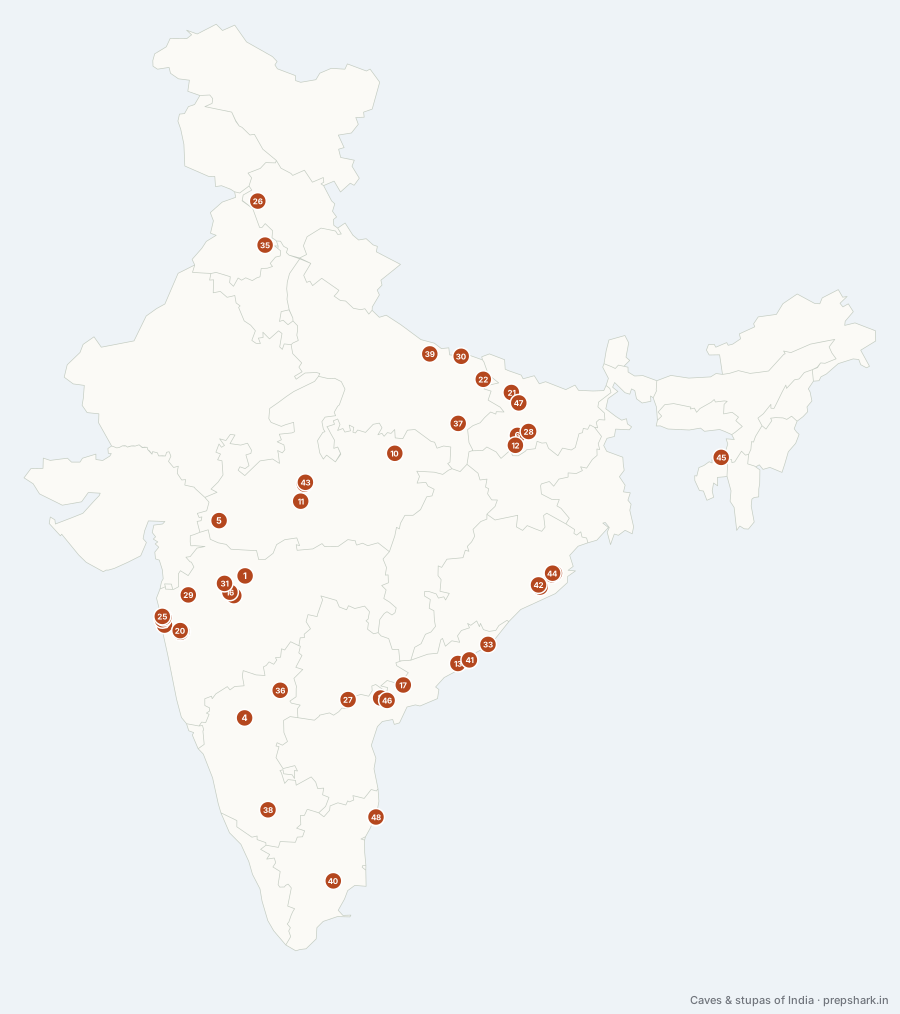
Numbered as on the map
The 48 on the map
1. Ajanta Caves
Maharashtra
Known forThe only surviving body of classical Indian painting
Thirty caves cut into a horseshoe gorge of the Waghora in two campaigns — Satavahana in the second century BCE, Vakataka under Harishena in the fifth century CE — and painted throughout in a technique of mud plaster, lime and mineral colour. The murals are the only surviving body of classical Indian painting, and they are Buddhist narrative: Jatakas, told as court life.
SettingSatavahana and Vakataka · basalt, cut and painted · 2nd century BCE–5th century CE · Waghora gorge
For the examAll thirty are Buddhist; a British hunting party found them in 1819. Caves 1, 2, 16 and 17 hold the paintings.
2. Amaravati Stupa
Andhra Pradesh
Known forThe Mahachaitya, and the school of sculpture named for it
The Mahachaitya on the Krishna was the largest stupa in the south, faced in limestone carved with crowded narrative panels that give their name to a whole school. The mound was quarried for lime in the nineteenth century and its slabs are now divided between Chennai and the British Museum, which is why the site itself is a low ring.
SettingSatavahana · limestone-faced brick stupa · 2nd century BCE–3rd century CE · lower Krishna
For the examThe three early schools: Gandhara, Mathura and this one — the southern, in limestone.
3. Aurangabad Caves
Maharashtra
Known forLate Buddhist caves where the imagery turns Tantric
Twelve Buddhist excavations in two groups on a hill above the city, cut in the sixth and seventh centuries — late enough that the sculpture has turned Vajrayana, with a dancing scene and attendant goddesses that belong to Tantric Buddhism rather than to the plain halls of the early sites.
SettingKalachuri and Chalukya · basalt, cut into a hill · 6th–7th century CE · Deccan trap
4. Badami Cave Temples
Karnataka
Known forThe first Chalukya capital’s rock-cut cliff
Four caves cut into a red sandstone cliff above the Agastya tank at the first Chalukya capital — three Hindu, one Jain, with a dancing eighteen-armed Shiva at the entrance to the first and a dated inscription of 578 in the third. They are where the Deccan’s rock-cut idiom becomes structural temple building.
SettingBadami Chalukya · red sandstone, cut into a cliff · 6th century CE · Malaprabha basin
For the examThe Chalukya trio: this capital, Aihole the experiment, Pattadakal the finished statement.
5. Bagh Caves
Madhya Pradesh
Known forAjanta’s painting, in the Vindhyan sandstone
Nine Buddhist excavations in a sandstone hill above the Baghini in the Vindhyan country, cut in the fifth and sixth centuries and painted in the same manner as Ajanta — a procession of figures on a lime ground. The rock is soft and the paintings were lifted to Gwalior in the 1920s to save them.
SettingPost-Gupta · sandstone, cut and painted · 5th–6th century CE · Vindhyan hills
6. Barabar Caves
Bihar
Known forIndia’s oldest rock-cut caves, polished to a mirror
The oldest surviving rock-cut caves in India, hewn out of granite in the third century BCE and given a polish so fine that a whisper in the Lomas Rishi chamber comes back as an echo. Ashoka and his grandson Dasharatha gave them by inscription to the Ajivikas, and the Lomas Rishi doorway copies a wooden hut in stone.
SettingMauryan · granite, cut and mirror-polished · 3rd century BCE · Magadha hills
For the examGiven to the Ajivikas, not the Buddhists; the Mauryan polish is the diagnostic feature.
7. Bavikonda
Andhra Pradesh
Known forA hilltop monastery kept alive by rock-cut wells
A hilltop monastery above the Bay of Bengal north of Visakhapatnam, named for the rock-cut wells that made it habitable — bavi is a well. Excavation found a relic casket with a piece of bone in it, a stupa, a chaitya hall and a refectory, all supported by the sea trade passing below.
SettingSatavahana · brick stupas and viharas on a hill · 3rd century BCE–3rd century CE · north Andhra coast
8. Bedse Caves
Maharashtra
Known forBell capitals over a stair cut into the hillside
A first-century BCE chaitya and vihara pair on the same ghat as Karla and Bhaja, reached by a stair cut into the hillside, with bell-shaped capitals carrying couples and animals above the pillars. The three sites together are how the early Deccan monastery is dated, because each borrows from the last.
SettingSatavahana · basalt, cut into a hill spur · 1st century BCE · Sahyadri
9. Bhaja Caves
Maharashtra
Known forAmong the earliest excavations, with a group of monks’ stupas
Twenty-two excavations of the second century BCE, among the earliest in the country, with an apsidal chaitya whose ceiling still carries the sockets of its wooden ribs and a group of fourteen stupas outside holding the ashes of named monks. The reliefs beside them — a chariot and a rider — are the earliest narrative carving in the Deccan.
SettingSatavahana · basalt, cut into a ghat spur · 2nd century BCE · Bhor Ghat
10. Bharhut
Madhya Pradesh
Known forThe earliest labelled Jataka reliefs, now in a museum
A stupa in the Satna country whose railing carried the earliest labelled narrative reliefs in India — Jataka scenes with the story named beside each in Brahmi, which is how the early Jatakas are matched to their images at all. Cunningham found it in 1873 and moved the railing to Kolkata; the mound itself is nearly gone.
SettingShunga · sandstone railing round a brick stupa · 2nd century BCE · Vindhyan plateau
For the examShunga-period, aniconic, and inscribed — the labels are what make it the reference site for early Jatakas.
11. Bhimbetka
Madhya Pradesh
Known forIndia’s oldest rock paintings, in shelters people lived in
Some seven hundred and fifty natural sandstone shelters in the Vindhyan hills, about four hundred of them painted — hunting scenes, dancers, horses and riders — in a sequence that runs from the Mesolithic to the historic period. It is the oldest continuous record of human life in the subcontinent, and the paintings are in the shelters people actually lived in.
SettingPalaeolithic to historic · natural sandstone shelters, painted · c. 10,000 BCE onward · Vindhyan hills
For the examInscribed by UNESCO in 2003; the paintings are Mesolithic at their densest, not Palaeolithic.
12. Bodh Gaya
Bihar
Known forThe Bodhi tree, the diamond throne and the Mahabodhi tower
The place of the awakening, and the one site on this layer that is a working centre of pilgrimage for the whole Buddhist world. The Mahabodhi temple is a fifty-metre brick tower of the Gupta period standing over the vajrasana — the diamond throne Ashoka set beside the tree — with a descendant of the Bodhi tree behind it.
SettingMauryan to Pala · brick temple over a polished stone throne · 3rd century BCE–6th century CE · Phalgu valley
For the examInscribed by UNESCO in 2002; the temple is one of the earliest brick structures still standing in India.
13. Bojjannakonda
Andhra Pradesh
Known forStupas hewn out of the hill rather than built on it
Two hills at Sankaram, the near one cut with rock-hewn cells and Buddha images and the far one covered with dozens of stupas carved straight out of the rock rather than built on it. Between them they hold all three phases of Buddhism and the earliest surviving Buddha images in the Andhra country.
SettingSatavahana · rock-cut cells and monolithic stupas · 3rd century BCE–9th century CE · Anakapalli hills
14. Dhauli
Odisha
Known forAshoka’s Kalinga edicts, under a rock-cut elephant
A rock beside the Daya carries Ashoka’s separate Kalinga edicts — the ones that speak to the conquered rather than to his own subjects — and above them an elephant is carved half out of the rock, the earliest sculpture in the state. The battlefield of the Kalinga war is traditionally placed on the plain below.
SettingMauryan · rock edict with a rock-cut elephant · 3rd century BCE · Daya valley
For the examThe separate rock edicts are here and at Jaugada; the war they follow is the one that changed Ashoka.
15. Elephanta Caves
Maharashtra
Known forThe Trimurti of Gharapuri island
Gharapuri island in Mumbai harbour holds a sixth-century Shaiva cave whose Trimurti — a six-metre three-headed Sadashiva, creator, preserver and destroyer in one block — is the single most famous piece of sculpture cut in India. The Portuguese named the island for a stone elephant that stood on it, and are said to have used the sculpture for target practice.
SettingKalachuri · basalt, cut into a hill · 6th century CE · Mumbai harbour
16. Ellora Caves
Maharashtra
Known forThe Kailasa, cut downward out of a single rock
Thirty-four excavations in one basalt scarp — twelve Buddhist, seventeen Hindu, five Jain, cut between the sixth and tenth centuries and in use together. Cave 16, the Kailasa, is not a cave at all: Rashtrakuta masons cut downward from the top of the hill and freed a whole temple, courtyard, elephants and all, out of one piece of rock.
SettingKalachuri, Chalukya and Rashtrakuta · basalt, cut into a scarp · 6th–10th century CE · Deccan trap
For the examThe three religions on one scarp is the point that gets asked; the Kailasa is Rashtrakuta, under Krishna I.
17. Guntupalli Caves
Andhra Pradesh
Known forA rock-cut chaitya and a built stupa field on one hill
A hill in the Eastern Ghats holding both halves of an early Buddhist site: a rock-cut chaitya with a stupa carved inside it and a horseshoe facade copied from timber, and beside it a brick monastery and a field of votive stupas built on the open rock. Few sites show the cut and the built together this clearly.
SettingSatavahana · rock-cut chaitya with brick stupas · 2nd century BCE–2nd century CE · Eastern Ghats
18. Jogeshwari Caves
Maharashtra
Known forAn early Hindu cave, now surrounded by a suburb
One of the earliest Hindu cave temples in the country, cut in the sixth century with a long pillared hall and a Shaiva sanctum — and now reached through a lane in a Mumbai suburb, with houses built against the rock and a shrine still in daily use inside it.
SettingKalachuri · basalt, cut into low rock · 6th century CE · Salsette
19. Kanheri Caves
Maharashtra
Known forA hundred and nine excavations inside a city national park
A hundred and nine excavations in a basalt hill on Salsette, cut over a thousand years and now inside a national park in the middle of Mumbai — cells, halls, a chaitya with a colossal pair of standing Buddhas, and an elaborate system of rock-cut cisterns and channels that made a monastery possible on a dry hill.
SettingSatavahana onward · basalt, cut with rock-cut cisterns · 1st century BCE–10th century CE · Salsette
20. Karla Caves
Maharashtra
Known forIndia’s largest chaitya hall, with its wooden ribs intact
The largest and best preserved chaitya hall in India, cut in the first century on the Bhor Ghat where the trade road from the Konkan ports climbed to the Deccan. Its horseshoe window still lights the stupa at the far end, and the teak ribs fixed to the ceiling two thousand years ago are still in place.
SettingSatavahana · basalt, cut with fitted teak ribs · 1st century BCE–1st century CE · Bhor Ghat
For the examChaitya (the hall with the stupa) against vihara (the cell block) is the distinction this site is used to teach.
21. Kesaria Stupa
Bihar
Known forOne of the tallest stupas, on the Buddha’s last road
A brick mound rising in terraces above the Champaran plain, one of the tallest stupas in the country, built where tradition says the Buddha gave his alms bowl to the Licchavis as he left Vaishali for the last time. Its excavated core is Mauryan and the terraces above it are Gupta and later.
SettingMauryan to Pala · terraced brick stupa · 3rd century BCE–7th century CE · Champaran plain
22. Kushinagar
Uttar Pradesh
Known forThe parinirvana, and the reclining Buddha of Chunar sandstone
The Malla town where the Buddha died and passed into parinirvana, between two sal trees. The Mahaparinirvana temple holds a six-metre reclining Buddha of the fifth century cut from one block of Chunar sandstone, and the Ramabhar stupa a kilometre away stands over the cremation ground.
SettingMalla and Gupta · brick stupas with a sandstone image · 5th century BCE–5th century CE · Gandak plain
For the examThe four great sites: Lumbini, Bodh Gaya, Sarnath and this one — birth, awakening, first sermon, death.
23. Lalitgiri
Odisha
Known forThe oldest of the Odisha Buddhist hills, and its relic casket
The oldest of the three hills, with an apsidal chaitya of the first century and four monasteries below it — and a stupa on the crest that gave up a casket holding bone relics, the only such find in eastern India. Occupation here runs from before the common era to the thirteenth century without a break.
SettingKushan to Pala · brick chaitya, stupas and monasteries · 1st century BCE–13th century CE · Birupa valley
24. Mahabalipuram Cave Temples
Tamil Nadu
Known forThe monolithic rathas, and Arjuna’s Penance
The Pallavas cut nine cave temples and a group of monolithic rathas out of the granite outcrops behind this beach in the seventh century — five of the rathas, each a different temple form carved whole from one boulder, are the reference set for early Dravidian architecture. Beside them Arjuna’s Penance covers a whole rock face.
SettingPallava · granite, cut and carved whole · 7th century CE · Coromandel shore
For the examRathas are monoliths, not built; the sequence here runs cave, monolith, then the structural Shore Temple.
25. Mandapeshwar Caves
Maharashtra
Known forA Shaiva cave converted to a Portuguese chapel
A Shaiva rock-cut shrine of the sixth century at Borivali that the Portuguese took over in 1544, cut crosses into and converted to a chapel with a Franciscan college built on the rock above it. Both layers are still legible on the same face, which is what makes a small cave worth protecting.
SettingKalachuri, then Portuguese · basalt, cut and later built over · 6th century CE and 1544 · Salsette
26. Masrur Temples
Himachal Pradesh
Known forMonolithic rock-cut temples facing the Dhauladhar
Fifteen temples cut downward out of one sandstone ridge in the Kangra valley in the eighth century — the northern equivalent of the Kailasa at Ellora, and the only monolithic rock-cut temple complex in the Himalaya. The 1905 Kangra earthquake shook much of the carving off, and what is left faces the Dhauladhar.
SettingEarly medieval north Indian · sandstone, cut from a single ridge · 8th century CE · Kangra valley
27. Nagarjunakonda
Andhra Pradesh
Known forAn Ikshvaku Buddhist capital, moved uphill before a dam drowned it
Vijayapuri, the Ikshvaku capital of the third century, held more than thirty Buddhist establishments in one valley of the Krishna — and the valley was drowned by the Nagarjuna Sagar dam in the 1960s. The monuments were cut up, carried uphill and rebuilt on an island that is now all that is above water, which makes it the largest rescue excavation in India.
SettingIkshvaku · limestone stupas and viharas · 3rd century CE · Krishna valley
For the examNamed for Nagarjuna, the Madhyamaka philosopher; the site is Vijayapuri, the Ikshvaku capital.
28. Nalanda Mahavihara
Bihar
Known forThe Gupta monastic university, and the walk it is laid out around
A monastic university founded under the Guptas in the fifth century and run for seven hundred years, with monasteries facing temples across a central walk and a library that Tibetan accounts describe as burning for months. Xuanzang studied here and left the description everything known about its teaching rests on.
SettingGupta and Pala · brick monasteries and temples · 5th–12th century CE · Magadha plain
For the examXuanzang and Yijing wrote it up; it was sacked at the end of the twelfth century, and inscribed by UNESCO in 2016.
29. Pandavleni Caves
Maharashtra
Known forThe inscriptions of the Satavahana–Kshatrapa war
Twenty-four Hinayana excavations on the Trirashmi hill above Nashik, cut between the second century BCE and the sixth CE. Their inscriptions are the reason they matter: the record of Gautamiputra Satakarni’s victory over the Kshaharata Nahapana is on this rock, and it is the primary source for the Satavahana–Kshatrapa war.
SettingSatavahana and Kshatrapa · basalt, cut into a hill · 2nd century BCE–6th century CE · upper Godavari
For the examGautamiputra Satakarni against Nahapana — the epigraphy is here, not in a chronicle.
30. Piprahwa
Uttar Pradesh
Known forThe relic casket that names the Buddha’s own clan
A brick stupa opened in 1898 by a colonial landowner, who found inside it a steatite casket inscribed in Brahmi as holding the relics of the Buddha of the Sakya clan — the earliest inscribed reference to the Buddha as a historical person. The excavation is why the site is argued to be Kapilavastu.
SettingMauryan and Kushan · brick stupa with a steatite casket · 3rd century BCE onward · Terai plain
31. Pitalkhora Caves
Maharashtra
Known forAmong the oldest excavations, in a waterfall ravine
Fourteen excavations in a ravine of the Satmala hills, cut in the second century BCE and among the oldest Buddhist rock architecture anywhere — reached by a stair beside a waterfall. The basalt here is friable and much of the front has fallen away, which is why a site this early is so little visited.
SettingSatavahana · friable basalt, cut into a ravine · 2nd century BCE · Satmala hills
32. Ratnagiri, Odisha
Odisha
Known forThe carved monastery doorway of the Diamond Triangle
The richest of the three Buddhist hills between the Brahmani and the Birupa, with a great monastery whose carved doorway is the finest in eastern India, a brick stupa and hundreds of votive stupas around it. Tibetan tradition makes it a centre of Vajrayana teaching, and the sculpture bears that out.
SettingBhaumakara and Pala · brick monasteries and stupas · 5th–13th century CE · Brahmani–Birupa doab
For the examThe Diamond Triangle: this hill with Lalitgiri and its neighbour, the Puspagiri complex of the Chinese accounts.
33. Salihundam
Andhra Pradesh
Known forA stupa hill above the Vamsadhara, with all three Buddhist phases
A hill of Buddhist stupas above the Vamsadhara near its mouth, holding relic caskets and the remains of four stupas — and carrying all three phases, Hinayana, Mahayana and Vajrayana, on one site. Its position above a river mouth is the point: this coast shipped Buddhism to Sri Lanka and south-east Asia.
SettingSatavahana onward · brick and stone stupas · 2nd century BCE–12th century CE · north Andhra coast
34. Sanchi
Madhya Pradesh
Known forThe Great Stupa and its four carved gateways
Ashoka raised the core of the Great Stupa here in the third century BCE, and the Satavahanas added the four carved gateways two centuries later — the finest early Buddhist sculpture in India, and all of it aniconic: the Buddha appears as a footprint, a tree, a wheel, an empty throne, never as a figure.
SettingMauryan and Satavahana · sandstone stupa with toranas · 3rd century BCE–1st century CE · Malwa plateau
For the examAniconic representation — the Buddha shown by symbol — is what the toranas are asked about.
35. Sanghol
Punjab
Known forA buried hoard of Kushan railing pillars beside a stupa
A mound in the Sutlej plain with layers running from the Harappan period to the Kushan, and a stupa at its centre — beside which a pit was found in 1985 holding a hundred and seventeen carved railing pillars in Mathura’s red sandstone, buried in antiquity and never re-erected. It is the largest single find of Kushan sculpture in the north.
SettingKushan · brick stupa with Mathura sandstone railings · 1st–2nd century CE · Sutlej plain
36. Sannati
Karnataka
Known forThe only labelled portrait of Ashoka
A Buddhist site on the Bhima in north Karnataka where a collapsed temple floor turned out to be an Ashokan edict slab, and where the Kanaganahalli stupa gave up a relief panel labelled Raya Asoko with his queens — the only known portrait of Ashoka from his own period.
SettingSatavahana · limestone-faced stupa with Mauryan edicts · 3rd century BCE–3rd century CE · Bhima valley
37. Sarnath
Uttar Pradesh
Known forThe first sermon, and the lion capital on the national emblem
The deer park where the Buddha preached his first sermon and set the wheel of the law turning. The Dhamek Stupa of the Gupta period still stands forty-three metres high with carved bands round it, and Ashoka’s pillar here carried the four-lion capital that the Republic took as its emblem in 1950.
SettingMauryan and Gupta · brick and stone stupas, polished sandstone pillar · 3rd century BCE–6th century CE · Ganga plain
For the examDhammachakkappavattana — the turning of the wheel — happened here; the capital is in the site museum.
38. Shravanabelagola
Karnataka
Known forThe Bahubali monolith, anointed once in twelve years
Two granite hills with a tank between them, and on the taller one a seventeen-metre Bahubali cut in place out of the living rock in about 981 by the Ganga minister Chavundaraya — the largest monolithic statue in India. Every twelve years the Mahamastakabhisheka pours milk, saffron and gold over it from a scaffold.
SettingWestern Ganga · granite monolith and rock-cut basadis · c. 981 CE · Karnataka maidan
For the examJain tradition brings Chandragupta Maurya here with Bhadrabahu to end his life by sallekhana.
39. Shravasti
Uttar Pradesh
Known forThe Jetavana grove, where the Buddha spent most of his rains
The Kosala capital, where the Buddha spent twenty-four rain retreats — more than anywhere else — in the Jetavana monastery Anathapindika bought by covering its ground with coins. The twin mounds of Sahet and Mahet are the monastery and the city, and the Anandabodhi tree in the grove is still the focus of the site.
SettingKosala and later · brick stupas and monasteries · 6th century BCE–12th century CE · Rapti plain
For the examA mahajanapada capital: Kosala’s, with Ayodhya. The miracle performed here is the standard reference.
41. Thotlakonda
Andhra Pradesh
Known forA Buddhist hill monastery found from a helicopter
A Hinayana monastery on a hill overlooking the Bay of Bengal, found by a naval helicopter survey in 1976 and excavated in the 1980s: a stupa, a congregation hall, viharas and rock-cut cisterns for a community that lived off the Roman and south-east Asian sea trade putting in below.
SettingSatavahana · brick stupas and cisterns on a hill · 2nd century BCE–2nd century CE · north Andhra coast
42. Udayagiri and Khandagiri Caves
Odisha
Known forKharavela’s Jain cells, and the Hathigumpha inscription
Two facing sandstone hills honeycombed with cells cut for Jain ascetics under Kharavela in the first century BCE. One of them, the Hathigumpha, carries his inscription — seventeen lines that are the main source for Kalinga after Ashoka — and the Rani Gumpha next to it is a two-storey court with carved friezes.
SettingChedi under Kharavela · sandstone, cut into twin hills · 1st century BCE · Bhubaneswar
For the examThe Hathigumpha inscription is the source for Kharavela and for Kalinga a century after Ashoka.
43. Udayagiri Caves, Vidisha
Madhya Pradesh
Known forThe Gupta Varaha panel, and a dated inscription of 401
Twenty rock-cut shrines in a sandstone ridge near Vidisha, carrying the great Varaha panel — the boar-headed Vishnu lifting the earth out of the ocean, with the assembly of gods watching — and an inscription dated to 401 in the reign of Chandragupta II. It is the fixed point Gupta sculpture is dated from.
SettingGupta · sandstone, cut into a ridge · early 5th century CE · Betwa valley
For the examThe Varaha panel is read as an allegory of Chandragupta II’s conquests.
44. Udayagiri, Odisha
Odisha
Known forThe one Odisha monastery that names itself in an inscription
The largest excavated Buddhist complex in the state, with two monasteries, a stepped stupa and a stone well whose inscription names the place Madhavapura Mahavihara — the only one of the three hills whose ancient name is known from the site itself rather than from a chronicle.
SettingBhaumakara and Pala · brick monasteries and a stepped stupa · 7th–13th century CE · Birupa valley
45. Unakoti
Tripura
Known forColossal Shaiva rock reliefs on a forested hillside
A forested hillside carved with colossal Shaiva reliefs — a nine-metre Unakotiswara head in a headdress, three Ganeshas, rows of faces cut straight into the rock face beside a waterfall. Tradition counts one less than a crore of them, and nobody has securely dated the carving; the eighth to twelfth centuries is the usual guess.
SettingEarly medieval north-east · rock-cut reliefs and stone images · 8th–12th century CE proposed · Tripura hills
46. Undavalli Caves
Andhra Pradesh
Known forA four-storey rock-cut hill with a monolithic reclining Vishnu
A four-storey excavation cut into a sandstone hill above the Krishna, holding a reclining Vishnu carved from a single block on its second floor. It began as a Buddhist vihara and was converted to a Hindu shrine under the Vishnukundinas, which is the pattern this whole stretch of the Krishna follows.
SettingVishnukundina · sandstone, cut in four storeys · 4th–7th century CE · lower Krishna
47. Vaishali
Bihar
Known forThe Licchavi republic, and the second Buddhist council
The Licchavi capital, one of the earliest republics anywhere, where the Buddha preached his last sermon and the second Buddhist council met a century after his death. The Ashokan pillar at Kolhua still stands with its lion intact, beside the tank the Licchavis are said to have used for their coronations.
SettingMauryan and later · polished sandstone pillar and brick stupas · 6th century BCE onward · north Gangetic plain
For the examA mahajanapada capital and a gana-sangha: the republic every polity question reaches for.
48. Varaha Cave Temple
Tamil Nadu
Known forFour Pallava relief panels in one rock-cut hall
A small Pallava mandapa cut into the ridge, holding four panels that are among the best relief sculpture in south India: Vishnu as the boar lifting the earth, Gajalakshmi bathed by elephants, Durga as the slayer of the buffalo demon, and Vishnu striding across the world.
SettingPallava · granite, cut into a shore ridge · 7th century CE · Coromandel shore
Keep going