Art & culture · Atlas of India
UNESCO sites of India
Monuments, traditions, and the regions that made them.
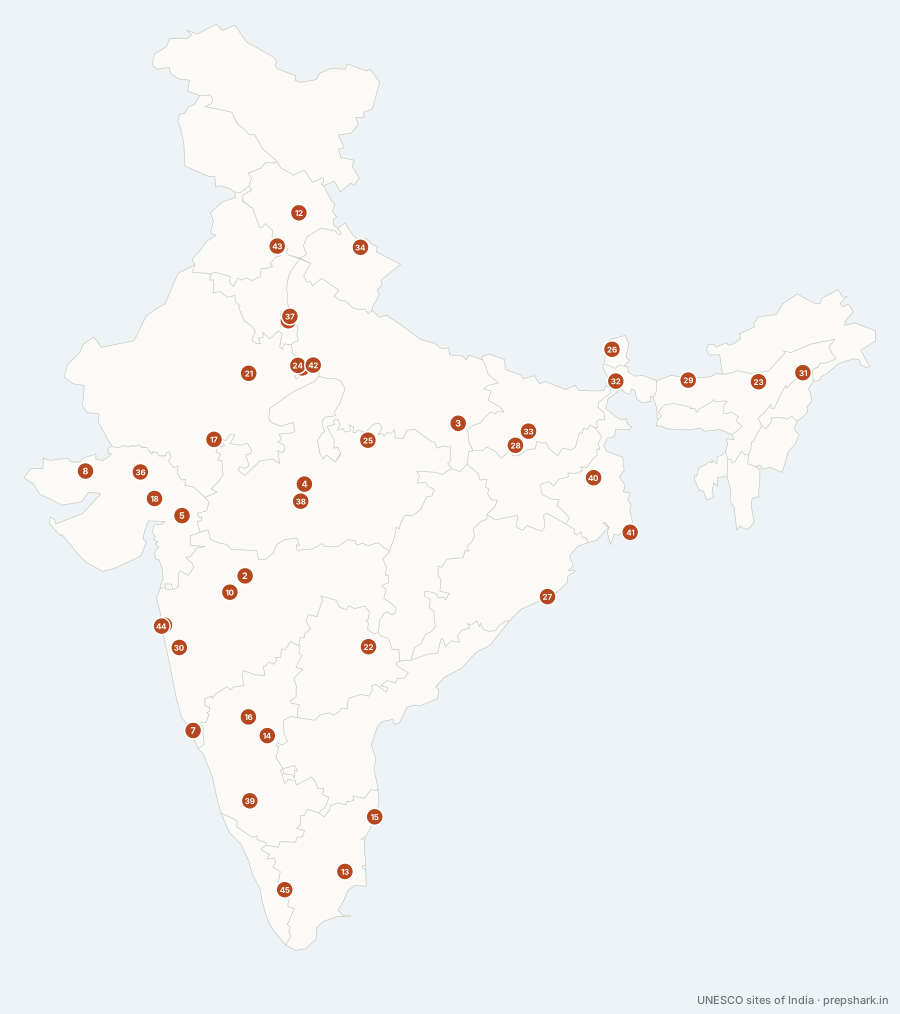
Numbered as on the map
The 45 on the map
1. Agra Fort
Uttar Pradesh
Known forAkbar’s capital, and the room Shah Jahan was imprisoned in
A Mughal walled city in red sandstone on the right bank of the Yamuna, rebuilt by Akbar from 1565 on the site of an earlier Lodi fort. Agra sat where the road from Delhi to the Deccan met a navigable river, which is why three emperors ruled from it before Shah Jahan moved the capital to Delhi.
SettingYamuna right bank · Ganga–Yamuna doab · red Sikri sandstone
For the examAkbar built it in sandstone; Shah Jahan replaced parts in marble. The Musamman Burj is where Aurangzeb confined him, in sight of the Taj.
2. Ajanta Caves
Maharashtra
Known forThe mural painting — the only substantial body of classical Indian painting to survive
Thirty rock-cut caves in a horseshoe scarp above the Waghora, excavated in two phases separated by four centuries — Satavahana-era Hinayana work from the second century BCE, then a Vakataka Mahayana burst in the fifth. The bend in the gorge is the reason: it gave a sheer basalt face and a water source, and it was far enough off the trade road for a monsoon retreat.
SettingDeccan trap basalt · Waghora gorge · Sahyadri scarp
For the examPainting at Ajanta, sculpture at Ellora, and the two are a hundred kilometres apart. Ajanta is Buddhist only; Ellora is Buddhist, Hindu and Jain.
3. Ancient Buddhist Site of Sarnath
Uttar Pradesh
Known forThe first sermon, and the lion capital that became the state emblem
The deer park north of Varanasi where the Buddha preached his first sermon and the sangha began. Ashoka marked it with a stupa and a pillar in the third century BCE; the lion capital of that pillar is India’s state emblem and the wheel on its abacus is the one on the flag.
SettingGanga–Varuna doab · middle Ganga plain · Chunar sandstone
For the examWhere the Dhammachakkappavattana Sutta was preached. The Ashokan lion capital here is the State Emblem of India; its Dharmachakra is on the national flag.
4. Buddhist Monuments at Sanchi
Madhya Pradesh
Known forThe Great Stupa and its carved toranas
A hilltop stupa complex begun by Ashoka in the third century BCE and enlarged for a thousand years, above the trade route between the Gangetic plain and the western ports. Vidisha, the merchant town below, paid for it — the railings carry donors’ names, not a king’s.
SettingMalwa plateau hilltop · Betwa basin · sandstone
For the examAshokan in origin; the gateways are Satavahana, first century BCE. The Ashokan pillar here has the same lion capital as Sarnath but is not the national emblem.
5. Champaner-Pavagadh Archaeological Park
Gujarat
Known forAn unbuilt-over pre-Mughal city under a hilltop shrine
A hill fort and the city below it: Pavagadh is a volcanic plug rising from the Gujarat plain, fortified since the Chauhans, and Champaner is the capital Mahmud Begada built at its foot in 1484. The site holds the only complete pre-Mughal Islamic city that was never later built over.
SettingVolcanic plug · Gujarat plain · sandstone city walls
For the examMahmud Begada of the Gujarat Sultanate. Jami Masjid at Champaner is the building usually asked for; the Kalika Mata temple crowns Pavagadh.
6. Chhatrapati Shivaji Terminus
Maharashtra
Known forVictorian Gothic railway terminus, still the busiest station in the country
The Great Indian Peninsula Railway’s headquarters and terminus, finished in 1888 — Victorian Gothic Revival detailed by Indian craftsmen with Indian motifs, at the point where the first railway in India began its climb to the Deccan. The building is where a colonial style became a local one.
SettingBombay reclaimed foreshore · Kurla basalt and Porbandar stone
For the examArchitect F. W. Stevens; formerly Victoria Terminus. India’s first passenger train ran from Bori Bunder, this site, to Thane in 1853.
7. Churches and Convents of Goa
Goa
Known forThe Basilica of Bom Jesus, and the body of St Francis Xavier
Old Goa on the Mandovi was the capital of the Portuguese Estado da Índia, and its churches were built to be the eastern seat of a European empire — Manueline, Mannerist and Baroque, in laterite rendered with lime. The city was abandoned to malaria in the eighteenth century, which is why a cathedral complex survives with no city around it.
SettingMandovi estuary · Konkan laterite · Western Ghats hinterland
For the examSe Cathedral is the largest church in Asia. The Basilica of Bom Jesus holds Francis Xavier’s relics and is the one usually asked for.
8. Dholavira: a Harappan City
Gujarat
Known forHarappan water harvesting, and the world’s earliest known signboard
A Harappan city on Khadir island in the Rann of Kachchh, in a place with no perennial river — so its whole plan is water engineering, a cascade of rock-cut reservoirs catching two seasonal streams. It is the one Harappan site whose answer to aridity survives above ground.
SettingKhadir island · Rann salt flat · sandstone and reservoir cascade
For the examOne of the largest Harappan sites and the only one with a three-part division — citadel, middle town and lower town. The ten-sign "signboard" was found here.
9. Elephanta Caves
Maharashtra
Known forThe Trimurti — the three-headed Sadashiva
Rock-cut Shaiva caves on Gharapuri island in Mumbai harbour, cut in basalt in the sixth century. The island position is the point — it sat on the sea route into the Konkan, and the Portuguese who renamed it after a stone elephant used the caves for target practice, which is why so much of the sculpture is damaged.
SettingBasalt island · Mumbai harbour · Konkan coast
For the examShaiva, not Buddhist. The Trimurti is Sadashiva — Aghora, Tatpurusha and Vamadeva — not Brahma-Vishnu-Shiva.
10. Ellora Caves
Maharashtra
Known forThe Kailasa temple, carved top-down from one rock
Thirty-four caves cut into a single basalt escarpment on the Deccan trade route, Buddhist, Hindu and Jain in one line of rock. Kailasa, cave sixteen, was quarried downward out of the hillside as one piece — the largest monolithic excavation anywhere — under Rashtrakuta patronage in the eighth century.
SettingDeccan trap basalt · Charanandri escarpment · Elganga stream
For the examThree religions on one escarpment is the answer to "what makes Ellora different from Ajanta". Kailasa is Rashtrakuta, not Chalukya.
11. Fatehpur Sikri
Uttar Pradesh
Known forA complete Mughal city abandoned almost as soon as it was finished
Akbar’s purpose-built capital of the 1570s, raised on a sandstone ridge beside the Sufi Salim Chishti’s hermitage and abandoned within about fifteen years. Water is the usual explanation: the lake that supplied it could not carry a court, and there was no river.
SettingSandstone ridge · Sikri lake bed · semi-arid Braj
For the examBuland Darwaza commemorates the Gujarat conquest. The Ibadat Khana, where Akbar held religious debates, was here. Abandoned largely for want of water.
12. Great Himalayan National Park Conservation Area
Himachal Pradesh
Known forWhole Himalayan catchments protected from riverbed to ridge
The upper catchments of four Beas tributaries in the Kullu Himalaya, protected as whole valleys from the river to the watershed. Taking the entire altitudinal range rather than a band is the design: it is what lets species move up and down the slope with the season inside one protected area.
SettingKullu Himalaya · alpine meadow to temperate forest · Beas headwaters
For the examInscribed 2014 for biodiversity. Drains to the Beas via the Tirthan, Sainj, Jiwa and Parvati. Western Tragopan and Himalayan brown bear are the flagship species.
13. Great Living Chola Temples
Tamil Nadu
Known forRajaraja’s Brihadisvara, and a vimana taller than its gopuram
Three temples of the imperial Cholas in the Kaveri delta — Brihadisvara at Thanjavur, Brihadisvara at Gangaikonda Cholapuram and Airavatesvara at Darasuram. The delta is why they are there and why they are big: it was the richest rice country in the peninsula, and the temples were the institutions that ran it.
SettingKaveri delta · granite · Thanjavur rice plain
For the exam"Living" means still in worship. Rajaraja I built Thanjavur, Rajendra I Gangaikonda Cholapuram. In Chola temples the vimana dominates; later Nayaka temples put the height in the gopuram.
14. Group of Monuments at Hampi
Karnataka
Known forThe capital of Vijayanagara, and the stone chariot at Vittala
Vijayanagara’s capital, laid out among granite boulder hills in a bend of the Tungabhadra — the river gave water and the boulders gave both building stone and a defensible site. It was the largest city in India in the sixteenth century and was sacked after Talikota in 1565, which is why an imperial capital survives as a ruin field rather than a living city.
SettingTungabhadra bend · granite boulder landscape · Deccan semi-arid
For the examVijayanagara empire; sacked after the battle of Talikota, 1565. It was on the Danger List from 1999 to 2006 over a proposed bridge.
15. Group of Monuments at Mahabalipuram
Tamil Nadu
Known forThe monolithic rathas and Arjuna’s Penance, the largest open-air relief in India
A Pallava port on the Coromandel coast where seventh- and eighth-century sculptors worked directly in the granite outcrops above the beach — rathas cut from single boulders, mandapas cut into the rock face, and the Shore Temple built up in blocks. The port is why: this was where Pallava trade with South-East Asia left from.
SettingCoromandel coast · granite outcrops · Bay of Bengal surf
For the examPallava, under Narasimhavarman I and II. The five rathas are named for the Pandavas but are not chariots and were never finished.
16. Group of Monuments at Pattadakal
Karnataka
Known forNagara and Dravida temples in one compound
The Chalukya coronation town on the Malaprabha, where northern Nagara and southern Dravida temple forms were built side by side in the seventh and eighth centuries — the one place the two traditions can be compared in a single compound. The river bends north here, which is why it was held to be auspicious.
SettingMalaprabha bend · Deccan sandstone · Badami–Aihole belt
For the examChalukyas of Badami. Virupaksha is Dravida, Papanatha Nagara. Aihole and Badami are the other two of the trio and are NOT inscribed.
17. Hill Forts of Rajasthan
Rajasthan
Known forRajput hill fortification, and Kumbhalgarh’s thirty-six-kilometre wall
Six Rajput forts strung along the Aravalli — Chittorgarh, Kumbhalgarh, Ranthambore, Amber, Jaisalmer and Gagron. The range is the reason they exist and the reason they are where they are: it is the one line of high ground between the Thar and the Gangetic plain, and whoever held its passes held the road.
SettingAravalli quartzite · Mewar uplands · semi-arid scrub
For the examSix forts: Chittorgarh, Kumbhalgarh, Ranthambore, Gagron, Amber and Jaisalmer. Jaisalmer is the desert one and the only living fort; Gagron is a water fort.
18. Historic City of Ahmadabad
Gujarat
Known forIndia’s first World Heritage City, and its pol housing
Ahmad Shah’s 1411 walled city on the Sabarmati, and the first city in India to be inscribed as a whole rather than as monuments. What is listed is the fabric — the pols, dense timber-fronted neighbourhood blocks with shared gates and wells — as much as the sultanate mosques among them.
SettingSabarmati bank · Gujarat alluvial plain · carved timber and stone
For the examThe FIRST Indian city inscribed as a city (2017). Founded by Ahmad Shah I in 1411. Sidi Saiyyed’s jali and the Jama Masjid are the buildings usually named.
19. Humayun’s Tomb
Delhi
Known forThe first Mughal garden tomb — the Taj’s ancestor
The first great Mughal garden tomb, built for Humayun by Hamida Banu Begum from 1565 beside the Yamuna and the dargah of Nizamuddin Auliya — the river for the garden’s water, the saint for the company. Its plan, a domed tomb on a plinth in a quartered garden, is the design the Taj perfects eighty years later.
SettingYamuna floodplain · Delhi ridge quartzite · char bagh
For the examCommissioned by his widow Hamida Banu Begum; architect Mirak Mirza Ghiyas. The double dome and the char bagh both arrive in India here.
20. Jaipur City
Rajasthan
Known forA grid-planned eighteenth-century capital, the Pink City
Founded in 1727 by Sawai Jai Singh II as a planned commercial capital on the plain below the Amber hills — a grid of nine rectangular blocks laid out on the Vastu-Shastra prakara plan, with continuous colonnaded streets. It is a city planned as a whole before it was built, which almost nothing else of its date in India is.
SettingAravalli piedmont · Dravyavati catchment · plastered rubble in ochre
For the examSawai Jai Singh II, 1727. Planned on a nine-block grid by Vidyadhar Bhattacharya. Painted pink in 1876 for the Prince of Wales.
21. Jantar Mantar, Jaipur
Rajasthan
Known forThe largest stone sundial in the world
Sawai Jai Singh II’s masonry observatory of the 1730s, built large on purpose: instruments in stone rather than brass so they could be read to a finer division than any hand-held instrument allowed. The Samrat Yantra, a sundial twenty-seven metres high, resolves time to about two seconds.
SettingAravalli piedmont · Jaipur walled city · lime plaster and stone
For the examSawai Jai Singh II built five; only the Jaipur one is inscribed. Samrat Yantra is the great sundial; Jai Prakash Yantra the hemispherical bowl.
22. Kakatiya Rudreshwara (Ramappa) Temple
Telangana
Known forFloating bricks, a sandbox foundation, and a temple named for its sculptor
A thirteenth-century Kakatiya temple at Palampet built on a sandbox foundation — a pit of sand under the plinth that lets the structure ride out earthquakes — and roofed with bricks light enough to float. It is the only temple in India known by its sculptor’s name rather than its patron’s.
SettingTelangana granite upland · Ramappa tank · dolerite and sandstone
For the examKakatiya dynasty, under Ganapati Deva, 1213. Named for the sculptor Ramappa. The sandbox foundation is the detail examiners like.
23. Kaziranga National Park
Assam
Known forTwo-thirds of the world’s one-horned rhinoceros
Brahmaputra floodplain between the river and the Karbi Anglong hills, where annual flooding maintains the tall alluvial grassland the one-horned rhinoceros needs. The flood is the habitat, not a threat to it: the same water that drowns animals each monsoon is what stops the grassland turning to woodland.
SettingBrahmaputra floodplain · alluvial elephant grass · Karbi Anglong foothills
For the examA Tiger Reserve as well as a World Heritage site, and it has the highest tiger density of any protected area. The rhino is Rhinoceros unicornis.
24. Keoladeo National Park
Rajasthan
Known forWintering waterfowl, and the last Indian record of the Siberian crane
A man-made wetland: the Maharaja of Bharatpur flooded a natural depression in the 1760s to make a duck shoot, and the shallow water it created became the most concentrated wintering ground for waterfowl in northern India. It is entirely dependent on managed water, which is why droughts and canal disputes threaten it more than any predator.
SettingManaged shallow wetland · Gambhir–Banganga water · semi-arid eastern Rajasthan
For the examFormerly Bharatpur Bird Sanctuary. A Ramsar site as well. The Siberian crane stopped arriving after 2002.
25. Khajuraho Group of Monuments
Madhya Pradesh
Known forNagara temples, and the erotic sculpture on their outer walls
The Chandela capital’s temple field on the Bundelkhand plateau — about twenty-five of an original eighty-five temples surviving, built in sandstone between 950 and 1050 in the Nagara style, with the shikhara built up as a rising cluster of subsidiary peaks. Remoteness preserved them: the site was forest for centuries and was not on any invading route.
SettingBundelkhand plateau · granite and sandstone · Ken basin
For the examChandela dynasty, Nagara style. Kandariya Mahadeva is the largest. The erotic panels are a minority of the sculpture and are on the exterior only.
26. Khangchendzonga National Park
Sikkim
Known forIndia’s only mixed World Heritage site
The Sikkim flank of the world’s third-highest mountain, running from subtropical valley floor to permanent snow inside forty kilometres — one of the steepest environmental gradients anywhere. It is inscribed as mixed because the Lepcha hold the mountain and its glaciers sacred, so the natural and cultural claims are the same claim.
SettingEastern Himalaya · Zemu glacier · subtropical to nival in forty kilometres
For the examThe only MIXED site in India — natural and cultural together. Khangchendzonga is the highest peak in India. The Zemu is its largest glacier.
27. Konark Sun Temple
Odisha
Known forThe stone chariot of the sun god — the Black Pagoda of sailors
Narasimhadeva I’s thirteenth-century temple to Surya, built as the god’s chariot with twelve pairs of carved wheels and seven horses. It stood on the shore when it was built; the coastline has since moved seaward, which is why a temple named for the sea now sits three kilometres inland.
SettingOdisha coastal plain · khondalite and laterite · Chandrabhaga shore
For the examKalinga architecture, Eastern Ganga dynasty. The wheels are sundials. The main deul has collapsed; what stands is the jagamohana.
28. Mahabodhi Temple Complex at Bodh Gaya
Bihar
Known forWhere the Buddha attained enlightenment, and the Bodhi tree
The place of the Buddha’s enlightenment, on the Niranjana in south Bihar. The present brick tower is Gupta, fifth or sixth century, standing where Ashoka built a shrine seven centuries earlier — so the site is continuous even though the building is not the original.
SettingNiranjana (Phalgu) bank · south Bihar plain · brick
For the examOne of the four principal Buddhist sites — with Lumbini, Sarnath and Kushinagar. The temple is one of the earliest surviving brick temples in India.
29. Manas Wildlife Sanctuary
Assam
Known forA transboundary reserve, and the pygmy hog
On the Manas river where it leaves Bhutan for the Assam plain, so the reserve is continuous with Bhutan’s Royal Manas — one habitat across an international border. The bhabar gravel and terai grassland at the foot of the hills is what carries the pygmy hog and the hispid hare, which live almost nowhere else.
SettingBhabar gravel · terai grassland · Bhutan foothills
For the examIt was on the List of World Heritage in Danger from 1992 to 2011 because of Bodo militancy. Tiger Reserve, National Park and Biosphere Reserve as well.
30. Maratha Military Landscapes of India
Maharashtra
Known forHill, coastal and island forts as one defensive system
Twelve forts that together show how the Marathas fortified terrain rather than places — hill forts on the Sahyadri spurs, forts on the coast, and sea forts on rock islands, each type answering a different approach. Eleven are in Maharashtra and one, Gingee, is in Tamil Nadu, which is how far the empire reached.
SettingSahyadri spurs · Konkan coast · basalt scarp and sea rock
For the examInscribed 2025. Twelve forts, eleven in Maharashtra and Gingee in Tamil Nadu. Raigad was Shivaji’s capital; Sindhudurg and Vijaydurg are the sea forts.
31. Moidams — the Ahom mound-burial system
Assam
Known forThe pyramids of Assam — six centuries of Ahom royal burials
The burial mounds of the Ahom kings at Charaideo, their first capital in upper Assam — a vaulted brick chamber under a hemispherical earth mound with a shrine on top, used for six hundred years. It is the north-east’s first cultural World Heritage site and the only one for a dynasty that kept the Mughals out of Assam.
SettingUpper Assam · Patkai foothills · earth mound over brick vault
For the examInscribed 2024 — the first cultural site from the North-East. The Ahoms ruled Assam for about six hundred years and defeated the Mughals at Saraighat.
32. Mountain Railways of India
West Bengal
Known forNarrow-gauge hill lines, and the only rack railway in India
Three narrow-gauge lines built to carry a colonial administration into the hills — Darjeeling in the eastern Himalaya, the Nilgiri in the Western Ghats, Kalka–Shimla in the Siwaliks. Each solved the same gradient problem differently: Darjeeling with loops and zigzags, the Nilgiri with a rack-and-pinion rail, Shimla with a hundred and two tunnels.
SettingEastern Himalayan spur · tea slopes · 2 ft gauge
For the examA serial site of three: Darjeeling (1999), Nilgiri (2005) and Kalka–Shimla (2008), inscribed in stages under one listing. The Nilgiri is the rack railway.
33. Nalanda Mahavihara
Bihar
Known forThe oldest university in the subcontinent
A monastic university on the Magadha plain that ran for some eight hundred years from the Gupta period, endowed by kings and drawing students from China, Korea and Tibet. Xuanzang and Yijing both studied here and both wrote it down, which is why the plan of a vanished institution is known in such detail.
SettingMagadha plain · brick viharas and stupas · south Bihar alluvium
For the examFounded under Kumaragupta I. Xuanzang and Yijing are the two Chinese travellers usually named. Destroyed by Bakhtiyar Khalji around 1193.
34. Nanda Devi and Valley of Flowers National Parks
Uttarakhand
Known forA sanctuary walled in by peaks, and an alpine meadow in flower
A high Himalayan basin ringed by peaks, reached only through the Rishi Ganga gorge — a wall of mountains that kept the sanctuary closed to grazing and to almost everybody else, which is why its alpine meadow survived intact. The Valley of Flowers on the far side of the ridge is the same protection with a gentler floor.
SettingInner Himalaya · glacial basin · alpine meadow and birch
For the examTwo parks, one inscription — Nanda Devi in 1988, Valley of Flowers added in 2005. Nanda Devi is the highest mountain entirely within India.
35. Qutb Minar complex
Delhi
Known forThe tallest brick minaret in the world, and an iron pillar that will not rust
Built at Lal Kot, the Tomar and Chauhan citadel that was Delhi’s first city, from the stone of twenty-seven demolished temples — which is why Hindu carving turns up on the columns of the mosque. The minar was begun by Qutbuddin Aibak in 1199 as a victory tower and finished by Iltutmish.
SettingDelhi ridge quartzite · Aravalli outlier · Mehrauli
For the examQuwwat-ul-Islam is India’s earliest surviving mosque. The iron pillar is Gupta, moved here, and predates the complex by seven centuries. Alai Darwaza is Khalji.
36. Rani-ki-Vav, Patan
Gujarat
Known forThe finest stepwell in India, buried by silt and dug out intact
A stepwell built by Queen Udayamati in the eleventh century on the Saraswati at Patan — seven storeys of sculpture descending to the water table, which is what a stepwell is: architecture that goes down instead of up because the water does. The Saraswati flooded and silted it over, and the silt is why the carving survived unweathered.
SettingSaraswati floodplain · north Gujarat alluvium · sandstone
For the examSolanki (Chaulukya) period, built by Rani Udayamati for Bhima I. It appears on the ₹100 note. A stepwell is a vav in Gujarat, a baoli in the north.
37. Red Fort Complex
Delhi
Known forThe Mughal seat of Shahjahanabad, and the Independence Day address
Shah Jahan’s citadel for Shahjahanabad, begun in 1638 when the Mughal capital moved back from Agra — laid out on the Yamuna so the river washed its eastern wall, with the Nahr-i-Bihisht carrying water through the palaces. The site includes the older Salimgarh, which is why the inscription is a "complex".
SettingYamuna right bank · red Dholpur sandstone · Shahjahanabad
For the examIncludes Salimgarh fort. Shah Jahan moved the capital from Agra in 1648. The Peacock Throne stood in the Diwan-i-Khas until Nadir Shah took it in 1739.
38. Rock Shelters of Bhimbetka
Madhya Pradesh
Known forThe oldest rock art in India, in continuous use for millennia
Sandstone shelters in the Vindhyan hills above the Narmada valley, painted more or less continuously from the Mesolithic into the historic period. The quartzite overhangs gave shelter and a dry wall, and the position — between the Deccan and the Gangetic plain — is why the paintings show hunting, then cattle, then horses and armies.
SettingVindhyan sandstone · Ratapani teak forest · Narmada catchment
For the examMesolithic onwards, with some Upper Palaeolithic evidence. Discovered by V. S. Wakankar in 1957. Inside the Ratapani sanctuary.
39. Sacred Ensembles of the Hoysalas
Karnataka
Known forSoapstone carving on star-shaped plans
Three temples of the Hoysalas — Belur, Halebidu and Somanathapura — built in chloritic schist, a stone soft enough to be turned on a lathe and carved like ivory and hard enough to keep the detail. The star-shaped plan on a raised platform is what the softness allowed: a wall with far more surface to carve.
SettingMalnad foothills · chloritic schist · Kaveri and Hemavati basins
For the examA serial site of three: Belur, Halebidu and Somanathapura, inscribed 2023. Soapstone (chloritic schist) and the stellate plan are the identifying features.
40. Santiniketan
West Bengal
Known forTagore’s open-air school, and Visva-Bharati
Rabindranath Tagore’s school and university on the Birbhum laterite plain, begun in 1901 as an ashram where classes were held under the trees — a deliberate rejection of the colonial classroom. Visva-Bharati grew out of it in 1921 as an experiment in pan-Asian rather than European learning.
SettingBirbhum laterite plain · Khoai badlands · sal and amlaki groves
For the examFounded by Rabindranath Tagore (his father Debendranath bought the land). Visva-Bharati became a central university in 1951. Inscribed 2023.
41. Sundarbans National Park
West Bengal
Known forMangrove tiger country
The Indian half of the largest mangrove forest on earth, in the tidal delta where the Ganga, Brahmaputra and Meghna meet the Bay. Daily salt-water flooding is what makes the forest, and it is why the tiger here swims, hunts in water and has learned to take fishermen.
SettingGanga–Brahmaputra delta · tidal mangrove · saline creeks
For the examThe Bangladesh half is separately inscribed. Ramsar site, Biosphere Reserve and Tiger Reserve as well. Sundari is the tree it is named for.
42. Taj Mahal
Uttar Pradesh
Known forThe riverfront mausoleum in white marble
Shah Jahan’s mausoleum for Mumtaz Mahal, finished about 1653 on a riverfront terrace rather than in the centre of a garden — the Yamuna is the fourth side of the char bagh, and the reflecting pool and the river do the work a rear wall would otherwise do. Makrana marble, inlaid with stone brought from as far as Afghanistan and Sri Lanka.
SettingYamuna right bank · Makrana marble · char bagh terrace
For the examThe garden is a char bagh with the tomb at the END rather than the centre — the river completes it. Ustad Ahmad Lahauri is the architect usually named.
43. The Architectural Work of Le Corbusier
Chandigarh
Known forThe only transnational World Heritage site India is part of
India’s share of a transnational listing spread over seven countries. Chandigarh was commissioned as a capital for Indian Punjab after Lahore went to Pakistan in 1947, and the Capitol Complex — Assembly, Secretariat and High Court in raw concrete below the Shivaliks — is Le Corbusier’s largest built work anywhere.
SettingShivalik piedmont · Sukhna catchment · béton brut
For the examTransnational, shared with Argentina, Belgium, France, Germany, Japan and Switzerland. Chandigarh was planned because Lahore, the Punjab capital, went to Pakistan.
44. Victorian Gothic and Art Deco Ensembles of Mumbai
Maharashtra
Known forThe world’s second-largest collection of Art Deco, facing Victorian Gothic
Two façades facing each other across the Oval Maidan — nineteenth-century Victorian Gothic public buildings on one side, 1930s Art Deco apartments and cinemas on the other, built on land reclaimed from the sea. The maidan is the site: it is the gap that lets the two centuries be read as a single ensemble.
SettingReclaimed Backbay foreshore · Oval Maidan · basalt and reinforced concrete
For the examMumbai has the second-largest Art Deco stock after Miami. The ensembles face each other across the Oval Maidan. Inscribed 2018.
45. Western Ghats
Kerala
Known forOne of the world’s eight hottest biodiversity hotspots
The scarp that runs sixteen hundred kilometres down the western edge of the peninsula and forces the south-west monsoon to rise and rain — which is why the wet side is rainforest, the leeward side is the dry Deccan, and almost every peninsular river rises here and flows the wrong way, east.
SettingDeccan trap escarpment · shola-grassland mosaic · monsoon rainforest
For the examA serial site of thirty-nine components across Maharashtra, Karnataka, Kerala and Tamil Nadu. Older than the Himalaya. The Palghat gap is the major break.
Keep going