Art & culture · Atlas of India
Forts & monuments of India
Monuments, traditions, and the regions that made them.
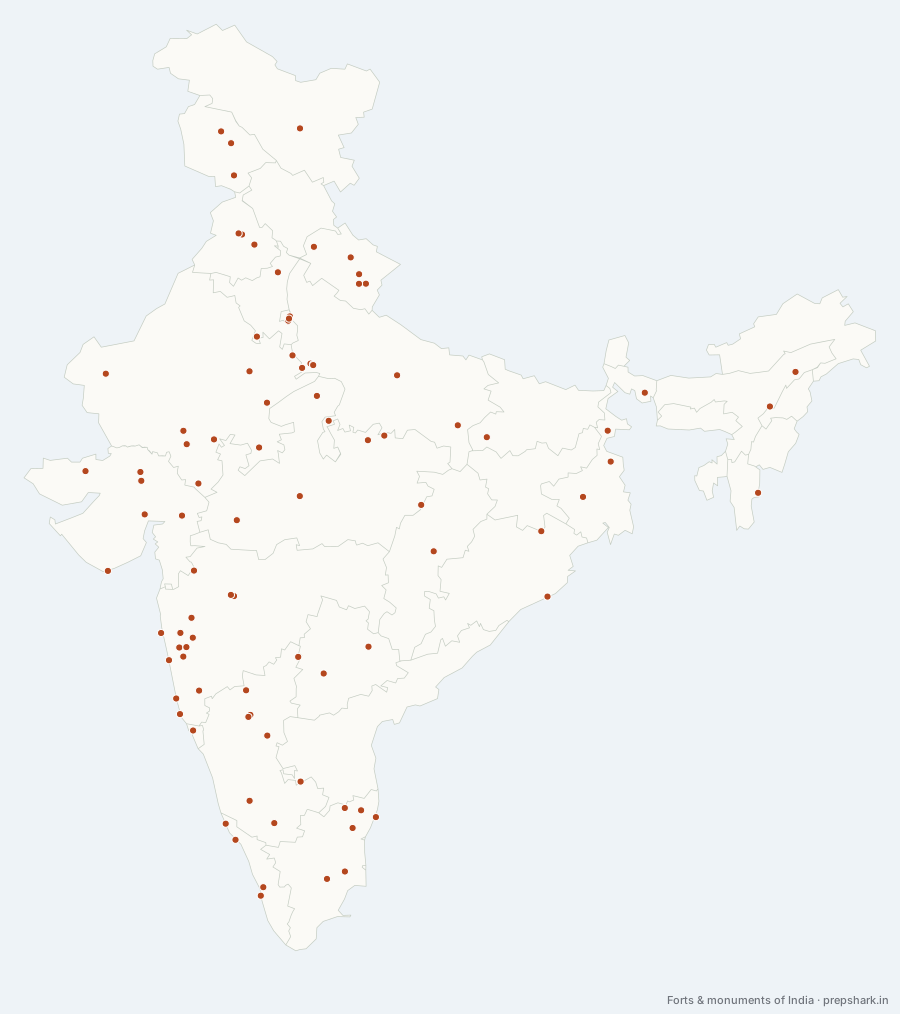
Numbered as on the map
The 94 on the map
1. Adina Mosque
West Bengal
Known forThe subcontinent’s largest mosque, at Pandua
Sikandar Shah of the Ilyas Shahi dynasty built the largest mosque in the subcontinent at Pandua in 1373, its courtyard ringed by hundreds of arches on piers made partly from the stone of demolished temples. Bengal’s brick-and-stone sultanate style begins here, before it turns to the curved-roof idiom of Gaur.
SettingBengal Sultanate · brick with reused stone · 1373 · Malda plain
2. Aga Khan Palace
Maharashtra
Known forThe Quit India prison; Kasturba’s samadhi
Built in 1892 by Aga Khan III as famine relief work in Pune, and used half a century later as the prison of Gandhi, Kasturba and Mahadev Desai after the Quit India resolution. Kasturba and Desai died in custody here and their samadhis are in the garden, which is why the building is a national memorial rather than a palace.
SettingColonial · stone with Italianate arches · 1892 · Pune
For the examQuit India, August 1942: Gandhi held here, the Congress Working Committee at Ahmednagar Fort.
3. Agra Fort
Uttar Pradesh
Known forThe Mughal seat of power, and Shah Jahan’s prison
Akbar rebuilt the old Lodi fort in red sandstone from 1565 in a crescent along the Yamuna; Shah Jahan replaced much of the inside with marble, and was then held prisoner in it by Aurangzeb until he died. Three generations of Mughal building sit inside one wall, which is why it reads as a chronology rather than a building.
SettingMughal · red sandstone with marble insertions · 1565–1650s · Yamuna bank
4. Aihole
Karnataka
Known forThe cradle of Indian temple architecture
A hundred and twenty-odd temples in a Malaprabha village where the Chalukyas worked out what an Indian temple should look like — the apsidal Durga temple, the flat-roofed Lad Khan, the Meguti with its inscription of 634 that dates Pulakeshin II’s victory over Harsha. It is usually called the cradle of Indian temple architecture, and the description is literal.
SettingEarly Chalukya · sandstone · 5th–8th century · Malaprabha valley
5. Akbar’s Tomb, Sikandra
Uttar Pradesh
Known forThe domeless, terraced Mughal tomb
Akbar began his own tomb and Jahangir finished it in 1613: a five-storey sandstone pyramid rising to an open marble court instead of a dome, with no other Mughal tomb built like it. The gateway’s inlaid minarets are the first of the four-minaret arrangement that ends at the Taj.
SettingMughal · red sandstone with marble inlay · 1605–1613 · Agra
6. Amber Fort
Rajasthan
Known forThe Kachhwaha capital above Maota lake
The Kachhwaha capital before Jaipur, built up from 1592 on an Aravalli spur above Maota lake, with a mirrored Sheesh Mahal and a Ganesh Pol gate that mark the point where Rajput and Mughal decoration stop being separable. The Kachhwahas married into the Mughal house and the building shows it.
SettingKachhwaha · sandstone and marble hill palace · 1592 onward · Aravalli spur
For the examOne of the six Hill Forts of Rajasthan inscribed in 2013.
7. Arthuna Temples
Rajasthan
Known forParamara temples in the Vagad country
A group of eleventh- and twelfth-century temples in the Vagad country of southern Rajasthan, built by the Paramaras of Vagad in a style that mixes Gujarat’s Solanki carving with Malwa’s. The tribal Bhil country around them is why the site sits outside the usual Rajput circuit.
SettingParamara of Vagad · sandstone · 11th–12th century · Banswara hills
8. Baijnath Temple, Bageshwar
Uttarakhand
Known forThe Katyuri capital’s temples on the Gomati
The Katyuri capital’s temple group on the Gomati at Baijnath, twelfth century, holding a Parvati image cut in black stone that is the finest sculpture in Kumaon. The dynasty took its name from this valley, which is why the site matters beyond its architecture.
SettingKatyuri · stone · 12th century · Katyur valley
9. Bekal Fort
Kerala
Known forKerala’s largest fort, on a sea headland
The largest fort in Kerala, built in the 1650s by the Ikkeri Nayakas on a laterite headland and later held by Hyder Ali and by Tipu as the base for the Malabar campaigns. It has no palace inside — it is a garrison and an observation tower over the sea lane, which is why it survives so complete.
SettingIkkeri Nayaka · laterite · 1650s · Malabar coast
10. Benisagar
Jharkhand
Known forAn excavated temple town on the Jharkhand–Odisha line
An excavated temple site around an ancient tank in West Singhbhum, on the old route between the Chotanagpur plateau and the Odisha coast. Brick and stone temples of the sixth to twelfth centuries have come out of the mounds, which is what makes an unglamorous village a protected site.
SettingEarly medieval · brick and stone temples · 6th–12th century · Chotanagpur edge
11. Bhojeshwar Temple, Bhojpur
Madhya Pradesh
Known forAn unfinished temple with its building ramp intact
An eleventh-century Shiva temple left unfinished by the Paramara king Bhoja, holding one of the largest lingas cut from a single stone in India, with the earthen ramp used to lift the roof slabs still lying against it. The masons’ working drawings are engraved on the rocks around — a medieval building site frozen mid-job.
SettingParamara · sandstone · 11th century · Betwa valley
12. Bibi ka Maqbara
Maharashtra
Known forThe Deccan’s Taj, built on a smaller budget
Aurangzeb’s son Azam Shah built this for his mother Dilras Banu Begum in 1660 as a copy of the Taj — and it is a copy on a reduced budget, marble only to the dome and plastered basalt below. It is called the Deccan’s Taj, and the difference between the two is a lesson in what imperial money could buy at each date.
SettingMughal · marble over plastered basalt · 1660 · Deccan
13. Bidar Fort
Karnataka
Known forThe Bahmani capital, its karez and bidriware
The Bahmani capital from 1430, a laterite plateau fort with a triple moat cut into rock and Persian tilework on the Rangin Mahal. The karez underneath it — a Persian system of tunnel wells — watered the city, and the town outside gave its name to bidriware, the zinc inlay craft.
SettingBahmani · laterite with Persian tile · 15th century · Deccan plateau
14. Brihadisvara Temple, Thanjavur
Tamil Nadu
Known forThe Great Living Chola Temple of Rajaraja I
Rajaraja Chola I finished it in 1010: a sixty-six metre vimana of granite in a country with no granite nearby, capped by a single stone said to weigh eighty tonnes, with the temple’s endowments and staff listed in inscriptions round its base. Those inscriptions are the best economic record of the Chola state that survives.
SettingChola · granite · 1010 · Kaveri delta
For the examGreat Living Chola Temples: Thanjavur, Gangaikonda Cholapuram, Airavatesvara at Darasuram.
15. Champaner–Pavagadh
Gujarat
Known forA complete abandoned Sultanate capital
A city abandoned complete: Mahmud Begada moved the Gujarat Sultanate’s capital here in 1484, built mosques whose minarets and carving are Hindu craft in Islamic form, and it was left after 1535. Above it stands Pavagadh hill with a Kalika temple on the summit, so one World Heritage site holds a living pilgrimage and a dead city.
SettingGujarat Sultanate · sandstone · 1484–1535 · Pavagadh hill
16. Chittorgarh Fort
Rajasthan
Known forIndia’s largest fort, and the Vijay Stambha
The largest fort in India by area, on a plateau above the Berach, and the seat of Mewar until Akbar took it in 1568. Its two victory towers — Rana Kumbha’s Vijay Stambha and the older Jain Kirti Stambha — and its three recorded jauhars are what it is remembered for.
SettingMewar · sandstone plateau fort · 7th–16th century · Berach valley
For the examThree jauhars: 1303 under Alauddin Khalji, 1535 under Bahadur Shah, 1568 under Akbar.
17. Church of St Augustine, Old Goa
Goa
Known forThe half-fallen tower of Old Goa
A ruined Augustinian church of 1602 in Old Goa whose forty-six-metre bell tower is half fallen and still the tallest thing on the site. Its collapse followed the 1835 expulsion of the religious orders — the ruin is a record of Portuguese policy rather than of neglect.
SettingPortuguese Baroque · laterite and lime plaster · 1602 · Old Goa
18. Cooch Behar Palace
West Bengal
Known forThe Koch kingdom’s renaissance palace
Nripendra Narayan built this Italian-renaissance palace in 1887 in the Koch kingdom’s capital, modelled on Buckingham Palace and topped by a fifty-metre dome. It stands in the narrow corridor between Bhutan, Assam and Bangladesh where the Koch state had held out since the sixteenth century.
SettingColonial Italian renaissance · brick with a domed hall · 1887 · Duars corridor
19. Dakhni Sarai, Doraha
Punjab
Known forA double-gated sarai on the Grand Trunk Road
A Jahangir-period sarai on the Grand Trunk Road at Doraha, square, double-gated and moated, with the chambers for travellers built into its walls. The road is why Punjab has so many of these and why they are always a day’s march apart.
SettingMughal · brick with tiled gateways · early 17th century · Sutlej plain
20. Daria Daulat Bagh
Karnataka
Known forTipu’s teak summer palace and the Pollilur mural
Tipu Sultan’s summer palace of 1784 at Srirangapatna, teak on a stone plinth, with its west wall painted with the Mysore army’s victory at Pollilur over the East India Company. A palace that puts a specific battle on its own wall is a political document as much as a building.
SettingMysore · teak and plaster murals · 1784 · Kaveri island
21. Daulatabad Fort
Maharashtra
Known forTughlaq’s abandoned capital; the spiral tunnel
A conical hill scarped into a vertical cliff, ringed by a moat and entered by a single dark spiral tunnel that could be flooded, smoked or blocked — the most defensible fort in the Deccan. Muhammad bin Tughlaq moved his capital here from Delhi in 1327 and marched it back a few years later, which is the episode it is remembered for.
SettingYadava and Tughlaq · basalt scarp with moat · 12th–14th century · Deccan trap
For the examMuhammad bin Tughlaq’s capital transfer of 1327 — from Delhi to Devagiri, renamed Daulatabad.
22. Deeg Palace
Rajasthan
Known forThe Jat water palace built with Mughal spoils
The Jat rulers of Bharatpur built this water palace in the 1770s with two great tanks and two thousand fountains fed by them, run for festivals by opening sluices — and furnished it with marble taken from Mughal Delhi after their raid on the imperial capital. The building is a Jat statement about the empire’s collapse.
SettingBharatpur Jat · sandstone and looted marble · 1770s · eastern Rajasthan
23. Dholavira
Gujarat
Known forHarappan water harvesting, and the signboard
A Harappan city on Khadir island in the Rann, laid out as citadel, middle town and lower town, with sixteen reservoirs cut into rock to hold the runoff of two seasonal streams. Its ten-character signboard is the largest surviving inscription in the Indus script, and its water engineering is the most elaborate the civilisation left.
SettingHarappan · stone masonry · c. 2650–1450 BCE · Rann of Kachchh
24. Dimapur Ruins
Nagaland
Known forThe Kachari monoliths of Dimapur
The brick remains of the Kachari capital at Dimapur, with rows of carved monoliths — mushroom-shaped and Y-shaped pillars whose purpose is still argued over — standing where the city was before the Ahoms destroyed it in 1536. It is the only substantial pre-colonial masonry in Nagaland.
SettingKachari · brick and carved monoliths · pre-1536 · Dhansiri valley
25. Diu Fort
Dadra and Nagar Haveli and Daman and Diu
Known forThe Portuguese sea fort held until 1961
A Portuguese sea fort of 1535 on the island’s eastern point, built after the alliance with Bahadur Shah of Gujarat and besieged twice by Ottoman and Gujarati fleets. It held until 1961, which makes it one of the last European fortifications in India to change hands.
SettingPortuguese · laterite and basalt bastions · 1535 · Arabian Sea
26. Fatehpur Sikri
Uttar Pradesh
Known forAkbar’s capital, abandoned for want of water
Akbar built a whole capital in red sandstone on a ridge near Sikri after Salim Chishti foretold him a son, and abandoned it within fifteen years — water was the reason, not war. The Buland Darwaza, the Diwan-i-Khas with its single carved central pillar, and the Ibadat Khana debates on religion all belong to this short-lived city.
SettingMughal · red sandstone · 1571–1585 · Sikri ridge
For the examThe Ibadat Khana debates and the 1582 Din-i-Ilahi belong to this site.
27. Gagron Fort
Rajasthan
Known forThe water fort among the Rajasthan six
A jal-durg — a water fort — held on three sides by the meeting of the Ahu and the Kali Sindh and on the fourth by a moat, with no foundation course because the walls rise straight off the rock. It is the water-fort member of the six Rajasthan hill forts, which is why it is always the odd one out in that list.
SettingKhichi Chauhan · stone at a river confluence · 12th century · Hadoti plateau
For the examHill Forts of Rajasthan: Chittorgarh, Kumbhalgarh, Ranthambore, Amber, Jaisalmer, Gagron.
28. Gingee Fort
Tamil Nadu
Known forThree fortified hills; the Troy of the East
Three hills — Rajagiri, Krishnagiri and Chandrayandurg — fortified and linked into one enclosure, which Shivaji took in 1677 and the Marathas then held against Aurangzeb for eight years. The British called it the Troy of the East, and it is the Tamil Nadu member of the Maratha military landscapes inscribed by UNESCO in 2025.
SettingNayaka and Maratha · granite hills · 13th–17th century · Villupuram
29. Gol Gumbaz
Karnataka
Known forIndia’s largest masonry dome, and its whispering gallery
The tomb of Muhammad Adil Shah at Bijapur, finished in 1656, carrying the largest masonry dome in India and one of the largest anywhere — held up not by buttresses but by four intersecting arches that transfer the load inward. The whispering gallery under it is a by-product of that geometry.
SettingAdil Shahi · basalt and plaster · 1656 · Bijapur
For the examLargest dome by volume in India; the Taj is marble and smaller, which is the comparison offered.
30. Golconda Fort
Telangana
Known forThe Qutb Shahi citadel; the diamond market
The Qutb Shahi citadel on a granite hill west of Hyderabad, with an acoustic system that carries a hand-clap at the entrance to the top of the hill, and a water supply lifted by Persian wheels through clay pipes. The diamonds of the Krishna valley — Koh-i-Noor and Hope among them — were traded here, which is why the name means diamonds to most people.
SettingQutb Shahi · granite hill fort · 16th century · Deccan plateau
For the examGolconda traded the diamonds; it did not mine them — the mines were in the Krishna valley at Kollur.
31. Gopeshwar
Uttarakhand
Known forThe Gopinath temple and its inscribed iron trident
The Gopinath temple in Chamoli, of about the twelfth century, with an iron trident in its courtyard carrying inscriptions from the ninth century onward — the trident is older than the building around it. This is Garhwal’s counterpart to the Kumaoni Katyuri temples on the other side of the watershed.
SettingGarhwal · stone with an iron trident · 12th century · Alaknanda valley
32. Gwalior Fort
Madhya Pradesh
Known forThe oldest written zero, and Man Singh’s palace
A sandstone hill fort held by Tomars, Mughals, Marathas and the British, with Man Singh’s tiled palace on its eastern face and Jain colossi cut into the cliffs below. Its Chaturbhuj temple carries an inscription of 876 CE containing the oldest recorded use of zero as a written numeral.
SettingTomar and Mughal · sandstone hill fort · 8th–16th century · Gwalior plateau
For the examThe zero inscription of 876 CE is the fact that turns a fort into a mathematics question.
33. Hampi
Karnataka
Known forThe Vijayanagara capital, sacked in 1565
Vijayanagara’s capital, spread over twenty-six square kilometres of granite boulders above the Tungabhadra, and the largest city in the world by some accounts when the Portuguese saw it in 1520. The Vitthala temple’s stone chariot and musical pillars, the Virupaksha gopura and the royal enclosure’s stepped tank are what survive of a city sacked in 1565 and never reoccupied.
SettingVijayanagara · granite · 14th–16th century · Tungabhadra boulder country
For the examSacked after Talikota in 1565. Krishnadevaraya is the reign the buildings are dated by.
34. Hazarduari Palace
West Bengal
Known forThe thousand-door palace of the pensioned nawabs
Duncan Macleod built this Greek-revival palace at Murshidabad in 1837 for the Nawab Nazim — a thousand doors, of which some are false, in the capital the British had already reduced to a pension. It is the architecture of a court that had lost the country at Plassey eighty years earlier.
SettingColonial Greek revival · brick and stucco · 1837 · Bhagirathi bank
For the examMurshidabad was Bengal’s capital until Plassey in 1757; the palace is what came after.
35. Hoysala temples, Belur and Halebidu
Karnataka
Known forSoapstone carving at its finest
The Chennakeshava at Belur and the Hoysaleswara at Halebidu, built in the twelfth century of soapstone — soft enough when quarried to be carved like ivory and hardening afterwards, which is why the friezes of elephants, horses and battle scenes are as fine as they are. They were inscribed as World Heritage with Somanathapura in 2023.
SettingHoysala · chloritic schist (soapstone) · 12th century · star-shaped plan
36. Humayun’s Tomb
Delhi
Known forThe first Mughal garden tomb; the Taj’s ancestor
The first garden tomb in the subcontinent, built for Humayun by his widow Hamida Banu Begum in the 1560s and the direct ancestor of the Taj: a domed mausoleum on a plinth at the centre of a charbagh divided by water channels. Everything the Mughals built afterwards is a variation on this plan.
SettingMughal · red sandstone and marble · charbagh · 1560s
For the examFirst garden tomb in India, first double dome, and a World Heritage site — the three facts asked of it.
37. Itimad-ud-Daulah’s Tomb
Uttar Pradesh
Known forThe first all-marble Mughal tomb; the Taj’s rehearsal
Nur Jahan built it for her father between 1622 and 1628, and it is the first Mughal building faced entirely in white marble and the first covered in pietra dura inlay — the two techniques the Taj would use at scale a decade later. It is called the baby Taj for that reason, though the order runs the other way.
SettingMughal · white marble with pietra dura · 1622–1628 · Yamuna bank
38. Jageshwar
Uttarakhand
Known forA hundred Katyuri temples in one deodar valley
More than a hundred stone temples of the seventh to twelfth centuries packed into a deodar valley in Kumaon, built by the Katyuris and added to by the Chands. The density is the point: a whole medieval temple town survives in one narrow glen because nothing later was built over it.
SettingKatyuri and Chand · stone · 7th–12th century · Kumaon Himalaya
39. Jaisalmer Fort
Rajasthan
Known forA living fort in the Thar, in yellow sandstone
Rawal Jaisal raised it on Trikuta hill in 1156 in the yellow sandstone that makes it disappear into the Thar at midday, and about a quarter of the town still lives inside the walls — one of the few inhabited forts left anywhere. The seepage from that modern plumbing, not any army, is what now threatens it.
SettingBhati Rajput · yellow sandstone · 1156 · Thar Desert
For the examOne of the six Hill Forts of Rajasthan; the only one still lived in.
40. Jal Mahal, Narnaul
Haryana
Known forA Mughal water pavilion in dry country
A pleasure pavilion of 1591 standing in the middle of a large tank at Narnaul, built by Shah Quli Khan out of the profits of a Mughal governorship. Southern Haryana is dry country and the water it stands in is harvested runoff, which is what the building is really about.
SettingMughal · sandstone pavilion on a tank · 1591 · Ahirwal
41. Jhansi Fort
Uttar Pradesh
Known forLakshmibai’s fort in the 1857 rising
Bir Singh Deo of Orchha raised it on the Bangira rock in 1613, and it is where Rani Lakshmibai held out in the siege of 1858 before breaking out towards Kalpi. The granite of the Bundelkhand upland is both the fort’s foundation and its wall.
SettingBundela · granite hill fort · 1613 · Bundelkhand upland
For the exam1857: Jhansi under Lakshmibai, Kanpur under Nana Saheb, Lucknow under Begum Hazrat Mahal.
42. Kailasanathar Temple, Kanchipuram
Tamil Nadu
Known forKanchipuram’s oldest temple, and Pattadakal’s model
Rajasimha’s sandstone temple of about 700 CE, the oldest structure in Kanchipuram and the model Queen Lokamahadevi copied at Pattadakal a generation later. Fifty-eight small shrines line its enclosure wall, each with its own painted plaster surviving in patches.
SettingPallava · sandstone with plaster painting · c. 700 CE · Palar valley
43. Kalinjar Fort
Uttar Pradesh
Known forThe fort where Sher Shah Suri was killed
A Chandela fort on a flat Vindhyan spur, with rock-cut tanks and sculpture on the climb and a reputation for never being taken by siege — Sher Shah Suri was killed by his own exploding gunpowder store outside its walls in 1545. Mahmud of Ghazni and Humayun both failed against it.
SettingChandela · sandstone spur fort · 9th century onward · Vindhyan scarp
For the examSher Shah’s death at Kalinjar in 1545, five years into the Sur interregnum.
44. Katarmal Sun Temple
Uttarakhand
Known forThe Himalayan sun temple, on a Kumaon ridge
A Katyuri sun temple of the ninth century on a ridge above the Kosi, the most important surviving sun temple in the hills, with forty-four smaller shrines around the main one. It is oriented so that the first light of the day reaches the image.
SettingKatyuri · stone · 9th century · Kumaon ridge
45. Khajuraho
Madhya Pradesh
Known forThe Chandela temples of the Nagara style
The Chandela capital’s temples, built between 950 and 1050 in sandstone and left in forest until 1838 — twenty-five of an original eighty-five survive. The Kandariya Mahadeva is the high point of the Nagara style: a mountain of ascending spires with the sculpture, erotic and otherwise, band on band around it.
SettingChandela · sandstone · 950–1050 · Bundelkhand upland
For the examNagara style at its height; the Western Group holds Kandariya Mahadeva and Lakshmana.
46. Khanderi Fort
Maharashtra
Known forThe island Shivaji fortified against the English fleet
Shivaji fortified this island off Alibag in 1679 in the teeth of the English fleet from Bombay and the Siddis of Janjira, both of whom claimed the water — the fight over it is the clearest case of the Marathas asserting sea power against Europeans. A lighthouse stands on the island now.
SettingMaratha · basalt island fort · 1679 · mouth of Mumbai harbour
47. Konark Sun Temple
Odisha
Known forThe stone chariot of the sun
Narasimhadeva I built it in the thirteenth century as the sun god’s chariot: twenty-four carved wheels along the plinth, seven horses at the front, the whole thing oriented so that the first light falls on the sanctum. The main tower fell centuries ago; what stands is the audience hall, and its wheels work as sundials.
SettingEastern Ganga · khondalite and chlorite · 13th century · Odisha coast
For the examKalinga style: Konark, Puri’s Jagannath and Bhubaneswar’s Lingaraja are the three asked together.
48. Kudakkallu Parambu
Kerala
Known forKerala’s umbrella-stone megaliths
A field of umbrella stones — kudakkallu — cut from laterite and set over burial urns in the first millennium BCE, the Kerala form of the South Indian megalithic tradition. They are graves rather than architecture, and they are the oldest built things on this layer by a thousand years.
SettingMegalithic · laterite umbrella stones · 1st millennium BCE · Thrissur
49. Kumbhalgarh Fort
Rajasthan
Known forA thirty-six kilometre wall; Pratap’s birthplace
Rana Kumbha’s fort on an Aravalli ridge, its perimeter wall running thirty-six kilometres — the second longest continuous wall in the world after China’s — and enclosing three hundred temples inside it. Maharana Pratap was born here, and the fort was never taken except once, when its water supply was poisoned.
SettingMewar · granite and lime · 15th century · Aravalli ridge
For the examOne of the six Hill Forts of Rajasthan inscribed by UNESCO in 2013.
50. Lakhamandal
Uttarakhand
Known forAn eighth-century Shiva temple in the Yamuna valley
A Nagara-style Shiva temple of about the eighth century in the Yamuna valley of Jaunsar-Bawar, its courtyard crowded with loose lingas and sculpture recovered from around it. Local tradition attaches the Mahabharata’s lac house to the site, which is where the name is read from.
SettingEarly Nagara · stone · c. 8th century · Jaunsar-Bawar
51. Lakshmana Temple, Sirpur
Chhattisgarh
Known forIndia’s finest seventh-century brick temple
A seventh-century brick temple on the Mahanadi, and the best-preserved brick building of its age in India — the Panduvamshi capital of Sripura stood around it, with Buddhist monasteries alongside the Hindu shrines. Brick is the point: most temples of the period that survive are stone, because brick does not.
SettingPanduvamshi · moulded brick · 7th century · Mahanadi valley
52. Lal Khan’s Tomb, Varanasi
Uttar Pradesh
Known forGlazed-tile Mughal tomb on the Rajghat mound
A square Mughal tomb of 1773 at Rajghat in Varanasi, faced in blue, green and yellow glazed tile — an ordinary noble’s tomb that survives because the tilework on it does. It stands on the mound that holds the city’s oldest occupation layers, beside the Ganga crossing.
SettingMughal · sandstone with glazed tile · 1773 · Ganga bank
53. Leh Palace
Ladakh
Known forThe nine-storey palace that preceded the Potala
A nine-storey palace built by Sengge Namgyal in the 1600s above Leh, of mud brick, stone and poplar on a rock spur — the model the Potala in Lhasa followed a generation later. The Namgyals abandoned it in the 1830s when the Dogras took Ladakh.
SettingNamgyal dynasty · mud brick and poplar · 17th century · Indus valley
54. Lepakshi
Andhra Pradesh
Known forVijayanagara murals, and a hanging pillar
A Vijayanagara temple of the 1530s whose ceilings carry the largest surviving mural cycle of the empire, painted on plaster in vegetable colour. Its hanging pillar — resting on the floor at one corner only — is the detail every visitor is shown, and the monolithic Nandi down the road is the largest in the country.
SettingVijayanagara · granite and plaster mural · 1530s · Penukonda country
55. Lohagad Fort
Maharashtra
Known forThe scorpion-tail rampart above the Bhor Ghat
An iron fort on the Bhor Ghat above Lonavala, with a curving fortified spur called the Vinchu Kata — the scorpion’s tail — running out along the ridge. Shivaji used it as a treasury, and it commands the pass road between the Konkan and Pune that the railway later followed.
SettingMaratha · basalt ridge fort · 17th century · Bhor Ghat
56. Lothal
Gujarat
Known forThe Harappan dockyard
A Harappan port on the Sabarmati’s old channel with what is generally read as the world’s earliest known dock — a brick basin two hundred metres long, with a spillway and a sluice. Bead-making workshops and a warehouse make the case that this was a manufacturing town trading with the Gulf.
SettingHarappan · kiln-fired brick · c. 2400 BCE · Gulf of Khambhat
For the examLothal is the dock and the bead factory; Dholavira is the water system and the signboard. Papers swap them.
57. Martand Sun Temple
Jammu and Kashmir
Known forThe Karkota sun temple above the valley
The ruined sun temple built by Lalitaditya Muktapida in the eighth century on a plateau above the Kashmir valley, with a colonnaded courtyard of eighty-four shrines and a Greek-looking trefoil arch that is the signature of Kashmiri stone building. It was destroyed by Sikandar Shah Miri around 1400 and never rebuilt.
SettingKarkota · limestone with trefoil arches · 8th century · Anantnag plateau
58. Muvar Koil, Kodumbalur
Tamil Nadu
Known forThe temple where early Chola style forms
Three shrines built in the tenth century by the Irukkuvel chieftain Bhuti Vikramakesari — two survive — in the phase when Pallava building was becoming Chola. The site is small and the sculpture is the point: it is where the early Chola style can be seen forming.
SettingIrukkuvel under the Cholas · granite · 10th century · Pudukkottai
59. Nurmahal Sarai
Punjab
Known forNur Jahan’s caravanserai on the Lahore road
A Mughal caravanserai built in 1621 by Nur Jahan on the road between Delhi and Lahore, a walled square with a hundred and forty chambers, a mosque and a well — imperial infrastructure rather than a monument. Sher Shah began the sarai system on this road and the Mughals continued it; this is the best-preserved one in Punjab.
SettingMughal · brick with carved panels · 1621 · Grand Trunk Road
60. Panhala Fort
Maharashtra
Known forThe Deccan’s largest fort; the escape to Vishalgad
The largest fort in the Deccan, built by the Shilaharas in the twelfth century and later Maratha, with granaries big enough to outlast a siege and a triple-arched well built so that it could not be poisoned. Shivaji broke out of its blockade in 1660 through the Pavan Khind, where Baji Prabhu held the pass behind him.
SettingShilahara and Maratha · basalt with vast granaries · 12th century onward · Sahyadri
61. Pari Mahal
Jammu and Kashmir
Known forDara Shikoh’s terraced observatory above the Dal
A terraced garden and library above Srinagar, built by Dara Shikoh in the 1650s for his Sufi teacher and used as an observatory and a school of astrology. Six terraces step down the Zabarwan spur with the Dal below — the Mughal garden idea worked on a mountainside rather than a plain.
SettingMughal · terraced garden on a spur · 1650s · Zabarwan range
62. Pattadakal
Karnataka
Known forNagara and Dravida temples side by side
The Chalukya coronation town on the Malaprabha, where northern Nagara and southern Dravida temples stand in the same courtyard — the Virupaksha built by Queen Lokamahadevi in 740 to a Kanchipuram model, the Papanatha in the northern manner beside it. It is the single best place to see the two Indian temple styles compared.
SettingBadami Chalukya · sandstone · 7th–8th century · Malaprabha valley
For the examAihole is the experiment, Badami the rock-cut, Pattadakal the culmination — the standard three-site sequence.
63. Pratapgad Fort
Maharashtra
Known forWhere Shivaji killed Afzal Khan in 1659
Built in 1656 above the Koyna valley, and the site of Shivaji’s killing of Afzal Khan of Bijapur at the foot of its walls in 1659 — the encounter that turned a local chief into a power the Deccan sultanates and then the Mughals had to answer. The fort has an upper and a lower level on a spur between two valleys.
SettingMaratha · basalt spur fort on two levels · 1656 · Koyna valley
64. Purana Qila
Delhi
Known forDinpanah; the mound that may be Indraprastha
The fort of Dinpanah, begun by Humayun and finished by Sher Shah, and the mound under it has produced Painted Grey Ware — the pottery that ties the site to the Mahabharata’s Indraprastha. Humayun fell down its library stairs and died, which is how Sher Shah’s buildings ended up in a Mughal fort.
SettingSur and early Mughal · rubble and sandstone · 1530s–1540s · Yamuna bank
65. Qutb Complex
Delhi
Known forThe tallest brick minaret, and the rustless Iron Pillar
The first monuments of the Delhi Sultanate, begun in 1192: the Quwwat-ul-Islam mosque raised out of the columns of demolished temples, the Qutb Minar beside it, and the fourth-century Iron Pillar in the courtyard that has not rusted in sixteen hundred years. The minar is the tallest brick minaret in the world.
SettingSlave dynasty · red sandstone and marble · 1192 onward · Mehrauli
For the examIron Pillar: Chandragupta II’s, moved here, and its corrosion resistance is a metallurgy question as often as a history one.
66. Raigad Fort
Maharashtra
Known forShivaji’s capital and coronation hill
Shivaji made this Sahyadri hill his capital and was crowned Chhatrapati on it in 1674; he was cremated here six years later. The single approach through the Maha Darwaja, and the scarped basalt on every other side, are why he chose it out of hundreds of hills.
SettingMaratha · basalt hill fort · 17th century · Sahyadri scarp
For the examThe 1674 coronation at Raigad begins the Maratha state as a sovereign kingdom; one of the twelve Maratha Military Landscapes inscribed in 2025.
67. Rajgad Fort
Maharashtra
Known forThe Maratha capital before Raigad
Shivaji’s capital for twenty-six years before Raigad, built on Murumdev hill with three long ridges — Padmavati, Suvela and Sanjivani — and a walled citadel where they meet. Most of the early Maratha state was run from here, which is why it outranks the better-known forts in importance if not in fame.
SettingMaratha · basalt hill fort on three ridges · 17th century · Sahyadri
68. Ramappa Temple
Telangana
Known forFloating bricks, a sandbox foundation, a sculptor’s name
The Kakatiya temple at Palampet, finished in 1213 and named after its sculptor rather than its patron — the only such case in India. Its tower is built of bricks light enough to float, and it stands on a sandbox foundation that has carried it through the earthquakes that flattened its neighbours.
SettingKakatiya · sandstone with floating brick tower · 1213 · Telangana plateau
For the examInscribed by UNESCO in 2021; the sandbox foundation is the engineering fact asked about it.
69. Ramnagar Palace
Jammu and Kashmir
Known forDogra wall paintings in the Jammu hills
A Dogra palace in the Shivalik foothills built by Raja Suchet Singh in the 1830s, and the best surviving set of Pahari wall paintings in the Jammu style — Basohli and Kangra painting done on plaster instead of paper. It is the one Adarsh monument on this list that is a painting gallery first.
SettingDogra · brick and plaster with murals · 1830s · Shivalik foothills
70. Rang Ghar
Assam
Known forThe Ahom amphitheatre at Sivasagar
A two-storey royal pavilion at Sivasagar built by the Ahom king Pramatta Singha in the 1740s to watch buffalo fights and games from — one of the oldest surviving amphitheatres in Asia. Its walls are brick set in a mortar of rice paste and eggs, which is the Ahom building technique the papers ask about.
SettingAhom · brick with rice-paste mortar · 1740s · Brahmaputra valley
For the examAhom architecture: rice paste and egg mortar, and the Kareng Ghar palace beside it at Garhgaon.
71. Rani ki Vav
Gujarat
Known forThe queen’s stepwell at Patan
A stepwell built at Patan in the 1060s by the Solanki queen Udayamati, seven storeys deep and carved with over five hundred principal sculptures — a water building treated as a temple turned upside down. Silt from the Saraswati buried it for centuries, which is why the carving is as sharp as it is.
SettingSolanki · sandstone · 11th century · subterranean stepwell
For the examIt is on the hundred-rupee note, it is a World Heritage site, and a stepwell is a vav in Gujarat and a baoli in the north.
72. Ranthambore Fort
Rajasthan
Known forA hill fort inside a tiger reserve
A tenth-century Chauhan fort on an isolated Vindhyan crag, besieged by Alauddin Khalji in 1301 and now standing inside a tiger reserve — the one fort on this layer where the approach is through a national park. Its position, ringed by ravines and dry forest, is why it held out as long as it did.
SettingChauhan · sandstone crag fort · 10th century · Vindhyan scarp
73. Red Fort
Delhi
Known forShahjahanabad’s citadel; the Independence Day rampart
Shah Jahan’s citadel at the heart of Shahjahanabad, finished in 1648 when the capital moved from Agra, and the seat of Mughal authority until 1857. The Diwan-i-Am, the Diwan-i-Khas with its lost Peacock Throne, and the marble Rang Mahal are the buildings; the Prime Minister speaking from its ramparts each Independence Day is the reason it still matters.
SettingMughal · red sandstone with marble pavilions · 1638–1648 · Yamuna bank
74. Royal Palace, Mandu
Madhya Pradesh
Known forThe Malwa Sultanate’s ship palace
The Malwa Sultanate’s hill capital on a plateau cut off by ravines, where the Jahaz Mahal stands between two tanks like a ship and the Hindola Mahal leans on battered walls. Its Jama Masjid is modelled on the mosque at Damascus, and the Afghan austerity of it all is the opposite of Mughal ornament.
SettingMalwa Sultanate · sandstone · 15th century · Vindhyan plateau
75. Safdarjung’s Tomb
Delhi
Known forThe last Mughal garden tomb
The last garden tomb the Mughals built, raised in 1754 for the Nawab of Awadh who served as the empire’s vizier, and openly a copy of Humayun’s — with marble stripped from an older tomb because there was no longer money for new. It is the clearest architectural evidence of the empire’s decline.
SettingLate Mughal · reused marble and sandstone · 1754 · charbagh
76. Salher Fort
Maharashtra
Known forThe Sahyadris’ highest fort; the 1672 open-field win
The highest fort in the Sahyadris at about 1,570 metres, in the Baglan hills near the Gujarat line, and the site of the 1672 battle in which the Marathas beat a Mughal army in the open field for the first time. Until then they had won by ambush and siege; Salher changed what the empire thought it was facing.
SettingMaratha · basalt summit fort at 1,570 m · 17th century · Baglan hills
77. Sas Bahu Temple, Nagda
Rajasthan
Known forMewar’s oldest temple carving
Twin tenth-century temples at Nagda near Eklingji — Sahastrabahu, the thousand-armed Vishnu, worn down in speech to Sas-Bahu, mother-in-law and daughter-in-law. The carving is Mewar’s earliest surviving temple work and the ruined capital around it was Mewar’s first.
SettingGuhila (early Mewar) · sandstone · 10th century · Aravalli lake country
78. Sheikh Chilli’s Tomb
Haryana
Known forA Sufi teacher’s tomb on Harsha’s mound
A Persian-style tomb in white marble at Thanesar, built for Dara Shikoh’s Sufi teacher in the 1650s and standing on the mound of Harsha’s capital — so a Mughal monument sits directly on an early medieval city. The madrasa beside it is the reason the complex is a school as much as a shrine.
SettingMughal · marble with a Persian dome · 1650s · Thanesar mound
79. Sher Shah Suri’s Tomb
Bihar
Known forThe Afghan tomb in a lake at Sasaram
A domed octagon standing on a terrace in the middle of an artificial lake at Sasaram, built for the Afghan ruler who interrupted the Mughals and left them the Grand Trunk Road and the rupee. The tomb is the high point of Indo-Afghan building: the water is not decoration but the base the whole composition is designed to be seen across.
SettingSur dynasty · sandstone octagon on a lake terrace · 1540s · Sasaram, on the Grand Trunk Road
For the examSher Shah: the rupiya, the Grand Trunk Road, the sarai system — and this tomb, the finest Indo-Afghan one.
80. Shivneri Fort
Maharashtra
Known forShivaji’s birthplace, above the Naneghat road
Shivaji was born inside this fort in 1630, and it guards the Naneghat pass where the trade road from the Konkan ports climbed to the Deccan — the same pass the Satavahanas taxed sixteen centuries earlier. Seven gates in sequence defend the single path up.
SettingMaratha · basalt hill fort with seven gates · 17th century · Naneghat
81. Shore Temple, Mahabalipuram
Tamil Nadu
Known forThe Pallava move from rock-cut to structural
Narasimhavarman II built it about 700 CE as one of the earliest free-standing stone temples in South India — the Pallava move from cutting into rock to building with cut stone. Sea spray has eaten its carving for thirteen centuries, and the 2004 tsunami briefly exposed structures offshore that suggest it was one of a group.
SettingPallava · granite · c. 700 CE · Coromandel shore
For the examMahabalipuram sequence: cave temples, rathas (monoliths), then structural — the Shore Temple is the last stage.
82. Sindhudurg Fort
Maharashtra
Known forShivaji’s sea fort and the Maratha navy
Shivaji built it from 1664 on a rock island off Malvan with lead poured into the foundations and a curtain wall bent so that its main gate cannot be seen from the sea — the first work of a Maratha navy meant to answer the Siddis and the Europeans. His handprint and footprint are set in the courtyard.
SettingMaratha · laterite island fort with lead-set foundations · 1664 · Konkan coast
For the examThe Maratha navy under Shivaji, later under the Angres — Sindhudurg is where it begins.
83. St Angelo Fort
Kerala
Known forPortuguese, Dutch, Arakkal and British in turn
A triangular laterite fort built by the Portuguese viceroy Francisco de Almeida in 1505 on the Kannur headland, taken by the Dutch in 1663, sold to the Ali Rajas of Kannur and finally held by the British. Four flags in three centuries is the point: this coast was the contested one.
SettingPortuguese · laterite bastions · 1505 · Malabar coast
84. St Francis Church, Kochi
Kerala
Known forThe oldest European church in India; da Gama’s first grave
The oldest European church in India, built in stone in 1516 at Fort Kochi, and the place Vasco da Gama was buried in 1524 before his remains were taken to Lisbon. It went Catholic to Protestant to Anglican as the port changed hands, which is the history of Kochi in one building.
SettingPortuguese · laterite and timber · 1516 · Fort Kochi
85. Sun Temple, Modhera
Gujarat
Known forThe sun temple with a stepped tank
A Solanki sun temple of 1026 on the Pushpavati, designed so that the equinox sunrise strikes the sanctum through the hall — and fronted by a stepped tank, the Surya Kund, ringed with a hundred and eight small shrines. It was sacked by Mahmud of Ghazni’s successors and never reconsecrated, so nothing has been added to it since.
SettingSolanki · sandstone · 1026 · Surya Kund
For the examThree sun temples get asked together: Konark in Odisha, Modhera in Gujarat, Martand in Kashmir.
86. Suvarnadurg Fort
Maharashtra
Known forThe Angre fleet’s island dockyard
A golden fort on an island off Harnai with a land fort, Kanakadurg, facing it across the channel — a pair meant to hold the harbour between them. The Angre fleet was built and repaired here, which makes it the dockyard of the Maratha navy rather than one of its gun platforms.
SettingMaratha · laterite island fort with a paired land fort · 17th century · Konkan coast
87. Taj Mahal
Uttar Pradesh
Known forShah Jahan’s marble tomb for Mumtaz Mahal
Shah Jahan built it between 1632 and 1648 for Mumtaz Mahal, in Makrana marble inlaid with stones carried from Rajasthan, Afghanistan, Tibet and Sri Lanka. The garden is a charbagh split by water channels, the mosque and its mirror-building balance the platform, and the four minarets lean outward so that an earthquake would drop them away from the dome.
SettingMughal · Makrana marble with pietra dura · 1632–1648 · Yamuna bank
For the examThe one Mughal building whose plan is asked directly: charbagh garden, riverfront terrace, four detached minarets.
88. Temples at Amarkantak
Madhya Pradesh
Known forTemples at the source of the Narmada
The Kalachuri temple group at the source of the Narmada, on the Maikal hills where the Narmada and the Son rise and leave in opposite directions. The temples are a pilgrimage built on a watershed — the geography is why the place is sacred, not the other way round.
SettingKalachuri · sandstone · 11th century · Maikal hills
89. Temples at Bishnupur
West Bengal
Known forThe Malla terracotta temples of Bengal
The Malla kings built in terracotta because the Bengal delta has no stone: brick temples faced with moulded panels of the Ramayana and the Krishna stories, in the curved chala and ratna forms borrowed from thatched village roofs. Rasmancha, Jor Bangla and Shyam Rai are the ones named in every list.
SettingMalla · laterite and terracotta brick · 17th century · Rarh plain
For the examTerracotta and the chala/ratna roof are Bengal’s answer to having no building stone.
90. The Residency, Lucknow
Uttar Pradesh
Known forThe 1857 siege, kept in ruins on purpose
The British Resident’s compound at the Awadh court, besieged for eighty-seven days in 1857 while some three thousand people sheltered inside it. It was deliberately left shot-scarred and roofless afterwards as an imperial memorial, and that is exactly how it still stands.
SettingColonial · brick and stucco, left ruined · 1780s · Gomti bank
For the examThe Lucknow siege of 1857 — Henry Lawrence died here; Begum Hazrat Mahal led the city.
91. Tombs of Mohammad Momin and Haji Jamal
Punjab
Known forThe best Mughal tilework in Punjab
Two Jahangir-period tombs at Nakodar, faced in glazed tile of a blue and yellow that came to Punjab from Lahore and Multan — the best surviving Mughal tilework in India outside Delhi. They are the tombs of a musician and a court noble rather than of royalty, which is unusual for buildings of this quality.
SettingMughal · brick with glazed tile · 1612 and 1657 · Doaba
92. Vangchhia
Mizoram
Known forMizoram’s engraved menhirs
A field of engraved menhirs on the Myanmar border — Kawtchhuah Ropui, the great gateway — carved with human and animal figures by a people nobody has yet identified, alongside terraces, water pavilions and burial sites. It is the only nationally protected site in Mizoram and the least understood monument on this layer.
SettingMegalithic · engraved sandstone menhirs · dating unsettled, 15th–17th century proposed · Myanmar border
93. Vellore Fort
Tamil Nadu
Known forThe 1806 Vellore mutiny
A Vijayanagara-period granite fort with a wet moat, held afterwards by Bijapur, the Marathas, the Mughals, the Carnatic Nawabs and the Company. The 1806 sepoy mutiny inside it — over headgear, beards and caste marks — is the rehearsal for 1857 that every syllabus names.
SettingVijayanagara · granite with a wet moat · 16th century · Palar valley
For the examVellore 1806: the first large sepoy mutiny, half a century before 1857.
94. Vijaydurg Fort
Maharashtra
Known forKanhoji Angre’s naval base and its hidden sea wall
The oldest fort on this coast, Shilahara in origin and rebuilt by Shivaji, with a submerged wall built offshore to wreck ships that came in too close. Kanhoji Angre made it his naval base, and it held out against the English and the Portuguese for decades.
SettingShilahara and Maratha · laterite headland fort · 12th century onward · Vaghotan creek
Keep going