

Start hereAbout 1 min
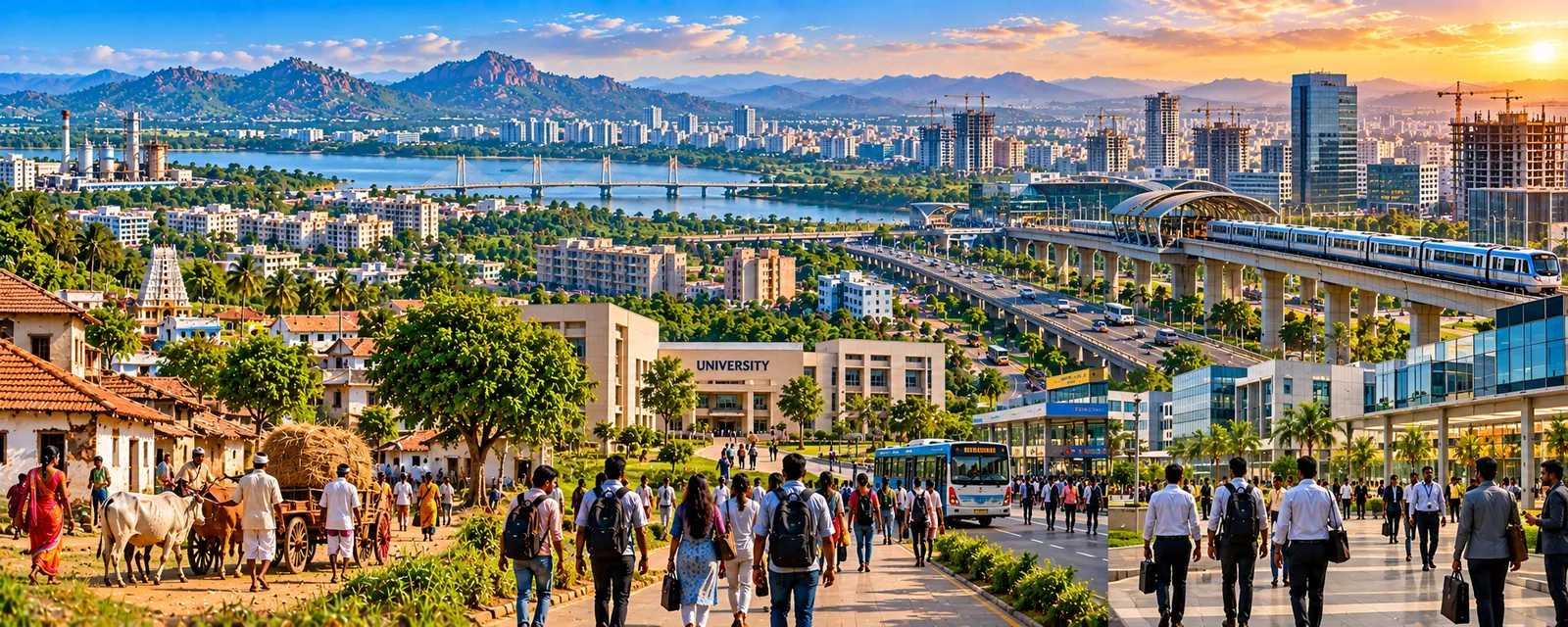
Chapter Overview Map
Settlements, Migration, Education and Work
11.1–11.3 Settlements
- A settlement is a place where people live; its site and situation explain where it grows.
- Rural settlements take clustered, semi-clustered, hamleted or dispersed forms set by relief, water and society.
- In Andhra Pradesh, delta villages are large and compact, while Eastern Ghats habitations are small and scattered.
11.4–11.5 Towns, cities and hierarchy
- The Census separates statutory towns (declared by law) from census towns (meeting three tests).
- Settlements form a hierarchy from hamlet to metropolis; Central Place Theory explains how towns serve their hinterlands.
11.6–11.8 Urbanisation
- India was 31.1% urban in 2011; urban growth is concentrated in large metropolitan regions.
- Present Andhra Pradesh was less urbanised than India in 2011, with its main cities along the coast and the Krishna delta.
11.9–11.10 Migration
- Migration is measured by place of birth or place of last residence; most Indian migration is within a State.
- Push and pull factors and intervening obstacles decide who moves, where and for how long.
11.11–11.14 Education, work and integration
- Literacy (reading and writing with understanding, age 7 and above) is higher in urban areas and among men.
- Workers are grouped into primary, secondary and tertiary activities; agriculture still employs the biggest share.
- Settlement, migration, education and work reinforce each other and shape regional disparities in Andhra Pradesh.
Don't confuse
- Urban growth is a rise in urban population; urbanisation is a rise in the urban share of population.
- Labour force includes the unemployed who seek work; workforce counts only those working.
Notice that the chapter moves from where people live to how they move, learn and work; the last branch holds two confusions that run through the whole chapter.