

Start hereAbout 1 min
Chapter Overview Map
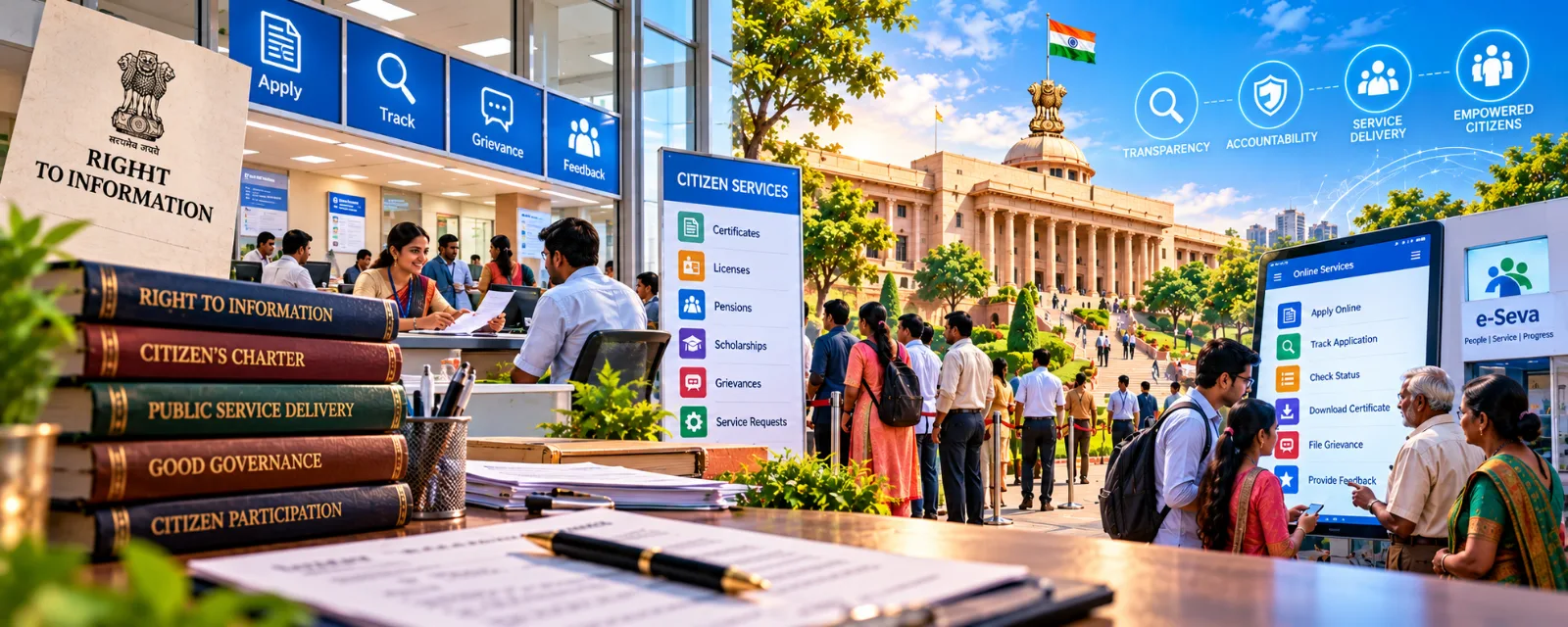
Citizen-centric governance
7.1 Foundations
- Citizens are rights-bearing participants, not passive beneficiaries of state favour.
- Rooted in Articles 14, 19(1)(a) and 21, the Directive Principles and the rule of law.
7.2 Citizen's Charter and Sevottam
- A public promise of service standards, timelines and redress, launched in India in 1997.
- Sevottam turns the charter into a management system with three modules.
7.3–7.5 Right to Information
- The right to know is part of Article 19(1)(a); the Right to Information (RTI) Act, 2005 makes it enforceable.
- Information Commissions hear appeals; a 2019 amendment and the Digital Personal Data Protection (DPDP) Act, 2023 changed the law.
7.6–7.7 Service guarantees and grievances
- Right-to-service laws make timelines legally binding, with appeals and penalties.
- Grievance redressal through the Union portal (CPGRAMS) and Andhra Pradesh's Public Grievance Redressal System (PGRS) fixes individual failures and system faults.
7.8–7.10 Social audit
- Communities verify records against reality and present findings at a public hearing.
- Made a legal duty by Section 17 of the Mahatma Gandhi National Rural Employment Guarantee Act (MGNREGA) and the 2011 Rules.
7.11–7.13 Andhra Pradesh and synthesis
- Andhra Pradesh: the Society for Social Audit, Accountability and Transparency (SSAAT), a 2017 service guarantee law, MeeSeva, secretariats and PGRS.
- Each mechanism covers a different link in the accountability chain.
Don't confuse
- A charter is a promise; a service guarantee law is an enforceable right.
- Transparency shows what happened; accountability makes someone answer and correct it.
Notice how the chapter moves from promises (charters) to information (RTI), legal guarantees, remedies (grievances) and collective verification (social audit).