Start hereAbout 2 min
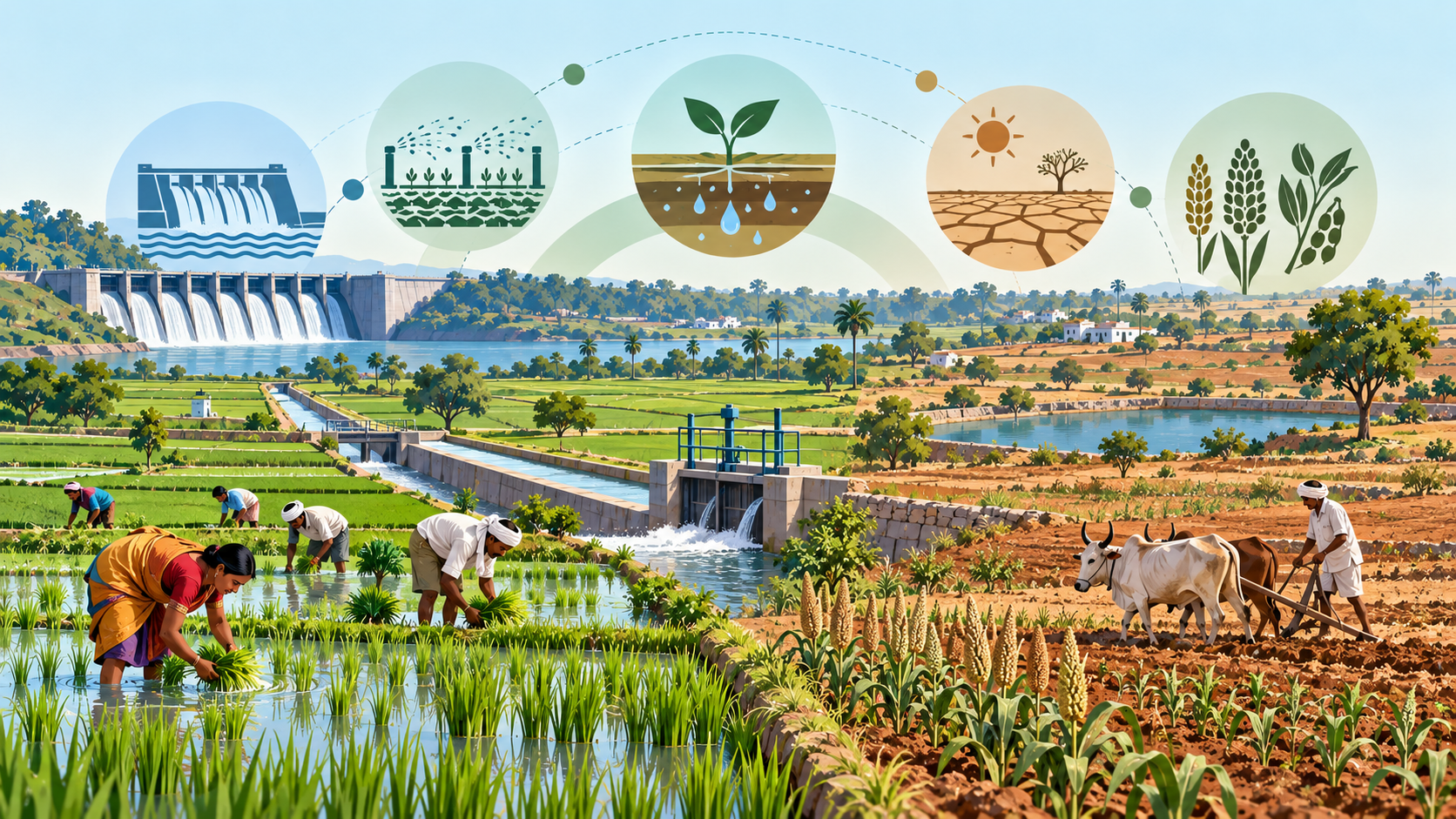
Chapter Overview Map
Irrigation and Dryland Agriculture in Telangana
7.1–7.2 Why irrigation matters and how it changed
- Irrigation reduces a farm's dependence on rainfall, which makes crops more reliable and allows more than one crop a year.
- Telangana moved from tanks under Hyderabad State to canals in the united Andhra Pradesh period and then to borewells.
- After 2014, net irrigated area roughly doubled, from a drought-hit base, under official land-use statistics.
7.3–7.4 Surface water: canals and tanks
- Canals carry river water from reservoirs or barrages to a project's command area.
- Tanks are small local reservoirs, often linked in a chain, which also recharge groundwater.
- Mission Kakatiya (from 2015) set out to restore minor irrigation tanks.
7.5 Groundwater: wells and borewells
- Groundwater schemes make up about 96% of minor irrigation schemes in Telangana (Minor Irrigation Census, 2017-18).
- Borewells give the farmer control over timing, but depend on electricity and on aquifer recharge.
- The Central Ground Water Board (CGWB) rates assessment units from Safe to Over-exploited by their stage of extraction.
7.6 Coverage and intensity
- Irrigation intensity compares gross irrigated area with net irrigated area.
- District comparisons need care because Telangana went from 10 to 33 districts.
7.7–7.8 Dryland agriculture and drought
- Rainfed farms face yield risk and income risk because rainfall varies in amount and timing.
- A rainfall deficit is not the same as a declared drought, which follows official indicators.
7.9–7.10 Efficiency, sustainability and development
- Drip and sprinkler irrigation cut application losses, but total water use can still rise.
- Irrigation helps development when it is reliable, efficient and sustainable, not merely large.
Notice how each branch moves from water sources to risk and then to sustainability; the chapter ends by joining these to farm income.