Start hereAbout 1 min
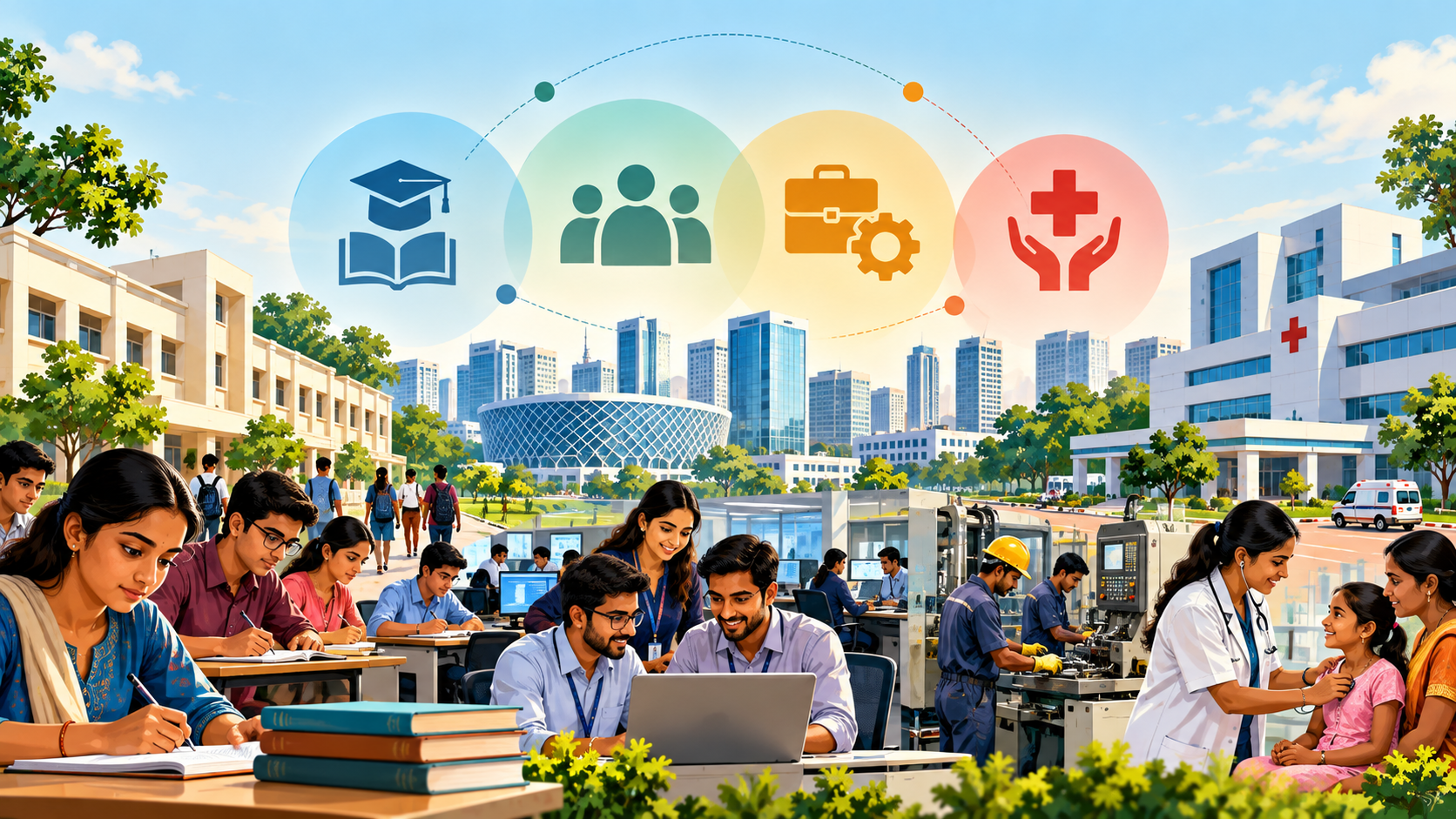
Chapter Overview Map
Human resources and Telangana's economy
4.1 Human capital
- Human capital is the education, skill and health that make people productive workers.
- Spending on education and health is treated as an investment, not only as welfare.
4.2–4.4 Literacy, occupations and labour
- Literacy (Census 2011: 66.54%) is the base on which education and skills are built.
- Occupational structure shows where workers earn a living; most rural workers in 2011 were in agriculture.
- Labour force participation, worker population and unemployment rates describe how fully the working-age population is used.
4.5–4.7 Education and skills
- School education gives access and basic learning; higher and skill education give qualifications and employability.
- Telangana has high enrolment ratios but a sharp fall after Class X and weak learning scores.
4.8–4.9 Health
- Care is organised in primary, secondary and tertiary tiers, public and private.
- Infrastructure and access (beds, institutional births) are inputs; outcomes (infant and maternal mortality, stunting) are results.
- The State's Rajiv Aarogyasri, converged with the Union's Pradhan Mantri Jan Arogya Yojana (PM-JAY), protects poor families against large hospital bills.
4.10 Development link
- Better human capital raises productivity, income and mobility, and supports inclusive growth.
- Unequal access to schooling and health care turns into unequal opportunity.
Don't confuse
- A literacy rate counts who can read and write; an enrolment ratio counts who is in school.
- A sector's share of gross state domestic product (GSDP) is not its share of workers.
- Health infrastructure is an input; a health outcome is the result it aims at.
Notice how the branches follow the chapter: concepts first, then literacy and work, then education, health and their combined effect on development.