Environment & ecology · Atlas of India
Biosphere reserves of India
Protected areas, habitats, and the corridors between them.
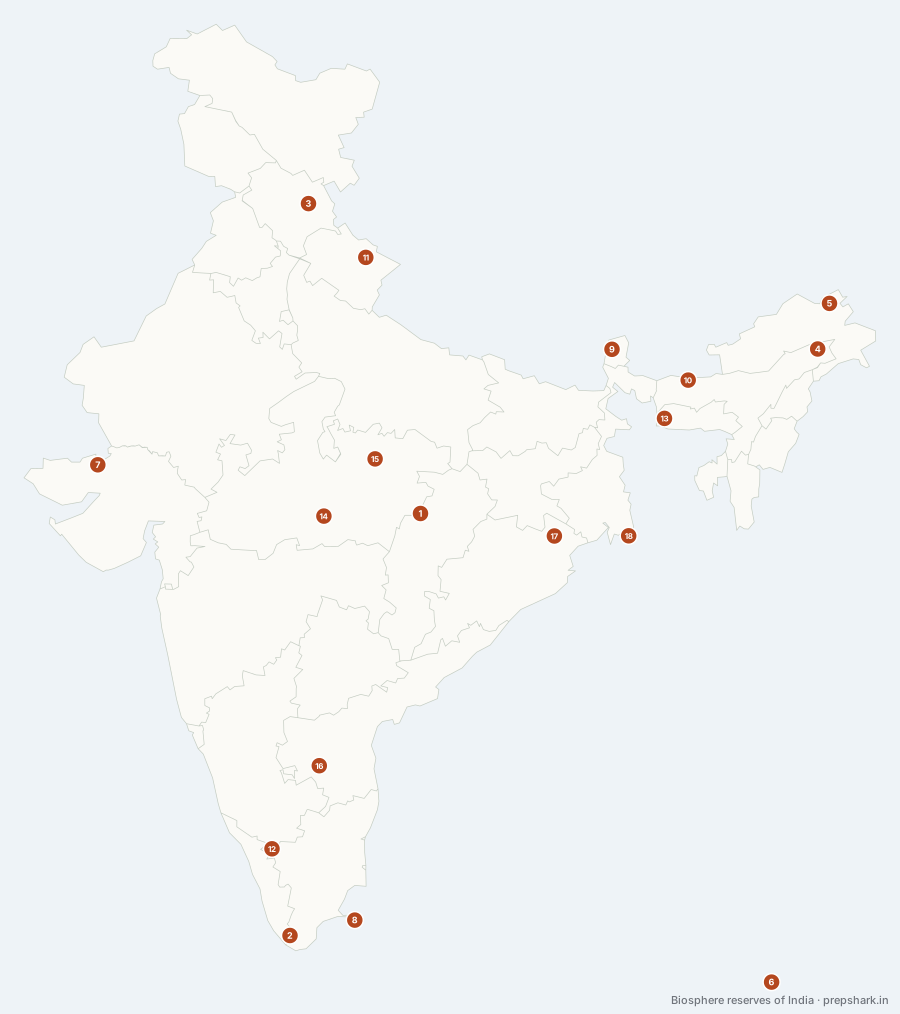
Numbered as on the map
The 18 on the map
1. Achanakmar–Amarkantak
Chhattisgarh
Known forThe Narmada’s source; a two-state reserve
The Narmada, the Son and the Johila all rise at Amarkantak in the Maikal hills — one hill deciding the drainage of central India, west to the Arabian Sea and east to the Ganga. The reserve spans Chhattisgarh and Madhya Pradesh because the hills do.
SettingMaikal hills · sal forest · river source · four-horned antelope
For the examAmarkantak is the source of the Narmada AND the Son, which leave in opposite directions. That fact is why this reserve appears in papers.
2. Agasthyamalai
Kerala
Known forThe Ghats south of the Shencottah gap; Kani benefit-sharing
The southern end of the Western Ghats, below the Shencottah gap, holding the Kalakad–Mundanthurai tiger reserve and the Neyyar, Peppara and Shendurney sanctuaries. Being cut off from the rest of the Ghats by that gap is why its endemism is so high — and why the Kani people’s knowledge of the arogyapacha plant became the first benefit-sharing case in Indian law.
SettingSouthern Western Ghats · evergreen forest · high endemism · Nilgiri tahr
3. Cold Desert
Himachal Pradesh
Known forThe trans-Himalayan cold desert; snow leopard density
The Spiti country behind the Great Himalaya — Pin Valley, Chandratal, Sarchu and Kibber — where under two hundred millimetres of precipitation falls a year and the snow leopard density is among the highest measured anywhere. It joined the UNESCO network in 2025, the most recent Indian addition.
SettingTrans-Himalayan cold desert · above 3,000 m · Pin valley · snow leopard and ibex
For the examThe Cold Desert biosphere reserve is in Himachal’s Spiti, not in Ladakh — the standard confusion.
4. Dibru-Saikhowa
Assam
Known forFeral horses on a river island; white-winged wood duck
A wetland-and-grassland island between the Brahmaputra and the Lohit in upper Assam, cut off by water on three sides and holding the feral horses left behind by the Second World War. The 1950 Assam earthquake reshaped the rivers around it, which is why the reserve is an island at all.
SettingBrahmaputra–Lohit island · swamp forest and grassland · white-winged wood duck
5. Dihang-Dibang
Arunachal Pradesh
Known forThe Eastern Himalayan altitude range in one reserve
The largest biosphere reserve in the Eastern Himalaya, spanning the Siang and Dibang valleys where the Brahmaputra turns the corner at Namcha Barwa. Its altitude range runs from five hundred metres to over five thousand, which is why one reserve holds tropical forest and snow leopard habitat at once.
SettingEastern Himalaya · Siang and Dibang valleys · Mishmi takin · musk deer
6. Great Nicobar
Andaman and Nicobar Islands
Known forIsland endemism; the Shompen and the Nicobarese
India’s southernmost territory, with island endemism and two particularly vulnerable tribal groups — the Shompen and the Nicobarese — inside the same boundary. That combination is why its township-and-transhipment plan is the most contested land-use question in the country.
SettingTropical evergreen island · Indira Point · Galathea Bay · leatherback turtle
7. Great Rann of Kachchh
Gujarat
Known forIndia’s largest biosphere reserve; the wild ass
The largest biosphere reserve in India at over twelve thousand square kilometres, covering the salt flat, the Banni grassland and the desert around them. The Indian wild ass survives here and nowhere else on earth, on ground that is seabed for three months of the year.
SettingSalt desert · Banni grassland · seasonal inundation · Indian wild ass
For the examLargest biosphere reserve by area; NOT in the UNESCO network, which is the trap when it is offered against Nilgiri or Sundarbans.
8. Gulf of Mannar
Tamil Nadu
Known forIndia’s first marine biosphere reserve; the dugong
The first marine biosphere reserve in South and South-East Asia, designated in 1989: twenty-one islands with coral reef and seagrass between them, running from Rameswaram down to Kanyakumari. It holds India’s main dugong population, which feeds on that seagrass and nothing else.
SettingCoral reef · seagrass meadow · 21 islands · dugong
For the examFour reef systems in India: Gulf of Mannar, Gulf of Kachchh, Lakshadweep, Andaman and Nicobar. Mannar is the biosphere reserve and the dugong one.
9. Khangchendzonga
Sikkim
Known forIndia’s only mixed World Heritage site
The reserve around the third highest mountain on earth, and India’s only mixed World Heritage site — inscribed for its natural values and for the sacred landscape the Lepcha and Bhutia hold it as. It runs from subtropical forest at two thousand metres to the summit at 8,586.
SettingEastern Himalaya · glaciers and alpine meadow · sacred landscape · snow leopard
For the examMixed World Heritage means natural AND cultural criteria in one inscription — Khangchendzonga is the only Indian example.
10. Manas
Assam
Known forPygmy hog and golden langur; a World Heritage site regained
The Bhutan-border grasslands and forest of the Manas river, holding four species that survive almost nowhere else — pygmy hog, hispid hare, golden langur and Assam roofed turtle. It lost its World Heritage standing during the Bodo insurgency and won it back in 2011, which is the recovery case in Indian conservation.
SettingTerai grassland and forest · Manas river · Bhutan border · four endemic-scarce species
For the examIt is a tiger reserve, an elephant reserve, a national park and a World Heritage site — but NOT in the UNESCO biosphere network.
11. Nanda Devi
Uttarakhand
Known forInner Himalayan alpine ecosystem; World Heritage
A closed inner-Himalayan basin ringed by peaks with one gorge in and out, which is exactly why it survived as an intact alpine ecosystem — nobody got in until 1934, and the core has been shut again since 1983. The Valley of Flowers sits in the same reserve.
SettingAlpine and glacial · Rishi Ganga gorge · Nanda Devi massif · snow leopard
12. Nilgiri
Tamil Nadu
Known forIndia’s first biosphere reserve (1986)
India’s first biosphere reserve, notified in 1986, and the umbrella over protected areas in three states — Bandipur, Nagarhole, Mudumalai, Wayanad, Silent Valley and Mukurthi. It is the reserve concept working as intended: one management idea across boundaries the ecology ignores.
SettingWestern Ghats · shola–grassland mosaic · Nilgiri plateau · elephant range
For the examFirst designated (1986) and among the first Indian sites added to the UNESCO network (2000). Both dates get asked.
13. Nokrek
Meghalaya
Known forThe wild citrus gene pool of the Garo hills
The West Garo hills around Nokrek peak, and the reason the reserve exists is a fruit: the wild citrus that survives here — the Citrus indica of the Garo hills — is the closest thing to an ancestor of every cultivated orange and lemon. The reserve was designated in 1988 to protect a gene pool rather than a species.
SettingMeghalaya plateau · subtropical evergreen · wild Citrus indica · red panda
14. Pachmarhi
Madhya Pradesh
Known forThe Satpura highland; India’s oldest forest reserve
Three protected areas — Satpura, Bori and Pachmarhi — managed as one central-Indian highland unit on the Satpura crest. Bori, notified in 1865, is the oldest forest reserve in the country, which makes this the reserve with the longest paper trail.
SettingSatpura highland · Denwa river · moist deciduous · giant squirrel
15. Panna
Madhya Pradesh
Known forThe tiger reintroduction that worked
The teak and Vindhyan sandstone country of the Ken valley, and the reserve behind the best-known tiger reintroduction in India: Panna lost every tiger by 2009 and was repopulated from Bandhavgarh and Kanha. UNESCO added it to the World Network in 2020.
SettingVindhyan plateau · teak forest · Ken river gorge · reintroduced tiger
For the examPanna and Sariska are the two reserves that lost all their tigers and were restocked; the Ken–Betwa link would submerge part of this one.
16. Seshachalam Hills
Andhra Pradesh
Known forRed sanders country in the Eastern Ghats
The Eastern Ghats hills above Tirupati, and the only place red sanders grows wild — which is why this reserve is as much a smuggling problem as an ecological one. The slender loris and the golden gecko are the species it is otherwise known for.
SettingEastern Ghats · dry deciduous and scrub · red sanders · slender loris
17. Simlipal
Odisha
Known forSal forest, and the only melanistic tigers
Sal forest at the eastern edge of the Chotanagpur plateau, isolated enough by the plains around it to have produced a distinct tiger phenotype — the melanistic tigers found nowhere else. Isolation is the whole story of this reserve.
SettingChotanagpur edge · sal forest · Barehipani and Joranda falls · melanistic tiger
18. Sundarbans
West Bengal
Known forA mangrove biosphere reserve with four designations
One geography carrying four designations at once — biosphere reserve, tiger reserve, Ramsar site and World Heritage — which makes it the standard example of overlapping protection, and of why overlapping protection does not mean four times the enforcement.
SettingTidal mangrove delta · Ganga–Brahmaputra–Meghna · Royal Bengal tiger
Keep going