Environment & ecology · Atlas of India
Ramsar sites of India
Protected areas, habitats, and the corridors between them.
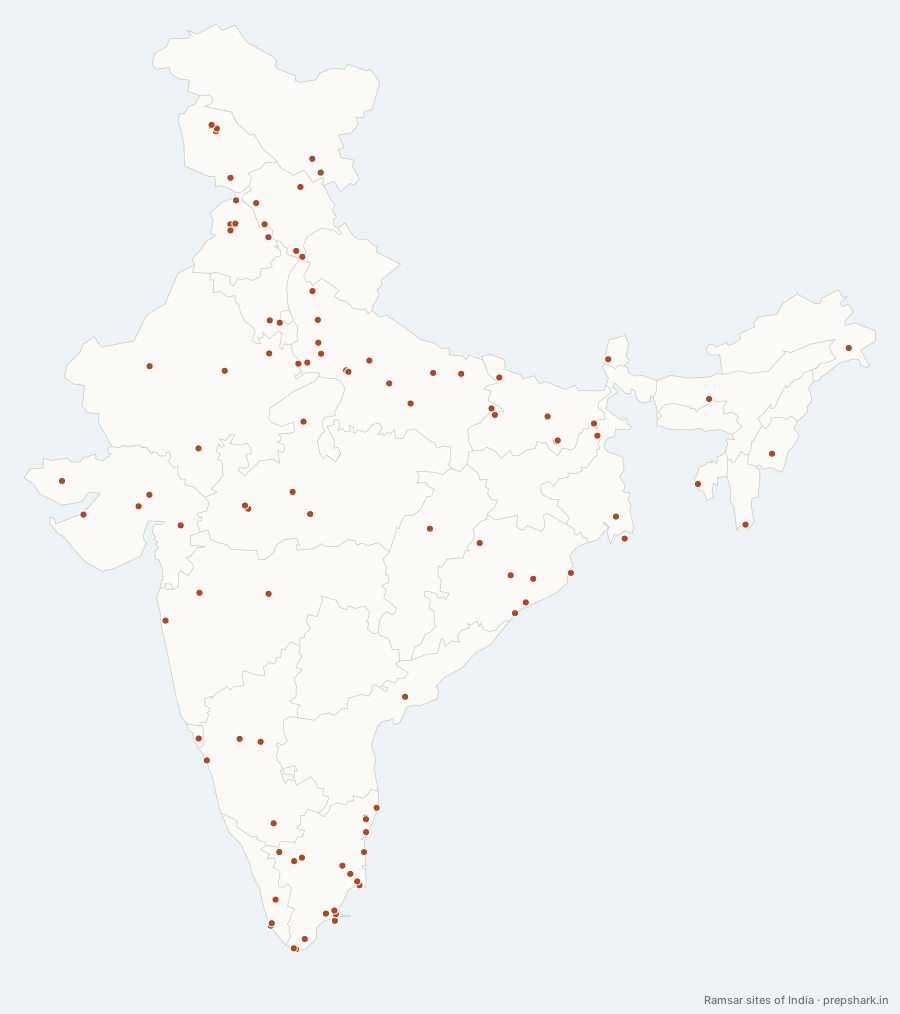
Numbered as on the map
The 101 on the map
1. Aghanashini Estuary
Karnataka
Known forAn undammed Ghats river meeting the sea
The estuary of a Western Ghats river that reaches the Arabian Sea undammed, which is rare enough on this coast to be the reason it is listed. Mudflats, mangrove, bivalve beds and the fishery that depends on all three sit inside one tidal system.
SettingEstuary · intertidal mudflat · mangrove · bivalve fishery
2. Ankasamudra Bird Conservation Reserve
Karnataka
Known forA Tungabhadra irrigation tank turned bird reserve
A tank built to hold monsoon run-off from the Tungabhadra and irrigate drought-prone country around it, now a conservation reserve managed mainly for its birds. It is one of three Karnataka tanks designated on the same day in 2023.
SettingHuman-made tank · Tungabhadra catchment · dry Deccan · waterbird colony
3. Ansupa Lake
Odisha
Known forOdisha’s largest freshwater lake
A horseshoe ox-bow left behind by the Mahanadi under the Saranda hills, and the largest freshwater lake in Odisha. It is fed by the river in flood and by hill streams the rest of the year, which is why its water stays fresh where the state’s other big wetlands are brackish.
SettingOx-bow lake · Mahanadi floodplain · hill catchment · 194 bird species
4. Asan Conservation Reserve
Uttarakhand
Known forUttarakhand’s first Ramsar site
A stretch of the Asan down to its confluence with the Yamuna in the Dehradun valley, made into a wetland by the Asan barrage of 1967 and the siltation behind it. It is Uttarakhand’s first Ramsar site and the first stop for birds coming down the Yamuna corridor out of the hills.
SettingBarrage wetland · Asan–Yamuna confluence · dun valley · wintering waterfowl
5. Ashtamudi Wetland
Kerala
Known forKerala’s eight-armed backwater; the clam fishery
A palm-shaped estuarine system — eight arms, which is what the name says — opening to the sea at Neendakara, and the second largest backwater in Kerala. Its short-neck clam fishery was the first in India certified as sustainable, which is the reason it is quoted in fisheries questions as well as wetland ones.
SettingEstuarine backwater · mangrove fringe · clam fishery · Kallada river
6. Bakhira Wildlife Sanctuary
Uttar Pradesh
Known forEastern UP’s largest natural marsh
The largest natural floodplain marsh in eastern Uttar Pradesh, in Sant Kabir Nagar, protected since 1980 and fed by the monsoon rather than by any canal. Its winter counts are what make the eastern UP marshes matter on the Central Asian Flyway.
SettingFreshwater floodplain marsh · monsoon-fed · Ghaghara basin · flyway stopover
7. Beas Conservation Reserve
Punjab
Known forIndia’s only Indus river dolphin population
A hundred and eighty-five kilometres of the Beas from the foothills down to the Harike headworks, protected as a river rather than as a lake. It is the only place in India where the Indus river dolphin survives, which is what the reserve exists for.
SettingRiver reach · Beas · riverine sand bars · Indus river dolphin · gharial reintroduction
For the examIndus river dolphin: found in India only on this stretch. Gangetic dolphin is the distractor.
8. Bhindawas Wildlife Sanctuary
Haryana
Known forHaryana’s largest wetland, made by a canal
Haryana’s largest wetland, and a wholly human-made one: it is fed by drainage from the canal system in an otherwise dry district. More than two hundred and fifty species use it, which is the argument for treating canal seepage as habitat rather than as waste.
SettingCanal-fed freshwater lake · semi-arid plain · over 250 bird species
9. Bhitarkanika Mangroves
Odisha
Known forSaltwater crocodiles; India’s second mangrove system
The second largest mangrove system in India, in the delta the Brahmani and the Baitarani build together, and the densest saltwater crocodile population in the country. The mangrove wall is also what takes the first hit from a Bay of Bengal cyclone before it reaches the villages behind.
SettingDeltaic mangrove · Brahmani–Baitarani delta · saltwater crocodile · cyclone buffer
For the examBhitarkanika is crocodiles and mangrove; Gahirmatha beside it is the olive ridley arribada. Questions swap the two.
10. Bhoj Wetland
Madhya Pradesh
Known forAn eleventh-century lake inside a state capital
Two reservoirs in the middle of Bhopal: an Upper Lake dammed across the Kolans in the eleventh century by Raja Bhoj, and a Lower Lake made about two hundred years ago. It is the rare Ramsar site whose whole catchment is a city, which is what makes it a case study in urban wetland management.
SettingTwin urban reservoirs · Kolans river · drinking water · sarus crane
11. Chandertal Wetland
Himachal Pradesh
Known forA cold-desert lake below the Kunzum pass
A high-altitude lake at about 4,300 metres in the upper Chandra valley, in a basin below the Kunzum pass where the Himalaya meets the Pir Panjal. It is snow-leopard country rather than waterbird country, which is what separates it from nearly every other site on this list.
SettingHigh-altitude lake · above 4,000 m · Chandra valley · snow leopard country
12. Chhari Dhand
Gujarat
Known forA desert depression that fills and empties
A seasonal saline depression between the Banni grasslands and the salt flats of Kachchh — a dhand is exactly that, a shallow bowl that holds the monsoon and dries out again. In a wet year it is one of the largest bird congregations in western India; in a dry one there is nothing there at all.
SettingSeasonal saline depression · Banni grassland · flamingo and crane
13. Chilika Lake
Odisha
Known forAsia’s largest brackish lagoon; Irrawaddy dolphin
Asia’s largest brackish lagoon, cut off from the Bay of Bengal by a long sand bar and kept alive by the exchange through its mouth. It was India’s first Ramsar site in 1981 and the first site anywhere taken off the Montreux Record, after a new sea mouth cut in 2000 restored the salinity gradient and the fishery with it.
SettingBrackish coastal lagoon · sand bar · Nalabana island · Irrawaddy dolphin
For the examFirst Indian Ramsar site AND first removal from the Montreux Record. Both are Chilika’s; Keoladeo is offered for either.
14. Chitrangudi Bird Sanctuary
Tamil Nadu
Known forA village tank nesting herons and storks
A village irrigation tank — a kanmoli — in Ramanathapuram, protected since 1989 and designated with the cluster of southern tanks in 2021. The babul and acacia standing in the shallow water are what the heron and stork colonies nest in.
SettingIrrigation tank · babul stands · nesting colonies · Ramanathapuram
15. Deepor Beel
Assam
Known forGuwahati’s flood sink, and Assam’s only Ramsar site
A permanent freshwater lake in an abandoned channel of the Brahmaputra, and the only large storm-water basin Guwahati has. Everything that threatens it — the railway along its southern edge, the city’s landfill, encroachment — follows from that same position beside a growing city.
SettingOx-bow of the Brahmaputra · permanent freshwater · elephant corridor
For the examAssam has exactly one Ramsar site. The elephant corridor along its southern bank is what the railway line cuts.
16. East Calcutta Wetlands
West Bengal
Known forA city’s sewage treated by fish ponds
The world’s best-known working example of a city treating its sewage with fish ponds: Kolkata’s waste water flows into shallow bheris where sunlight and algae clean it, and the fish and vegetables grown in it come back into the city’s markets. The wetland is infrastructure, and it is being eaten by the city it serves.
SettingSewage-fed aquaculture · bheris · resource recovery · peri-urban
For the examThe standard "wetland as infrastructure" case: waste water in, fish and vegetables out, no treatment plant.
17. Glaw Lake
Arunachal Pradesh
Known forIndia’s 101st Ramsar site, and Arunachal’s first
A stream-fed lake inside the Kamlang Tiger Reserve, in the wet forest where the Eastern Himalaya turns south along the Myanmar border. It is Arunachal’s first Ramsar site and the newest in the country, designated in August 2026.
SettingEastern Himalayan foothill lake · evergreen forest · perennial streams
For the examThe most recent designation on the list, and the first for its state.
18. Gogabil Lake
Bihar
Known forBihar’s first community reserve
An ox-bow caught between the Ganga and the Mahananda, which joins the two rivers outright when the floods are high. It is Bihar’s first community reserve, which is the point of it: the wetland is run by the villages around it rather than by a forest department.
SettingOx-bow lake · Ganga–Mahananda floodplain · community-managed
19. Gokul Jalashay
Bihar
Known forA flood-pulse ox-bow on the Ganga
An ox-bow on the southern edge of the Ganga near Buxar whose whole year is set by the river’s flood pulse — marsh and cropland in the dry months, open water after the monsoon. It came in the batch of Bihar wetlands designated in 2025.
SettingOx-bow lake · Ganga floodplain · seasonal inundation · farmed when dry
20. Gulf of Mannar Marine Biosphere Reserve
Tamil Nadu
Known forIndia’s dugong stronghold; the first marine biosphere reserve
Twenty-one islands and the shallow sea between them, where the Bay of Bengal meets the Indian Ocean — coral reef, seagrass bed and mangrove in one reserve, and the dugong’s last stronghold in India. It was the first marine biosphere reserve in South and South-East Asia.
SettingCoral reef · seagrass meadow · 21 islands · dugong and sea turtle
For the examDugong and seagrass go together, and both are here. Palk Bay to the north is the other half of the same habitat.
21. Haiderpur Wetland
Uttar Pradesh
Known forA barrage wetland holding swamp deer and gharial
A wetland made in 1984 by the Madhya Ganga barrage on the Ganga floodplain, inside the Hastinapur wildlife sanctuary — a hydrological accident that now holds hog deer, gharial and a swamp deer population. It is the newest kind of Ramsar site in the Gangetic plain: infrastructure that turned into habitat.
SettingBarrage-formed wetland · Ganga floodplain · Hastinapur sanctuary · gharial
22. Harike Lake
Punjab
Known forThe Beas–Sutlej confluence; the head of the Indira Gandhi canal
A shallow reservoir with thirteen islands at the confluence of the Beas and the Sutlej, made by a barrage in 1953 and now the largest wetland in northern India. It is the head of the Indira Gandhi canal, so a wetland in Punjab is also the source of irrigation in the Thar.
SettingBarrage reservoir · Beas–Sutlej confluence · floating vegetation · Indus dolphin
For the examHarike feeds the Indira Gandhi canal, which waters western Rajasthan — the link between a Punjab wetland and the desert.
23. Hirakud Reservoir
Odisha
Known forIndia’s longest dam, and the wetland behind it
The reservoir behind the longest earthen dam in the world, built across the Mahanadi in the 1950s to stop the floods that used to reach the delta. Sixty years of that regulation turned the storage into a wetland with its own bird counts, which is what the designation recognises.
SettingLarge reservoir · Mahanadi · flood moderation · open water
24. Hokera Wetland
Jammu and Kashmir
Known forThe valley’s surviving reed marsh
A natural marsh ten kilometres from Srinagar, at the foot of the Pir Panjal, and the last reed-bed of its kind left in the valley. It is the first stop inside India for birds coming over the mountains from Siberia and Central Asia.
SettingPerennial marsh · reed bed · Jhelum basin · Central Asian Flyway entry
25. Hygam Wetland
Jammu and Kashmir
Known forWular’s downstream flood basin
A flood basin on the Jhelum immediately downstream of Wular, and connected to it — the two work as one system, taking the river’s spate and holding it off Srinagar. Forty thousand birds a year use it, and the same siltation that is shrinking Wular is shrinking this.
SettingJhelum floodplain marsh · silt-loaded · flyway stopover
26. Jai Prakash Narayan Bird Sanctuary
Uttar Pradesh
Known forA Ganga meander wetland in eastern UP
A wetland formed from an old meander of the Ganga in the middle stretch of the basin, fed by three channels and surrounded by floodplain farmland. Designated in 2026, it is one of the newest sites on the list and one of thirteen in a single state.
SettingOx-bow of the Ganga · three inflow channels · floodplain agriculture
27. Kabartal Wetland
Bihar
Known forKanwar Jheel; Bihar’s first Ramsar site
The largest freshwater ox-bow of the Gangetic plain in Bihar and one of eighteen wetlands in a single floodplain complex — it floods to about a metre and a half in the monsoon and is farmed when it dries. In a state where most of the land is flood-prone, that absorption is the service it performs.
SettingOx-bow lake · Indo-Gangetic floodplain · seasonal · flyway stopover
For the examAlso called Kanwar Jheel, and Bihar’s first designation, in 2020.
28. Kanjirankulam Bird Sanctuary
Tamil Nadu
Known forA heronry in a Ramanathapuram tank
A tank two kilometres from Chitrangudi with the same babul thickets and the same job: it is a nesting site for migratory herons in a district where the tanks are the only standing water. The pair is why southern Tamil Nadu’s Ramsar sites come in twos.
SettingIrrigation tank · Acacia nilotica · heronry · semi-arid plain
29. Kanjli Wetland
Punjab
Known forThe Kali Bein, dammed in 1870
The Kali Bein — a stream with a place in Sikh history — dammed in 1870 into a storage for irrigation, and one of the earliest Indian sites designated in 2002. Its recovery is the standard example of a community-led river cleaning in Punjab.
SettingBarrage on a stream · Beas basin · irrigation storage · marsh
30. Karaivetti Bird Sanctuary
Tamil Nadu
Known forA delta tank with colonial nesting
One of the largest inland freshwater tanks in Tamil Nadu, in the Kaveri delta country of Ariyalur, fed by the Kollidam through an old canal. Ten thousand birds of a dozen colonial species have been counted nesting in one season.
SettingInland freshwater tank · Kaveri delta · canal-fed · colonial waterbirds
31. Karikili Bird Sanctuary
Tamil Nadu
Known forVedanthangal’s neighbouring tanks
Two rain-fed irrigation tanks near Vedanthangal, on flat ground between low rocky hillocks, whose rainfall swings from 400 mm to 1,700 mm between years. Everything about the site follows from that unreliability: the birds come when the tanks fill.
SettingRain-fed tanks · non-perennial · rocky hillocks · migratory waterbirds
32. Kazhuveli Bird Sanctuary
Tamil Nadu
Known forPeninsular India’s second largest brackish lake
The second largest brackish lake in peninsular India, linked to the Bay of Bengal by the Uppukalli creek, so its salinity rises with every high tide and cyclone and falls with the monsoon. That swing is what makes it a different wetland twice a year.
SettingBrackish lagoon · tidal creek · fluctuating salinity · Villupuram coast
33. Keoladeo National Park
Rajasthan
Known forBharatpur; a wetland that has to be filled by hand
Ten artificial seasonal lagoons made in the 1700s as a duck shoot for the rulers of Bharatpur, and the most studied wetland in India. It is on the Montreux Record because it depends entirely on water released from the Ajan bund — when the release is withheld for irrigation, the wetland does not fill.
SettingArtificial seasonal lagoons · Ajan bund · World Heritage site · Montreux Record
For the examThe Siberian crane wintered here and no longer does — the standard example of a lost migratory population.
34. Keshopur–Miani Community Reserve
Punjab
Known forA farmed marsh managed by its villages
A mosaic of natural marsh, fish ponds and flooded farmland in Gurdaspur, run as a community reserve — the villages farm it, fish it and manage it, and the birds use it because it is farmed rather than in spite of that. Punjab’s first community reserve.
SettingMarsh and aquaculture mosaic · rain-fed · community reserve · waterbirds
35. Khachoedpalri Wetland
Sikkim
Known forSikkim’s only Ramsar site; a sacred lake
A temperate Himalayan lake ringed by peatland and evergreen oak and chestnut forest, sacred to both Buddhists and Lepchas — the local vow that no leaf shall rest on its surface is the reason it is intact. Sikkim’s only Ramsar site.
SettingTemperate Himalayan lake · peatland · oak and chestnut forest · sacred site
36. Khichan Wetland
Rajasthan
Known forThe demoiselle crane village of the Thar
Two desert water bodies — a seasonal river and a village tank — in the northern Thar, and the winter gathering ground of thousands of demoiselle cranes that the village itself feeds. The site exists because of that relationship, not in spite of it.
SettingDesert tank and seasonal river · scrub · demoiselle crane congregation
37. Khijadia Wildlife Sanctuary
Gujarat
Known forFresh water and salt marsh either side of one bund
A freshwater wetland that exists because of a bund built in 1920 to keep the sea out of farmland: fresh water on one side of the embankment, salt marsh and mangrove on the other. That accident is why so many species use one small site on the Gulf of Kachchh.
SettingBunded freshwater marsh · coastal saline flats · Gulf of Kachchh
38. Kolleru Lake
Andhra Pradesh
Known forThe flood balance between two deltas
A natural freshwater lake in the gap between the Godavari and the Krishna deltas, and the flood balance between them: it takes the surplus of both systems and lets it down slowly to the sea. Aquaculture ponds cut into the lakebed are why it spent years under a court-ordered clearance.
SettingFreshwater lake · Godavari–Krishna interfluve · eutrophic · pelican and painted stork
For the examOperation Kolleru removed illegal fish tanks from it — the standard case of aquaculture squeezing a Ramsar wetland.
39. Koonthankulam Bird Sanctuary
Tamil Nadu
Known forSouth India’s largest waterbird reserve, protected by its villages
A network of centuries-old irrigation tanks below the Western Ghats in Tirunelveli, and the largest reserve for migratory waterbirds in southern India. The villages have protected the nesting colonies by custom for generations, which is why the birds nest inside the settlement rather than away from it.
SettingLinked irrigation tanks · Ghats-fed canals · village-protected heronry
40. Kopra Jalashay
Chhattisgarh
Known forChhattisgarh’s first Ramsar site
An irrigation reservoir in the upper catchment of the Mahanadi, ringed by farmland, whose shallow nutrient-rich backwaters do the work of a natural wetland. It is Chhattisgarh’s first Ramsar site and so far its only one.
SettingIrrigation reservoir · upper Mahanadi catchment · shallow backwaters
41. Loktak Lake
Manipur
Known forFloating phumdis; the only floating national park
The largest freshwater lake in the north-east, carrying the phumdis — floating mats of vegetation and soil — that make Keibul Lamjao the only floating national park in the world. The Ithai barrage downstream holds the water level steady, which is why the phumdis are thinning and why the lake is on the Montreux Record.
SettingFreshwater lake · phumdi mats · Keibul Lamjao · Ithai barrage
For the examSangai deer, phumdis, Keibul Lamjao and the Montreux Record are one cluster of facts about one lake.
42. Lonar Lake
Maharashtra
Known forA meteorite crater lake in the Deccan traps
A closed saline lake in a meteorite crater punched into the Deccan basalt — the only such crater in basalt anywhere that holds a lake. With no outflow, evaporation has made the water both salty and strongly alkaline, and the micro-organisms that live in it are why it is studied.
SettingImpact crater · endorheic · saline and alkaline · basalt escarpment
For the examImpact origin, basalt bedrock, no outlet, high alkalinity — all four turn up in one stem.
43. Longwood Shola Reserve Forest
Tamil Nadu
Known forA shola wetland in the Nilgiris
Marshes and streams inside a shola — the montane forest that survives in folds of the Nilgiri grassland — above Kotagiri. It is the one Ramsar site in India that is a mountain forest wetland rather than a lake, a tank or a floodplain.
SettingMontane shola forest · intermittent marsh and streams · Nilgiri slopes
44. Magadi Kere Conservation Reserve
Karnataka
Known forAn alkaline tank that geese winter on
A rain-fed tank in Gadag whose water turned too alkaline for irrigation and became, of all things, a wintering ground for bar-headed geese. The failure of its original purpose is precisely why it is on the list.
SettingHuman-made tank · alkaline water · dry Deccan · bar-headed goose
45. Menar Wetland Complex
Rajasthan
Known forThree village ponds run as a bird sanctuary
Three village ponds near Udaipur and the farmland that floods between two of them, holding a hundred and ten waterbird species in a monsoon year. Like Khichan it is a community wetland: the village protects the birds and the ponds by custom rather than by notification.
SettingMonsoon ponds · Aravalli foothills · farmland flooding · waterbirds
46. Nagi Bird Sanctuary
Bihar
Known forA dammed river turned wintering ground
The reservoir behind a dam on the Nagi river, in the dry deciduous hill country of Jamui. Clear water in a forested catchment made a wintering ground good enough that an irrigation work became a bird sanctuary, and then a Ramsar site alongside Nakti next door.
SettingReservoir · dry deciduous catchment · bar-headed goose · Jamui hills
47. Nakti Bird Sanctuary
Bihar
Known forNagi’s twin, designated the same day
The Nakti dam’s reservoir, five kilometres from Nagi and designated on the same day, which is why the two are always asked about together. Built for irrigation, it now carries over a hundred and fifty species of birds, fish, reptiles and amphibians.
SettingIrrigation reservoir · dry deciduous catchment · waterbird habitat
48. Nalsarovar
Gujarat
Known forA relict sea, and Gujarat’s largest natural wetland
A shallow natural lake left behind by a sea that once joined the Gulf of Khambhat to the Little Rann — which is why its salinity swings with the season and why it is the largest natural wetland in the Thar biogeographic province. Depth and salt both change enough that the bird community changes with them.
SettingRelict shallow lake · fluctuating salinity · flamingo and crane
49. Nanda Lake
Goa
Known forGoa’s only Ramsar site
Seasonal freshwater marsh beside a tributary of the Zuari, flooded deliberately by closing a sluice gate on the channel. It is Goa’s only Ramsar site and the smallest kind of wetland the list carries: a managed marsh rather than a lake.
SettingIntermittent freshwater marsh · Zuari tributary · sluice-managed
50. Nandur Madhameshwar
Maharashtra
Known forMaharashtra’s first Ramsar site
A weir at the confluence of the Godavari and the Kadwa, built to store water, that silted up into a mosaic of lakes, marshes and riparian forest — the accident that made Maharashtra’s first Ramsar site. It is called the Bharatpur of Maharashtra for the birds the accident produced.
SettingWeir-formed wetland · Godavari–Kadwa confluence · riparian forest · silt
51. Nangal Wildlife Sanctuary
Himachal Pradesh
Known forA Bhakra–Nangal reservoir on the Sutlej
The reservoir of the Bhakra–Nangal project on the Sutlej, made in 1961 in the Shivalik foothills and protected as a sanctuary. It is the Ramsar site with a diplomatic footnote: the Panchsheel principles were formalised on its bank in 1954.
SettingHuman-made reservoir · Shivalik foothills · Indian pangolin · Egyptian vulture
52. Nanjarayan Bird Sanctuary
Tamil Nadu
Known forA four-century-old tank in an industrial district
A tank in Tiruppur built four hundred years ago by the king it is named after, whose level rises and falls with the monsoon and with the Amaravathi canal. It sits in a heavily industrial district, which is what its water quality problem is about.
SettingHistoric irrigation tank · Amaravathi canal · seasonal level · waterbirds
53. Nawabganj Bird Sanctuary
Uttar Pradesh
Known forA marsh between Lucknow and Kanpur
A shallow marsh on the Lucknow–Kanpur road, fed by the monsoon and topped up from the Sarda canal, holding around twenty-five thousand waterbirds in a good winter. One of the six UP sanctuaries designated together in 2019.
SettingShallow marsh · Sarda canal supply · 220 bird species · Ganga plain
54. Pala Wetland
Mizoram
Known forMizoram’s only Ramsar site
The largest natural lake in Mizoram, deep by Indian standards at over sixteen metres, sitting in a forested catchment that climbs to six hundred metres. It is the state’s only Ramsar site and one of the few in the country that is a lake in hill forest rather than on a floodplain.
SettingDeep natural lake · hill forest catchment · Purvanchal hills
55. Pallikaranai Marsh Reserve Forest
Tamil Nadu
Known forChennai’s last marsh, and its flood sponge
The last natural marsh left in Chennai, and the city’s flood sponge: what it can hold is what does not stand in the streets of the districts south of the city. It has been cut down to a fraction of its old extent by roads, a dump and building, which is exactly why the 2015 floods are taught beside it.
SettingFreshwater and brackish marsh · peri-urban · flood buffer · 115 bird species
For the examThe standard Indian case of urban wetland loss causing urban flooding — Chennai 2015.
56. Parvati Arga Bird Sanctuary
Uttar Pradesh
Known forA pair of permanent ox-bows in the Ghaghara plain
Two permanent ox-bow lakes in Gonda — Parvati and Arga — which is what a Gangetic plain wetland usually is: an abandoned river meander that never dried. Counts of over a hundred thousand birds have been recorded across the pair.
SettingTwin ox-bow lakes · permanent freshwater · Ghaghara floodplain
57. Patna Bird Sanctuary
Uttar Pradesh
Known forA small Etah marsh with a misleading name
A small marsh with woodland and grassland around it in Etah — not in Bihar, despite the name — carrying 178 bird species on a hundred and nine hectares. It is one of the smallest notified sanctuaries in the country.
SettingFreshwater marsh · woodland and grassland · agricultural surrounds
For the examIt is in Uttar Pradesh, not Bihar; the name is the trap.
58. Pichavaram Mangrove
Tamil Nadu
Known forMangrove between two estuaries; the tsunami buffer
One of the largest mangrove systems in India, in the ground between the Vellar and the Coleroon estuaries, where the trees stand in water deep enough to be paddled through. The stands took the 2004 tsunami’s force off the villages behind them, which is the case usually made from it.
SettingEstuarine mangrove · Vellar–Coleroon · littoral swamp forest
For the examPichavaram and the 2004 tsunami: the standard evidence that mangrove belts reduce inland damage.
59. Point Calimere Wildlife and Bird Sanctuary
Tamil Nadu
Known forThe east coast’s flamingo cape
The cape where the Coromandel coast turns west into the Palk Strait, with salt swamps, sand bars, mangrove and the Great Vedaranyam salt marsh behind it. It carries the country’s largest flamingo congregation on the east coast, and blackbuck in the dry thorn forest inland.
SettingCoastal salt swamp · sand bar · mangrove · blackbuck · greater flamingo
60. Pong Dam Lake
Himachal Pradesh
Known forBar-headed geese over the Himalaya
The reservoir behind the Beas dam of 1975, in the low hills at the northern edge of the Gangetic plain, and the wintering ground that took the pressure when the plains’ own wetlands were drained. Bar-headed geese cross the main Himalayan range to reach it.
SettingReservoir on the Beas · foothill wetland · bar-headed goose · northern pintail
For the examThe bar-headed goose crossing the Himalaya to winter here is the standard migration example.
61. Ranganathittu Bird Sanctuary
Karnataka
Known forRiverine nesting islands in the Kaveri
A group of river islets in the Kaveri, made when a dam was built across the river in the 1600s and identified as a nesting site by Salim Ali in the 1940s. Being islands in a working river is the whole of it: the colonies nest out of reach of ground predators.
SettingRiver islets · Kaveri · nesting colonies · mugger crocodile
For the examSalim Ali’s survey is what got it protected — a standard link between the ornithologist and a specific sanctuary.
62. Renuka Wetland
Himachal Pradesh
Known forOne of the two smallest Ramsar sites in India
A spring-fed lake in a karst basin draining to the Giri, and at twenty hectares one of the two smallest Ramsar sites in the country. It is a sacred lake as much as an ecological one, which is why its catchment survived the deforestation around it.
SettingSpring-fed natural lake · karst · Giri catchment · sacred site
For the examTwenty hectares — tied with Vembannur in Tamil Nadu as the smallest Indian site.
63. Ropar Wetland
Punjab
Known forA Sutlej barrage wetland at the edge of the hills
A lake-and-river wetland made by the 1952 barrage that diverts Sutlej water for drinking and irrigation, at the point where the river leaves the Shivaliks for the plain. It breeds the smooth-coated otter and several turtles that need moving water rather than still.
SettingBarrage wetland · Sutlej · Shivalik foothills · smooth-coated otter
64. Rudrasagar Lake
Tripura
Known forTripura’s only Ramsar site; the Neermahal palace
A lowland sedimentation reservoir fed by three perennial streams and draining to the Gomti, with the water palace of Neermahal standing in the middle of it. Tripura’s only Ramsar site, and a working fishery as much as a wetland.
SettingSedimentation lake · Gomti basin · freshwater fishery · migratory duck
65. Sakhya Sagar
Madhya Pradesh
Known forA park reservoir with marsh crocodiles
A reservoir made in 1918 on the edge of Shivpuri, inside Madhav National Park, whose marshes and open water carry a marsh crocodile population. It sits in the Chambal country where dry forest and river meet.
SettingHuman-made reservoir · Madhav National Park · marsh crocodile · dry deciduous forest
66. Sakkarakottai Bird Sanctuary
Tamil Nadu
Known forA three-village tank on the Palk Bay plain
A peri-urban tank shared by three villages in Ramanathapuram, doing the ordinary work of a southern tank — recharging groundwater, holding floodwater, stopping soil moving. Designated in 2024 with the rest of the district’s cluster.
SettingPeri-urban tank · groundwater recharge · flood buffer · waterbirds
67. Saman Bird Sanctuary
Uttar Pradesh
Known forA monsoon-dependent ox-bow in Mainpuri
A seasonal ox-bow on the Ganga floodplain in Mainpuri whose whole existence depends on the July–August monsoon; in a weak year it barely fills. Its winter counts run past fifty thousand birds when it does.
SettingSeasonal ox-bow · monsoon-fed · Ganga floodplain · sarus crane
68. Samaspur Bird Sanctuary
Uttar Pradesh
Known forSix connected marshes in one sanctuary
Six connected lowland lakes in Raebareli, typical of the Indo-Gangetic plain and dependent on the monsoon, with counts regularly over seventy-five thousand birds. Connectedness is the point: the six spread the risk of any one drying.
SettingPerennial lowland marshes · monsoon-fed · Ganga plain · waterfowl
69. Sambhar Lake
Rajasthan
Known forIndia’s largest inland salt lake
India’s largest inland salt lake, an endorheic basin west of Jaipur fed by seasonal streams and emptied by evaporation. It has been worked for salt since at least the sixth century, and the same brine that makes the salt supports the flamingo flocks.
SettingEndorheic saline lake · evaporation basin · salt works · flamingo
For the examEndorheic and saline: no outlet, so everything the streams carry in stays. Contrast with Chilika, which is brackish because the sea gets in.
70. Sandi Bird Sanctuary
Uttar Pradesh
Known forA rain-fed marsh on the Garra
A freshwater marsh in Hardoi fed almost entirely by monsoon rain, rich enough in aquatic plants to hold big wintering flocks on the Garra, a Ramganga tributary. One of the 2019 batch that took Uttar Pradesh to the top of the state count.
SettingFreshwater marsh · monsoon-fed · aquatic macrophytes · Hardoi
71. Sarsai Nawar Jheel
Uttar Pradesh
Known forA sarus crane stronghold in farmland
A permanent marsh in Etawah on the Gangetic floodplain, farmed around and through, and one of the strongholds of the sarus crane — the world’s tallest flying bird, which nests in flooded fields rather than away from people.
SettingPermanent marsh · floodplain agriculture · sarus crane
For the examSarus crane: state bird of Uttar Pradesh, nests in cultivated wetland, which is why these small jheels are designated.
72. Sasthamkotta Lake
Kerala
Known forKerala’s largest freshwater lake; a city’s drinking water
The largest freshwater lake in Kerala, spring-fed and with no river feeding it at all — which is why its water is clean enough to supply Kollam without treatment. Larval organisms in it are credited with keeping it that way.
SettingSpring-fed freshwater lake · no riverine inflow · drinking water source
73. Satkosia Gorge
Odisha
Known forThe Mahanadi’s gorge through the Eastern Ghats
The twenty-two kilometre gorge where the Mahanadi cuts through the Eastern Ghats, and the meeting point of two biogeographic regions — the Deccan peninsula and the Eastern Ghats. River, marsh and evergreen forest in one place is what carries the gharial and the mugger together.
SettingRiver gorge · Eastern Ghats · gharial and mugger · moist deciduous forest
74. Shallbugh Wetland
Jammu and Kashmir
Known forOne of the valley’s chain of five
A shallow marsh in the Sindh river delta west of Anchar lake, fed by rain, snowmelt and the Sindh itself. It sits between Hokera and Wular in one chain of Kashmir wetlands, which is why the valley’s five Ramsar sites are taught as a set rather than singly.
SettingShallow marsh · Sindh delta · snowmelt-fed · reed and willow
75. Sheikha Jheel Bird Sanctuary
Uttar Pradesh
Known forA wetland made by the Upper Ganges Canal
A lake and its surrounding deciduous woodland formed after the Upper Ganges Canal was cut past it in the 1850s — a canal-age wetland that has had a century and a half to become one. Designated in 2026, it is among the newest on the list.
SettingCanal-fed lake · deciduous woodland fringe · Aligarh · waterbirds
76. Siliserh Lake
Rajasthan
Known forA permanent lake in Sariska’s buffer
A nineteenth-century reservoir in the buffer of the Sariska tiger reserve, in the semi-arid Aravalli hills. In country this dry, a permanent water body is the resource that decides where the wildlife of a whole landscape can be.
SettingHuman-made reservoir · Aravalli · semi-arid · tiger reserve buffer
77. Sirpur Wetland
Madhya Pradesh
Known forIndore’s urban bird lake
A two-century-old tank on the western edge of Indore, shallow and alkaline, locally called a pakshi vihar. It is designated as an urban wetland: the point is that a city of three million kept one, and that it now buffers Indore’s own floods.
SettingShallow alkaline tank · urban catchment · monsoon flooding · waterbirds
78. Suchindram Theroor Wetland Complex
Tamil Nadu
Known forThe flyway’s southern terminus
A chain of tanks at the very tip of the peninsula, fed by the Kodaiyar system, and the last stop on the Central Asian Flyway before the sea. Birds that come this far south have nowhere else to go, which is why so few hectares matter so much.
SettingLinked tanks · Kodaiyar drainage · flyway terminus · Kanniyakumari
79. Sultanpur National Park
Haryana
Known forA national park on the edge of the capital region
A shallow lake fed by canal overflow and saline groundwater at the core of a very small national park, half an hour from Gurugram. Its value is almost entirely positional: it is the last large waterbird stop before the Delhi conurbation.
SettingShallow seasonal lake · saline groundwater · grassland · migratory waterfowl
80. Sundarban Wetland
West Bengal
Known forThe largest Ramsar site in India; tigers in mangrove
The Indian share of the largest mangrove forest on earth, in the Ganga–Brahmaputra delta: hundreds of islands in a maze of tidal creeks, and the only mangrove system anywhere with a resident tiger population. At 423,000 hectares it is by a distance the largest Ramsar site in India.
SettingDeltaic mangrove · tidal creeks · Royal Bengal tiger · cyclone buffer
For the examLargest Indian Ramsar site by area, a World Heritage site, a biosphere reserve and a tiger reserve — four designations on one forest.
81. Sur Sarovar
Uttar Pradesh
Known forKeetham lake, Agra’s reservoir
Keetham lake, built to supply Agra with summer water, which became a bird lake and then the site of a bear rescue facility on its bank. It sits on the Yamuna between Agra and Mathura, in a stretch of river with very little else left.
SettingHuman-made reservoir · Yamuna corridor · waterbirds · sloth bear facility
82. Surinsar–Mansar Lakes
Jammu and Kashmir
Known forA paired sacred lake in the Shivaliks
A pair of lakes in the Shivalik country north-east of Jammu, one rain-fed and one spring-fed, which is why they are designated together as a single composite site. Both are sacred, and the pilgrimage is what has kept their catchment forested.
SettingComposite freshwater lakes · Shivalik · rain- and spring-fed · sacred site
83. Tampara Lake
Odisha
Known forA coastal freshwater lake on the Rushikulya
A freshwater lake in Ganjam that began as a depression — the local account is that explosives during an eighteenth-century colonial engagement dug it — and now drains to the Rushikulya. It does flood duty for the coastal plain and holds fish that support the villages around it.
SettingFreshwater lake · Rushikulya catchment · coastal plain · flood control
84. Tawa Reservoir
Madhya Pradesh
Known forAn irrigation reservoir inside a tiger reserve
The reservoir behind the Tawa dam on the Narmada’s largest left-bank tributary, lying inside the Satpura Tiger Reserve. A working irrigation dam inside a tiger reserve is the tension the site is about, and it is the largest Ramsar site in the state.
SettingReservoir on the Tawa · Satpura highlands · tiger reserve · 57 fish species
85. Thane Creek
Maharashtra
Known forMumbai’s flamingo creek
A tidal creek between Mumbai and the mainland, mangrove-lined and fed by the Ulhas, that carries tens of thousands of flamingos each winter. It is the clearest Indian case of a major waterbird site sitting inside a metropolitan region.
SettingTidal creek · mangrove · Ulhas estuary · lesser and greater flamingo
86. Therthangal Bird Sanctuary
Tamil Nadu
Known forA twenty-nine hectare village lake on the flyway
A marshy village lake in Ramanathapuram fed by two seasonal rivers, holding ninety-six recorded bird species on twenty-nine hectares. It is one of the smallest sites on the list and shows what the density of tanks in this district is for.
SettingMarshy village tank · seasonal river inflow · Ramanathapuram
87. Thol Lake
Gujarat
Known forA 1912 irrigation tank on the flyway
An irrigation tank of 1912 that turned into one of the best bird lakes in the west and was protected as a sanctuary in 1988. Over three hundred species use it on the Central Asian Flyway, and the dry scrub around it carries blackbuck.
SettingShallow reservoir · open water · flyway stopover · blackbuck around it
88. Tso Kar Wetland Complex
Ladakh
Known forA fresh lake feeding a salt one, at 4,500 m
Two connected lakes above 4,500 metres in the Changthang — freshwater Startsapuk Tso feeding hypersaline Tso Kar, which has no outlet and concentrates its salt by evaporation. The pair in one basin is why it is designated as a complex rather than as a lake.
SettingHigh-altitude complex · hypersaline and freshwater · Changthang · black-necked crane
For the examBlack-necked crane breeding grounds: Tso Kar and Tso Moriri are the two Indian sites.
89. Tso Moriri
Ladakh
Known forA cold-desert lake breeding bar-headed geese
A brackish high-altitude lake at about 4,500 metres with wet meadows and borax flats along its shores, in the Changthang cold desert. It is the main Indian breeding ground of the bar-headed goose and one of two for the black-necked crane.
SettingBrackish high-altitude lake · Changthang · wet meadow · borax flats
90. Udaipur Jheel
Bihar
Known forA forest-backed ox-bow in the Terai
An ox-bow wrapped around a village and backed by the forest of the Udaipur wildlife sanctuary, in West Champaran against the Nepal border. Its plant list includes a herb endemic to India, which is unusual for a wetland this small.
SettingOx-bow lake · Terai forest edge · wintering waterfowl
91. Udhayamarthandapuram Bird Sanctuary
Tamil Nadu
Known forA delta breeding tank fed from Mettur
Irrigation tanks in the Kaveri delta linked by canals older than the record of them and fed today from the Mettur dam through the Koraiyar. It is a breeding site rather than a stopover, which is what separates the delta tanks from the coastal lagoons.
SettingDelta irrigation tanks · Mettur canal supply · breeding waterbirds
92. Udhwa Lake Bird Sanctuary
Jharkhand
Known forJharkhand’s only Ramsar site
Two connected lakes — Pataura and Barhel — under the Rajmahal hills, linked by a channel to the Ganga. It is Jharkhand’s first and only Ramsar site, and its water comes from a river that is about to turn south into Bengal.
SettingTwin lakes · Rajmahal hills · Ganga-linked channel · sedge marsh
93. Upper Ganga River
Uttar Pradesh
Known forA protected reach of the Ganga itself
The Brijghat-to-Narora stretch of the Ganga: shallow river with deep pools above the barrages, and the reach that holds gharial, Gangetic dolphin, otter and turtles together. It is designated as a river rather than as a wetland beside one, which is rare on this list.
SettingRiver reach · deep pools above barrages · Gangetic dolphin · gharial
For the examGangetic dolphin — India’s national aquatic animal — and gharial share this reach; the Beas holds the Indus dolphin instead.
94. Vaduvur Bird Sanctuary
Tamil Nadu
Known forA delta tank thick with floating vegetation
Small reservoirs in semi-arid Thiruvarur, linked by the same ancient canal network and fed from Mettur, where rooted floating plants give cover to nesting birds. One of the cluster of delta tanks designated in 2022.
SettingHuman-made reservoirs · canal-fed · floating macrophytes · Thiruvarur
95. Vedanthangal Bird Sanctuary
Tamil Nadu
Known forIndia’s oldest water-bird sanctuary
A small irrigation tank protected by its village since the eighteenth century — the oldest water-bird sanctuary in the country — where the birds nest in the barringtonia standing in the water and the villagers use the guano-rich silt on their fields. Protection and farming are the same act here.
SettingVillage irrigation tank · barringtonia stands · nesting colonies
For the examThe oldest bird sanctuary in India, protected by village order since the 1790s.
96. Vellode Bird Sanctuary
Tamil Nadu
Known forA farm-fed tank on the flyway
A tank in Erode surrounded by farmland whose food supply is the reason the birds stay: the sanctuary works because of the fields around it, not in spite of them. A staging and breeding ground on the Central Asian Flyway in an otherwise dry district.
SettingHuman-made tank · agricultural surrounds · staging and breeding ground
97. Vembanad–Kol Wetland
Kerala
Known forThe largest wetland on the west coast; Kuttanad below sea level
The largest wetland system on the west coast: the Vembanad backwater fed by ten rivers, plus the Kol paddy lands of Thrissur that flood behind it. The Thanneermukkom barrage across it — built to keep salt out of the paddy — is the standard example of a barrier solving one problem and creating another.
SettingBrackish backwater · ten river inflows · Kol paddy lands · Thanneermukkom barrage
For the examKuttanad’s below-sea-level farming and the Thanneermukkom salinity barrier are the two things asked about it.
98. Vembannur Wetland Complex
Tamil Nadu
Known forThe smallest Ramsar site in India
A twenty-hectare irrigation tank a few kilometres inland of the southernmost point of the mainland — the smallest Ramsar site in India, tied with Renuka. Its size is the point: the flyway narrows to nothing here, so even a tank this small is a landfall.
SettingHuman-made tank · Kanniyakumari · flyway landfall · 20 hectares
For the examTwenty hectares, tied with Renuka in Himachal for the smallest Indian site.
99. Wadhvana Wetland
Gujarat
Known forA princely-era reservoir on the flyway
A reservoir built by the princely state of Baroda in 1910, now sitting in wheat and paddy country and wintering birds off the Central Asian Flyway. Like most of Gujarat’s Ramsar sites it is irrigation infrastructure that outgrew its purpose.
SettingIrrigation reservoir · semi-arid farmland · wintering waterfowl
100. Wular Lake
Jammu and Kashmir
Known forAsia’s largest freshwater lake; the Jhelum’s flood absorber
One of Asia’s largest freshwater lakes, and the Jhelum’s flood absorber. Its shrinkage under siltation and willow plantation is the documented reason Srinagar’s flood exposure has grown — the 2014 floods are the standard case.
SettingTectonic freshwater lake · Jhelum basin · water chestnut · siltation
For the examFlood absorption is the function to remember: the lake shrank, the 2014 flood did not have anywhere to go.
101. Yashwant Sagar
Madhya Pradesh
Known forIndore’s water supply, and a sarus crane stronghold
A 1930s reservoir on the Gambhir built to water Indore, now one of the two Important Bird Areas in the city’s region and a stronghold of the sarus crane. Irrigation, drinking water, aquaculture and birds all use the same shallow spread.
SettingReservoir on the Gambhir · shallow spread · sarus crane · aquaculture
Keep going