Environment & ecology · Atlas of India
Tiger reserves of India
Protected areas, habitats, and the corridors between them.
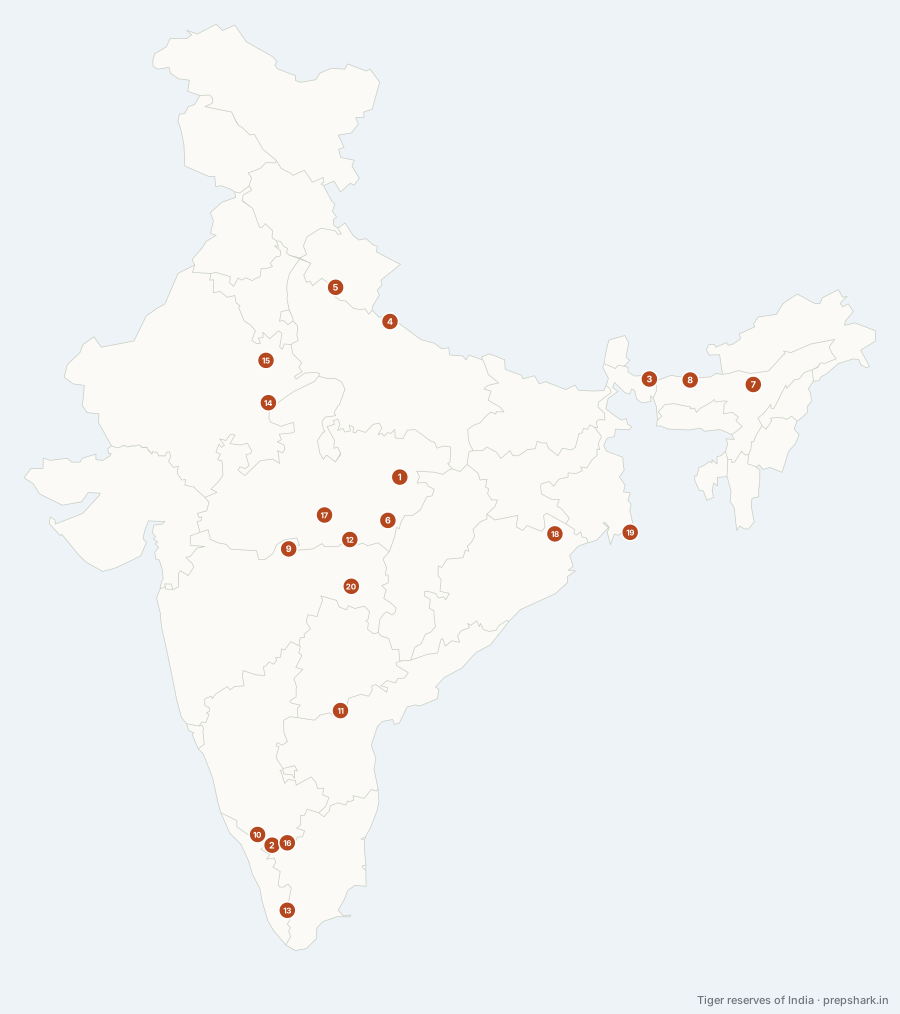
Numbered as on the map
The 20 on the map
1. Bandhavgarh
Madhya Pradesh
Known forVery high tiger density; the Bandhavgarh fort massif
A Vindhyan plateau reserve built around a sandstone massif, with among the highest tiger densities recorded in India. The topography — a fort hill ringed by valleys — concentrates prey, and the density follows from that.
SettingVindhyan hills · sal and mixed forest · Son river catchment
2. Bandipur
Karnataka
Known forNilgiri Biosphere Reserve; Asia’s largest elephant population
Bandipur is one piece of a single contiguous forest — with Nagarhole, Mudumalai and Wayanad it forms the Nilgiri Biosphere Reserve, which holds the largest wild elephant population in Asia. The reserve boundary is administrative; the ecosystem is not.
SettingWestern Ghats · dry and moist deciduous · Kabini catchment
3. Buxa
West Bengal
Known forThe Dooars elephant corridor; Bhutan border
A Dooars reserve wedged between Bhutan and the Assam corridor, so it is the eastern hinge of the entire Terai–Dooars elephant route. Its importance is positional before it is biological.
SettingDooars · moist deciduous and riverine · Raidak and Sankosh
4. Dudhwa
Uttar Pradesh
Known forSwamp deer (barasingha) and reintroduced one-horned rhino
A Terai reserve pressed against the Indo-Nepal border, which makes it a transboundary conservation unit as much as a park. Its swamp forest is the last serious stronghold of swamp deer outside Assam.
SettingTerai swamp forest · tall wet grassland · Sharda river
For the examThe barasingha distinction: Dudhwa holds the wetland subspecies, Kanha the hard-ground form. Questions rely on candidates collapsing the two.
5. Jim Corbett
Uttarakhand
Known forThe first national park, and the densest tiger population in the Terai arc
India’s first national park (1936, as Hailey) and one of the nine original Project Tiger reserves. It sits where the Shivalik foothills meet the Bhabar–Terai belt, so the Ramganga spreads into grassland the moment it leaves the hills.
SettingShivalik foothills · sal forest · Ramganga floodplain grassland
For the examAsked as a pair of firsts — first national park (1936) and an original 1973 Project Tiger reserve. The trap is Kaziranga, which is older as a reserve forest but was never the first park.
6. Kanha
Madhya Pradesh
Known forThe hard-ground barasingha — its only wild population
The Maikal range of the Satpuras, and the one reserve that saved a species outright: hard-ground barasingha existed nowhere else, and Kanha’s meadow management brought it back from about sixty animals.
SettingMaikal range, Satpura · sal forest · maidan grassland
For the examThe single most reliable Kanha question is the hard-ground barasingha. Dudhwa is always the distractor.
7. Kaziranga
Assam
Known forThe one-horned rhinoceros
A Brahmaputra floodplain park that holds roughly two-thirds of the world’s one-horned rhino, and one of the highest tiger densities anywhere. The annual flood is not a disaster here — it is the process that maintains the grassland.
SettingBrahmaputra floodplain · wet alluvial grassland · wetland
For the examMost candidates can name Kaziranga as a rhino park and cannot name it as a tiger reserve. The papers know that.
8. Manas
Assam
Known forPygmy hog, golden langur, hispid hare
A World Heritage site that was placed on the "in danger" list and then taken off it — the only Indian example of a heritage site recovered after conflict. It is contiguous with Bhutan’s Royal Manas.
SettingHimalayan foothills · Manas river · alluvial grassland
For the examBoth Manas and Buxa border Bhutan; only Manas is World Heritage. That is the whole question.
9. Melghat
Maharashtra
Known forAn original 1973 Project Tiger reserve
One of the nine reserves declared when Project Tiger began in 1973. It sits on the Gawilgarh hills of the Satpuras and forms the catchment of the Tapi — protection here is water security for Vidarbha.
SettingGawilgarh hills, Satpura · southern dry deciduous teak
10. Nagarhole
Karnataka
Known forRajiv Gandhi National Park; exceptional prey density
Separated from Bandipur only by the Kabini backwater. Together they carry one of the highest densities of large carnivores and prey anywhere in the tropics, which is why the Nilgiri block is treated as one landscape.
SettingWestern Ghats · moist deciduous · Kabini backwater
11. Nagarjunsagar–Srisailam
Andhra Pradesh
Known forIndia’s largest tiger reserve by area
The largest tiger reserve in India, spread across the Nallamala hills in both Andhra Pradesh and Telangana, with the Krishna cutting a gorge through the middle of it.
SettingNallamala hills, Eastern Ghats · Krishna gorge · dry deciduous
For the examLargest by area — the distractor is Sundarbans, which is the largest mangrove but not the largest reserve.
12. Pench
Madhya Pradesh
Known forThe Jungle Book landscape; a two-state reserve
Split across Madhya Pradesh and Maharashtra by the Pench river, so it is managed as two reserves on one landscape — the clearest example in the country of a corridor that crosses a state line.
SettingSouthern Satpura · teak forest · Pench river
13. Periyar
Kerala
Known forPeriyar lake; community-led protection
A reserve built around a reservoir in the Cardamom Hills, and the standard Indian example of ecotourism run with former poachers as guides. The lake is artificial; the ecosystem around it is not.
SettingCardamom Hills, Western Ghats · evergreen and moist deciduous
14. Ranthambore
Rajasthan
Known forDry deciduous tiger habitat, and the Ranthambore fort inside it
It stands exactly where the Aravalli and the Vindhyan systems meet — the reason a dry deciduous forest survives in eastern Rajasthan at all. Water is the structuring fact here: the lakes, not the forest, hold the wildlife.
SettingAravalli–Vindhya junction · dry deciduous forest · lake system
15. Sariska
Rajasthan
Known forIndia’s first tiger reintroduction (2008)
Sariska lost its entire tiger population by 2004 and became the site of India’s first tiger reintroduction in 2008. It is the standard case study for what happens when protection fails, and for translocation as a recovery tool.
SettingAravalli hills · dry deciduous and thorn forest
For the examSariska 2008 then Panna 2009 — the order of the two reintroductions is the question, and the NTCA’s present statutory form dates from this failure.
16. Sathyamangalam
Tamil Nadu
Known forThe Western–Eastern Ghats elephant corridor
The bridge between the Western and the Eastern Ghats. Its value is almost entirely connective: it keeps the Nilgiri elephant population linked to the Eastern Ghats, and it is a recent, fast-recovering reserve.
SettingGhats junction · dry deciduous and scrub · Cauvery catchment
17. Satpura
Madhya Pradesh
Known forPachmarhi Biosphere Reserve; rugged central-Indian highland
The core of the Pachmarhi Biosphere Reserve, and the highest terrain in central India. Its ravines are why the Satpura landscape holds species you otherwise have to go to the Western Ghats to see.
SettingSatpura highland · Denwa river · moist deciduous forest
18. Simlipal
Odisha
Known forMelanistic tigers; a biosphere reserve
A biosphere reserve on the Chhotanagpur plateau’s eastern edge, and the one place with a recorded population of pseudo-melanistic tigers — a genetic isolation effect, which is why it comes up in conservation-genetics questions.
SettingEastern Ghats / Chhotanagpur edge · sal forest · Budhabalanga
For the examMelanistic tigers are a phenotype produced by isolation, not a subspecies. Questions test exactly that distinction.
19. Sundarbans
West Bengal
Known forMangrove tigers; Ramsar and World Heritage
The only mangrove forest on earth with a resident tiger population. It is simultaneously a tiger reserve, a biosphere reserve, a Ramsar site and a World Heritage site — and a cyclone buffer for Kolkata.
SettingGanga–Brahmaputra delta · tidal mangrove · estuarine
For the examOne geography, four designations. Questions pick any two and ask whether both apply.
20. Tadoba–Andhari
Maharashtra
Known forMaharashtra’s oldest reserve; high tiger sightings
Maharashtra’s oldest and largest reserve, in the middle of the Chandrapur coal belt — which makes it the textbook case of a protected area whose survival depends on corridor management rather than on fencing.
SettingSouthern dry deciduous teak · Andhari river · Tadoba lake
Keep going