Environment & ecology · Atlas of India
Wildlife sanctuaries of India
Protected areas, habitats, and the corridors between them.
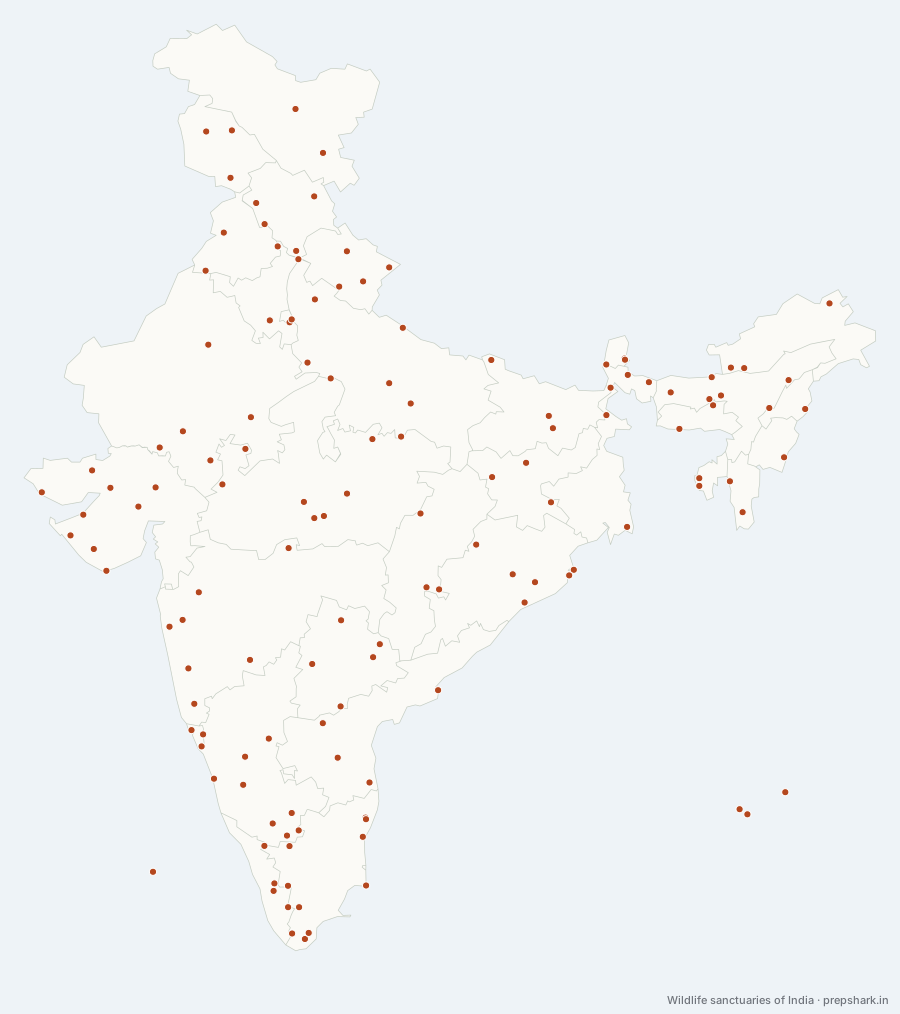
Numbered as on the map
The 133 on the map
1. Abohar Wildlife Sanctuary
Punjab
Known forBlackbuck on Bishnoi farmland, protected by belief
A sanctuary with no forest in it at all — thirteen villages of Bishnoi farmland in Fazilka, notified because the Bishnoi have protected blackbuck on their fields for five centuries as a matter of faith. The animals live among the crops and the people accept the loss.
Settingdeclared 1988 · 186.5 km² · irrigated farmland and village common · Punjab plain
For the examA sanctuary made of private farmland — the counter-example to the idea that protection means excluding people.
2. Achanakmar Wildlife Sanctuary
Chhattisgarh
Known forThe Maikal tiger forest between Kanha and Amarkantak
Sal forest on the Maikal range where the Narmada and the Son rise, protected as a tiger reserve since 2009 and as the core of the Achanakmar–Amarkantak biosphere reserve. It is the link between the tiger populations of Kanha and the forests of Chhattisgarh.
Settingdeclared 1975 · 551.55 km² · sal and mixed deciduous forest · Maikal range
3. Askot Musk Deer Sanctuary
Uttarakhand
Known forMusk deer country on the Nepal border of Kumaon
The Kali valley in Pithoragarh against the Nepal border, notified for the musk deer and holding the snow leopard, the Himalayan black bear and the last of Kumaon’s high forest. The Askot–Arakot walk that crosses it every decade is how its condition is publicly tracked.
Settingdeclared 1986 · 600 km² · temperate forest to alpine meadow · Kumaon Himalaya
4. Asola Bhatti Wildlife Sanctuary
Delhi
Known forDelhi’s only forest, on the last of the Aravalli
The southern Delhi ridge — the last outcrop of the Aravalli before the range dies out under the city — reclaimed from abandoned quarries and now the capital’s only real forest. Leopards have started using it again, which in a city of thirty million is a fact worth the notification on its own.
Settingdeclared 1992 · 27.82 km² · Aravalli scrub on reclaimed quarry · southern Delhi ridge
For the examThe Aravalli ends here: this is the range’s northern tip, not a separate hill.
5. Baghmara Pitcher Plant Wildlife Sanctuary
Meghalaya
Known forA sanctuary for India’s only native pitcher plant
Two hectares in the Garo hills — one of the smallest protected areas in India — notified for a single plant: Nepenthes khasiana, the only pitcher plant native to the country, which grows on poor soils and eats insects to make up the difference.
Settingdeclared 1984 · 0.02 km² · pitcher plant habitat on poor soil · Garo hills
6. Barda Wildlife Sanctuary
Gujarat
Known forThe second home for the lion, reached without help
A low hill range near Porbandar chosen as the second home for the Asiatic lion — the answer Gujarat offered instead of moving lions to Kuno in Madhya Pradesh, which the Supreme Court ordered in 2013 and which has never happened. Lions reached Barda on their own in 2023.
Settingdeclared 1979 · 192.31 km² · dry deciduous scrub on hills · Saurashtra coast
For the examThe Kuno translocation order of 2013 is the context; Barda is the alternative Gujarat put forward.
7. Barnadi Wildlife Sanctuary
Assam
Known forThe last refuge of the wild pygmy hog
A small sanctuary on the Bhutan border set up in 1980 for the pygmy hog and the hispid hare, two animals of tall wet grassland that had almost gone. The hog was later bred in captivity and released elsewhere; this is the ground the last wild ones were found on.
Settingdeclared 1980 · 26.22 km² · tall alluvial grassland and moist forest · Bhutan foothills
8. Bhadra Wildlife Sanctuary
Karnataka
Known forIndia’s model voluntary village relocation
A tiger reserve in the Western Ghats of Chikkamagaluru, and the site of India’s first fully voluntary and widely regarded as successful village relocation — thirteen villages and about seven hundred families moved out between 2001 and 2002, and the forest closed over the fields.
Settingdeclared 1974 · 500.16 km² · moist deciduous and evergreen Ghat forest · Bhadra valley
For the examThe relocation is the case study: voluntary, compensated, and used as the benchmark since.
9. Bhagwan Mahavir Sanctuary
Goa
Known forGoa’s largest sanctuary, and the Dudhsagar falls
Goa’s largest protected area, on the Western Ghats crest where the state meets Karnataka, holding the Dudhsagar falls and the railway that runs across their face. It is contiguous with Bhimgad and Anshi across the border, which is what makes it useful to a tiger rather than merely scenic.
Settingdeclared 1967 · 133 km² · moist deciduous and evergreen Ghat forest · Western Ghats
10. Bhimashankar Wildlife Sanctuary
Maharashtra
Known forThe northern limit of the Indian giant squirrel
Evergreen forest on the Sahyadri crest around one of the twelve jyotirlingas, and the northern limit of the Indian giant squirrel — the shekru, Maharashtra’s state animal — which needs continuous canopy and finds it here and almost nowhere else this far north.
Settingdeclared 1985 · 130.78 km² · semi-evergreen Sahyadri forest · Bhima headwaters
11. Bhimbandh Wildlife Sanctuary
Bihar
Known forBihar’s largest sanctuary, and its hot springs
The forested Kharagpur hills of Munger, with hot springs along their foot that give the place its name and its pilgrims. It is the largest sanctuary in Bihar and the eastern anchor of what little forest the state has left south of the Ganga.
Settingdeclared 1976 · 681.9 km² · dry deciduous hill forest with thermal springs · Kharagpur hills
12. Bhindawas Wildlife Sanctuary
Haryana
Known forHaryana’s largest wetland, and one of its first Ramsar sites
A man-made lake on the drainage of the Jawaharlal Nehru canal in Jhajjar, and the largest wetland in Haryana — a state with almost no natural standing water left. It became one of Haryana’s first two Ramsar sites in 2021.
Settingdeclared 1986 · 4.12 km² · man-made freshwater lake · Jhajjar
For the examRamsar site 2436’s companion: Bhindawas and Sultanpur were designated together in 2021.
13. Bhitarkanika Wildlife Sanctuary
Odisha
Known forMangrove creeks with India’s largest saltwater crocodiles
The Brahmani–Baitarani delta, India’s second largest mangrove after the Sundarbans and the country’s densest population of saltwater crocodiles — one of them, at seven metres, held the world record. The heronry at Bagagahana takes tens of thousands of nesting birds.
Settingdeclared 1975 · 525 km² · mangrove creeks and mudflats · Brahmani–Baitarani delta
For the examRamsar site 1205, designated 2002; the national park sits inside the sanctuary.
14. Biligiri Rangaswamy Temple Wildlife Sanctuary
Karnataka
Known forThe bridge between the Western and Eastern Ghats
The hills where the Western Ghats meet the Eastern Ghats — the only bridge between the two ranges, which is why its species lists read like both. It became a tiger reserve in 2011, over the objections of some who argued that the Soliga, who live inside it, were doing the job already.
Settingdeclared 1987 · 539.52 km² · dry and moist deciduous forest on hills · Chamarajanagar
For the examThe Soliga were the first tribal community granted forest rights inside a tiger reserve, in 2011.
15. Binsar Wildlife Sanctuary
Uttarakhand
Known forKumaon’s surviving oak forest, and its view of the crest
An oak ridge above Almora, the summer capital of the Chand kings, kept as forest since — and one of the few places in Kumaon where broadleaf oak has not been replaced by pine. From the top, three hundred kilometres of the Himalayan crest is visible on a clear morning.
Settingdeclared 1988 · 47.07 km² · banj oak and rhododendron forest · Kumaon
16. Bori Wildlife Sanctuary
Madhya Pradesh
Known forIndia’s oldest reserved forest, demarcated in 1865
The oldest reserved forest in India — demarcated in 1865 by Captain J. C. Doveton, which makes this ground the beginning of the Indian forest department. It is now part of the Satpura tiger reserve, along the Denwa and Tawa.
Settingdeclared 1977 · 485.72 km² · teak and sal forest on the Denwa · Satpura range
For the examThe Indian forest service’s origin story is here: reserved in 1865, the year of the first Indian Forest Act.
17. Buxa Wildlife Sanctuary
West Bengal
Known forThe Bhutan-border tiger reserve of the Duars
The Duars forest against the Bhutan border, a tiger reserve since 1983 and the eastern anchor of the north Bengal elephant landscape. Buxa fort inside it held political prisoners under the British, which is the other reason the name is known.
Settingdeclared 1986 · 251.89 km² · moist deciduous and riverine forest · Duars
18. Cauvery Wildlife Sanctuary
Karnataka
Known forThe Kaveri gorge, its mahseer and its elephants
A thousand square kilometres of dry forest and gorge along the Kaveri where it leaves the Karnataka plateau, holding the mahseer — the great river carp of Indian angling — and the elephants that move between the Ghats and the eastern hills. Veerappan operated in these forests for twenty years.
Settingdeclared 1987 · 1,027.53 km² · dry deciduous forest and river gorge · Kaveri valley
19. Chakrashila Wildlife Sanctuary
Assam
Known forGolden langur country, protected by its villages first
India’s second sanctuary declared specifically for the golden langur, a monkey confined to the country between the Sankosh and the Manas and the foothills of Bhutan. Villagers around the hill did the protection first and the notification followed them, which is unusual enough to be the site’s reputation.
Settingdeclared 1994 · 45.56 km² · semi-evergreen hill forest with two lakes · western Assam
20. Chandaka Dampara Wildlife Sanctuary
Odisha
Known forElephants at the edge of a growing capital
An elephant sanctuary on the edge of Bhubaneswar, which is the whole difficulty: the herds move between it and the forests to the west across roads, a canal, quarries and now a city expanding into their route.
Settingdeclared 1982 · 175.79 km² · dry deciduous forest on the Khordha uplands · near Bhubaneswar
21. Changthang Cold Desert Wildlife Sanctuary
Ladakh
Known forIndia’s only breeding black-necked cranes, and the kiang
The Tibetan plateau’s Indian edge — four thousand square kilometres above four thousand metres, holding Tso Moriri and Pangong, the kiang, and the only breeding population of black-necked cranes in India. The Changpa graze pashmina goats across the same ground.
Settingdeclared 1987 · 4,000 km² · high-altitude cold desert and brackish lakes, above 4,000 m · Changthang
For the examTso Moriri is Ramsar site 1213 and sits inside this sanctuary; the black-necked crane breeds nowhere else in India.
22. Chapramari Wildlife Sanctuary
West Bengal
Known forA small Duars forest on an elephant crossing
A small forest on the Murti river in the Duars, joined to Gorumara, and one of the places where the north Bengal elephant herds cross the railway. It is a fraction of the size of the reserves around it and matters entirely because of where it sits.
Settingdeclared 1976 · 9.6 km² · riverine and sal forest · Duars
23. Chinnar Wildlife Sanctuary
Kerala
Known forKerala’s dry forest, and its grizzled giant squirrels
A rain-shadow sanctuary — thorn forest on the dry side of the Western Ghats, which Kerala has almost none of — and the only place in the state with the grizzled giant squirrel. Ninety centimetres of rain a year here against four metres thirty kilometres west.
Settingdeclared 1984 · 90.44 km² · thorn and dry deciduous forest in rain shadow · Anamalai hills
For the examThe rain shadow is the point: the same range that gives Kerala four metres of rain leaves this valley with one.
24. Coringa Wildlife Sanctuary
Andhra Pradesh
Known forIndia’s second largest mangrove, in the Godavari delta
The second largest stretch of mangrove in India after the Sundarbans, in the Godavari delta where the river breaks into creeks before the sea. It holds saltwater crocodiles, fishing cats and the otters that work the tidal channels, and it is the delta’s defence against a cyclone coast.
Settingdeclared 1978 · 235.7 km² · tidal mangrove and creek · Godavari delta
25. Cotigao Wildlife Sanctuary
Goa
Known forTall evergreen forest in Goa’s far south
Goa’s southernmost forest, tall evergreen with a canopy high enough that the sanctuary built watchtowers into it, and continuous with Karnataka’s forests across the border. Its value is as a corridor rather than as an island.
Settingdeclared 1968 · 85.65 km² · moist evergreen forest · southern Goa
26. Cuthbert Bay Wildlife Sanctuary
Andaman and Nicobar Islands
Known forFour species of nesting sea turtle, leatherbacks among them
A beach on Middle Andaman where four species of sea turtle come ashore to nest — olive ridley, green, hawksbill and the giant leatherback, which nests almost nowhere else in India. The sanctuary is the sand itself and the strip of forest behind it.
Settingdeclared 1997 · 5.82 km² · nesting beach and littoral forest · Middle Andaman
27. Dalma Wildlife Sanctuary
Jharkhand
Known forThe elephant ridge above a steel city
A forested ridge above Jamshedpur that sits on the elephant route between Jharkhand, Bengal and Odisha — the herds cross it every year, and the sanctuary exists to keep that crossing open through an industrial district.
Settingdeclared 1976 · 193.22 km² · dry deciduous forest on a ridge · Chotanagpur
28. Dampa Wildlife Sanctuary
Mizoram
Known forMizoram’s only tiger reserve, on the Bangladesh border
Mizoram’s largest protected area and its only tiger reserve, on the Bangladesh border in the Indo-Burma hotspot. Camera traps here have produced some of India’s only records of the marbled cat and the clouded leopard together.
Settingdeclared 1985 · 500 km² · tropical evergreen and bamboo forest · western Mizoram
29. Daroji Sloth Bear Sanctuary
Karnataka
Known forIndia’s first sanctuary for the sloth bear
Boulder country outside Hampi, notified in 1992 specifically for the sloth bear — the granite tors are full of caves the bears use, and the sanctuary was the first in India for the species. Bears come out at dusk to the same rocks every evening.
Settingdeclared 1992 · 82.72 km² · scrub on granite boulder country · Ballari
30. Debrigarh Wildlife Sanctuary
Odisha
Known forHill forest along the Hirakud reservoir
Forest on the Barapahad hills along the Hirakud reservoir, where Veer Surendra Sai fought the British from the caves in the 1850s. The reservoir edge gives it grassland the rest of the district has lost, and the bison use it.
Settingdeclared 1985 · 346.91 km² · dry deciduous forest by a reservoir · Barapahad hills
31. Deepar Beel Wildlife Sanctuary
Assam
Known forGuwahati’s Ramsar lake, and the pressure of a city on it
A permanent freshwater lake on the Brahmaputra’s old channel at the edge of Guwahati — a Ramsar site, an Important Bird Area, and the city’s stormwater sink all at once. A railway line and a rubbish dump on its southern shore are what the site is usually in the news for.
Settingdeclared 1989 · 4.41 km² · permanent freshwater beel · Brahmaputra floodplain
For the examRamsar site 1207, designated 2002 — Assam’s first.
32. Dibang Wildlife Sanctuary
Arunachal Pradesh
Known forThe largest sanctuary of the north-east, on the Tibetan border
Four thousand square kilometres of high, almost unvisited valley in the far north-east corner of the country, running up to the Tibetan border. The Mishmi takin and the red goral live here, and the only Indian record of the Chinese goral came out of this valley.
Settingdeclared 1991 · 4,149 km² · temperate and alpine forest to snowline · Dibang valley
33. Eaglenest Wildlife Sanctuary
Arunachal Pradesh
Known forThe Bugun liocichla, and an extraordinary altitude range
A ridge running from five hundred metres to over three thousand in twenty kilometres, which is why it holds more bird species than almost anywhere else in India. The Bugun liocichla — described in 2006, the first new Indian bird genus in half a century — lives in a few hectares of scrub beside its road.
Settingdeclared 1989 · 217 km² · evergreen to temperate forest, 500–3,250 m · West Kameng
For the examThe Bugun liocichla, described in 2006, is the most recent new bird species from India.
34. Eturnagaram Wildlife Sanctuary
Telangana
Known forA 1953 sanctuary in the Dandakaranya forest belt
One of the oldest sanctuaries in the country, notified by the Hyderabad state in 1953, on the Godavari in the Dandakaranya forest belt. The Koya and Gond live throughout it, and the Sammakka Saralamma jatara — one of the largest tribal gatherings in the world — happens on its edge.
Settingdeclared 1953 · 803 km² · teak and bamboo forest · Godavari valley
35. Fakim Wildlife Sanctuary
Nagaland
Known forNagaland’s border sanctuary for tragopan and gibbon
Six square kilometres against the Myanmar border in Kiphire, protecting tragopan and hoolock gibbon habitat in a state where almost all forest is owned by village councils rather than by the government. Its size is what the state could notify, not what the animals need.
Settingdeclared 1980 · 6.42 km² · subtropical evergreen hill forest · Kiphire
36. Fudam Bird Sanctuary
Dadra and Nagar Haveli and Daman and Diu
Known forThe union territory’s only sanctuary, on a Diu creek
A tidal creek and mudflat on Diu island, where waders and flamingos winter on a shore that is otherwise entirely built on. It is the only wildlife sanctuary in the union territory, and it exists because a creek is the one piece of an island nobody could build over.
Settingdeclared 1991 · 2.18 km² · tidal creek and mudflat · Diu island
37. Gahirmatha Marine Sanctuary
Odisha
Known forThe world’s largest olive ridley nesting beach
India’s only marine turtle sanctuary, and the largest mass nesting beach for olive ridleys anywhere — up to half a million turtles come ashore in a few nights of arribada. The fishing ban that protects them is the longest-running conflict of its kind on the coast.
Settingdeclared 1997 · 1,435 km² · sea, sandbar and nesting beach · Odisha coast
For the examArribada — the mass synchronous nesting — happens at three Odisha beaches; this is the largest.
38. Gandhi Sagar Sanctuary
Madhya Pradesh
Known forThe second home of the reintroduced cheetah
Dry forest and open savannah around the Gandhi Sagar reservoir on the Chambal, chosen as the second site for India’s cheetah reintroduction after Kuno — the first animals were moved here in 2025. The Chaturbhujnath Nala rock art runs for kilometres along its gorge.
Settingdeclared 1981 · 368.62 km² · savannah and dry deciduous forest by a reservoir · Chambal valley
For the examProject Cheetah: Kuno first in 2022, this second — the open savannah is what the cat needs.
39. Girnar Wildlife Sanctuary
Gujarat
Known forThe first hill the lions spread to outside Gir
The volcanic massif above Junagadh, notified in 2008 as lions began to spread out of Gir — and now home to a resident population of its own. A lion range that had shrunk to one forest is being rebuilt hill by hill, and this was the first of them.
Settingdeclared 2008 · 178.8 km² · dry deciduous forest on a volcanic massif · Saurashtra
40. Great Indian Bustard Sanctuary
Maharashtra
Known forThe bustard grassland that was notified and then reduced
Grassland at Nannaj in Solapur, notified for the bustard across an enormous area and then cut down when farmers objected to the restrictions on private land inside it. The bustards have all but gone from Maharashtra since; the case is the standard example of protecting grassland that people live on.
Settingdeclared 1979 · 366.73 km² · semi-arid grassland and farmland · Solapur
41. Grizzled Squirrel Wildlife Sanctuary
Tamil Nadu
Known forThe grizzled giant squirrel’s valley forest
Riverine forest in the Srivilliputhur hills, notified for the grizzled giant squirrel — a metre-long animal that lives in tall trees along streams and is found in only a handful of valleys in the southern Ghats. It became half of a tiger reserve with Megamalai in 2021.
Settingdeclared 1988 · 485.2 km² · riverine and dry deciduous forest · southern Western Ghats
42. Gulmarg Wildlife Sanctuary
Jammu and Kashmir
Known forThe meadow and forest above Kashmir’s ski slope
The forest and alpine meadow above the ski resort in the Pir Panjal, holding musk deer, brown bear and the hangul’s western neighbours. It is the sanctuary a hill station grew inside, which makes it the clearest case in Kashmir of tourism and protection sharing one slope.
Settingdeclared 1987 · 180 km² · conifer forest and alpine meadow · Pir Panjal
43. Harike Lake Wildlife Sanctuary
Punjab
Known forThe Beas–Sutlej confluence wetland, and its river dolphins
The wetland made where the Beas joins the Sutlej behind a barrage built in 1953 — the largest in northern India, on the flyway from Central Asia, and the place the Indus river dolphin was rediscovered in Punjab in 2007 after being thought gone.
Settingdeclared 1982 · 86 km² · barrage wetland at a river confluence · Punjab plain
For the examRamsar site 462, designated 1990; the Indus river dolphin is Punjab’s state aquatic animal because of this stretch.
44. Hastinapur Wildlife Sanctuary
Uttar Pradesh
Known forUttar Pradesh’s largest sanctuary, and it is mostly farmland
Two thousand square kilometres of Ganga floodplain across five districts — the largest sanctuary in Uttar Pradesh, and almost none of it is forest. It is farmland, khadar grassland and the river itself, holding swamp deer, dolphins and the country’s densest population of people inside a protected area.
Settingdeclared 1986 · 2,073 km² · Ganga khadar, grassland and farmland · upper Doab
45. Hazaribagh Wildlife Sanctuary
Jharkhand
Known forOld plateau forest in the Jharkhand coal country
Plateau forest of sal and bamboo north of Hazaribagh, one of the oldest protected areas in the region and a link in the chain of forest that runs from Palamau across the Chotanagpur plateau. Coal is the pressure on all of it.
Settingdeclared 1976 · 186.25 km² · sal forest on the plateau · Chotanagpur
46. Hoollongapar Gibbon Sanctuary
Assam
Known forIndia’s only ape, in a forest island among tea gardens
A twenty-square-kilometre island of rainforest in a sea of tea gardens, holding the only apes in India — the western hoolock gibbon, which cannot cross open ground and so cannot leave. A railway line cut through the forest in 1887 severed the canopy and split the population.
Settingdeclared 1997 · 20.98 km² · semi-evergreen rainforest · upper Assam
For the examThe hoolock gibbon is the only ape found in India; canopy continuity is the whole conservation question here.
47. Interview Island Wildlife Sanctuary
Andaman and Nicobar Islands
Known forFeral elephants left behind by a logging camp
An uninhabited island carrying a feral elephant population — the descendants of animals brought in for logging in the 1950s and abandoned when the operation closed. It is the only place in the islands with wild elephants, and they are an introduced species in a place that never had them.
Settingdeclared 1987 · 133.87 km² · island evergreen forest · west of Middle Andaman
48. Kalesar Wildlife Sanctuary
Haryana
Known forHaryana’s only sal forest, and its elephant corridor
Sal forest in the Shivalik foothills at the point where Haryana, Himachal and Uttarakhand meet — the only sal in the state and a corridor between Rajaji’s elephants and the Yamuna. Elephants and leopards use it seasonally rather than living in it.
Settingdeclared 1996 · 54.36 km² · sal forest on Shivalik foothills · Yamunanagar
49. Kanwarjheel Wildlife Sanctuary
Bihar
Known forAsia’s largest freshwater oxbow, and Bihar’s first Ramsar site
An oxbow lake left behind by the Burhi Gandak in Begusarai, and the largest freshwater oxbow in Asia — Kabartal, which took nearly half a million migratory birds a year before it began to shrink under encroachment and silt. It became Bihar’s first Ramsar site in 2020.
Settingdeclared 1989 · 63.11 km² · oxbow lake and seasonal marsh · Burhi Gandak floodplain
For the examRamsar site 2436, designated 2020, and listed under the name Kabartal.
50. Karakoram Wildlife Sanctuary
Ladakh
Known forThe high Karakoram, and India’s wild yak country
The Nubra and Shyok country up to the Karakoram pass, protected in 1987 for the Tibetan antelope, the snow leopard and the wild yak. Most of it is rock, ice and gravel above five thousand metres, and it is the least visited protected area in the country.
Settingdeclared 1987 · 5,000 km² · glaciated high-altitude desert, above 5,000 m · Nubra and Shyok
51. Karikili Bird Sanctuary
Tamil Nadu
Known forVedanthangal’s twin, and a Ramsar site since 2022
Two irrigation tanks a few kilometres from Vedanthangal, working as the same heronry system — when one dries the birds move to the other. It was designated a Ramsar site in 2022, in the batch that took India past seventy-five.
Settingdeclared 1989 · 0.61 km² · irrigation tanks with heronry · Chengalpattu
For the examRamsar site 2481, designated 2022.
52. Karnala Bird Sanctuary
Maharashtra
Known forA small Konkan forest under a basalt pinnacle
A small forest around a basalt pinnacle on the Mumbai–Goa road, and one of the first bird sanctuaries in western India — its value is as a stop for the birds moving up and down the Konkan rather than as a place anything rare lives.
Settingdeclared 1968 · 12.16 km² · moist deciduous forest under a fort pinnacle · Konkan
53. Katarniaghat Wildlife Sanctuary
Uttar Pradesh
Known forGharial, mugger and dolphin in one river
Terai forest on the Nepal border where the Girwa river holds gharial, mugger and the Ganges river dolphin in the same water — one of very few places all three occur together. It is the corridor between Dudhwa in India and Bardia in Nepal.
Settingdeclared 1976 · 400.09 km² · sal forest, tall grassland and river · Terai
54. Kawal Wildlife Sanctuary
Telangana
Known forThe tiger reserve on the Godavari’s north bank
Teak forest on the Godavari’s northern bank in Nirmal, made a tiger reserve in 2012 — the ground tigers dispersing south from Tadoba in Maharashtra have to cross, which is why its corridor status matters more than its resident population.
Settingdeclared 1965 · 892.23 km² · teak and mixed deciduous forest · Godavari valley
55. Kedarnath Wildlife Sanctuary
Uttarakhand
Known forThe western Himalaya’s largest sanctuary, and its musk deer
The largest protected area in the western Himalaya, running from oak and deodar forest up to permanent snow between the Mandakini and the Alaknanda. It was notified for the musk deer, which is hunted for a gland the size of a walnut worth more than its weight in gold.
Settingdeclared 1972 · 975.2 km² · oak, conifer and alpine meadow to snowline · Garhwal Himalaya
56. Ken Gharial Sanctuary
Madhya Pradesh
Known forGharial water on the Ken, and the river-link question
The Ken at its confluence with the Khudar, protected for the gharials released here from the Deori hatchery — and the stretch that the Ken–Betwa river link, sanctioned in 2021, will change. The dam’s reservoir will drown part of Panna upstream.
Settingdeclared 1981 · 45.2 km² · river channel with sandbanks · Ken valley
For the examThe Ken–Betwa link is India’s first interlinking project to be sanctioned; this is the river it takes water from.
57. Khijadiya Bird Sanctuary
Gujarat
Known forFresh water and salt marsh side by side, behind one bund
An accident of engineering: a bund built in the 1920s to keep the sea out of farmland created fresh water on one side and salt marsh on the other, and the two together now hold more than three hundred bird species within a few hundred metres of each other.
Settingdeclared 1981 · 6.05 km² · freshwater marsh and coastal saltmarsh · Gulf of Kachchh
For the examRamsar site 2464’s neighbour — designated in 2021, in the same batch.
58. Kibber Wildlife Sanctuary
Himachal Pradesh
Known forSnow leopards in the cold desert of Spiti
Cold desert above four thousand metres in Spiti, and the most reliable place in India to see a snow leopard — not because there are many but because there is no cover: the ground is bare rock and the animals are countable against it. Blue sheep and ibex are the prey.
Settingdeclared 1992 · 2,220.12 km² · trans-Himalayan cold desert, 3,600–6,700 m · Spiti valley
59. Koonthankulam Bird Sanctuary
Tamil Nadu
Known forSouth India’s largest breeding waterbird colony, kept by a village
Two village tanks in Tirunelveli where the villagers have kept a breeding colony of painted storks, spoonbills and pelicans for generations — no hunting, no noise near the tank in the season, and the guano taken for the fields. It is the largest breeding water bird reserve in south India.
Settingdeclared 1994 · 1.29 km² · village irrigation tanks · Tirunelveli
For the examRamsar site 2480, designated 2022.
60. Koyna Wildlife Sanctuary
Maharashtra
Known forThe Sahyadri crest forest above Maharashtra’s power reservoir
The catchment of the Koyna reservoir on the Sahyadri crest, and half of the Sahyadri tiger reserve. Its forest is what keeps the reservoir — which supplies a fifth of Maharashtra’s electricity — from silting, which is the argument that protected it.
Settingdeclared 1985 · 335.3 km² · evergreen and semi-evergreen Ghat forest · Koyna valley
For the examAlso a Western Ghats World Heritage site, and half of the Sahyadri tiger reserve with Chandoli.
61. Kumbhalgarh Wildlife Sanctuary
Rajasthan
Known forAravalli ridge forest, and Rajasthan’s wolves
The Aravalli ridge around the fort, and the last real wolf country in Rajasthan — the sanctuary was notified partly for the Indian wolf, which needs the open scrub between the hills rather than the hills themselves. Leopards, sloth bears and the fort share the same ridge.
Settingdeclared 1971 · 610.53 km² · dry deciduous forest and scrub on the Aravalli · Mewar
62. Kutch Bustard Sanctuary
Gujarat
Known forIndia’s smallest sanctuary
Two square kilometres of grass at Lala-Parjan, the smallest wildlife sanctuary in India, notified for the great Indian bustard when there were still bustards in Kutch. The size is the lesson: a bird that needs a hundred square kilometres of open country was given two.
Settingdeclared 1995 · 2.03 km² · protected grassland · Abdasa, Kutch
For the examSmallest sanctuary in India — the counterpart to the largest, which is in the same district.
63. Kutch Desert Wildlife Sanctuary
Gujarat
Known forIndia’s largest sanctuary, and its only flamingo breeding ground
The largest wildlife sanctuary in India at 7,506 km², and almost all of it is the Great Rann — a salt flat that floods to a few inches in the monsoon and bakes white for the rest of the year. India’s only breeding colony of greater flamingos is on a mound in the middle of it.
Settingdeclared 1986 · 7,506.22 km² · seasonal salt marsh and mudflat · Great Rann of Kachchh
For the examLargest sanctuary in the country; Flamingo City, the breeding colony, is inside it.
64. Kyongnosla Alpine Sanctuary
Sikkim
Known forAlpine flowers and red pandas on the Nathu La road
Alpine meadow and scrub on the road to Nathu La, above three thousand metres, protecting the ground orchids and the blue poppy — and the red panda, which lives in the bamboo below the treeline here.
Settingdeclared 1977 · 31 km² · alpine scrub and meadow, 3,200–4,100 m · east Sikkim
65. Mahananda Wildlife Sanctuary
West Bengal
Known forElephant forest inside the Siliguri corridor
Forest between the Teesta and the Mahananda in the Darjeeling foothills, and the western end of the elephant route that runs across north Bengal into Assam. The Siliguri corridor — the country’s twenty-kilometre neck — runs through it, with a national highway and a railway inside the sanctuary.
Settingdeclared 1976 · 158.04 km² · sal and riverine forest · Darjeeling foothills
For the examElephant deaths on the railway line through this sanctuary are the standard example of infrastructure inside a protected area.
66. Manjira Wildlife Sanctuary
Telangana
Known forMugger crocodiles in Hyderabad’s water supply
A stretch of the Manjira river and its reservoir islands west of Hyderabad, notified for the mugger crocodile — the reservoir supplies the city with drinking water, and the sanctuary is the reason that catchment stayed intact.
Settingdeclared 1978 · 20 km² · river and reservoir with islands · Manjira valley
67. Melghat Wildlife Sanctuary
Maharashtra
Known forOne of the first nine tiger reserves, in the Satpuras
The Satpura hills of Amravati — melghat means the meeting of the ghats — and one of the original nine tiger reserves of 1973. It is the catchment of five rivers that feed the Tapi, and the Korku live throughout it.
Settingdeclared 1985 · 778.75 km² · dry deciduous teak forest on hills · Satpura range
For the examAmong the original nine Project Tiger reserves of 1973 — Maharashtra’s first.
68. Mount Abu Wildlife Sanctuary
Rajasthan
Known forThe Aravalli’s highest point, and its wettest flora
The only hill station in Rajasthan and the highest point of the Aravalli at Guru Shikhar, with a flora that belongs to the Western Ghats rather than to the desert around it — an island of moisture left behind on a dry range.
Settingdeclared 1960 · 103.97 km² · sub-tropical hill forest on granite · southern Aravalli
For the examGuru Shikhar, 1,722 m, is the highest point of the Aravalli and of Rajasthan.
69. Mundanthurai Wildlife Sanctuary
Tamil Nadu
Known forThe Agasthyamalai forest at the Ghats’ southern end
The southern end of the Western Ghats, joined with Kalakad into one tiger reserve — the Agasthyamalai hills, which hold the highest concentration of endemic plants in peninsular India and the catchment of the Tamiraparani.
Settingdeclared 1962 · 582.08 km² · evergreen and semi-evergreen Ghat forest · Agasthyamalai
For the examKalakad–Mundanthurai is Tamil Nadu’s first tiger reserve, declared in 1988.
70. Nagarjunsagar-Srisailam Tiger Reserve
Andhra Pradesh
Known forIndia’s largest tiger reserve, on the Krishna gorge
The largest tiger reserve in India, wrapped around the Krishna where the river has cut a gorge through the Nallamala hills, and split between two states since 2014. The Chenchu, one of the oldest forest-dwelling communities in the peninsula, live inside it.
Settingdeclared 1978 · 2,131.31 km² in Andhra · dry deciduous forest and river gorge · Nallamala hills
For the examLargest tiger reserve by area; the Amrabad portion became Telangana’s own reserve after 2014.
71. Nal Sarovar Bird Sanctuary
Gujarat
Known forGujarat’s great winter bird lake
A shallow, brackish lake between Ahmedabad and the Little Rann that takes a quarter of a million waterbirds a winter and dries to mud by May. It was Gujarat’s first Ramsar site, and its water comes from monsoon runoff rather than any river.
Settingdeclared 1969 · 120.82 km² · shallow brackish lake with islands · central Gujarat
For the examRamsar site 2078, designated 2012.
72. Nalbana Bird Sanctuary
Odisha
Known forThe island at the centre of Chilika’s bird season
An island in Chilika that disappears under the lagoon in the monsoon and emerges in winter as mudflat — at which point it becomes the centre of the largest wintering waterbird congregation in India, upwards of a million birds across the lagoon.
Settingdeclared 1987 · 15.53 km² · seasonally exposed lagoon island · Chilika Lake
For the examChilika is Ramsar site 229 — India’s first, designated 1981 — and this island is its core.
73. Nandur Madhameshwar Wildlife Sanctuary
Maharashtra
Known forMaharashtra’s first Ramsar site, made by a weir
A weir built across the Godavari in 1907 backed silt up behind it into a shallow marsh, and the marsh became the best waterbird site in Maharashtra — the state’s first Ramsar site, sometimes called its Bharatpur.
Settingdeclared 1986 · 100.12 km² · shallow reservoir marsh · upper Godavari
For the examRamsar site 2403, designated 2019 — the first in Maharashtra.
74. Nangal Wildlife Sanctuary
Punjab
Known forA dam pond that became a Ramsar site
A small reservoir on the Sutlej below the Bhakra dam, notified in 2009 and made a Ramsar site in 2019 — one of three Punjab wetlands designated together, all of them made by dams rather than by nature.
Settingdeclared 2009 · 2.9 km² · man-made reservoir on the Sutlej · Shivalik foothills
For the examRamsar site 2404, designated 2019, with Beas and Keshopur-Miani in the same batch.
75. Narcondam Island Wildlife Sanctuary
Andaman and Nicobar Islands
Known forThe only home of the Narcondam hornbill
A dormant volcano rising alone out of deep water, and the entire world range of the Narcondam hornbill — about four hundred birds on seven square kilometres and nowhere else on earth. A police post and its goats were the main threat for decades; the goats have been removed.
Settingdeclared 1987 · 6.81 km² · island evergreen forest on a volcanic cone · eastern Andaman Sea
For the examA single-island endemic: the hornbill has the smallest range of any Indian bird.
76. National Chambal Wildlife Sanctuary
Madhya Pradesh
Known forThe gharial’s last stronghold, protected by three states
Four hundred kilometres of the Chambal and its ravines, notified by three states together because the river is the boundary between them — and the last real stronghold of the gharial, the fish-eating crocodile with the pot on its snout, along with the Ganges river dolphin and the red-crowned roof turtle.
Settingdeclared 1978 · 435 km² in Madhya Pradesh · river channel, sandbanks and ravines · Chambal valley
For the examGharial, Ganges river dolphin and the red-crowned roof turtle — the three species this stretch is famous for.
77. Nauradehi Wildlife Sanctuary
Madhya Pradesh
Known forMadhya Pradesh’s largest sanctuary, and its lion proposal
The largest sanctuary in Madhya Pradesh, on the watershed between the Narmada and the Yamuna, and the state’s long-standing proposal as a second home for the Asiatic lion before the cheetah went to Kuno instead. Tigers walked back into it on their own after 2013.
Settingdeclared 1984 · 1,197.04 km² · dry deciduous forest and grassland · Narmada–Yamuna watershed
78. Nawabganj Bird Sanctuary
Uttar Pradesh
Known forOne of the Ganga plain’s string of Ramsar lakes
A shallow lake between Lucknow and Kanpur, one of the string of small Uttar Pradesh wetlands designated as Ramsar sites in 2019 and 2020 — together they are the reason the state has more Ramsar sites than any other.
Settingdeclared 1984 · 2.25 km² · shallow freshwater lake · Ganga plain
For the examRamsar site 2400, designated 2019, under the name Nawabganj.
79. Nelapattu Bird Sanctuary
Andhra Pradesh
Known forA pelican colony a village has protected for a century
A village tank with barringtonia trees standing in it, and one of the largest breeding colonies of spot-billed pelicans in south Asia — about fifteen hundred birds a year. The village has protected the colony for more than a century because the droppings fertilise the fields.
Settingdeclared 1976 · 4.59 km² · freshwater tank with nesting trees · Nellore coast
80. Ngengpui Wildlife Sanctuary
Mizoram
Known forSouthern Mizoram’s evergreen forest island
Evergreen forest in the far south of Mizoram towards the Myanmar and Bangladesh borders, with elephants, gaur and hoolock gibbons. Jhum cultivation around it is both the pressure and the reason the forest inside has survived as an island.
Settingdeclared 1997 · 110 km² · tropical evergreen forest · Lawngtlai
81. Nongkhyllem Wildlife Sanctuary
Meghalaya
Known forMeghalaya’s principal state sanctuary
Meghalaya’s main sanctuary, in the Ri Bhoi district between Shillong and the Assam plain, holding elephants, clouded leopard and the rufous-necked hornbill. Most of Meghalaya’s forest is community-owned, which makes a state-notified sanctuary unusual here.
Settingdeclared 1981 · 29 km² · subtropical evergreen forest · Ri Bhoi
82. Okhla Wildlife Sanctuary
Uttar Pradesh
Known forA barrage wetland where the capital meets its neighbour
The Yamuna backed up behind the Okhla barrage at the point where Delhi becomes Uttar Pradesh — four square kilometres of water and reeds that take more than three hundred bird species in a city that has almost no wetland left.
Settingdeclared 1990 · 4 km² · barrage wetland on the Yamuna · Noida
83. Oussudu Bird Sanctuary
Puducherry
Known forPuducherry’s only sanctuary, on a shared lake
A shallow irrigation lake on the Puducherry–Tamil Nadu boundary, the union territory’s only sanctuary, and one of the most important freshwater bird sites on the Coromandel — spot-billed pelicans, storks and thousands of ducks in winter.
Settingdeclared 2008 · 3.9 km² · shallow irrigation lake · Coromandel plain
84. Overa-Aru Wildlife Sanctuary
Jammu and Kashmir
Known forHangul country in the upper Lidder
The upper Lidder valley above Pahalgam, running from conifer forest to permanent snow, and one of the last places holding the hangul — the Kashmir stag, the only red deer in India, down to a few hundred animals almost all of them in Dachigam.
Settingdeclared 1987 · 425 km² · conifer forest to alpine snow · Lidder valley
85. Pabitora Wildlife Sanctuary
Assam
Known forThe densest rhino population in the world
Thirty-nine square kilometres of grassland and swamp carrying more than a hundred greater one-horned rhinos — the highest density of the animal anywhere on earth, and about one rhino to every sixteen hectares. The crowding is the problem as well as the achievement.
Settingdeclared 1987 · 38.81 km² · wet alluvial grassland and swamp · Brahmaputra floodplain
For the examDensity, not numbers: Kaziranga has more rhinos, this has more per square kilometre.
86. Pachmarhi Wildlife Sanctuary
Madhya Pradesh
Known forThe Satpura plateau, and a biosphere reserve core
The Satpura plateau around the hill station, with sandstone gorges, waterfalls and rock shelters, and the core of the Pachmarhi biosphere reserve along with Satpura and Bori. Dhupgarh, the highest point in the Satpuras, is inside it.
Settingdeclared 1977 · 491.63 km² · sal and mixed forest on sandstone plateau · Satpura range
87. Pakhal Wildlife Sanctuary
Telangana
Known forA Kakatiya irrigation lake protected since 1952
Forest around a lake the Kakatiyas built in the twelfth century, and one of the oldest sanctuaries in the country — notified in 1952, before most of the modern protected area system existed. The lake is still an irrigation tank as well as a bird site.
Settingdeclared 1952 · 860 km² · dry deciduous forest around a medieval tank · Warangal
88. Pakke Tiger Reserve
Arunachal Pradesh
Known forFour hornbills, and the Nyishi who stopped hunting them
Lowland evergreen forest at the foot of the eastern Himalaya, holding four hornbill species and the Nyishi villages that gave up hunting them — the hornbill nest adoption programme here is the most cited community conservation success in the north-east.
Settingdeclared 1977 · 861.95 km² · lowland evergreen forest · eastern Himalayan foothills
For the examThe Pakke Declaration of 2021 on climate-resilient development came out of this reserve.
89. Palamau Wildlife Sanctuary
Jharkhand
Known forOne of the first nine tiger reserves, and the first tiger census
Part of one of the nine reserves Project Tiger opened with in 1973, and the place the world’s first tiger census by pug marks was tried, in 1932. The forest has been through decades of insurgency since, and its tigers with it.
Settingdeclared 1976 · 752.94 km² · sal and bamboo forest on the plateau · Chotanagpur
For the examAmong the original nine Project Tiger reserves of 1973.
90. Pangolakha Wildlife Sanctuary
Sikkim
Known forThe three-border ridge, and its transboundary corridor
The ridge where Sikkim, Bhutan and Tibet meet, from subtropical forest to alpine snow in a few kilometres, and a transboundary corridor for red panda and snow leopard between Sikkim and Bhutan’s protected areas.
Settingdeclared 2002 · 128 km² · subtropical to alpine forest · east Sikkim
91. Parambikulam Wildlife Sanctuary
Kerala
Known forThe Kannimara teak, and a reserve run with its communities
Teak forest between the Anamalai and Nelliampathy hills, holding Kannimara — a teak tree about four hundred and fifty years old and said to be the largest in Asia. The tiger reserve here works with the Kadar and Malasar communities living inside it.
Settingdeclared 1973 · 285 km² · moist deciduous teak forest · Anamalai hills
92. Periyar Wildlife Sanctuary
Kerala
Known forA tiger reserve around a Victorian reservoir
A reservoir made in 1895 by damming the Periyar to send water east through the Ghats to Tamil Nadu, and a forest protected around it since 1934. The drowned trees still standing in the lake are its signature, and the elephants come down to the shore in the evening.
Settingdeclared 1950 · 427 km² · evergreen and moist deciduous forest around a reservoir · Cardamom Hills
For the examAmong the first nine Project Tiger reserves, in 1978; the Mullaperiyar dam dispute is about this lake.
93. Pitti
Lakshadweep
Known forThe archipelago’s only seabird nesting island
A single uninhabited coral islet of about a hectare, and the only sanctuary in Lakshadweep — notified because it is the one nesting ground in the archipelago for sooty terns, brown noddies and greater crested terns. Egg collection is the reason it needed protecting.
Settingdeclared 2002 · 0.01 km² · coral sand islet and reef flat · Lakshadweep
94. Point Calimere Wildlife and Bird Sanctuary
Tamil Nadu
Known forFlamingos on the Vedaranyam lagoon, at the coast’s elbow
The elbow of the Coromandel where the coast turns west into the Palk Strait — dry evergreen forest, salt swamp and the Great Vedaranyam lagoon, which takes tens of thousands of greater flamingos each winter. Blackbuck live in the forest behind the beach.
Settingdeclared 1967 · 141.36 km² · tropical dry evergreen forest, saltpan and lagoon · Palk Strait
For the examRamsar site 1210, designated 2002; tropical dry evergreen forest survives almost nowhere else.
95. Pong Dam Lake Wildlife Sanctuary
Himachal Pradesh
Known forBar-headed geese wintering behind a Himalayan dam
The reservoir behind the Beas dam at Pong, filled in 1974 and now the most important winter wetland in the western Himalaya — bar-headed geese arrive here over the mountains from Central Asia, having crossed the highest range on earth to reach it.
Settingdeclared 1982 · 207.59 km² · reservoir and drawdown wetland · Beas valley
For the examRamsar site 1035, designated 2002; the bar-headed goose crosses the Himalaya to reach it.
96. Radhanagari Wildlife Sanctuary
Maharashtra
Known forMaharashtra’s first sanctuary, and its gaur
Maharashtra’s first sanctuary, notified in 1958 by the Kolhapur state that had already been protecting it as a royal preserve, and the state’s main population of Indian bison. It is one of the Western Ghats sites UNESCO inscribed in 2012.
Settingdeclared 1958 · 351.16 km² · semi-evergreen Ghat forest and lateritic plateau · Kolhapur
For the examPart of the Western Ghats World Heritage serial site, inscribed in 2012.
97. Raiganj Wildlife Sanctuary
West Bengal
Known forKulik, one of Asia’s largest heronries
Kulik, a single square kilometre of trees around a river bend in North Dinajpur, holding one of the largest heronries in Asia — around a hundred thousand open-billed storks, egrets and night herons nest in it every monsoon and leave when the young can fly.
Settingdeclared 1985 · 1.3 km² · riverine woodland heronry · North Dinajpur
98. Ramadevarabetta Vulture Sanctuary
Karnataka
Known forIndia’s first vulture sanctuary
A granite hill at Ramanagara notified in 2012 as India’s first sanctuary for vultures, protecting one of the last long-billed vulture colonies in south India — a bird that lost ninety-nine per cent of its population to diclofenac in cattle carcasses within a decade.
Settingdeclared 2012 · 3.46 km² · granite cliffs and scrub · Ramanagara
For the examDiclofenac is the reason vultures need a sanctuary at all; it was banned for veterinary use in 2006.
99. Ramgarh Vishdhari Wildlife Sanctuary
Rajasthan
Known forThe corridor reserve between Ranthambore and Mukundra
Forest on the Bundi plateau between Ranthambore and Mukundra, notified as India’s fifty-second tiger reserve in 2021 — the point of it is the corridor: tigers dispersing out of Ranthambore need somewhere to go, and this is the ground on the way.
Settingdeclared 1982 · 303.05 km² · dry deciduous forest on the Vindhyan scarp · Bundi
100. Ranganathittu Bird Sanctuary
Karnataka
Known forSálim Ali’s heronry, protected since 1940
Six islets in the Kaveri below Srirangapatna, formed when a dam was built across the river in the 1640s, and India’s first bird sanctuary in the modern sense — notified in 1940 after Sálim Ali persuaded the Mysore state to protect the heronry.
Settingdeclared 1940 · 0.67 km² · riverine islets and heronry · Kaveri at Srirangapatna
For the examRamsar site 2482, designated 2022; notified in 1940 at Sálim Ali’s urging.
101. Rangapahar Wildlife Sanctuary
Nagaland
Known forThe last of Nagaland’s lowland foothill forest
A small patch of foothill forest at Dimapur where the Naga hills meet the Assam plain — the last of the lowland forest that once ran along that edge, and the only protected ground of its kind left in the state.
Settingdeclared 1986 · 4.7 km² · tropical semi-evergreen foothill forest · Dimapur
102. Ranibennur Blackbuck Sanctuary
Karnataka
Known forBlackbuck in a plantation, and the bustard that left
A eucalyptus plantation that became a blackbuck sanctuary, which is the awkward part of its story: the trees were planted for pulp, the blackbuck arrived for the open ground between them, and the great Indian bustard that once used the same grass has gone.
Settingdeclared 1974 · 119 km² · grassland with eucalyptus plantation · Haveri
103. Ranipur Wildlife Sanctuary
Uttar Pradesh
Known forUttar Pradesh’s newest tiger reserve, in Bundelkhand
Dry forest on the Vindhyan plateau of Chitrakoot, notified as India’s fifty-third tiger reserve in 2022 — the fourth in Uttar Pradesh, and the one meant to hold the Bundelkhand end of the corridor from Panna in Madhya Pradesh.
Settingdeclared 1977 · 230.31 km² · dry deciduous forest on the Vindhyan plateau · Chitrakoot
104. Ratapani Wildlife Sanctuary
Madhya Pradesh
Known forA tiger reserve with the Bhimbetka shelters inside it
Teak forest on the Vindhyan plateau south of Bhopal, holding the Bhimbetka rock shelters inside its boundary — thirty thousand years of painted human occupation in a tiger forest. It was notified as India’s fifty-seventh tiger reserve in 2024.
Settingdeclared 1978 · 910.64 km² · teak and mixed deciduous forest · Vindhyan plateau
105. Renuka Wildlife Sanctuary
Himachal Pradesh
Known forHimachal’s largest natural lake
A natural lake in the Sirmaur hills shaped, tradition says, like a reclining woman, with a small sanctuary around it holding a captive-bred population of Asiatic lions and a great many resident birds. It is the largest natural lake in Himachal Pradesh.
Settingdeclared 2013 · 3.87 km² · natural lake in low hills · Sirmaur
For the examRamsar site 1160, designated 2005 — one of India’s smallest.
106. Rollapadu Wildlife Sanctuary
Andhra Pradesh
Known forGrassland kept open for the great Indian bustard
Six square kilometres of ungrazed grassland in Kurnool, kept as it is for the great Indian bustard — a bird that needs open country with nothing tall in it and has declined to about a hundred and fifty individuals nationally. Blackbuck, lesser florican and the Indian wolf use the same grass.
Settingdeclared 1988 · 6.14 km² · protected short grassland · Rayalaseema
For the examGrassland is the habitat India protects least and has lost most of; the bustard is what that costs.
107. Sailana Wildlife Sanctuary
Madhya Pradesh
Known forThe lesser florican’s monsoon display ground
Thirteen square kilometres of grassland in Ratlam kept for the lesser florican — the kharmor, a bustard the size of a chicken whose males leap vertically out of the grass in the monsoon to display. Fewer than a thousand birds are thought to remain.
Settingdeclared 1983 · 12.97 km² · protected grassland · Malwa plateau
108. Sajnakhali Wildlife Sanctuary
West Bengal
Known forThe Sundarbans buffer, where the tigers swim
The northern half of the Indian Sundarbans, and the buffer of the tiger reserve whose core is the national park — mangrove creeks where the tigers swim between islands and take fishermen and honey collectors most years. The whole delta is a Ramsar site and a World Heritage site.
Settingdeclared 1976 · 362.4 km² · tidal mangrove forest and creek · Sundarbans delta
For the examSundarban is Ramsar site 2370, the largest in India, and the national park is a World Heritage site.
109. Salim Ali Bird Sanctuary
Goa
Known forA mangrove island named for India’s great ornithologist
A mangrove island in the Mandovi estuary at Chorao, named for the ornithologist who did more than anyone to make Indian birdwatching a science. Its value is the mudflat: at low tide the whole estuary’s waders are on it.
Settingdeclared 1988 · 1.78 km² · estuarine mangrove and mudflat · Mandovi estuary
110. Samaspur Bird Sanctuary
Uttar Pradesh
Known forSix linked lakes that hold water through the dry season
Six connected lakes in Rae Bareli that hold water through the dry season when the rest of the district has none, which is why a quarter of a million birds use them. It became a Ramsar site in 2019 with four other Uttar Pradesh wetlands.
Settingdeclared 1987 · 7.99 km² · linked freshwater lakes · Ganga plain
For the examRamsar site 2401, designated 2019.
111. Sathyamangalam Wildlife Sanctuary
Tamil Nadu
Known forThe corridor joining the Western and Eastern Ghats tigers
The largest protected area in Tamil Nadu, on the Eastern Ghats between the Nilgiris and the Cauvery, and the corridor that joins the Western Ghats tiger population to the Eastern Ghats. Veerappan hid in these forests for two decades, which kept them empty of everything else.
Settingdeclared 2008 · 1,411.61 km² · dry and moist deciduous forest · Eastern Ghats
112. Satkosia Gorge Wildlife Sanctuary
Odisha
Known forThe Mahanadi gorge, and a tiger reintroduction that failed
The twenty-two kilometre gorge where the Mahanadi cuts through the Eastern Ghats — satkosia means seven kos — with gharial and mugger in the river and a tiger reserve on both banks. The 2018 attempt to reintroduce tigers here from Kanha ended badly and is still studied.
Settingdeclared 1976 · 745.52 km² · moist deciduous forest and river gorge · Mahanadi valley
113. Sepahijala Wildlife Sanctuary
Tripura
Known forThe spectacled langur, and Tripura’s zoo in a sanctuary
A forest and lake near Agartala best known for the spectacled langur — phayre’s leaf monkey, which has white rings round its eyes and is found in India only in the north-eastern states. It doubles as the state zoo, which is unusual and contested.
Settingdeclared 1987 · 18.53 km² · moist deciduous forest with a lake · west Tripura
115. Sita Mata Wildlife Sanctuary
Rajasthan
Known forRajasthan’s flying squirrels, where three uplands meet
Teak forest in the Vagad country of southern Rajasthan, where the Aravalli, the Vindhya and the Malwa plateau meet, and the state’s only population of flying squirrels. Three river systems rise inside it, which is why the forest is as wet as it is.
Settingdeclared 1979 · 422.94 km² · teak and mixed deciduous forest · Pratapgarh
116. Sitanadi Wildlife Sanctuary
Chhattisgarh
Known forHalf of the Udanti–Sitanadi tiger reserve
Forest along the Sitanadi where it rises in the Dhamtari hills, joined with Udanti in 2009 to make one tiger reserve out of two sanctuaries. Between them they carry the state’s hopes for a tiger population that has come close to disappearing twice.
Settingdeclared 1974 · 553.36 km² · sal and teak forest along a river · Dhamtari hills
117. Sonanadi Wildlife Sanctuary
Uttarakhand
Known forThe corridor between Corbett and Rajaji
The buffer between Corbett and Rajaji, in the Sonanadi and Palain valleys — the ground elephants use to move between the two, and now part of the Corbett tiger reserve. Without it, Corbett would be an island in the Terai rather than the end of a corridor.
Settingdeclared 1987 · 301.18 km² · sal forest and riverine grassland · Terai and bhabar
118. Sri Lankamalleswara Wildlife Sanctuary
Andhra Pradesh
Known forThe only known home of Jerdon’s courser
Scrub forest in the Eastern Ghats of Kadapa, and the only place on earth where Jerdon’s courser is known to survive — a nocturnal bird considered extinct for eighty-six years until it was rediscovered here in 1986. It has not been reliably seen since 2009.
Settingdeclared 1988 · 464.43 km² · thorn scrub on rocky foothills · Eastern Ghats
For the examRediscovered in 1986 after being thought extinct since 1900 — the Lazarus species Indian ornithology cites.
119. Sukhna Wildlife Sanctuary
Chandigarh
Known forThe Shivalik catchment that keeps a city’s lake alive
The catchment of Chandigarh’s Sukhna lake, on the Shivalik slopes above the city — protected because the hills were eroding so fast that the lake was filling with their soil. It is the only sanctuary in the union territory and a case study in why a catchment is a conservation unit.
Settingdeclared 1986 · 25.98 km² · Shivalik scrub and eroded ravine · Chandigarh
120. Sur Sarovar Bird Sanctuary
Uttar Pradesh
Known forA Ramsar lake, and the home of the rescued dancing bears
Keetham lake on the Yamuna near Agra — a reservoir built in the 1920s, now a Ramsar site, and the location of the Wildlife SOS bear rescue facility that took in the last of India’s dancing bears when the practice was ended in 2009.
Settingdeclared 1991 · 4.03 km² · reservoir on the Yamuna · Agra
For the examRamsar site 2429, designated 2020.
121. Surinsar-Mansar Wildlife Sanctuary
Jammu and Kashmir
Known forTwin foothill lakes, the first Ramsar site of Jammu
Two lakes in the Shivalik foothills near Jammu — Mansar the larger, with a temple on its bank and turtles in it that pilgrims feed. It was the region’s first Ramsar site and is a rare example of a religious site and a wetland being protected as one thing.
Settingdeclared 1990 · 97.82 km² · freshwater lakes in Shivalik forest · Jammu
For the examRamsar site 1161, designated 2005.
122. Tal Chhapar Wildlife Sanctuary
Rajasthan
Known forBlackbuck on open salt grassland, and wintering harriers
Seven square kilometres of flat saline grassland in Churu, and the best place in India to watch blackbuck — several thousand of them on open ground with nothing to hide behind. It is also a raptor site: harriers roost here in winter in numbers seen almost nowhere else.
Settingdeclared 1971 · 7.19 km² · flat saline grassland · Shekhawati
123. Thattekad Bird Sanctuary
Kerala
Known forKerala’s first bird sanctuary, on Sálim Ali’s recommendation
Kerala’s first bird sanctuary, notified in 1983 on ground Sálim Ali called the richest bird habitat in peninsular India after surveying Travancore in the 1930s. It is lowland evergreen forest on the Periyar, and its list runs past three hundred species.
Settingdeclared 1983 · 25 km² · lowland evergreen forest · Periyar valley
124. Thol Lake Bird Sanctuary
Gujarat
Known forA century-old irrigation tank that became a bird lake
An irrigation tank built in 1912 that turned into one of the best bird lakes in Gujarat — sarus cranes breed here, and flamingos and pelicans winter. It is a reminder that a great deal of Indian wetland conservation is about reservoirs rather than about wilderness.
Settingdeclared 1988 · 6.99 km² · man-made freshwater tank · north of Ahmedabad
For the examRamsar site 2464, designated 2021.
125. Trishna Wildlife Sanctuary
Tripura
Known forTripura’s bison forest
Tripura’s largest sanctuary, in the south of the state, and the only place in it with a resident bison population — about a hundred and fifty gaur in bamboo and secondary forest, with the Bangladesh border a few kilometres away.
Settingdeclared 1988 · 194.71 km² · bamboo and moist deciduous forest · south Tripura
126. Udanti Wildlife Sanctuary
Chhattisgarh
Known forCentral India’s last wild buffalo
The last stand of the wild buffalo in central India, and the reason Chhattisgarh made the animal its state animal. Fewer than a dozen remained here by the 2010s, and the population’s purity — wild buffalo interbreed with village stock — is as much the problem as its size.
Settingdeclared 1983 · 247.59 km² · dry deciduous forest and grassland · Udanti valley
127. Vallanadu Wildlife Sanctuary
Tamil Nadu
Known forAn isolated blackbuck herd on a scrub hill
A hillock of scrub near Thoothukudi holding an isolated blackbuck population — a few hundred animals cut off from every other herd by farmland, which makes it a textbook case of a population too small and too separate to be safe.
Settingdeclared 1987 · 16.41 km² · thorn scrub on a hillock · Thoothukudi
128. Valmiki Wildlife Sanctuary
Bihar
Known forBihar’s only tiger reserve, joined to Chitwan across the border
Bihar’s only tiger reserve, in the Gandak’s foothill forests against the Nepal border, and continuous with Nepal’s Chitwan across the river — which is why its tigers are counted as one population with Chitwan’s rather than as an island.
Settingdeclared 1978 · 880.78 km² · sal and bhabar forest with grassland · Gandak valley
129. Varsey Rhododendron Sanctuary
Sikkim
Known forA whole sanctuary of rhododendron forest
A ridge in west Sikkim at about three thousand metres that is essentially one enormous rhododendron forest — some forty species flower across April and May, which is what the sanctuary exists to protect. Kanchenjunga stands directly across the valley from it.
Settingdeclared 1998 · 104 km² · temperate rhododendron and conifer forest, about 3,000 m · west Sikkim
130. Vedanthangal Bird Sanctuary
Tamil Nadu
Known forIndia’s oldest bird sanctuary, protected by its villages since the 1790s
The oldest bird sanctuary in India: the villages around this irrigation tank have protected the heronry since at least the 1790s, when they obtained an order from the Nawab of Arcot against a landlord who was shooting the birds. It was formally notified in 1936.
Settingdeclared 1936 · 0.3 km² · irrigation tank with barringtonia heronry · Chengalpattu
For the examOldest bird sanctuary in the country, and Ramsar site 2482’s neighbour — Vedanthangal itself was designated in 2022.
131. Wayanad Wildlife Sanctuary
Kerala
Known forThe Kerala corner of the Nilgiri elephant landscape
The Kerala corner of the Nilgiri biosphere, joined without a break to Bandipur and Nagarhole in Karnataka and Mudumalai in Tamil Nadu — together the largest population of Asian elephants anywhere. Which state a herd is in on a given day is an administrative fact, not an ecological one.
Settingdeclared 1973 · 344.44 km² · moist deciduous forest and bamboo · Wayanad plateau
132. Wild Ass Wildlife Sanctuary
Gujarat
Known forThe world’s only population of Indian wild ass
The Little Rann, and the only place on earth with Indian wild asses — about six thousand of them now, up from fewer than nine hundred in 1976. The habitat is a salt desert dotted with bets, low islands of grass that stay above the monsoon flood and carry the herds through it.
Settingdeclared 1973 · 4,953.71 km² · saline desert with grassy bets · Little Rann of Kachchh
For the examKhur, the Indian wild ass: one population, one sanctuary, and salt-panning inside the notified area.
133. Yangoupokpi-Lokchao Wildlife Sanctuary
Manipur
Known forBorder forest of the Indo-Burma hotspot
Forest on the Myanmar border in Chandel, on the road to Moreh, holding hoolock gibbons, clouded leopards and the slow loris. It is the Indo-Burma biodiversity hotspot at its border, and the trade in wildlife across that border is the pressure.
Settingdeclared 1989 · 184.4 km² · tropical semi-evergreen hill forest · Manipur–Myanmar border
Keep going