Environment & ecology · Atlas of India
National parks of India
Protected areas, habitats, and the corridors between them.
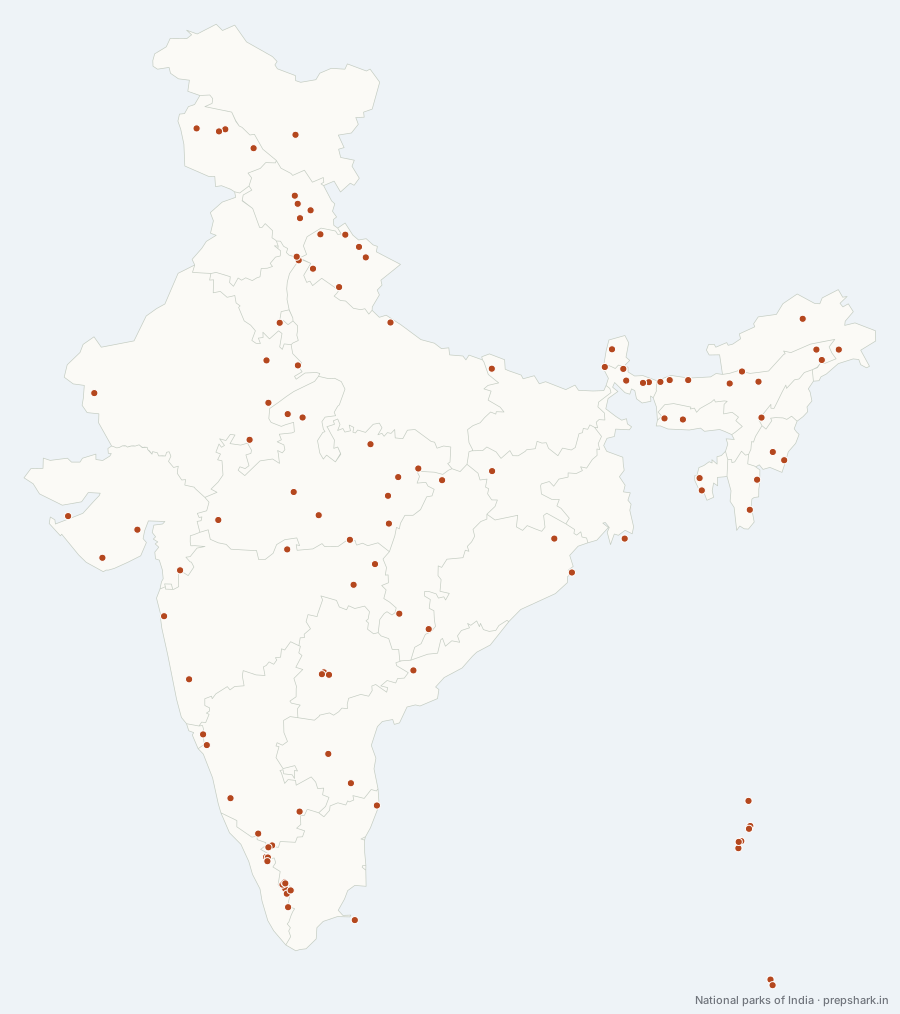
Numbered as on the map
The 113 on the map
1. Anamudi Shola
Kerala
Known forShola forest above the Munnar high range
One of three shola parks carved out of the Munnar high range in 2003, protecting the stunted montane forest that survives in the folds between grassland. Shola and grassland are one system, not two: the trees hold water in the valleys and release it through the dry season, which is why these fragments matter far beyond their size.
SettingWestern Ghats · shola and grassland · Idukki
2. Anshi
Karnataka
Known forEvergreen Ghats forest, and its black panthers
Evergreen forest on the Uttara Kannada coast, joined with Dandeli to form the Kali Tiger Reserve. It is one of the wettest parks in the country and among the few places black panthers are seen with any regularity — melanistic leopards, favoured by the low light under a closed canopy.
SettingWestern Ghats · evergreen · Kali river
3. Balpakram
Meghalaya
Known forThe Garo land of the dead, on a gorge plateau
A plateau above a deep gorge in the South Garo hills, held by the Garo as the land where the souls of the dead rest before departing. That belief is the reason the plateau was never cleared, and the reason a park could be declared on intact ground in one of the most densely farmed hill regions in the north-east.
SettingGaro hills · subtropical broadleaf · limestone gorge
4. Bandhavgarh
Madhya Pradesh
Known forAmong the densest tiger populations in India
A former hunting reserve of the Rewa maharajas around a sandstone fort, and long the densest tiger population in India. The white tigers of Rewa were caught here, which is why a recessive coat mutation from one forest ended up in zoos across the world.
SettingVindhya · sal and bamboo · sandstone hills
For the examThe white tigers of Rewa came from here. Mohan, caught in 1951, is the ancestor of most captive white tigers.
5. Bandipur
Karnataka
Known forThe core of the largest wild elephant range in India
The old Mysore hunting preserve, and the keystone of the Nilgiri Biosphere Reserve: Bandipur, Nagarhole, Mudumalai and Wayanad form one continuous forest across three states, which is what makes it the largest wild elephant population in the country rather than four separate ones.
SettingNilgiri biosphere · dry deciduous · Kabini and Moyar
For the examBandipur, Nagarhole, Mudumalai and Wayanad are one contiguous block. The elephant number is for the block, not the park.
7. Betla
Jharkhand
Known forPart of Palamau, an original Project Tiger reserve
Part of Palamau, one of the nine reserves declared when Project Tiger began in 1973, on the Chhotanagpur plateau. It holds the distinction of the first tiger census anywhere attempted by pugmark count, in 1932 — the method that governed Indian tiger numbers for the next seventy years and was eventually abandoned as unreliable.
SettingChhotanagpur plateau · sal and bamboo · North Koel
For the examOne of the nine original 1973 Project Tiger reserves, and the site of the first pugmark census.
8. Bhitarkanika
Odisha
Known forSaltwater crocodile; a Ramsar mangrove
India’s second-largest mangrove system, in the Brahmani–Baitarani delta, holding the country’s largest saltwater crocodile population. The coast in front of it, Gahirmatha, is the world’s largest olive ridley rookery — mangrove protection here is turtle protection.
SettingBrahmani–Baitarani delta · mangrove · Gahirmatha coast
9. Blackbuck (Velavadar)
Gujarat
Known forBlackbuck grassland, and the largest harrier roost on earth
Flat grassland on the Bhal coast of the Gulf of Khambhat, protecting blackbuck and the largest harrier roost in the world — thousands of birds coming down into the grass each winter evening. It is also the one park where the lesser florican, a bustard almost gone elsewhere, still displays.
SettingBhal grassland · saline flat · Gulf of Khambhat
10. Buxa
West Bengal
Known forThe Dooars corridor between Manas and Bengal
Forest in the Dooars against the Bhutan border, at the point where the eastern Himalaya, the Brahmaputra plain and the peninsular forests all meet — which is why its species list draws from three biogeographic zones at once. It is the corridor animals use between Manas in Assam and the Bengal Dooars.
SettingDooars · moist deciduous and evergreen · Raidak and Jayanti
11. Campbell Bay
Andaman and Nicobar Islands
Known forGreat Nicobar evergreen forest, south of the Ten Degree Channel
Tropical evergreen forest on Great Nicobar, part of the biosphere reserve that also holds Galathea. It sits on the far side of the Ten Degree Channel from the Andamans, which is why its species are Sumatran rather than Burmese — the channel is a biogeographic wall as much as a shipping lane.
SettingGreat Nicobar · tropical evergreen · island endemism
For the examThe Ten Degree Channel separates the Andamans from the Nicobars, and separates two different biotas.
12. Chandoli
Maharashtra
Known forPart of the Sahyadri Tiger Reserve, and its rock plateaus
Evergreen forest on the Sahyadri crest, joined with Koyna to form the Sahyadri Tiger Reserve — the northernmost tiger habitat in the Western Ghats. The plateau tops here are lateritic sheet rock that floods in the monsoon and flowers en masse, a habitat found almost nowhere else.
SettingNorthern Sahyadri · evergreen · lateritic plateau
13. Clouded Leopard
Tripura
Known forOne of the few reliable clouded leopard sites in India
A small park at Sepahijala named for the cat it protects, and one of the few places the clouded leopard is reliably recorded in India. The species is the evolutionary link between the big cats and the small ones, with the longest canines relative to skull size of any living cat.
SettingTripura lowland · moist deciduous · Sepahijala
14. Dachigam
Jammu and Kashmir
Known forThe last hangul population on earth
The last refuge of the hangul, the only red deer subspecies in India, in the mountains above Srinagar. The name means ten villages, for the settlements moved out in 1910 to protect the city’s water supply — a watershed reserve that became a wildlife park by accident and is now the species’ entire range.
SettingKashmir Himalaya · temperate broadleaf · Dagwan stream
For the examThe hangul is the Kashmir stag, the only red deer in India, and Dachigam is effectively its whole range.
15. Dehing Patkai
Assam
Known forThe largest lowland rainforest in India
The largest stretch of lowland tropical rainforest left in India, on the Assam–Arunachal border, declared a national park only in 2021 after a long public campaign against coal mining under it. It is called the Amazon of the East for the canopy, and it holds all seven cats found in the state.
SettingUpper Assam · tropical wet evergreen · Dehing river
For the examDeclared in 2021. The mining clearance controversy is why it appears in current affairs as well as geography.
16. Desert National Park
Rajasthan
Known forThe Great Indian Bustard
The last serious refuge of the Great Indian Bustard, in sand dune and sewan grassland near the Pakistan border. Its standing controversy is power lines: the Supreme Court ordered transmission undergrounded across bustard habitat in 2021, against the renewables build-out in the same districts.
SettingThar desert · sand dune and sewan grassland
For the examThe bustard is the standing example of a conservation objective in direct conflict with a climate objective. That framing is what gets asked, not the bird.
17. Dibru-Saikhowa
Assam
Known forFeral horses, and the white-winged wood duck
An island of wet grassland and semi-evergreen forest between the Brahmaputra and the Lohit, and the only place in India with feral horses — descendants of army mounts abandoned after the Second World War. It is also the last stronghold of the white-winged wood duck, the state bird of Assam.
SettingBrahmaputra island · wet grassland · semi-evergreen
18. Dinosaur Fossils
Madhya Pradesh
Known forDinosaur nesting sites and eggs in the Lameta beds
A fossil park in the Narmada valley near Bagh in Dhar district, protecting dinosaur nesting sites and eggs in the Lameta beds — the sediments laid down just before the Deccan traps erupted. The eggs here are among the largest clutches found anywhere in the world, and the beds record the last few hundred thousand years before the extinction.
SettingNarmada valley · Lameta beds · fossil nesting sites
For the examNotified for fossils rather than habitat, like Ghughua and the Mandla plant fossil patches. All three are in Madhya Pradesh.
19. Dudhwa
Uttar Pradesh
Known forIndia’s first rhino reintroduction, in the Terai
Terai grassland and sal forest on the Nepal border, and the site of India’s first rhino reintroduction in 1984 — animals brought from Assam and Nepal to a range the species had been shot out of a century before. Billy Arjan Singh’s hand-raised tigress Tara was released here, which remains the most argued-over release in Indian conservation.
SettingTerai · sal and tall grassland · Sharda river
For the examRhino reintroduced 1984. The Terai Arc Landscape links it to Corbett, Valmiki and the Nepali parks.
20. Eravikulam
Kerala
Known forHalf the world’s Nilgiri tahr, and the neelakurinji
High rolling grassland and shola on the shoulder of Anamudi, holding roughly half the world’s Nilgiri tahr. It closes to visitors each calving season, and every twelve years the neelakurinji on its slopes flowers at once and turns the hillside blue — a mass synchronous flowering that is its own kind of clock.
SettingAnamalai · shola and grassland · Anamudi
For the examNilgiri tahr is the state animal of Tamil Nadu; its largest population is in Kerala, here.
21. Galathea
Andaman and Nicobar Islands
Known forIndia’s most important leatherback nesting beach
The southern end of Great Nicobar, where the Galathea river reaches the sea on the beach that is the most important leatherback turtle nesting ground in India. The 2004 tsunami reshaped the coast and drowned parts of the nesting beach, and the proposed transhipment port is the current argument about it.
SettingGreat Nicobar · evergreen and coastal · leatherback nesting
22. Gangotri
Uttarakhand
Known forThe Gangotri glacier, and the source of the Bhagirathi
High alpine and glacial country around the Gangotri glacier, from whose snout at Gaumukh the Bhagirathi emerges. The park protects the catchment of the Ganga’s main headstream, which makes it a water-security reserve as much as a wildlife one, and it is core snow leopard range.
SettingGarhwal Himalaya · alpine and glacial · snow leopard
23. Ghughua Fossil
Madhya Pradesh
Known forThe plant fossil beds of Dindori, and their museum
The best known of the fossil patches in Dindori district, holding plant fossils — leaves, fruit, seeds and wood — from the age when the Deccan traps were erupting around them. It is the site most people mean when they say the Mandla fossil park, and it is the one with a museum on it.
SettingUpper Narmada · Deccan trap intertrappean beds · fossil flora
For the examGhughua and the Mandla Plant Fossils patches are the same fossil bed under two names, a few hundred metres apart; both are notified.
24. Gir
Gujarat
Known forThe only wild Asiatic lion population
The single wild population of Asiatic lion on earth, in dry deciduous forest and scrub on the Saurashtra peninsula. One population in one place is also the entire policy problem: an epidemic or a cyclone here is an extinction, which is why translocation to Kuno has been a standing Supreme Court matter since 2013.
SettingSaurashtra · dry deciduous and thorn scrub · Hiran river
For the examKuno (Madhya Pradesh) is the designated second home for the lion and is also where cheetah were introduced in 2022. Questions conflate the two programmes on purpose.
25. Gorumara
West Bengal
Known forDooars rhino grassland, in the Bhutan corridor
Riverine grassland and sal in the Dooars, between the Teesta and the Jaldhaka, holding a recovering population of the Indian one-horned rhino. It sits in the narrow corridor of forest between Bhutan and the plains, which is why elephant movement through it is a recurring railway-collision problem.
SettingDooars · riverine grassland and sal · Teesta and Jaldhaka
26. Govind Pashu Vihar
Uttarakhand
Known forThe upper Tons, and its snow leopards
Alpine meadow and conifer forest in the upper Tons valley, holding the source catchment of the Yamuna’s largest tributary and a well-studied snow leopard population. The Har Ki Dun valley inside it is one of the few Himalayan valleys where transhumant grazing still runs on its old calendar.
SettingGarhwal Himalaya · alpine meadow and conifer · Tons
27. Grass Hills
Tamil Nadu
Known forMontane grassland on the Anamalai plateau
High rolling grassland on the Anamalai plateau above Valparai, one of three small parks carved out of the Anamalai Tiger Reserve. The grassland here is natural rather than cleared — a montane system above the tree line that supports Nilgiri tahr on the Tamil Nadu side of the same massif as Eravikulam.
SettingAnamalai · montane grassland · Nilgiri tahr
28. Great Himalayan
Himachal Pradesh
Known forWestern Himalayan altitudinal gradient; World Heritage
A whole altitudinal range from riverine forest at 1,500 m to alpine meadow above 5,000 m inside one boundary, which is why it was inscribed as World Heritage in 2014 — the property protects a gradient rather than a habitat.
SettingAlpine and temperate Himalaya · Beas catchment · Tirthan and Sainj
29. Gugamal
Maharashtra
Known forThe core of Melghat, an original Project Tiger reserve
The core of Melghat, one of the nine original Project Tiger reserves, on the Satpura range in Vidarbha. Melghat means meeting of the ghats, and the park protects the catchment of five rivers feeding the Tapi — which is the argument that has kept the Upper Wardha and other dam proposals inside it contested.
SettingSatpura · dry deciduous teak · Tapi catchment
For the examMelghat is one of the nine reserves declared in 1973.
30. Guindy
Tamil Nadu
Known forA national park inside Chennai, and the last dry evergreen forest
One of the smallest national parks in the country and among the very few inside a city, carved out of the Raj Bhavan grounds in Chennai. It protects the last patch of tropical dry evergreen forest on the Coromandel coast, a forest type that has almost entirely gone to the city around it.
SettingCoromandel coast · tropical dry evergreen · urban
For the examAmong the smallest national parks in India, and one of very few within a city.
31. Gulf of Mannar Marine
Tamil Nadu
Known forIndia’s only dugong population, on its seagrass beds
Twenty-one islands and the reefs and seagrass between them, the first marine biosphere reserve in South Asia. The seagrass is what matters most: it is the feeding ground of the dugong, and the Gulf of Mannar holds the only breeding population left in India.
SettingCoral reef and seagrass · 21 islands · Palk Bay
For the examFirst marine biosphere reserve in South Asia. Dugong, not dolphin — the sea cow is a herbivore and grazes seagrass.
32. Guru Ghasidas
Chhattisgarh
Known forWhere India’s last wild cheetah was shot, in 1947
Sal forest on the Chhattisgarh–Madhya Pradesh border, the northern part of what was Sanjay National Park before the states divided in 2000. It was notified a tiger reserve with Tamor Pingla in 2021 and is the last place a wild Asiatic cheetah was recorded in India, in 1947.
SettingChhotanagpur edge · sal forest · Hasdeo catchment
For the examThe last three wild Asiatic cheetahs in India were shot in this area in 1947; the species was declared extinct here in 1952.
33. Hemis
Ladakh
Known forThe largest national park in India, and its snow leopards
The largest national park in India by area, in the Trans-Himalayan cold desert of Ladakh, and the best place on earth to see a snow leopard. The density is not because the cat is common but because the terrain is open: there are no trees to hide in, which is the whole reason Ladakh became the centre of snow leopard research.
SettingTrans-Himalaya · cold desert · Indus catchment
For the examLargest national park in India by area. Also holds Stok Kangri and the Markha valley.
34. Inderkilla
Himachal Pradesh
Known forA Dhauladhar extension of the Great Himalayan landscape
A small high-altitude park above the Kullu valley notified in 2010, on the Dhauladhar slopes. It exists as part of the Great Himalayan conservation landscape rather than on its own account: the value of these small parks is that they extend a protected corridor upslope, where the western tragopan and the musk deer live.
SettingDhauladhar · temperate conifer and alpine · Beas catchment
35. Indira Gandhi (Anamalai)
Tamil Nadu
Known forThe Anamalai reserve, and its lion-tailed macaques
The Tamil Nadu side of the Anamalai massif, formerly Anamalai National Park, holding the Grass Hills and Karian Shola parks inside its tiger reserve and adjoining Parambikulam across the Kerala line. It is the stronghold of the lion-tailed macaque, a canopy monkey that will not cross open ground, which makes forest fragmentation lethal to it in a way it is not to most species.
SettingAnamalai · evergreen to dry deciduous · Aliyar and Amaravati
For the examRenamed from Anamalai. Grass Hills and Karian Shola are separate national parks inside the same tiger reserve.
36. Indravati
Chhattisgarh
Known forThe last wild buffalo of central India
Sal and bamboo forest on the Indravati river in Bastar, and the last refuge of the wild Asiatic water buffalo in central India — a population reduced to a handful of animals. It is also among the least surveyed parks in the country, because most of it has been inaccessible to forest staff for decades.
SettingBastar · sal and bamboo · Indravati river
37. Intanki
Nagaland
Known forNagaland’s only national park, and its hoolock gibbons
Nagaland’s only national park, in Peren district, holding hoolock gibbon, slow loris and the state’s last hornbill populations. It is the standing example of the north-eastern problem that protection on paper is not protection on the ground: much of it is under community claim and jhum cultivation.
SettingNaga hills · tropical semi-evergreen · Barak catchment
38. Jaldapara
West Bengal
Known forIndia’s second largest rhino population
Tall riverine grassland on the Torsa in the Dooars, holding the second largest rhino population in India after Kaziranga. The grass here grows above head height, which is why the census is done from elephant back and why the park is one of the few places that still needs to be.
SettingDooars · Torsa grassland · riverine
39. Jim Corbett
Uttarakhand
Known forThe first national park in India, and where Project Tiger began
The first national park in India, declared in 1936 as Hailey National Park, and the place Project Tiger was launched from in 1973. The Ramganga runs through it and the grasslands of the Dhikala chaur are the reason its tiger density is what it is — prey, not protection alone.
SettingTerai and Shivalik · sal and chaur grassland · Ramganga
For the examDeclared 1936 as Hailey National Park — the oldest in India. Project Tiger was launched here in 1973.
40. Kalesar
Haryana
Known forThe only sal forest in Haryana
Sal forest in the Shivalik foothills where Haryana meets Himachal and Uttarakhand, notified in 2003. It is the only sal forest in Haryana and the state’s one connection to the Shivalik elephant range, which is why leopard and occasional elephant movement through it is watched closely.
SettingShivalik · sal forest · Yamuna catchment
41. Kanger Valley
Chhattisgarh
Known forLimestone caves with blind fish, and the hill myna
A narrow valley park in Bastar built around limestone caves and the Kanger river, holding Kutumsar and Kailash caves — among the deepest natural caves in India, with blind cave fish in their pools. It is also the last stronghold of the hill myna, the state bird of Chhattisgarh.
SettingBastar · moist deciduous · limestone karst
42. Kanha
Madhya Pradesh
Known forThe last hard-ground barasingha, brought back from sixty-six
Sal forest and open maidan grassland on the Maikal range, and the reason the hard-ground barasingha still exists: the population fell to about sixty-six animals in 1970 and was brought back inside fenced enclosures here. Kipling’s Jungle Book country, and one of the nine original Project Tiger reserves.
SettingMaikal range · sal and maidan grassland · Banjar
For the examThe hard-ground barasingha (Rucervus duvaucelii branderi) exists only here. An original 1973 Project Tiger reserve.
43. Karian Shola
Tamil Nadu
Known forLow-elevation wet evergreen forest in the Anamalais
A small evergreen park inside the Anamalai Tiger Reserve, protecting one of the last undisturbed patches of low-elevation wet evergreen forest in the Anamalais. Low-elevation evergreen is the rarest forest type in the Western Ghats because it is the one most easily converted to plantation.
SettingAnamalai · wet evergreen · Aliyar catchment
44. Karimpuzha
Kerala
Known forRainforest below Nilambur, and the Cholanaikkan homeland
Notified in 2020 on the slopes below Nilambur, protecting the Karimpuzha catchment and the Cholanaikkan homeland — one of the last cave-dwelling forager communities in India. It adjoins Silent Valley and New Amarambalam, extending an already large block of undisturbed rainforest.
SettingNilgiri biosphere · wet evergreen · Karimpuzha
45. Kasu Brahmananda Reddy
Telangana
Known forAn urban national park inside Hyderabad
A wooded park inside Hyderabad around the old Chiran Palace, notified in 1998. Its interest is administrative rather than ecological: it is one of a small cluster of urban national parks in Telangana, which is why a state with modest forest cover has more city parks with that status than any other.
SettingDeccan plateau · dry deciduous · urban
46. Kazinag
Jammu and Kashmir
Known forIndia’s main Kashmir markhor population
Steep forest above the Jhelum on the Line of Control, holding the largest surviving population of the Kashmir markhor — a wild goat with spiral horns whose Indian range is essentially this park. Its position on the LoC has meant less disturbance than anywhere comparable, which is the accidental reason the markhor survived.
SettingPir Panjal · temperate conifer · Jhelum gorge
47. Kaziranga
Assam
Known forThe one-horned rhinoceros
Two-thirds of the world’s one-horned rhino on a Brahmaputra floodplain that the annual flood maintains rather than damages. The park is also a tiger reserve, which is the half of its identity most candidates never learn.
SettingBrahmaputra floodplain · wet alluvial grassland · beels
48. Keibul Lamjao
Manipur
Known forThe only floating national park in the world
The only floating national park in the world, on the phumdis of Loktak — mats of vegetation, soil and organic matter thick enough to carry a deer. It exists for one animal: the sangai, the brow-antlered deer, which was believed extinct until a handful were found here in 1951.
SettingLoktak · phumdis · sangai habitat
For the examThe sangai is the brow-antlered deer and the state animal of Manipur. The phumdis are thinning because the Ithai barrage holds the lake level steady.
49. Keoladeo
Rajasthan
Known forWintering waterfowl; a Ramsar and World Heritage site
A wholly man-made wetland — dug as a duck shoot for the Bharatpur rulers — that became a World Heritage site. It is the case that separates ecological value from wilderness: nothing here is natural and the ecology is real.
SettingMan-made freshwater wetland · Gambhir–Banganga feed
For the examThe Siberian crane stopped arriving after 2002. A question asserting it still winters here is testing whether you have read anything recent.
50. Khangchendzonga
Sikkim
Known forA mixed World Heritage site, and India’s highest mountain
A World Heritage site covering a quarter of Sikkim, from subtropical forest to the summit of the third highest mountain on earth. It was inscribed as a mixed site — for its ecology and for the Lepcha and Bhutia sacred geography written across it, which is a rare combination anywhere.
SettingSikkim Himalaya · subtropical to nival · Teesta headwaters
For the examIndia’s first Mixed World Heritage site, inscribed 2016, for both natural and cultural value.
51. Khirganga
Himachal Pradesh
Known forAlpine pasture in the Parvati valley
A high park in the Parvati valley notified in 2010, alongside Inderkilla and Simbalbara. Like them it extends the Great Himalayan landscape upslope, protecting alpine pasture that had been under heavy grazing pressure and is core western tragopan and Himalayan brown bear ground.
SettingKullu Himalaya · alpine and conifer · Parvati
52. Kishtwar
Jammu and Kashmir
Known forRemote Chenab high country, and its markhor
High country in the Chenab catchment above Kishtwar, one of the least visited parks in India and among the most important for the Kashmir markhor and the snow leopard. Its rivers — the Marusudar and the Chenab — are also the site of several large hydel projects, which is the standing argument about it.
SettingGreat Himalaya · alpine and conifer · Chenab and Marusudar
53. Kudremukh
Karnataka
Known forThe Ghats park that had its iron mine closed by the court
The largest block of shola and grassland in the Western Ghats outside the Nilgiris, and the case study in what open-cast mining does to a catchment: iron ore was worked here until the Supreme Court stopped it in 2005 on the argument that the Bhadra and the Tunga downstream mattered more.
SettingWestern Ghats · shola and grassland · Bhadra and Tunga
54. Kuno
Madhya Pradesh
Known forThe cheetah reintroduction site, and the lion’s intended second home
Dry deciduous forest on the Kuno river in the Chambal basin, prepared for decades as the second home of the Asiatic lion — a translocation the Supreme Court ordered in 2013 and Gujarat has resisted since. In 2022 it received cheetah from Namibia and South Africa instead, which is the first intercontinental carnivore reintroduction attempted anywhere.
SettingChambal basin · dry deciduous and grassland · Kuno river
For the examOrdered as the Asiatic lion’s second home in 2013; cheetah introduced from Africa in 2022. The two programmes are different and are deliberately conflated in questions.
55. Madhav
Madhya Pradesh
Known forThe Scindia hunting preserve, made a tiger reserve in 2023
The Scindia hunting preserve around Shivpuri, on the Malwa plateau, with lakes that were built as shooting waters and now hold marsh crocodile and wintering duck. It was notified a tiger reserve in 2023, restoring tigers to a stretch of the Vindhya they had gone from.
SettingMalwa plateau · dry deciduous · Sakhya Sagar
56. Mahatma Gandhi Marine
Andaman and Nicobar Islands
Known forThe most studied coral reefs in India, off Wandoor
Fifteen islands off Wandoor in South Andaman with the reefs between them, the most accessible coral in India and therefore the most studied. The 2010 and 2016 bleaching events here are the clearest Indian record of what sustained warm water does to a reef.
SettingAndaman Sea · coral reef and mangrove · 15 islands
57. Mahavir Harina Vanasthali
Telangana
Known forA Nizam hunting ground turned urban deer park
A deer park on the edge of Hyderabad, formerly a Nizam hunting ground, notified in 1975. It is one of the cluster of small urban national parks around the city, and it protects blackbuck and chinkara on a patch of Deccan scrub that would otherwise have been built over.
SettingDeccan plateau · thorn scrub · urban fringe
58. Manas
Assam
Known forA World Heritage site rebuilt after conflict, and the pygmy hog
A World Heritage site on the Bhutan border, and the only place in India holding pygmy hog, hispid hare, golden langur and Bengal florican together. It was on the List of World Heritage in Danger from 1992 to 2011 after the Bodo conflict emptied it of rhino; the rhino were brought back by translocation.
SettingBhutan foothills · terai grassland and forest · Manas river
For the examIn Danger 1992–2011. Contiguous with Royal Manas in Bhutan; the pygmy hog is found nowhere else.
59. Mandla Plant Fossils
Madhya Pradesh
Known forA national park protecting plant fossils, not habitat
Seven small patches around Mandla protecting plant fossils in the Lameta and Deccan trap beds — leaves, seeds and wood from the last age of the dinosaurs, laid down as the traps erupted. It is a national park for a rock, not a habitat, which is why it appears in questions as an anomaly.
SettingDeccan Traps · Lameta beds · fossil flora
For the examNotified for fossils rather than wildlife — the same category as the Salkhan fossil park, and a standing trick question.
60. Marine (Gulf of Kutch)
Gujarat
Known forThe first marine national park in India
The first marine national park in India, declared in 1982 across forty-two islands in the Gulf of Kutch. Its corals grow in some of the most extreme conditions any reef tolerates — huge tidal range, high salinity, heavy silt — which is why they are studied as a model for reefs under stress.
SettingGulf of Kutch · coral and mangrove · 42 islands
For the examFirst marine national park in India, 1982. Gulf of Mannar is the first marine biosphere reserve — the pair is the question.
61. Mathikettan Shola
Kerala
Known forA shola corridor between the Anamalai and Periyar blocks
A small shola park in Idukki notified in 2003 after a long campaign against converting it to cardamom. The name means the forest that confuses the mind, for how easily one is lost in it, and it is a corridor between the Anamalai and the Periyar blocks for elephant moving between them.
SettingWestern Ghats · shola and grassland · Idukki
63. Mollem
Goa
Known forGoa’s largest protected forest, and Dudhsagar falls
The largest protected area in Goa, on the Western Ghats crest at the Karnataka border, holding Dudhsagar falls and the old Portuguese road east. The 2020 proposals to run a railway line, a transmission corridor and a highway through it produced the largest environmental protest in the state’s history.
SettingWestern Ghats · moist deciduous and evergreen · Mandovi catchment
64. Mouling
Arunachal Pradesh
Known forUnsurveyed forest on the Siang, in Dihang-Dibang
Dense forest on the Siang in Upper Siang, part of the Dihang-Dibang Biosphere Reserve and among the least explored parks in India — much of it has never been systematically surveyed. The name comes from an Adi word for the red poison-bearing plant found on its slopes.
SettingEastern Himalaya · tropical to temperate · Siang
65. Mount Harriet
Andaman and Nicobar Islands
Known forThe Andamans’ highest point, and the view on the twenty-rupee note
The highest point in the South Andaman group, renamed Mount Manipur in 2021 for the Manipuri king exiled here after the 1891 war. The view from it is on the back of the twenty-rupee note, which makes it the most widely circulated Indian landscape almost nobody can name.
SettingSouth Andaman · tropical evergreen · coastal hill
For the examRenamed Mount Manipur in 2021. The view from it appears on the twenty-rupee note.
66. Mrugavani
Telangana
Known forDeccan scrub on the western edge of Hyderabad
A small dry-scrub park on the western edge of Hyderabad notified for the spotted deer it is named after. Like the other Telangana city parks it is an argument about urban green space more than about wildlife, and it is the last unbuilt patch of Deccan scrub on that side of the city.
SettingDeccan plateau · thorn scrub · urban fringe
67. Mudumalai
Tamil Nadu
Known forThe Nilgiri elephant block, and the Moyar gorge
The Tamil Nadu quarter of the Nilgiri block, at the junction of the Western and Eastern Ghats where the Moyar gorge cuts through. Its elephant research station has produced the longest continuous demographic record of any wild Asian elephant population.
SettingNilgiri biosphere · dry and moist deciduous · Moyar
68. Mukundara Hills
Rajasthan
Known forThe Hadoti tiger reserve, on the Chambal
A dry deciduous park in the Hadoti plateau between Kota and Jhalawar, notified a tiger reserve in 2013 to take pressure off Ranthambore. The Chambal runs along its edge, and the Darrah pass through the hills was the Mughal army’s route south — which is why a wildlife park carries a military name.
SettingHadoti plateau · dry deciduous · Chambal
69. Mukurthi
Tamil Nadu
Known forNilgiri tahr grassland, being cleared of plantations
High shola-grassland on the western Nilgiri plateau, managed specifically for the Nilgiri tahr and for removing the wattle and pine planted across it in the twentieth century. It is one of the few Indian parks whose main work is undoing a plantation rather than protecting a forest.
SettingNilgiri plateau · shola and grassland · Bhavani catchment
70. Murlen
Mizoram
Known forIndo-Myanmar border forest in eastern Mizoram
Semi-evergreen and montane forest in eastern Mizoram against the Myanmar border, adjoining the Chin hills. It sits in the Indo-Myanmar hotspot at a point where the two countries’ forests are continuous, which is why its bird list reads as much Burmese as Indian.
SettingMizo hills · montane semi-evergreen · Myanmar border
71. Nagarhole
Karnataka
Known forAmong the highest herbivore densities in Asia
The Kodagu quarter of the Nilgiri block, on the Kabini, holding one of the highest densities of large herbivores anywhere in Asia — which is why its predator density follows. The Kabini backwater in summer concentrates elephant, gaur and deer on the drawdown grass in numbers seen almost nowhere else.
SettingNilgiri biosphere · moist deciduous · Kabini
72. Namdapha
Arunachal Pradesh
Known forFour big cats in one park
The only protected area recording tiger, leopard, snow leopard and clouded leopard together. That is an altitude effect rather than an abundance one: the park runs from 200 m of tropical forest to 4,500 m of alpine in about fifty kilometres.
SettingEastern Himalaya · tropical to alpine · Noa-Dihing river
73. Nameri
Assam
Known forThe Jia Bhoroli corridor, and the white-winged wood duck
Semi-evergreen forest on the Jia Bhoroli at the Arunachal border, contiguous with Pakke across the river. It is the Indian stronghold of the white-winged wood duck and the place elephant move between the Assam plain and the Arunachal hills, which makes the corridor its main conservation value.
SettingAssam foothills · semi-evergreen · Jia Bhoroli
74. Nanda Devi
Uttarakhand
Known forA closed World Heritage sanctuary, ringed by peaks
The inner sanctuary of Nanda Devi, closed to entry since 1983 and a World Heritage site with the Valley of Flowers. The basin is ringed by a wall of peaks that kept it unentered until 1934; the closure is why it is one of the few Himalayan valleys whose vegetation has recovered rather than degraded.
SettingGarhwal Himalaya · alpine · Rishi Ganga
For the examInscribed with the Valley of Flowers as one World Heritage site. Entry to the inner sanctuary has been closed since 1983.
76. Neora Valley
West Bengal
Known forRed panda country between Bengal, Sikkim and Bhutan
Dense forest running from the Dooars up to the Sikkim and Bhutan borders, one of the last undisturbed stretches of eastern Himalayan wilderness in India and a confirmed red panda site. Its altitude range in a small area is what gives it the species list — tropical to temperate in a single day’s walk.
SettingEastern Himalaya · tropical to temperate · Neora river
77. Nokrek
Meghalaya
Known forThe world’s largest wild citrus gene pool
The core of the Nokrek Biosphere Reserve on the highest point of the Garo hills, protecting the largest known stand of wild citrus in the world — the ancestor of the cultivated orange. A biosphere reserve declared for a fruit rather than a mammal is unusual and is the entire point of it.
SettingGaro hills · subtropical broadleaf · wild citrus
For the examThe wild citrus (Citrus indica) gene pool is the reason for the biosphere reserve.
79. Orang
Assam
Known forThe mini Kaziranga, with one of the highest tiger densities on earth
A small park on the north bank of the Brahmaputra called the mini Kaziranga, with the same grassland, rhino, tiger and wild buffalo in a tenth of the area. Its tiger density is among the highest recorded anywhere, precisely because the prey base is concentrated into so little ground.
SettingBrahmaputra north bank · alluvial grassland · rhino habitat
80. Pampadum Shola
Kerala
Known forThe smallest national park in Kerala
The smallest national park in Kerala, a shola fragment near Vattavada on the Tamil Nadu border. It is one of the three 2003 shola parks and it exists to hold a corridor open between the Kerala high range and the Palani hills across the state line.
SettingWestern Ghats · shola and grassland · Idukki
81. Panna
Madhya Pradesh
Known forThe reserve that lost all its tigers and got them back
Teak and gorge country on the Ken in Bundelkhand, and the most instructive failure and recovery in Indian conservation: the park lost every one of its tigers to poaching by 2009 and was repopulated from Bandhavgarh and Kanha. The Ken-Betwa river link, whose submergence area falls inside it, is the current argument.
SettingBundelkhand · teak and gorge · Ken river
For the examTigers extinct here by 2009, reintroduced from 2009. The Ken-Betwa link would submerge part of the core.
82. Papikonda
Andhra Pradesh
Known forThe Godavari gorge park, facing submergence by Polavaram
Hill forest on both banks of the Godavari where the river cuts the Eastern Ghats in a gorge, and the largest protected area in Andhra Pradesh. The Polavaram reservoir will submerge a substantial part of it, which is why the park is argued about as an irrigation question rather than a forest one.
SettingEastern Ghats · moist deciduous · Godavari gorge
83. Pench
Madhya Pradesh
Known forKipling’s Seoni country, and India’s largest set of wildlife underpasses
Teak forest on the Pench river across the Madhya Pradesh and Maharashtra border, and the country Kipling wrote The Jungle Book from without ever seeing it. The Pench reservoir splits the reserve, and the NH-44 through it carries the largest set of wildlife underpasses built on an Indian highway.
SettingSatpura · teak · Pench river
For the examThe NH-44 mitigation structures here are the standard Indian example of a wildlife corridor crossing.
84. Periyar
Kerala
Known forA park around a colonial diversion dam, and its ecodevelopment model
Forest around an 1895 reservoir built to divert the Periyar east to the Tamil plains — a dam that created the lake the park is now famous for. Its ecodevelopment programme, which turned former poachers into guides, is the standard Indian model for community involvement in protection.
SettingCardamom hills · evergreen and moist deciduous · Periyar lake
For the examThe Mullaperiyar dam, and the water dispute between Kerala and Tamil Nadu, is inside this park.
85. Phawngpui
Mizoram
Known forThe Blue Mountain, Mizoram’s highest point
The Blue Mountain, the highest point in Mizoram, on a ridge near the Myanmar border. The Mizo held the summit as the home of the spirits and never cleared it, which is why a national park could be declared on ground that had never been cut — the protection followed the belief.
SettingLushai hills · montane forest and grassland · Myanmar border
86. Pin Valley
Himachal Pradesh
Known forIndia’s cold desert park, and its snow leopards
Cold desert in the Pin valley of Spiti, the only national park in India that is entirely trans-Himalayan, and prime snow leopard and Siberian ibex country. Almost nothing grows above knee height, which is why the ibex-leopard relationship here is one of the most watchable predator systems anywhere.
SettingSpiti · trans-Himalayan cold desert · Pin river
87. Raimona
Assam
Known forA 2021 park completing the Manas–Bhutan corridor
Notified in 2021 on the Bhutan border in Kokrajhar, completing a continuous protected belt from Manas east into Bhutan’s Phibsoo and Royal Manas. It is the western half of a transboundary elephant range, and it holds the golden langur — a species confined to the forests between the Sankosh and the Manas.
SettingBhutan foothills · semi-evergreen and grassland · Sankosh
88. Rajaji
Uttarakhand
Known forThe north-western limit of the Asian elephant’s range
Shivalik forest either side of the Ganga at Haridwar, and the north-western limit of the Asian elephant’s range. The river, the highway and the railway all cut through it, which makes it the standard Indian case study in what linear infrastructure does to an elephant corridor.
SettingShivalik · sal and mixed deciduous · Ganga and Song
For the examNorth-western limit of wild elephant in India. Linked to Corbett by the Chilla-Motichur corridor.
89. Rajbari
Tripura
Known forTripura’s gaur park
Also called Bison National Park, in south Tripura, protecting a small population of gaur at the western edge of their range. Tripura’s forests are fragmented between rubber and jhum, and this park is one of the two patches large enough to hold a herd of large herbivores at all.
SettingTripura lowland · moist deciduous · Gomati catchment
90. Rajiv Gandhi (Rameswaram)
Andhra Pradesh
Known forThe Nallamala park whose name is mistaken for the island
A small park in the Nallamala hills of Kadapa district, named for the prime minister and confusingly subtitled Rameswaram for the village it sits beside — not the island in the Gulf of Mannar, which is six hundred kilometres away. That name is the whole reason it turns up wrongly placed in half the lists that carry it.
SettingNallamala hills · dry deciduous · Eastern Ghats
For the examRameswaram here is a village in Kadapa, Andhra Pradesh — not the Tamil Nadu island. Sources routinely file this park under the wrong state.
91. Rani Jhansi Marine
Andaman and Nicobar Islands
Known forRitchie’s Archipelago reefs, and the tsunami’s uplift record
Reefs and islands in Ritchie’s Archipelago east of South Andaman, the least disturbed coral in the Indian territory. The 2004 tsunami lifted parts of the Andaman group and dropped others by a metre or more, which killed reefs in some places and exposed them in others — recorded here better than anywhere.
SettingAndaman Sea · coral reef · Ritchie’s Archipelago
92. Ranthambore
Rajasthan
Known forAn original Project Tiger reserve, and the source for Sariska’s recovery
Dry deciduous forest around a tenth-century hill fort on the edge of the Aravalli, and one of the nine original Project Tiger reserves. It is the most watched tiger population in the world and the source of the animals used to repopulate Sariska after that reserve lost all of its own.
SettingAravalli edge · dry deciduous · Banas and Chambal
For the examOne of the nine 1973 reserves. Sariska lost all its tigers by 2004 and was restocked from here in 2008.
93. Saddle Peak
Andaman and Nicobar Islands
Known forThe highest point of the Andaman and Nicobar Islands
Evergreen forest rising to the highest point in the Andaman and Nicobar Islands, above Diglipur on North Andaman. The islands are the tops of the Arakan Yoma arc continuing south towards Sumatra, which is why the same subduction zone gives all three their earthquakes.
SettingNorth Andaman · tropical evergreen · coastal hill
94. Salim Ali
Jammu and Kashmir
Known forSrinagar’s city park, on the edge of Dal
A small park on the edge of Dal lake in Srinagar, formerly the City Forest, renamed for the ornithologist whose Kashmir surveys established the valley’s bird list. It is a wetland-edge park inside a city, which is the whole of its interest: it is what Dal’s shoreline looked like before Srinagar reached it.
SettingKashmir valley · wetland edge · urban
95. Sanjay
Madhya Pradesh
Known forThe Madhya Pradesh half of the old cheetah country
Sal forest in Sidhi on the Chhattisgarh border, the Madhya Pradesh half of what was one park before the states divided in 2000 — Guru Ghasidas is the other half. Together they were the last recorded range of the Asiatic cheetah in India, which is the reason both are named in the same questions.
SettingChhotanagpur edge · sal forest · Son catchment
96. Sanjay Gandhi
Maharashtra
Known forA leopard population inside Mumbai, and the Kanheri caves
A forest inside Mumbai, one of the few national parks anywhere within a city of that size, holding a resident leopard population living alongside twenty million people. The Kanheri caves — Buddhist rock-cut chambers from the first century BCE — are inside it, which makes it an archaeology answer as well.
SettingNorthern Western Ghats spur · moist deciduous · urban
For the examAmong the most visited national parks in the world, and the standard example of urban leopard coexistence.
97. Sariska
Rajasthan
Known forThe reserve that lost all its tigers, and got them back by air
Dry deciduous forest in the Aravalli near Alwar, and the reserve that lost every one of its tigers to poaching by 2004 — the collapse that forced the National Tiger Conservation Authority into existence. Tigers were flown in from Ranthambore in 2008, in the first big-cat reintroduction of its kind in India.
SettingAravalli · dry deciduous and scrub · Ruparel catchment
For the examTigers declared locally extinct in 2004; restocked from Ranthambore in 2008. The collapse produced the NTCA and the Tiger Task Force.
98. Satpura
Madhya Pradesh
Known forThe walking-safari reserve, and India’s model village relocation
Rugged sal and teak country on the Satpura range around Pachmarhi, and one of the very few Indian reserves where walking safaris are allowed — the terrain is too broken for vehicles to cover. It was the first park in India to complete a full relocation of villages out of its core with consent, which is why it is cited in every argument about how that should be done.
SettingSatpura range · sal and teak · Denwa and Tawa
For the examPart of the Pachmarhi Biosphere Reserve with Bori and Pachmarhi. Dhupgarh, the highest point of the Satpura, stands above it.
99. Shirui
Manipur
Known forThe Shirui lily, found on one hillside on earth
A ridge park in Ukhrul protecting the Shirui lily, a pale ground orchid-like flower that grows on this one hillside and nowhere else on earth. It is the state flower of Manipur, and the park exists for a single plant with a range measured in square kilometres.
SettingNaga hills · montane grassland and forest · Shirui peak
For the examShirui lily (Lilium mackliniae) is the state flower of Manipur and is endemic to this single hill.
100. Sikhna Jwhwlao
Assam
Known forThe newest national park in India
The newest national park in India, notified in Bodoland in 2025 out of the Chirang reserve forest. It closes the last gap in a protected belt running from Manas west to Raimona and north into Bhutan, which is the point of it: the value is the continuity, not the area.
SettingBhutan foothills · semi-evergreen · Manas corridor
101. Silent Valley
Kerala
Known forLion-tailed macaque; the movement that stopped a dam
The dam that was not built. A hydroelectric project on the Kunthipuzha was abandoned in 1983 after a decade of campaigning, and Indian environmental movement politics effectively begins here.
SettingNilgiri Western Ghats · tropical evergreen rainforest
102. Simbalbara
Himachal Pradesh
Known forThe western end of the Shivalik forest belt
Sal forest in the Shivalik of Sirmaur on the Haryana border, upgraded from a sanctuary in 2010. It adjoins Kalesar across the state line, and the two together are the western end of the Shivalik forest belt that runs east to Rajaji and Corbett.
SettingShivalik · sal forest · Markanda catchment
103. Simlipal
Odisha
Known forThe world’s only population of melanistic tigers
Sal forest on a plateau in Mayurbhanj, a biosphere reserve and one of the nine original Project Tiger reserves, known for melanistic tigers found nowhere else in the world in any number. Its waterfalls — Joranda and Barehipani — fall off the plateau edge, and the Budhabalanga rises inside it.
SettingMayurbhanj plateau · sal forest · Budhabalanga
For the examAn original 1973 Project Tiger reserve, a biosphere reserve, and the only place black (pseudo-melanistic) tigers occur in any number.
104. Singalila
West Bengal
Known forThe Sandakphu ridge, and India’s red pandas
A ridge park on the Nepal border running up to Sandakphu, the highest point in West Bengal, and the most reliable red panda site in India. The ridge is a migration route for birds crossing the Himalaya, which is why its list is far longer than its size suggests.
SettingEastern Himalaya · temperate rhododendron · Singalila ridge
106. Sri Venkateswara
Andhra Pradesh
Known forThe only wild red sanders forest on earth
Hill forest on the Seshachalam range behind Tirupati, holding red sanders — a tree that grows nowhere else on earth and is smuggled for its timber on a scale that makes the park an enforcement problem as much as an ecological one. The slender loris and the golden gecko are the other endemics.
SettingSeshachalam hills · dry deciduous and scrub · red sanders
For the examRed sanders (Pterocarpus santalinus) is endemic to the Seshachalam and Palakonda hills and is CITES-listed.
107. Sultanpur
Haryana
Known forThe waterfowl wetland on Delhi’s doorstep
A shallow seasonal lake near Gurugram that is one of the most important wintering sites for waterfowl on the Delhi doorstep, and a Ramsar site since 2021. It is small, entirely artificialised in its water supply, and it demonstrates that a functioning wetland can be almost wholly managed.
SettingHaryana plain · shallow seasonal wetland · Ramsar
108. Sundarbans
West Bengal
Known forThe only mangrove forest on earth with tigers
The Indian portion of the largest mangrove forest on earth, at the mouth of the Ganga–Brahmaputra delta, and the only mangrove in the world holding a tiger population. The tigers here swim, drink brackish water and take prey in the water, which is behaviour recorded nowhere else in the species.
SettingGanga delta · tidal mangrove · Royal Bengal tiger
For the examA World Heritage site, a biosphere reserve, a Ramsar site and a tiger reserve — the same ground on four lists.
109. Tadoba
Maharashtra
Known forMaharashtra’s oldest and largest national park
Teak and bamboo forest around Tadoba lake in Chandrapur, the oldest and largest national park in Maharashtra. It sits in the middle of a coalfield, and the corridor between it and the Chhattisgarh forests running through open-cast mines is the clearest Indian example of a tiger population being cut off by industry.
SettingVidarbha · teak and bamboo · Andhari river
110. Valley of Flowers
Uttarakhand
Known forAlpine meadow flora; World Heritage with Nanda Devi
Inscribed as one World Heritage property together with Nanda Devi — the standard example of a core-and-buffer listing, where a fragile alpine meadow is protected by pairing it with the closed basin next door.
SettingAlpine meadow · Pushpawati valley · Bhyundar Ganga
111. Valmiki
Bihar
Known forBihar’s only national park, recovered through the Nepal corridor
The only national park in Bihar, in the Gandak valley on the Nepal border, contiguous with Chitwan across it. It was nearly empty of tigers twenty years ago and has recovered on the back of that transboundary link, which is the argument for the Terai Arc Landscape in one park.
SettingTerai · sal and grassland · Gandak
For the examBihar’s only national park and only tiger reserve. Contiguous with Chitwan in Nepal.
112. Van Vihar
Madhya Pradesh
Known forA national park run as a rescue centre, on Bhojtal
A park on the shore of Bhojtal in Bhopal, run as a national park but stocked as a rescue centre: the animals in it are ones that could not be returned to the wild. That makes it a hybrid category, which is why it appears in lists of national parks and confuses counts.
SettingMalwa plateau · dry deciduous · Bhojtal shore
113. Vansda
Gujarat
Known forGujarat’s last dense moist forest, at the Ghats’ northern limit
Dense moist deciduous forest on the Ambika in the Dangs, the last substantial patch of that forest type left in Gujarat and the northern limit of the Western Ghats’ moist forests. It was a Dharampur state forest kept unlogged, which is the only reason it survived.
SettingNorthern Western Ghats · moist deciduous · Ambika river
Keep going