

Start hereAbout 2 min
Chapter Overview Map
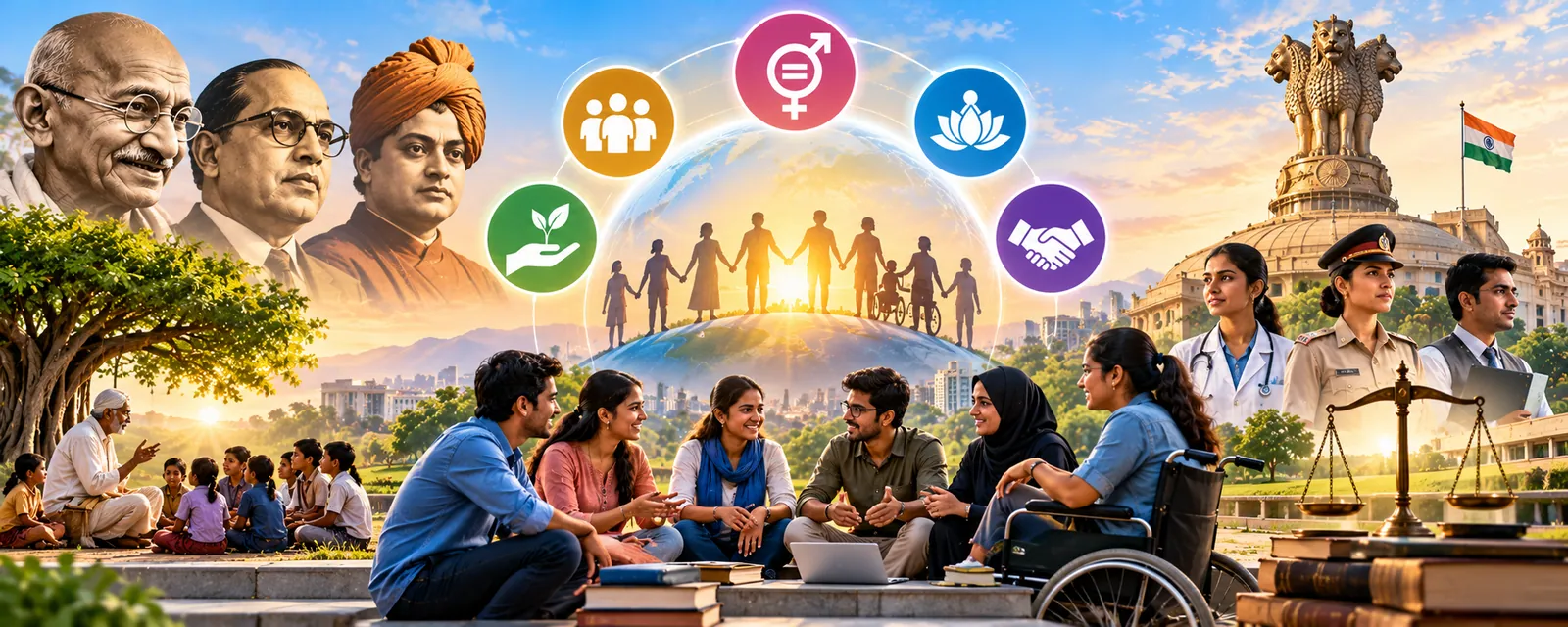
Human values, harmony, gender equity and lessons from great leaders
2.1–2.2 Human values
- Values are enduring beliefs about what is worth pursuing that guide conduct.
- They differ from ethics, beliefs, attitudes, habits and social norms.
- Twenty-one core values, from truthfulness to environmental responsibility, each have an administrative use.
2.3–2.6 Harmony
- Harmony is mutual fulfilment, not uniformity or silence.
- It works at six levels: self, family, relationships, society, nature and existence.
- Social harmony rests on equal dignity and justice.
2.7 Gender equity
- Equity is the means and equality the goal.
- Stereotypes, patriarchy, unpaid care work and intersecting disadvantages block gender justice.
- Constitutional provisions, gender budgeting and Andhra Pradesh schemes show the State's role.
2.8–2.10 Value formation
- Family builds values first, through modelling and habits.
- Society reinforces or reforms them through norms, media and movements.
- Educational institutions add reasoning, but each institution can also pass on prejudice.
2.11–2.13 Leaders, reformers, administrators
- National leaders and reformers such as Gandhi, Ambedkar and the Phules teach values through verified actions.
- Administrators such as Patel, Seshan, Sreedharan and S.R. Sankaran show values inside public office.
- Andhra reformers include Veeresalingam, Gurajada, Durgabai Deshmukh, Prakasam and Potti Sriramulu.
2.14–2.16 Values in administration
- Values guide discretion, resource allocation and citizen trust.
- Value conflicts are resolved with an eight-step decision framework.
- Andhra Pradesh applications cover welfare, village disputes, disasters, education, health and revenue.
Don't confuse
- Equality gives everyone the same treatment; equity gives support matched to need so that equality becomes real.
- A dilemma is a choice between two goods; a temptation is a choice between right and wrong.
- Harmony includes fair handling of disagreement; it is not the absence of disagreement.
Notice how the chapter moves from what values are, to where they are learned, to how leaders and administrators apply them.