

Start hereAbout 2 min
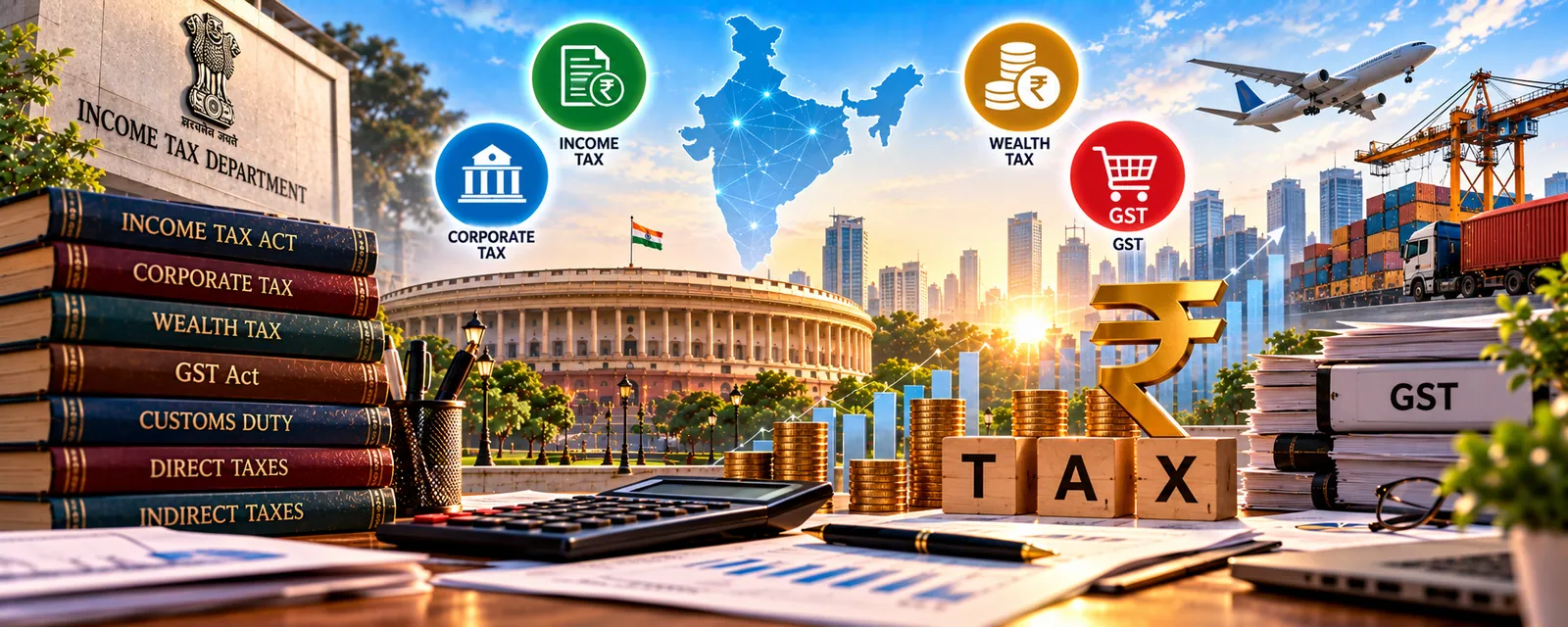
Chapter Overview Map
Taxation Laws in India
12.1–12.3 Foundations and Constitution
- A tax is a compulsory levy for public purposes imposed only by law (Article 265).
- The Seventh Schedule divides taxing entries; Article 246A gives the Union and States simultaneous power to levy Goods and Services Tax (GST).
- Taxes are direct (income, corporate) or indirect (GST, customs, excise).
12.4–12.8 Income tax
- The Income-tax Act, 2025 replaced the 1961 Act from 1 April 2026, with a single tax year.
- Income is computed under five heads; the new regime is the default, with no tax up to ₹12 lakh.
- Compliance runs through tax deducted at source (TDS), advance tax, returns, faceless assessment and appeals.
12.9–12.10 Corporate and wealth tax
- Companies pay 22%, 25% or 30% by regime; Minimum Alternate Tax (MAT) is 14% and a final tax from 2026.
- Transfer pricing, treaties and base erosion and profit shifting (BEPS) rules govern multinational profits.
- Wealth tax under the 1957 Act was abolished from assessment year 2016–17.
12.11–12.19 GST
- GST is a destination-based dual tax: central GST (CGST) and State GST (SGST) within a State, integrated GST (IGST) across States.
- Since 22 September 2025, the main rates are 5%, 18% and 40%.
- Input tax credit, returns, enforcement, refunds, the GST Appellate Tribunal (GSTAT) and the GST Council shape the system.
12.20–12.26 Administration, ethics and Andhra Pradesh
- The Central Board of Direct Taxes (CBDT), the Central Board of Indirect Taxes and Customs (CBIC) and State departments administer taxes, increasingly through digital and faceless systems.
- Ethical administration rests on legality, fairness, transparency and accountability.
- Andhra Pradesh relies on SGST, excise, value added tax (VAT) and stamp duty, plus Union devolution of about 4.22%.
Don't confuse
- Cess is earmarked for a purpose; surcharge is a tax on tax; neither is shared with States.
- Exempt supplies lose input tax credit; zero-rated exports keep it and get refunds.
- Property tax is a current local tax; wealth tax was a Union tax, now abolished.
Notice how the branches follow the chapter's sections in order, from constitutional foundations to State application; the last branch lists cross-section confusions.