

Start hereAbout 2 min
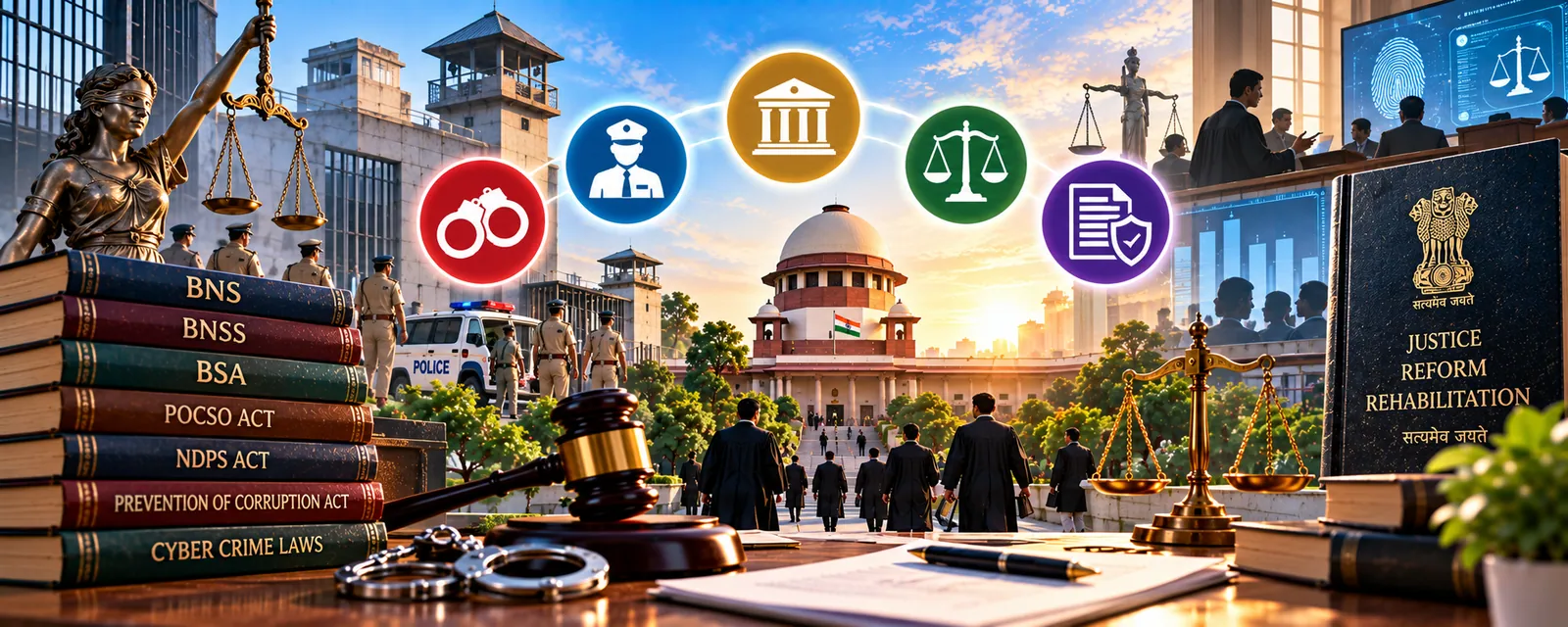
Chapter Overview Map
Criminal Laws and Criminal Justice
10.1–10.3 Foundations and the new codes
- Criminal law punishes public wrongs through the State; liability needs a prohibited act, a guilty mind and proof beyond reasonable doubt.
- Since 1 July 2024 the Bharatiya Nyaya Sanhita (BNS), Bharatiya Nagarik Suraksha Sanhita (BNSS) and Bharatiya Sakshya Adhiniyam (BSA) replace the Indian Penal Code (IPC), Code of Criminal Procedure (CrPC) and Indian Evidence Act for new cases.
10.4–10.8 Substantive offences
- The BNS keeps the old general exceptions, abetment, conspiracy and attempt, and adds organised crime, terrorist act, mob lynching and snatching.
- Offences against women and children come first in the BNS, reflecting the Nirbhaya reforms of 2013 and 2018.
10.9–10.15 Institutions and procedure
- Police, prosecution, courts, prisons and forensic laboratories form one criminal justice system.
- A case moves from the First Information Report (FIR) to investigation, arrest and bail, charge sheet, cognizance, charge, trial and judgment.
10.16–10.18 Evidence, sentence, appeal
- The BSA treats electronic records as documents and keeps the bar on confessions to police.
- Sentencing follows proportionality and the rarest of rare test for death; appeals and revision correct errors.
10.19–10.25 Rights, reforms and Andhra Pradesh
- Articles 20, 21 and 22 protect the accused; victims gain rights to information, compensation, appeal and protection.
- Police reform (Prakash Singh, 2006), forensic capacity and Andhra Pradesh institutions decide whether laws work in practice.
Don't confuse
- Cognizable is about police power to arrest without warrant; non-bailable is about whether bail is a right. They are different tests.
- A charge sheet is the police report after investigation; a charge is framed by the court before trial.
Each branch matches a group of sections; the warning branch lists the two confusions that cost most marks.