

Skip to content
PrepShark

Chapter 7Unit II — Social Exclusion and Vulnerable GroupsUpdated

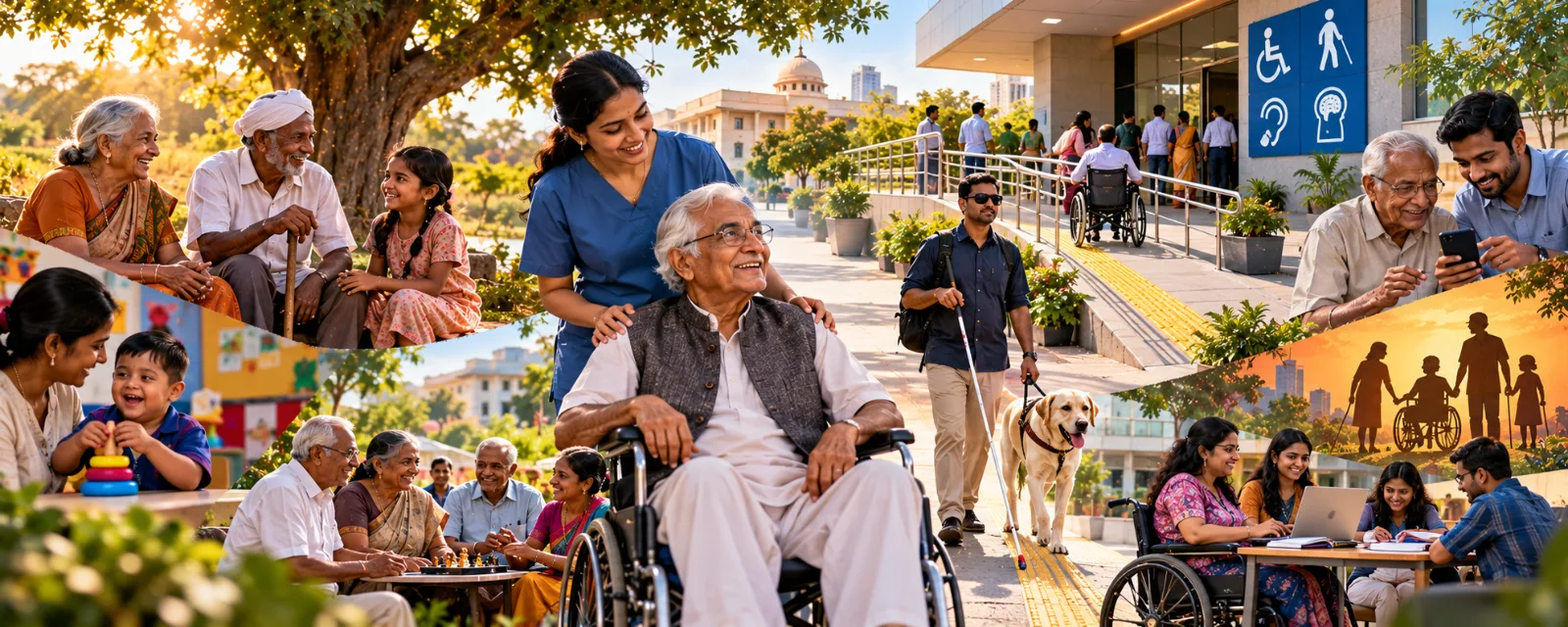
Aged Persons and Persons with Disabilities: Exclusion and Social Inclusion

How ageing and disability become sources of social exclusion in India and Telangana, through ageism, ableism, economic insecurity and inaccessible institutions, and how rights-based, accessible and age-friendly approaches support dignity and participation.

  • 32sections
  • ~100min read
0%

0 of 35 sections

~100 min read

~100 min read

Start hereAbout 1 min

Chapter Overview Map

In this section: 1 mind map

Figure 7.1Chapter overview: older persons and persons with disabilities
Older persons and persons with disabilities
  1. 7.1–7.3 Vulnerability, ageing and demography

    • Vulnerability comes from barriers and unequal resources, not from age or impairment alone.
    • India's population is ageing as fertility and mortality fall.
  2. 7.4–7.13 Older persons

    • Changing family roles, ageism, loneliness, economic insecurity and elder abuse shape exclusion.
    • Active and healthy ageing and age-friendly communities point to inclusion.
  3. 7.14–7.18 Disability, models and accessibility

    • Disability arises when impairment meets barriers; the social and rights models locate the problem in society.
    • Ableism and inaccessible design exclude; universal design and accommodation include.
  4. 7.19–7.24 Inclusion domains and rights

    • Inclusive education, employment, assistive technology and independent living are routes to equality.
    • The RPwD Act, 2016 and the 2007 senior citizens' Act frame rights.
  5. 7.25–7.32 Telangana, measurement and theory

    • Telangana shows rural migration, urban change and uneven access.
    • Data must be read by definition, year and source; theories explain why exclusion arises.
  6. Don't confuse

    • Ageing is a life-course process; disability arises from barriers at any age; one does not imply the other.

Notice how the chapter moves from shared concepts, to each group, to rights, Telangana and theory.

Inside this chapter

What Aged Persons and Persons with Disabilities: Exclusion and Social Inclusion covers

  1. Chapter Overview Map
  2. Social Vulnerability: Older Persons and Persons with Disabilities
  3. Ageing: Meaning, Nature and Sociological Significance
  4. Population Ageing and Demographic Transition in India
  5. Social Status and Changing Roles of Older Persons
  6. Family, Kinship and Care of Older Persons
  7. Ageism and Age-Based Discrimination
  8. Social Isolation, Loneliness and Emotional Wellbeing
  9. Economic Insecurity and Livelihood Challenges of Older Persons
  10. Health, Functional Ability and Long-Term Care
  11. Elder Abuse, Neglect and Exploitation
  12. Older Women and Intersectional Vulnerabilities
  13. Older Persons in Rural and Urban India
  14. Active Ageing, Healthy Ageing and Social Participation
  15. Disability: Meaning, Nature and Social Context
  16. Models of Disability
  17. Types and Diversity of Disabilities
  18. Ableism, Stigma and Disability-Based Discrimination
  19. Accessibility and Barriers to Participation
  20. Inclusive Education and Persons with Disabilities
  21. Employment and Economic Participation of Persons with Disabilities
  22. Healthcare, Rehabilitation and Assistive Technology
  23. Independent Living, Autonomy and Community Participation
  24. Intersectionality: Women, Children and Older Persons with Disabilities
  25. Rights-Based Framework for Older Persons and Persons with Disabilities
  26. Older Persons in Telangana: Social Conditions and Challenges
  27. Persons with Disabilities in Telangana: Exclusion and Inclusion
  28. Telangana: Documented Examples of Ageing and Disability
  29. Social Inclusion and Community-Based Approaches
  30. Measuring Age- and Disability-Related Exclusion
  31. Sociological Perspectives and Theories
  32. Comprehensive Comparative Study
  33. Sociological Significance and Conclusion
  34. Memory and Recall Review
  35. Rapid Revision Sheet
All 18 chapters in Paper: III - Section: I — Indian Society, Structure, Issues and Social Movements
  1. Indian Society: Salient Features, Unity in Diversity and Multiculturalism
  2. Family, Marriage and Kinship in Indian Society
  3. Caste, Tribe, Religion and Language as Social Institutions
  4. Rural–Urban Continuum and Social Transformation
  5. Social Exclusion: Scheduled Castes, Scheduled Tribes, Backward Classes and Minorities
  6. Women and Children: Social Exclusion and Vulnerability
  7. Aged Persons and Persons with Disabilities: Exclusion and Social Inclusion
  8. Poverty, Unemployment and Population Pressure
  9. Regionalism, Communalism, Secularism, Caste Conflicts and Corruption
  10. Agricultural Labour, Agrarian Distress and Rural Social Problems
  11. Urbanisation, Migration and Development-Induced Displacement
  12. Environmental Degradation and Sustainable Development: Social Dimensions
  13. Social Issues in Telangana I: Vetti, Jogini–Devadasi Practices and Gender Vulnerability
  14. Social Issues in Telangana II: Fluorosis, Child Labour and Migrant Labour
  15. Social Movements in Telangana
  16. Social Policies and Welfare Programmes for Vulnerable Groups in India
  17. National Social Policies: Education, Health, Population, Environment and Poverty Alleviation
  18. Social Welfare Policies and Programmes in Telangana

Open the Paper: III - Section: I — Indian Society, Structure, Issues and Social Movements library