

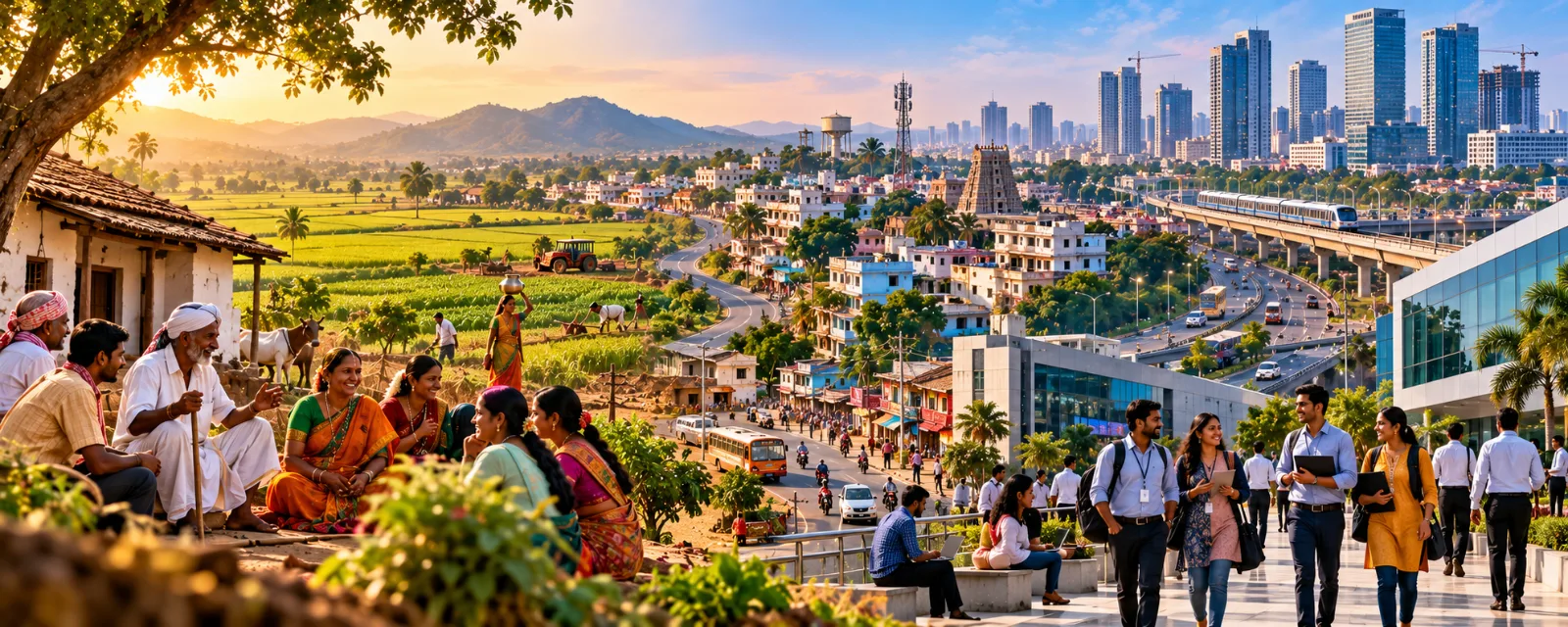
Start hereAbout 1 min
Chapter Overview Map
Rural–Urban Continuum and Social Transformation
4.1–4.3 Rural and urban society
- Rural and urban are sociological types of settlement, not just places on a map.
- Villages are internally unequal and changing; cities keep strong kinship, caste and community ties.
4.4–4.6 Dichotomy, continuum and theory
- The dichotomy sets rural and urban as opposites; the continuum treats them as ends of a graded range.
- Redfield, Sorokin and Zimmerman, Wirth, Tönnies and Durkheim gave the classic models; Srinivas, Dube and Desai tested them in India.
4.7–4.9 Linkages and communities
- People, goods, money, services and ideas flow both ways between village and city.
- Village and urban communities are each internally divided by caste, class and gender.
4.10–4.16 Processes of change
- Urbanisation, industrialisation, modernisation and migration are linked but separate processes.
- Peri-urban areas show rural and urban features side by side; family, caste and gender change unevenly.
4.17–4.18 Telangana and Hyderabad
- Hyderabad's growth has drawn surrounding villages in Rangareddy, Medchal–Malkajgiri and Sangareddy into a metropolitan region.
- Older village identities persist inside the expanding city.
4.19–4.23 Challenges, inclusion and synthesis
- Rural–urban change brings both new opportunities and new inequalities.
- Balanced, inclusive development links villages, small towns and cities.
Don't confuse
- Folk–urban continuum is Redfield's specific model; rural–urban continuum is the broader idea of graded settlements.
- Urbanisation is a change in where people live; urbanism is a way of life.
Notice how the chapter moves from types of society, to theory, to processes of change, to Telangana; the confusion branch flags two pairs of terms.