Geography · Atlas of India
Dams & reservoirs of India
Landforms, water, climate, and the hazards they carry.
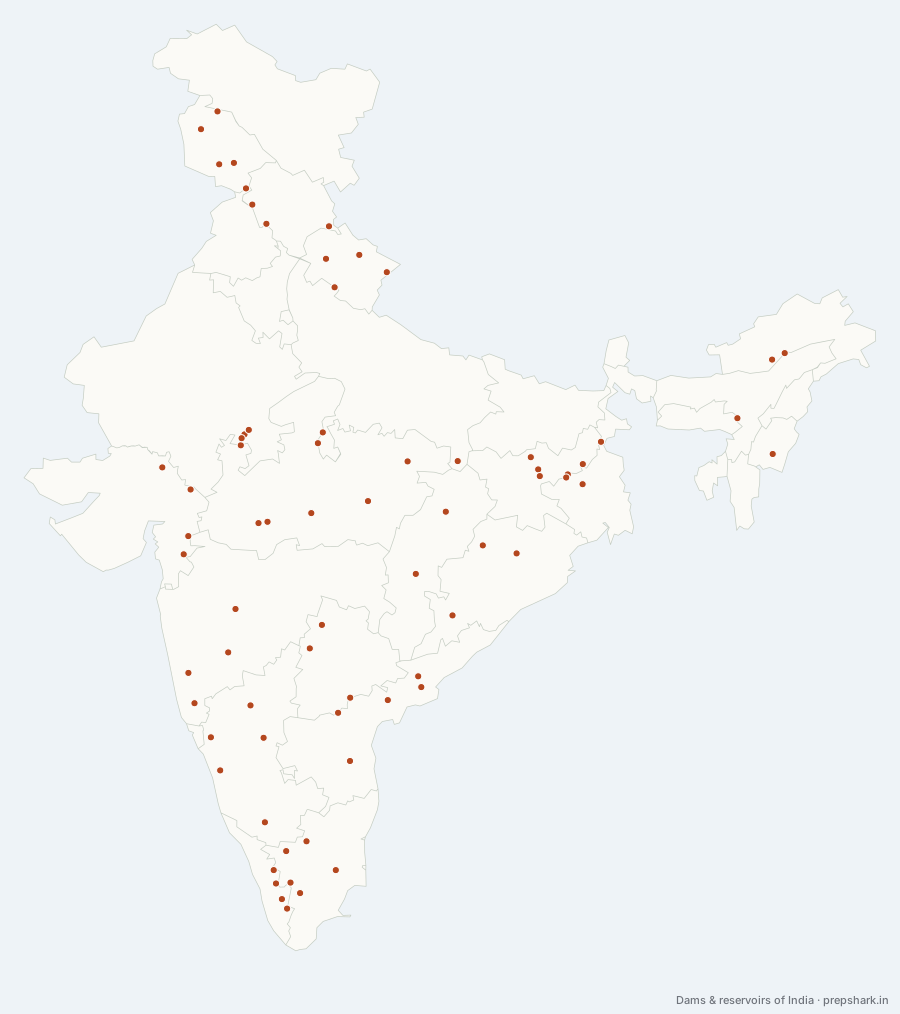
Numbered as on the map
The 71 on the map
1. Almatti
Karnataka
Known forThe dam whose height is the Krishna dispute
The upper Krishna dam whose height is the single most contested number in Indian interstate water disputes: Karnataka wants it raised for its command area, Andhra Pradesh and Telangana argue that a higher dam takes their share, and the tribunal has ruled on it more than once.
SettingUpper Krishna · earth and masonry · Bagalkot
For the examThe Krishna Water Disputes Tribunal’s rulings on its permitted height are the substance of the Karnataka–Andhra dispute.
2. Amaravathi
Tamil Nadu
Known forThe Kaveri tributary dam with South India’s mugger population
A dam on the Amaravathi, a Kaveri tributary in the Anamalai foothills, whose downstream stretch holds one of the largest breeding populations of the mugger crocodile in South India. An irrigation dam that is best known to biologists is unusual enough to be worth a marker.
SettingAnamalai foothills · earth and masonry · mugger crocodile
3. Baglihar
Jammu and Kashmir
Known forThe Neutral Expert ruling under the Indus Waters Treaty
The Chenab project Pakistan took to a Neutral Expert under the Indus Waters Treaty in 2005. The ruling largely upheld the design while trimming the gates and the pondage, and it is the single most cited precedent in the treaty’s history — the first time the dispute machinery was used and produced a working answer.
SettingChenab gorge · concrete gravity · Doda
For the examNeutral Expert, 2007 — not the Court of Arbitration, which heard Kishanganga. The two mechanisms and the two cases are routinely swapped.
4. Bansagar
Madhya Pradesh
Known forA three-state Son project settled before it was built
A dam on the Son in Shahdol built as a three-state project — Madhya Pradesh, Uttar Pradesh and Bihar share its water by an agreement predating the dam. That agreement is the point: it is one of the few interstate water settlements in India that was reached before construction rather than litigated after it.
SettingSon valley · earth and masonry · Shahdol
5. Bargi
Madhya Pradesh
Known forThe first Narmada dam, and the precedent for the valley’s protests
The first dam completed on the Narmada, near Jabalpur, and the one that taught the valley what submergence meant: it displaced far more people than it was projected to and irrigated far less land, which is the evidence the Narmada Bachao Andolan built its case on for every dam after it.
SettingNarmada · earth and masonry · Jabalpur
6. Bhakra
Himachal Pradesh
Known forThe temple of resurgent India, and Gobind Sagar
The dam Nehru called the temple of resurgent India, and the one every account of Indian planning starts from. It is a concrete gravity dam in a Sutlej gorge, and its reservoir, Gobind Sagar, waters the Punjab and Haryana that the Green Revolution was run on — the canal command is the reason those two states grew the wheat.
SettingSutlej gorge · concrete gravity · Gobind Sagar
For the examThe reservoir is Gobind Sagar. Bhakra and Nangal are two dams of one project; Nangal is the smaller barrage downstream.
7. Bhavanisagar
Tamil Nadu
Known forOne of India’s largest earthen dams
One of the largest earthen dams in India, on the Bhavani, a Kaveri tributary rising in the Nilgiris. It is the storage behind the Lower Bhavani project, among the first big irrigation schemes taken up after independence in the south.
SettingBhavani valley · earthen · Erode command
8. Dharoi
Gujarat
Known forThe Sabarmati storage behind Ahmedabad’s riverfront
The main dam on the Sabarmati, in Mehsana, and the reason Ahmedabad’s riverfront has water in it through the dry season — the river itself is seasonal, and the flow the city displays is released from here and topped up from the Narmada canal.
SettingSabarmati · earth and masonry · north Gujarat command
9. Dhauliganga
Uttarakhand
Known forA headwater scheme in the Kumaon Himalaya
A run-of-river scheme on the Dhauliganga in Pithoragarh, close to the Nepal border. It belongs in an exam corpus for the same reason the whole upper Ganga basin does: the density of hydro projects on these headwaters is what the arguments about Himalayan river ecology and disaster risk are actually about.
SettingKumaon Himalaya · run-of-river · Kali catchment
10. Dowleswaram
Andhra Pradesh
Known forCotton’s anicut, which made the Godavari delta
Arthur Cotton’s anicut of 1852 at Rajahmundry, rebuilt as a modern barrage, and the structure that turned the Godavari delta from famine country into one of the most productive rice regions in Asia. Cotton is still worshipped in the delta, which tells you what it did.
SettingGodavari delta · barrage · Rajahmundry
For the examSir Arthur Cotton built the original anicut in 1852. The modern structure is the Sir Arthur Cotton Barrage.
11. Durgapur Barrage
West Bengal
Known forWhere the Damodar valley’s water becomes canals and steel
The barrage at the downstream end of the Damodar Valley scheme, feeding the canal network across the Bengal plain and the industrial water supply of Durgapur. It is where the DVC’s stored water becomes irrigation and steel, which is the point the whole valley project was built for.
SettingDamodar · barrage · Durgapur canal command
12. Farakka
West Bengal
Known forThe Ganga diversion behind the India–Bangladesh water treaty
A barrage that diverts Ganga water down the Bhagirathi–Hooghly to flush the silt out of Kolkata port, and the reason India and Bangladesh needed a water-sharing treaty at all. The 1996 treaty splits the lean-season flow; the barrage is also blamed for the Hilsa no longer running upstream and for bank erosion in Malda and Murshidabad.
SettingGanga · barrage · Bhagirathi–Hooghly feeder canal
For the examBuilt to save Kolkata port. The Ganga Waters Treaty with Bangladesh, 1996, shares the lean-season flow here and runs thirty years.
13. Gandhi Sagar
Madhya Pradesh
Known forThe first of the four Chambal dams
The uppermost of the four dams on the Chambal, and the start of the chain that is the standard Indian example of a river developed in cascade — Gandhi Sagar, Rana Pratap Sagar, Jawahar Sagar and the Kota barrage, each using the water the one above it releases.
SettingMalwa plateau · masonry gravity · Chambal gorge
For the examThe Chambal chain in order: Gandhi Sagar, Rana Pratap Sagar, Jawahar Sagar, Kota barrage. The order is the question.
14. Gangrel
Chhattisgarh
Known forThe Chhattisgarh dam at the centre of the Mahanadi dispute
Also called Ravishankar Sagar, the largest dam in Chhattisgarh and the one at the centre of the Mahanadi water dispute: Odisha argues that this and the barrages above it cut the flow reaching Hirakud, and the tribunal constituted in 2018 is still hearing it.
SettingMahanadi · earth and masonry · Dhamtari
15. Hasdeo Bango
Chhattisgarh
Known forThe reservoir behind the Hasdeo Arand coal argument
A dam on the Hasdeo, a Mahanadi tributary, above the Hasdeo Arand forest — the largest contiguous stretch of dense forest in central India and one of the country’s biggest untapped coal reserves. The catchment argument against mining it is made partly on this reservoir’s behalf.
SettingHasdeo valley · earth and masonry · Hasdeo Arand catchment
16. Hirakud
Odisha
Known forThe longest earthen dam in the world
The longest earthen dam in the world at about twenty-six kilometres including its dykes, on the Mahanadi above Sambalpur, and the first major multipurpose project completed after independence. It was built for flood control above all — the Mahanadi delta floods were the disaster it was answering.
SettingMahanadi · earth, concrete and masonry · Sambalpur
For the examLongest earthen dam in the world. Built primarily for flood control of the Mahanadi delta; the Odisha–Chhattisgarh dispute over Mahanadi water is about upstream use above it.
17. Idukki
Kerala
Known forOne of Asia’s first double-curvature arch dams
A double-curvature arch dam wedged between two granite hills on the Periyar — one of the first of its kind in Asia and among the highest arch dams in the world. It is the single largest source of hydro power in Kerala, and its reservoir is the state’s biggest.
SettingPeriyar · double-curvature arch · Idukki reservoir
For the examArch dam — the type is the question. Kerala’s largest hydro source and largest reservoir.
18. Indira Sagar
Madhya Pradesh
Known forThe largest reservoir in India by volume
The largest reservoir in India by water volume, on the Narmada at Punasa, and the storage that makes Sardar Sarovar downstream work through the dry season. Between them the two dams are the reason the Narmada is the most heavily engineered peninsular river.
SettingNarmada · concrete gravity · Nimar plain
For the examLargest by VOLUME. Govind Ballabh Pant Sagar at Rihand is the largest by area — the pair is the question.
19. Indravati
Odisha
Known forThe Indravati diversion out of the Godavari basin
An inter-basin diversion in Kalahandi that turns Indravati water — which would flow west into the Godavari — north into the Mahanadi basin instead. It is the largest such diversion in Odisha, and it is why the Godavari tribunal’s allocations name a river most people associate with Chhattisgarh.
SettingEastern Ghats · inter-basin diversion · Kalahandi
20. Ithai Barrage
Manipur
Known forThe barrage thinning Loktak’s phumdis
A barrage built for the Loktak hydro project that holds the lake at a constant level all year, and in doing so ended the seasonal drying that the phumdis depend on to root and thicken. The floating islands have been thinning since, which is why a small barrage is the central fact in the survival of the sangai.
SettingManipur valley · barrage · Loktak level control
For the examIt keeps Loktak at a constant level, which stops the phumdis drying and thickening. Keibul Lamjao and the sangai depend on them.
21. Jawahar Sagar
Rajasthan
Known forThe third Chambal dam, inside the gharial sanctuary
The third and smallest of the Chambal dams, a pick-up weir between Rana Pratap Sagar and the Kota barrage that generates power from water already released upstream. It sits inside the National Chambal Sanctuary, which is the gharial habitat the chain both created and constrains.
SettingChambal gorge · pick-up weir · National Chambal Sanctuary
22. Jayakwadi
Maharashtra
Known forNathsagar, and Marathwada’s water
An earthen dam on the upper Godavari at Paithan whose reservoir, Nathsagar, waters Marathwada — the driest part of Maharashtra. The releases into it from the Nashik dams upstream are one of the most contested intra-state water arguments in the country.
SettingUpper Godavari · earthen · Marathwada command
For the examThe reservoir is Nathsagar. The upstream–downstream releases from the Nashik dams to Jayakwadi are the standing Maharashtra water dispute.
23. Kadana
Gujarat
Known forThe main storage on the Mahi
A dam on the Mahi in Mahisagar district, the main storage of a river that is otherwise notable for crossing the Tropic of Cancer twice. It supplies the Mahi canal command in central Gujarat and is one of the few large works on a west-flowing river that is not the Narmada or the Tapi.
SettingMahi valley · earth and masonry · central Gujarat command
For the examThe Mahi crosses the Tropic of Cancer twice — the only Indian river that does.
24. Kallanai
Tamil Nadu
Known forThe oldest working water-diversion structure in the world
The Grand Anicut, built by Karikala Chola in about the second century and still in use — the oldest water-diversion structure in the world still doing its original job. It splits the Kaveri from the Kollidam and sends the water into the delta, which is what has made that delta the granary it is.
SettingKaveri delta head · stone anicut · Kollidam divide
For the examBuilt by Karikala Chola, roughly 2nd century CE, and still functioning — the oldest such structure anywhere.
25. Kishanganga
Jammu and Kashmir
Known forThe Court of Arbitration award, and the first environmental flow under the treaty
A diversion scheme moving Kishanganga water through a tunnel into the Wular basin, and the case Pakistan took to a Permanent Court of Arbitration. The 2013 award let the diversion proceed but fixed a minimum environmental flow downstream — the first time the treaty was read to require one.
SettingKashmir Himalaya · inter-basin diversion · Jhelum catchment
For the examCourt of Arbitration, 2013 — Baglihar was the Neutral Expert. The river is the Neelum once it crosses the Line of Control.
26. Konar
Jharkhand
Known forThe DVC dam on the Konar
The second DVC dam, on the Konar, a Damodar tributary, completed in 1955. It completes the set of four that every question about the Damodar Valley Corporation turns on, and it is the one people forget — which is precisely why it is asked.
SettingKonar valley · earth and concrete · Hazaribagh
27. Kopili
Meghalaya
Known forThe reservoir acidified by rat-hole coal mining
A hydro scheme on the Kopili at the Meghalaya–Assam border whose reservoir has been acidified by acid mine drainage from unregulated rat-hole coal mining in the Jaintia hills — the water is corrosive enough to have damaged the turbines. It is India’s clearest case of mining wrecking a power project.
SettingJaintia hills · masonry · acid mine drainage
For the examRat-hole mining in the Jaintia hills is the source of the acidification. The NGT ban on it is the connected current-affairs point.
28. Kota Barrage
Rajasthan
Known forThe last of the four Chambal structures
The last structure of the Chambal chain, at Kota, diverting the water the three dams above it have already passed through turbines into the canals of Rajasthan and Madhya Pradesh. It is the point at which a hydro cascade becomes an irrigation system.
SettingChambal · barrage · Kota canal command
29. Koyna
Maharashtra
Known forThe world’s clearest case of reservoir-induced seismicity
A dam in the Sahyadri whose reservoir, Shivsagar, is the accepted case of reservoir-induced seismicity anywhere in the world: the region was aseismic before impoundment and produced a magnitude 6.3 earthquake in 1967 that killed close to two hundred people. A deep borehole observatory now studies it.
SettingSahyadri crest · rubble concrete · Shivsagar
For the examThe 1967 Koynanagar earthquake is the standard example of reservoir-induced seismicity. The reservoir is Shivsagar.
30. Krishna Raja Sagara
Karnataka
Known forVisvesvaraya’s Kaveri dam, and the upstream half of the dispute
Visvesvaraya’s dam above Mysuru, completed in 1932 with the Brindavan gardens below it, and the upstream half of the Kaveri dispute — the releases from here to Mettur in Tamil Nadu are what the tribunal award and the Cauvery Water Management Authority actually regulate.
SettingKaveri · masonry · Brindavan gardens
For the examBuilt under M. Visvesvaraya. Releases from KRS to Mettur are the operative question in the Cauvery dispute.
31. Linganamakki
Karnataka
Known forThe dam that controls Jog falls
The dam that regulates the Sharavathi above Jog falls, which is why the falls now run at their full height only when water is released. Its power station at Jog was for years the largest in India, and it is the reason a waterfall is on a hydrological schedule.
SettingSharavathi valley · masonry · Western Ghats
32. Maithon
Jharkhand
Known forThe largest DVC dam, with an underground station
The largest of the Damodar Valley Corporation dams, on the Barakar, and the one with an underground power station. The DVC was India’s first multipurpose river valley authority, modelled on the Tennessee Valley Authority, and Maithon is the piece of it that best shows what that meant.
SettingBarakar · earth and concrete · Damodar valley
For the examThe four DVC dams are Tilaiya and Maithon on the Barakar, Konar on the Konar, and Panchet on the Damodar. The list and the rivers are the question.
33. Malampuzha
Kerala
Known forKerala’s largest reservoir by area
The largest reservoir in Kerala by area, on a Bharathappuzha tributary below the Palghat gap. The Bharathappuzha is the state’s second longest river and among its most depleted, which makes this dam a standing illustration of what happens when a seasonal river is fully committed.
SettingPalghat gap · earth and masonry · Bharathappuzha catchment
34. Massanjore
Jharkhand
Known forThe Canada Dam, and a standing interstate argument
Also called the Canada Dam, built with Colombo Plan money on the Mayurakshi, and shared between Jharkhand and West Bengal — Bengal built it, Jharkhand hosts it, and the two have argued about its water and its revenue ever since. A small dam that is a large lesson in interstate arrangements.
SettingMayurakshi · masonry · Dumka
35. Matatila
Uttar Pradesh
Known forThe Betwa dam the Ken–Betwa link feeds into
A dam on the Betwa shared between Uttar Pradesh and Madhya Pradesh, and part of the Betwa system the Ken–Betwa river link is built around. The link would move Ken water into the Betwa above here, which is why an old dam is suddenly a current-affairs answer.
SettingBundelkhand · masonry and earth · Betwa
36. Mettur
Tamil Nadu
Known forStanley reservoir, and the downstream half of the Kaveri dispute
The dam that receives what Karnataka releases, its reservoir named Stanley, and the point at which the Kaveri becomes Tamil Nadu’s irrigation system. The delta’s kuruvai crop is planted on the strength of its June opening, which is why a date on a calendar is a political event.
SettingKaveri · masonry gravity · Stanley reservoir
For the examThe reservoir is Stanley. Its customary 12 June opening starts the delta’s kuruvai season.
37. Mullaperiyar
Kerala
Known forThe 999-year lease, and the longest-running dam dispute in India
An 1895 lime-surkhi masonry dam on the Periyar in Kerala, operated by Tamil Nadu under a 999-year colonial lease, diverting water east through the Ghats into the Vaigai. Kerala argues it is unsafe at its permitted level, Tamil Nadu that it is not, and the Supreme Court has heard it repeatedly.
SettingCardamom hills · lime-surkhi masonry · Periyar Tiger Reserve
For the examBuilt 1895 under a 999-year lease. The dam is in Kerala; Tamil Nadu operates it and takes the water. The dispute is about the permitted storage level.
38. Nagarjuna Sagar
Telangana
Known forThe largest masonry dam in the world, and a relocated Buddhist site
The largest masonry dam in the world when it was built, on the Krishna between Telangana and Andhra Pradesh, and the reason the Buddhist remains of Nagarjunakonda had to be moved to an island in its reservoir. Its water is the substance of the Krishna dispute between the two states.
SettingKrishna · masonry gravity · Nallamala hills
For the examNagarjunakonda’s Buddhist remains were moved to an island in the reservoir. The Krishna Water Disputes Tribunal governs its allocations.
39. Nathpa Jhakri
Himachal Pradesh
Known forOne of India’s largest underground hydro stations
A run-of-river scheme on the Sutlej in Kinnaur with almost no reservoir: the water is taken through a twenty-seven-kilometre head-race tunnel under the mountain and dropped through turbines at the far end. It is among the largest underground power stations in the country, and its desilting chambers are the largest anywhere.
SettingSutlej gorge · run-of-river · Kinnaur
For the examRun-of-river, not a storage dam — the distinction is the question. Its silt load from the Sutlej is the standing operational problem.
40. Nizam Sagar
Telangana
Known forThe Nizam-era Manjira dam
A Nizam-era dam on the Manjira, a Godavari tributary, built in the 1920s and for decades the largest irrigation work in Hyderabad state. Its storage has fallen sharply to siltation, which makes it the older twin of the Tungabhadra lesson.
SettingManjira valley · masonry · Kamareddy
41. Omkareshwar
Madhya Pradesh
Known forA Narmada dam carrying floating solar
A Narmada dam immediately below Indira Sagar, part of the same cascade and named for the jyotirlinga on the island in the river beside it. Its reservoir now carries one of the largest floating solar installations in the country, which is the current reason it appears in the papers.
SettingNarmada · concrete gravity · floating solar
42. Panchet
Jharkhand
Known forThe DVC dam on the Damodar itself
The last of the four original DVC dams, on the Damodar itself, completed in 1959. Between them the four were meant to end the flooding that earned the Damodar the name Sorrow of Bengal — they reduced it rather than ended it, which is the honest finding the DVC is assessed on.
SettingDamodar · earth and concrete · Dhanbad
For the examThe Damodar was called the Sorrow of Bengal. The DVC, 1948, was India’s first multipurpose valley authority.
43. Parambikulam
Kerala
Known forThe Kerala–Tamil Nadu inter-basin transfer
The centre of the Parambikulam–Aliyar project, an inter-state, inter-basin scheme moving water from Kerala’s rivers east through the Ghats into Tamil Nadu’s Coimbatore plain. It is the working example of what the Mullaperiyar arrangement is argued about in the abstract.
SettingAnamalai · masonry · Parambikulam–Aliyar project
44. Polavaram
Andhra Pradesh
Known forThe national project linking the Godavari to the Krishna
A national project on the Godavari above Rajahmundry, under construction, designed to link the Godavari to the Krishna and irrigate the Andhra delta. It would submerge parts of Papikonda National Park and villages in three states, which is why Odisha and Telangana have both been in court over it.
SettingGodavari gorge · earth-cum-rock fill · Papikonda submergence
For the examA National Project, and the first link of the Godavari–Krishna interlinking. Its submergence reaches Odisha and Telangana, which is why both contest it.
45. Pong
Himachal Pradesh
Known forMaharana Pratap Sagar, and the Beas–Sutlej link
An earthfill dam on the Beas whose reservoir, Maharana Pratap Sagar, is a Ramsar site and one of the largest waterbird grounds in northern India. It is the storage half of the Beas–Sutlej link, which diverts Beas water through a tunnel into the Sutlej above Bhakra — one river topping up another.
SettingShivalik foothills · earthfill · Ramsar reservoir
For the examThe reservoir is Maharana Pratap Sagar, a Ramsar site. The Beas–Sutlej link moves its water into Bhakra.
46. Prakasam Barrage
Andhra Pradesh
Known forThe Krishna delta barrage at Vijayawada
The barrage at Vijayawada that turns the Krishna into the delta canal system, on the site of Cotton’s original nineteenth-century anicut. It is the Krishna’s counterpart to Dowleswaram on the Godavari — the two structures that made the two deltas farmable.
SettingKrishna delta · barrage · Vijayawada
47. Radhanagari
Maharashtra
Known forOne of India’s oldest dams, begun in 1907
One of the oldest dams in India, begun by Shahu Maharaj of Kolhapur in 1907 and finished in 1954, on a Panchganga headwater in the Sahyadri. It sits inside a sanctuary that is the northernmost gaur habitat in the Western Ghats, which is the other reason it is named.
SettingSahyadri · masonry · Radhanagari sanctuary
48. Rajghat
Madhya Pradesh
Known forThe lower Betwa storage, shared by two states
A joint Madhya Pradesh and Uttar Pradesh dam on the Betwa below Matatila, whose reservoir is named for Rani Lakshmibai. With Matatila it forms the Betwa storage that the Ken–Betwa link is designed to top up, and the two states share both its water and its power.
SettingBundelkhand · masonry · Betwa
49. Ramganga
Uttarakhand
Known forThe reservoir inside Corbett
Also called Kalagarh, an earthfill dam whose reservoir lies inside Corbett — the only large reservoir in an Indian tiger reserve. That is its main significance: the drawdown grassland it creates is prime habitat, and the submergence took prime habitat away, which is the argument in one object.
SettingShivalik · earthfill · Corbett drawdown grassland
50. Rana Pratap Sagar
Rajasthan
Known forThe second Chambal dam, and Rawatbhata’s cooling water
The second dam of the Chambal chain, at Rawatbhata, and the site of India’s second nuclear power station — the reservoir supplies its cooling water. A hydro dam that became the reason a nuclear plant is where it is, which is the sort of link the chain is worth learning for.
SettingChambal gorge · masonry gravity · Rawatbhata
51. Ranganadi
Arunachal Pradesh
Known forThe diversion blamed for downstream flooding in Assam
A diversion scheme on the Ranganadi in Lower Subansiri that sends water through a tunnel into the Dikrong. Its sudden releases are regularly blamed for flooding in North Lakhimpur downstream, which is the smaller, sharper version of the Subansiri argument.
SettingEastern Himalaya · diversion · Dikrong
52. Ranjit Sagar
Punjab
Known forThe Ravi storage that puts India’s treaty share to use
Also called Thein, the largest dam on the Ravi and the one that lets India use the Ravi water the Indus Waters Treaty allots it. Before it the river ran largely unused into Pakistan, which is why the project is argued about as a treaty question rather than only an irrigation one.
SettingShivalik · earth-core rockfill · Ravi
For the examAlso called Thein dam. The Ravi, Beas and Sutlej are the eastern rivers allotted to India under the Indus Waters Treaty.
53. Rengali
Odisha
Known forThe main storage on the Brahmani
The main dam on the Brahmani, Odisha’s second river, built for power and later extended for irrigation across the Brahmani–Baitarani delta. It matters as the counterpart to Hirakud: two of the three big Odisha rivers dammed, and the third, the Baitarani, essentially not.
SettingBrahmani valley · masonry and earth · Angul
54. Rihand
Uttar Pradesh
Known forGovind Ballabh Pant Sagar, India’s largest artificial lake by area
A concrete gravity dam on the Rihand, a Son tributary, whose reservoir Govind Ballabh Pant Sagar is the largest artificial lake in India by area. The coalfield and the thermal power belt around Singrauli grew on its water, which is why an irrigation dam ended up defining an energy region.
SettingSon basin · concrete gravity · Singrauli coalfield
For the examThe reservoir is Govind Ballabh Pant Sagar — largest by AREA. Indira Sagar on the Narmada is the largest by volume.
55. Salal
Jammu and Kashmir
Known forThe first Indian dam on the Chenab, and the treaty precedent it set
The first big Indian project on the Chenab, and the first test of what the Indus Waters Treaty permits on a western river: Pakistan objected, India built it to a negotiated design with its low-level outlets plugged, and the silting that followed became the argument for every later dam’s drawdown flushing.
SettingChenab gorge · run-of-river with pondage · Reasi
For the examThe Chenab, Jhelum and Indus are the western rivers allotted to Pakistan; India may use them for run-of-river power under strict design limits.
56. Sardar Sarovar
Gujarat
Known forThe most contested dam in India
The terminal dam of the Narmada valley project and the most litigated dam in the world: the Narmada Bachao Andolan, the Supreme Court judgments, the World Bank withdrawal after the Morse review, and the four-state award that governs how Gujarat, Madhya Pradesh, Maharashtra and Rajasthan share the water.
SettingNarmada · concrete gravity · Gujarat canal command
For the examThe Narmada Water Disputes Tribunal award binds four states. The World Bank withdrew in 1993 after the Morse Commission — the first such withdrawal anywhere.
57. Somasila
Andhra Pradesh
Known forThe main storage on the Penna, in the rain shadow
The main storage on the Penna, the largest river of Rayalaseema, in one of the driest districts of the peninsula. It is the counter-example to the delta dams: a large reservoir on a river that frequently has nothing in it, which is the real condition of the peninsular rain-shadow.
SettingPenna valley · earth and masonry · Nellore command
58. Sriram Sagar
Telangana
Known forTelangana’s main Godavari storage, at Pochampad
The main Godavari storage in Telangana, at Pochampad, and the backbone of north Telangana irrigation before Kaleshwaram. Its silting and its shrinking command are the reason the state built a lift scheme to pump Godavari water uphill instead.
SettingGodavari · earth and masonry · Nizamabad
59. Srisailam
Andhra Pradesh
Known forThe Krishna gorge dam inside India’s largest tiger reserve
A dam in the Krishna gorge through the Nallamala hills, inside what is now the largest tiger reserve in India. It was built for power rather than irrigation, which is why its operating rules and Nagarjuna Sagar’s below it are argued over separately by the two states that share them.
SettingNallamala gorge · masonry gravity · Krishna
60. Subansiri Lower
Arunachal Pradesh
Known forIndia’s largest hydro project under construction
The largest hydro project under construction in India, on the Brahmaputra’s biggest tributary at the Assam–Arunachal border. Work was halted for eight years from 2011 by protests in Assam over downstream flooding and dam safety, which makes it the standing case for how North-East hydro is contested.
SettingEastern Himalaya · concrete gravity · Subansiri
For the examHalted 2011–2019 by downstream protest in Assam. The Subansiri is the Brahmaputra’s biggest tributary.
61. Supa
Karnataka
Known forThe largest of five dams on one Western Ghats river
The largest dam on the Kali in Uttara Kannada, one of a chain of five on a single short west-flowing river — the most heavily dammed river in the Western Ghats. That concentration inside a tiger reserve is why the Kali is the standard case in arguments about cumulative impact.
SettingKali valley · masonry · Kali Tiger Reserve
62. Tapovan Vishnugad
Uttarakhand
Known forThe 2021 Chamoli disaster
A run-of-river project on the Alaknanda’s Dhauliganga in Chamoli, and the site of the February 2021 disaster: a rock-and-ice avalanche off Ronti peak became a debris flow that destroyed the barrage and killed around two hundred people. It is the standing case in every question about Himalayan hydro and cascading hazard.
SettingGarhwal Himalaya · run-of-river · Alaknanda catchment
For the examThe February 2021 flood came from a rock-ice avalanche off Ronti, not from a glacial lake outburst — the distinction is regularly tested.
63. Tawa
Madhya Pradesh
Known forThe Narmada tributary dam with a displaced-persons fishing cooperative
A dam on the Tawa, the Narmada’s largest tributary, on the northern edge of the Satpura reserve. Its reservoir carries a fishing cooperative run by the displaced villagers themselves — for years the standard Indian example of reservoir fisheries returned to the people the reservoir displaced.
SettingSatpura foothills · earth and masonry · Tawa reservoir
64. Tehri
Uttarakhand
Known forThe tallest dam in India
The tallest dam in India and among the tallest earth-and-rockfill dams in the world, on the Bhagirathi just above its meeting with the Bhilangna. It drowned the old town of Tehri, and it sits in a seismic zone — the two facts that made it the longest-running dam protest in the country before Narmada.
SettingGarhwal Himalaya · earth and rockfill · Bhagirathi
For the examTallest dam in India. On the Bhagirathi, which becomes the Ganga at Devprayag — not on the Ganga itself.
65. Tenughat
Jharkhand
Known forThe Damodar dam the DVC does not run
A Damodar dam built and run by the Bihar and then Jharkhand government rather than by the DVC, which is its whole significance: it sits inside the Damodar valley and outside the valley authority, and the coordination problem that creates is the standard illustration of why basin-wide management is hard.
SettingDamodar · earth and masonry · Bokaro
66. Tilaiya
Jharkhand
Known forThe first DVC dam completed
The first dam the Damodar Valley Corporation completed, in 1953, on the Barakar. It is the smallest of the four and the one that matters chronologically: it is where India’s first river valley authority actually began building.
SettingBarakar · concrete gravity · Koderma
67. Tungabhadra
Karnataka
Known forThe Krishna’s largest tributary dam, and the silting problem
A joint Karnataka and Andhra Pradesh dam at Hosapete on the Krishna’s largest tributary, built with no gates on part of its spillway and now badly silted — its live storage has fallen by roughly a third, which makes it the standard Indian illustration of what sedimentation does to a reservoir’s life.
SettingTungabhadra · masonry · Hosapete
68. Ujjani
Maharashtra
Known forThe Bhima storage behind the Solapur sugar belt
The largest dam on the Bhima, the Krishna’s biggest tributary, and the water behind the sugarcane belt of Solapur — the crop that makes a drought-prone district one of the thirstiest in India. That contradiction is why the dam appears in questions about cropping patterns rather than only about engineering.
SettingBhima valley · earth and masonry · Solapur command
69. Ukai
Gujarat
Known forGujarat’s largest reservoir, and Surat’s flood question
The largest reservoir in Gujarat, on the Tapi above Surat, and the city’s flood defence and flood risk in one object: the 2006 Surat flood came from a release here, and every monsoon the reservoir’s operating rule is argued about in the same terms.
SettingTapi · earth and masonry · Surat command
70. Uri
Jammu and Kashmir
Known forThe Jhelum’s underground run-of-river station
A run-of-river station on the Jhelum near the Line of Control, built almost entirely underground. It is the Jhelum’s counterpart to the Chenab projects: the same treaty constraint, the same design compromise, and the same argument about how much a permitted run-of-river scheme can actually store.
SettingKashmir valley · run-of-river · Jhelum gorge
71. Vaigai
Tamil Nadu
Known forThe storage that receives Periyar water through the Ghats
The main storage on the Vaigai, the river of Madurai, which rises in the Varusanadu hills and runs to the Palk Strait without reaching a delta of any size. It is the water behind the Periyar–Vaigai scheme, which brings Periyar water through the Western Ghats into this basin.
SettingVaigai valley · earth and masonry · Theni
Keep going