Geography · Atlas of India
Lakes & lagoons of India
Landforms, water, climate, and the hazards they carry.
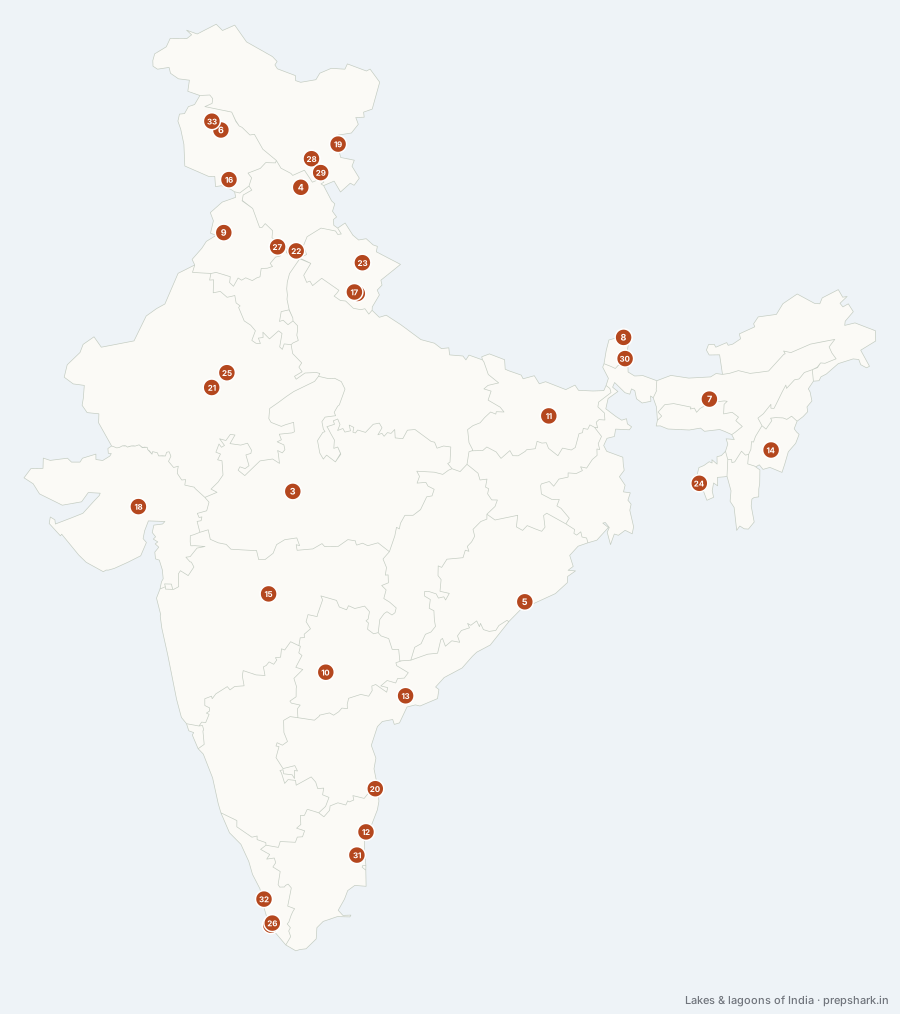
Numbered as on the map
The 33 on the map
1. Ashtamudi
Kerala
Known forThe gateway of the Kerala backwaters, and its clam fishery
A palm-shaped estuarine lagoon at Kollam whose name means eight-branched, and the second largest of the Kerala backwaters. It carries India’s first certified sustainable small-scale fishery, for the short-neck clam, which is the reason it turns up in questions about fisheries management rather than only about geography.
SettingEstuarine lagoon · eight-branched · Ramsar
2. Bhimtal
Uttarakhand
Known forThe largest of the Kumaon lakes
The largest of the Kumaon lakes, on the same fault system as Naini and a few kilometres from it, with an island at its centre. It is the clearest single answer to why the lake district is where it is: the basins are structural, not glacial and not river-cut, so they cluster along the faults rather than along the drainage.
SettingKumaon hills · fault-controlled basin · Lesser Himalaya
3. Bhojtal
Madhya Pradesh
Known forAn eleventh-century reservoir, and Bhopal’s water supply
An eleventh-century reservoir built by damming the Kolans, still the main water supply of Bhopal a thousand years later, and a Ramsar site. It is the oldest working large water body in the corpus and the reason Bhopal is called the city of lakes — a piece of medieval engineering that became municipal infrastructure.
SettingMalwa plateau · earthen dam of the Kolans · Ramsar
4. Chandra Taal
Himachal Pradesh
Known forA moraine-dammed glacial lake and Ramsar site
A glacial lake in the upper Chandra valley of Lahaul and Spiti, dammed behind moraine at about 4,300 m, and a Ramsar site. Moraine-dammed lakes are the ones that matter beyond their beauty: the same structure elsewhere in the Himalaya is what produces glacial lake outburst floods.
SettingLahaul and Spiti · moraine-dammed · Ramsar
5. Chilika
Odisha
Known forThe largest brackish lagoon in India
The largest brackish lagoon in India and the largest wintering ground for migratory birds on the subcontinent, held behind a sand bar built by the longshore drift of the Bay of Bengal. Its salinity is the whole story: the mouth silts up, the lagoon freshens, the fishery collapses — and the 2000 opening of a new sea mouth reversed that, which is why Chilika came off the Montreux Record.
SettingCoastal lagoon · sand bar · Irrawaddy dolphin
For the examLargest BRACKISH lagoon; Wular is the largest freshwater lake. It holds India’s only known resident Irrawaddy dolphin population.
6. Dal
Jammu and Kashmir
Known forSrinagar’s urban lake, and its floating gardens
An urban lake inside Srinagar, and the standing case study in eutrophication in India: sewage and the floating vegetable gardens have cut the open water sharply within living memory. The floating gardens themselves are the interesting part — mats of matted weed and mud that are farmed, anchored, and gradually turn water into land.
SettingTectonic valley lake · floating gardens · eutrophic
7. Deepor Beel
Assam
Known forA Brahmaputra oxbow, and Assam’s Ramsar wetland
A permanent freshwater lake on the southern edge of Guwahati and a former channel of the Brahmaputra — a beel is precisely that, an abandoned river course left as standing water when the river shifted. It is a Ramsar site, and the city’s landfill on its edge is the standing example of an urban wetland being lost from the rim inwards.
SettingBrahmaputra floodplain · oxbow beel · Ramsar
For the examA beel is an oxbow or abandoned channel of the Brahmaputra. The same landform is a chaur in Bihar and a jheel in the upper Ganga plain.
8. Gurudongmar
Sikkim
Known forOne of the highest lakes in India
One of the highest lakes in India at about 5,400 m, on the Tibetan plateau edge in north Sikkim, and a source stream of the Teesta. It freezes solid through winter except for one section, which is the origin of the story attached to it and, incidentally, of its use as a water source by the army post below.
SettingGlacial basin · frozen in winter · Teesta headwaters
9. Harike
Punjab
Known forThe largest wetland in northern India, at the Beas–Sutlej confluence
A man-made wetland formed by barraging the confluence of the Beas and the Sutlej, and the largest in northern India. It feeds the Indira Gandhi canal into Rajasthan, so a Ramsar site is also the head of the largest irrigation canal in the country — the clearest case in the corpus of a wetland and a waterworks being the same object.
SettingBarrage wetland · Beas and Sutlej confluence · Ramsar
For the examThe head of the Indira Gandhi canal. Punjab’s three Ramsar sites are Harike, Kanjli and Ropar.
10. Hussain Sagar
Telangana
Known forThe sixteenth-century tank joining Hyderabad and Secunderabad
A sixteenth-century tank built on a Musi tributary that now sits between Hyderabad and Secunderabad and joins them. It is in the corpus as the urban counterpart to Bhojtal: the same idea, dam a stream to hold the monsoon, five centuries later and now the subject of one of India’s longest-running lake clean-up programmes.
SettingDeccan plateau · dammed Musi tributary · urban lake
11. Kabartal
Bihar
Known forThe largest oxbow wetland on the Gangetic plain
The largest freshwater oxbow wetland on the Gangetic plain and Bihar’s first Ramsar site, an abandoned meander of the Burhi Gandak. It is the plainest illustration in the corpus of how a meandering river makes lakes: the neck of a loop is cut through in flood, the loop is sealed off, and what is left is a crescent of standing water.
SettingGangetic plain · oxbow of the Burhi Gandak · Ramsar
For the examBihar’s first Ramsar site, designated 2020. Also written Kanwar Jheel or Kabar Taal.
12. Kaliveli
Tamil Nadu
Known forOne of the largest brackish wetlands on the Coromandel coast
A coastal brackish lagoon draining to the sea at Yedayanthittai, designated a Ramsar site in 2022 and one of the largest wetlands on the Coromandel. It is a staging post rather than a destination on the Central Asian flyway, which is a distinction the bird questions turn on.
SettingCoromandel coast · brackish lagoon · Ramsar
13. Kolleru
Andhra Pradesh
Known forThe flood balancer between the Krishna and Godavari deltas
A large shallow freshwater lake sitting in the gap between the Krishna and Godavari deltas, acting as the natural flood balancer for both. It is the standing Indian case of aquaculture eating a wetland: fish ponds took most of the lake bed before Operation Kolleru began demolishing them, and the recovery is still partial.
SettingInter-deltaic basin · shallow freshwater · Ramsar
14. Loktak
Manipur
Known forThe floating phumdis, and the only floating national park
The largest freshwater lake in the north-east, and the only one anywhere carrying phumdis — floating islands of matted vegetation, soil and organic matter thick enough to walk on and to build on. The largest of them holds Keibul Lamjao, the only floating national park in the world, which is the last refuge of the sangai deer.
SettingManipur valley · phumdis · Ramsar
For the examKeibul Lamjao is the floating national park; the sangai is the brow-antlered deer it protects. The Ithai barrage downstream is the reason the phumdis are thinning.
15. Lonar
Maharashtra
Known forThe only meteorite crater lake in basalt on earth
The only meteorite impact crater in basalt anywhere on earth, and the only one in India holding a lake. The water is both saline and alkaline at once, which should not be chemically stable and is the reason the lake is studied; in 2020 it turned pink within days as its halophilic algae bloomed. NASA has used it as a Mars analogue.
SettingImpact crater in Deccan basalt · saline and alkaline · Ramsar
For the examImpact crater, not volcanic — the distinction is the question. Saline AND alkaline together, and a Ramsar site since 2020.
16. Mansar
Jammu and Kashmir
Known forThe larger of the Surinsar–Mansar Ramsar pair
A Shivalik lake in the Jammu foothills, designated with its neighbour Surinsar as one Ramsar site. It is a good illustration of what the outer Himalaya does to drainage: the Shivalik is young, loose and still rising, so it repeatedly dams its own streams and leaves lakes sitting behind ridges.
SettingShivalik foothills · ridge-dammed · Ramsar
17. Naini
Uttarakhand
Known forThe tectonic lake at the centre of the Kumaon lake district
A tectonic lake in a fault-controlled basin in the Kumaon hills, and the reason the town exists. The Kumaon lake district — Naini, Bhimtal, Sattal, Naukuchiatal — is a cluster of these along the same fault system, which is why so many lakes sit within a few kilometres of one another and nowhere else in the range.
SettingKumaon hills · fault-controlled basin · Lesser Himalaya
18. Nal Sarovar
Gujarat
Known forGujarat’s first Ramsar site, on a former sea strait
A large shallow lake on the edge of the Little Rann, the remnant of a strait that once separated Saurashtra from the mainland — which is why a freshwater bird sanctuary sits on a bed of marine sediment. Gujarat’s first Ramsar site, and among the biggest waterfowl grounds in western India.
SettingFormer strait · shallow seasonal water · Ramsar
19. Pangong Tso
Ladakh
Known forAn endorheic lake split by the Line of Actual Control
An endorheic lake at 4,250 m that runs 130 km east into Tibet, with roughly a third of its length in India — the Line of Actual Control crosses the water itself, which is why its northern bank has a place in every India–China standoff. Endorheic means it has no outlet: the water leaves only by evaporation, which is why a lake fed by meltwater is brackish.
SettingTrans-Himalaya · endorheic · brackish at 4,250 m
For the examIt is brackish despite being glacier-fed, because it has no outlet. The Finger areas on its northern bank are the standoff question.
20. Pulicat
Andhra Pradesh
Known forThe second largest brackish lagoon in India
The second largest brackish lagoon in India, straddling the Andhra–Tamil Nadu boundary and separated from the sea by the barrier island of Sriharikota — which is why the satellite launch centre and a flamingo lagoon share an address. The same longshore drift that built Chilika’s bar built this one.
SettingCoastal lagoon · barrier island · flamingo wintering
For the examSecond largest lagoon after Chilika. Sriharikota, the barrier island, carries the Satish Dhawan Space Centre.
21. Pushkar
Rajasthan
Known forThe pilgrimage lake of the Aravalli, and its Brahma temple
A small lake in an Aravalli hollow near Ajmer, ringed by bathing ghats and carrying the best-known Brahma temple in India. It is included as the counterpart to Sambhar twenty-five kilometres away: two lakes in the same arid basin, one a salt playa and one fresh, separated by nothing more than the local drainage.
SettingAravalli hollow · semi-arid · pilgrimage lake
22. Renuka
Himachal Pradesh
Known forThe largest natural lake in Himachal Pradesh
The largest natural lake in Himachal Pradesh, in the Shivalik of Sirmaur, and a Ramsar site since 2005. It is shaped, by tradition, like a reclining woman, which is the source of both its name and the fair held around it — one of the cases where a lake’s cultural life is why it was protected at all.
SettingShivalik · natural lake · Ramsar
23. Roopkund
Uttarakhand
Known forThe skeleton lake below Trisul
A small glacial tarn at about 5,000 m below Trisul, and the site of several hundred human skeletons exposed when the ice melts each year. Genetic work has since shown they are not one group or one event: some are South Asian and roughly twelve hundred years old, others Mediterranean and far more recent, which dismantled every single-disaster story told about it.
SettingGlacial tarn · Garhwal Himalaya · seasonally frozen
24. Rudrasagar
Tripura
Known forTripura’s Ramsar wetland, and the Neermahal palace
A natural sedimentation reservoir in the Tripura lowland, fed by three streams and draining to the Gomati, and a Ramsar site. The water palace built on an island in it is the reason most people meet the lake at all, which makes it a rare case of a wetland with a monument for a landmark.
SettingTripura lowland · sedimentation basin · Ramsar
25. Sambhar
Rajasthan
Known forThe largest inland salt lake in India
The largest inland salt lake in India and the country’s biggest source of inland salt — a playa in a shallow endorheic basin between Aravalli spurs, holding water only after the monsoon and evaporating to a crust for the rest of the year. That cycle is the whole landform: rain in, nothing out, salt left behind.
SettingPlaya · endorheic basin · salt works
For the examLargest inland SALT lake; Wular is the largest freshwater and Chilika the largest brackish lagoon. A Ramsar site, and a major flamingo ground after the monsoon.
26. Sasthamkotta
Kerala
Known forThe largest freshwater lake in Kerala
The largest freshwater lake in Kerala, and unusual on a coast of brackish backwaters: it is fed entirely by springs, with no river inflow, which is why its water is clean enough to supply Kollam without treatment. The larvae in it eat bacteria, which is the folk explanation and roughly the real one.
SettingSpring-fed · no river inflow · Ramsar
27. Sukhna
Chandigarh
Known forThe planned lake of Chandigarh, silting from the Shivalik
A rain-fed reservoir made by damming a seasonal Shivalik stream when Chandigarh was built, and part of Le Corbusier’s plan for the city rather than an accident of it. Its persistent problem is the Shivalik itself: the range is the most rapidly eroding in India, so the lake silts up faster than almost any other in the country.
SettingShivalik foothills · rain-fed reservoir · rapid siltation
28. Tso Kar
Ladakh
Known forA high-altitude salt lake and Ramsar site
A fluctuating salt lake in the Rupshu valley whose name means white lake, for the salt crust its evaporating margins leave behind. It was declared a Ramsar site in 2020, and it works as the plainest possible demonstration of why a lake with no outlet in a cold desert turns to salt.
SettingRupshu valley · salt crust · Ramsar
29. Tso Moriri
Ladakh
Known forA Ramsar site, and India’s bar-headed goose breeding ground
A high-altitude Ramsar site on the Changthang plateau, and the only regular breeding ground in India of the bar-headed goose — the bird that crosses the Himalaya at altitudes where the air holds a third of the oxygen at sea level. The Changpa herders who graze the surrounding plateau are the source of pashmina.
SettingChangthang plateau · endorheic and brackish · Ramsar
30. Tsomgo
Sikkim
Known forThe glacial lake on the road to Nathu La
A glacial lake on the road from Gangtok to Nathu La, fed by snowmelt off the surrounding slopes and frozen for several months of the year. Its position is the point worth holding: it sits on the old trade route to Lhasa, so the lake, the pass and the caravan road are three ways of describing one corridor.
SettingEastern Himalaya · glacial · snowmelt-fed
31. Veeranam
Tamil Nadu
Known forThe oldest of the great Chola irrigation tanks still in use
A Chola irrigation tank of the tenth century, still in use and now also a drinking water source for Chennai. It belongs here as the one entry that is neither natural nor a modern dam: the Tamil country’s system of chained tanks, each spilling into the next, is a thousand-year-old answer to a monsoon that arrives in eight weeks.
SettingCauvery delta margin · Chola tank system · monsoon-fed
32. Vembanad
Kerala
Known forThe longest lake in India
The longest lake in India and the largest in Kerala — the central body of the backwater system, a chain of brackish lagoons and channels held behind the coastal sand bars. The Thanneermukkom barrier across it separates salt from fresh so that the Kuttanad paddy below sea level can be farmed, and that barrier is now itself the ecological argument.
SettingBackwater lagoon · sand-bar coast · Ramsar
For the examLongest lake in India, and the Kuttanad farmland beside it is among the few places on earth farmed below sea level.
33. Wular
Jammu and Kashmir
Known forThe largest freshwater lake in India
The largest freshwater lake in India, and a tectonic basin rather than a river feature: the whole Kashmir valley is a downwarped trough between the Pir Panjal and the Great Himalaya, and Wular is where the Jhelum spreads out across the floor of it. It is also the valley’s flood absorber, which is why the shrinkage of its area to siltation and willow plantations is a flood question rather than only a conservation one.
SettingTectonic basin · Jhelum floodplain · flood absorber
For the examLargest FRESHWATER lake in India. Chilika is the largest brackish lagoon and Sambhar the largest inland salt lake — the three superlatives are one question.
Keep going