

Skip to content
PrepShark

Chapter 17Nationalist Movement and Formation of Andhra PradeshUpdated

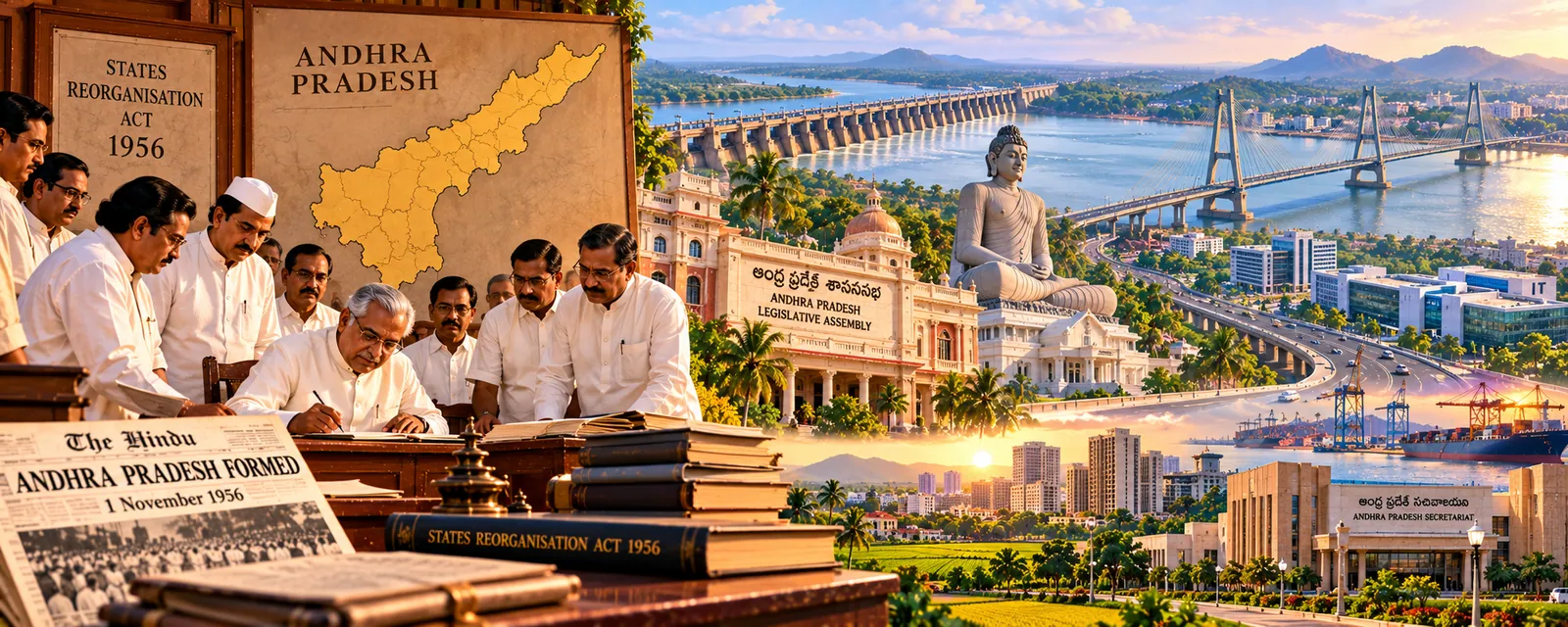
Formation of Andhra Pradesh, 1956 and Developments up to 2014

How Andhra State and Telangana merged into Andhra Pradesh in 1956 under the Gentlemen's Agreement, how the united state's safeguards, politics, economy and movements evolved, and why it was bifurcated on 2 June 2014.

  • 17sections
  • ~86min read
0%

0 of 21 sections

~86 min read

~86 min read

Start hereAbout 2 min

Chapter Overview Map

In this section: 1 mind map

Figure 17.1Mind map: how united Andhra Pradesh was formed, how it evolved and why it was divided
United Andhra Pradesh, 1956–2014
  1. 17.1–17.2 Two states, one language

    • Andhra State (1953), carved out of Madras, and the Telugu-speaking Telangana region of Hyderabad State were separate units with very different histories.
    • The States Reorganisation Commission (1955) advised keeping Telangana separate for the time being.
  2. 17.3–17.4 Merger with safeguards

    • The Gentlemen's Agreement (20 February 1956) promised Telangana safeguards in jobs, funds and education.
    • Andhra Pradesh, the first linguistic state to unite nearly all Telugu speakers, was formed on 1 November 1956.
  3. 17.5 Safeguards at work

    • The Telangana Regional Committee, the Mulki Rules and the surplus-revenue pledge were meant to protect Telangana inside the united state.
    • Disputes over how these safeguards worked never fully died down.
  4. 17.6 Political journey

    • The Congress governed for the first 26 years; N.T. Rama Rao's Telugu Desam Party ended that dominance in 1983.
    • Chandrababu Naidu pushed technology-led growth; Y.S. Rajasekhara Reddy expanded welfare.
  5. 17.7–17.10 Strains and settlements

    • The 1969 Telangana and 1972 Jai Andhra movements shook the state from opposite directions.
    • The answers came as the Six-Point Formula (1973), Article 371D, the Presidential Order of 1975 and GO 610 (1985).
  6. 17.11–17.17 Growth, disparity, parting

    • Irrigation, industry and the rise of Hyderabad transformed the economy, but regional disparities fed resentment.
    • The revived movement led by the Telangana Rashtra Samithi (founded 2001) ended in bifurcation on 2 June 2014.
  7. Don't confuse

    • Andhra State (1953) was only the Madras-side Telugu state; Andhra Pradesh (1956) added Telangana.
    • The announcement of 9 December 2009, the Act of 1 March 2014 and the appointed day of 2 June 2014 are three different milestones.

The first two branches cover 1953–56, the middle branches the united state's working, and the last branch the road to 2014. Notice how each settlement follows a movement.

Inside this chapter

What Formation of Andhra Pradesh, 1956 and Developments up to 2014 covers

  1. Chapter Overview Map
  2. The Starting Points — Andhra State and Hyderabad State
  3. The States Reorganisation Commission, 1953–55
  4. The Gentlemen's Agreement, 20 February 1956
  5. Formation of Andhra Pradesh, 1 November 1956
  6. Safeguards and Regional Arrangements after 1956
  7. The Political Journey, 1956–2014
  8. The Telangana Movement of 1969
  9. The Jai Andhra Movement of 1972
  10. The Six-Point Formula and the Article 371D Regime
  11. G.O. 610 and the Girglani Commission
  12. The Economy of United Andhra Pradesh, 1956–2014
  13. Society, Welfare and Social Movements, 1956–2014
  14. Regional Disparities and the Development Debate
  15. Language and Culture in United Andhra Pradesh
  16. The Revival of the Telangana Demand, 1990s–2009
  17. The Final Phase, 2009–2014
  18. Why Bifurcation Happened — and the Transition of 2 June 2014
  19. Location and Map Practice
  20. Memory and Recall Review
  21. Rapid Revision Sheet
All 18 chapters in History and Culture of Andhra Pradesh
  1. The Satavahanas and Ikshvakus
  2. The Salankayanas, Pallavas and Vishnukundins
  3. The Eastern Chalukyas, Rashtrakutas and Renati Cholas
  4. Society, Religion, Language, Literature, Art and Architecture in Ancient Andhra
  5. The Kakatiyas and Reddi Kingdoms
  6. The Gajapatis, Vijayanagara Empire and Regional Powers
  7. Evolution of Telugu Language and Literature
  8. Socio-Cultural and Religious Life, Fine Arts and Architecture in Medieval Andhra
  9. European Settlements and Colonial Rule in Andhra
  10. Colonial Education, Missionaries and Intellectual Contributions
  11. Social Reform and Literary Awakening in Modern Andhra
  12. Press, Library Movement and Cultural Traditions of Andhra
  13. Freedom Movement in Andhra Pradesh
  14. Justice Party, Non-Brahmin Movement and Political Awakening
  15. Nationalist Literature, Grandhalaya Movement and Role of Women
  16. Andhra Movement and Formation of Andhra State, 1953
  17. Formation of Andhra Pradesh, 1956 and Developments up to 2014
  18. Bifurcation of Andhra Pradesh and the AP Reorganisation Act, 2014

Open the History and Culture of Andhra Pradesh library

Daily Radar

This chapter in the news