

Start hereAbout 1 min
Chapter Overview Map
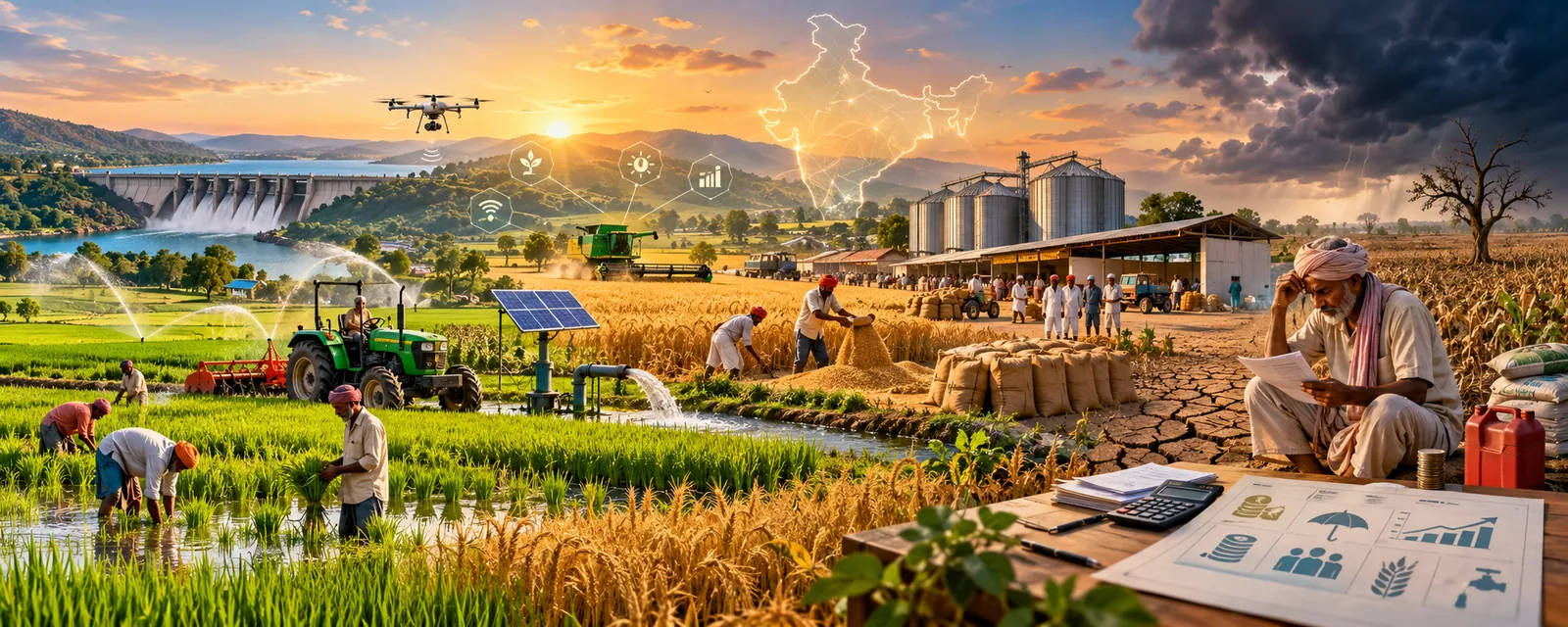
Agricultural Development in India
8.1–8.2 Agriculture in the economy
- Agriculture's share in output has fallen to about one-sixth, but it still employs about 46% of workers.
- Low productivity per worker and per hectare is the core structural problem.
8.3–8.4 Finance and markets
- Farmers need timely, cheap credit and insurance to invest and bear risk.
- Fragmented markets and intermediaries cut the farmer's share of the final price; the online National Agriculture Market and Farmer Producer Organisations are the main reforms.
8.5–8.7 Technology and sustainability
- The Green Revolution raised cereal output but left rainfed areas behind and strained water and soil.
- Dryland, organic, natural and sustainable farming aim at resilience as well as output.
8.8–8.10 Prices and policy
- The Minimum Support Price, recommended by the Commission for Agricultural Costs and Prices, is set at least at 1.5 times paid-out cost plus family labour; procurement is mainly of wheat and rice.
- The Swaminathan Commission put farmers' incomes at the centre of policy.
8.11–8.14 Diversification, infrastructure and reform
- Livestock, fisheries and horticulture (the "Rainbow Revolution") raise and stabilise incomes.
- Storage, processing and digital infrastructure link farms to markets; Andhra Pradesh examples apply these ideas.
Don't confuse
- Output and productivity: output is total production; productivity is output per unit of land, labour or input.
- Paid-out cost plus family labour and comprehensive cost: current price policy uses the first; the comprehensive cost also counts rent on owned land and interest on owned capital.
Notice how the branches move from agriculture's place in the economy to finance, technology, prices and reform; the last branch lists two confusions that run through the chapter.