

Skip to content
PrepShark

Chapter 5Updated

Government Budgeting, Taxation and Fiscal Federalism in India

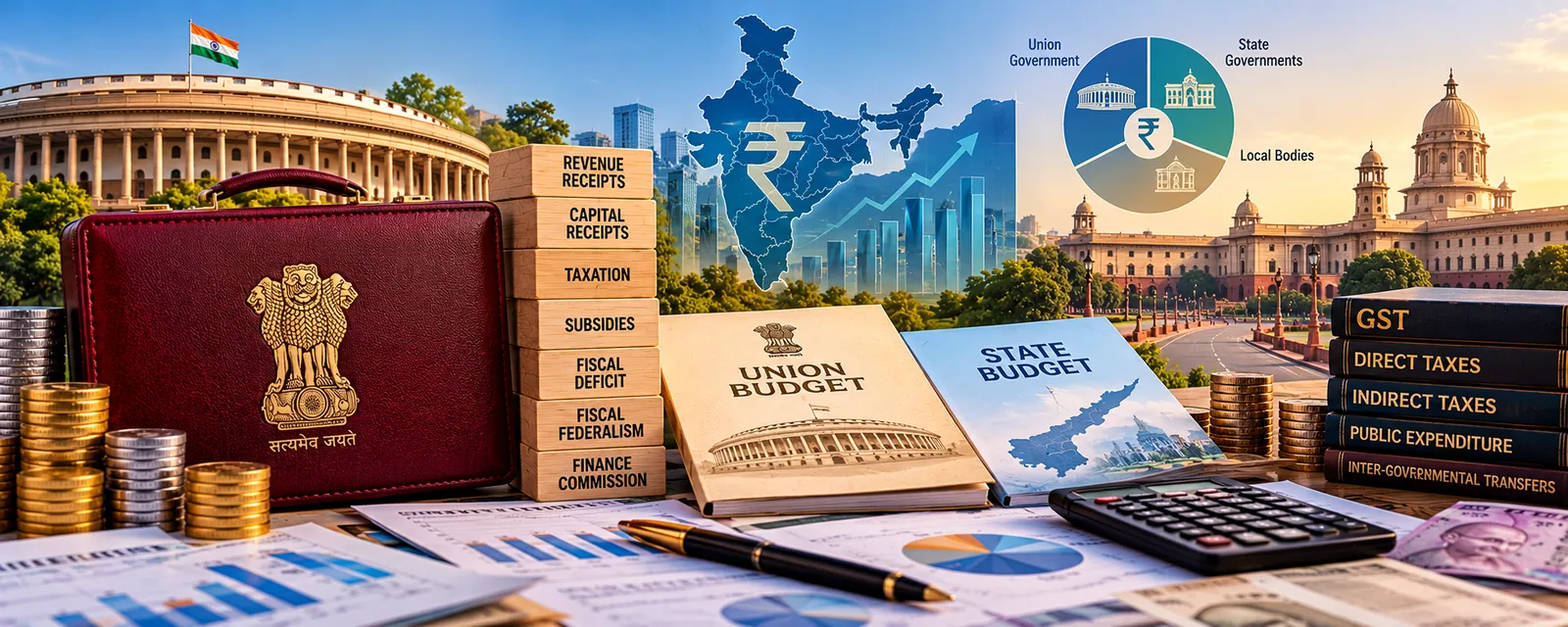
How the Union Budget is made, approved and audited, how taxes, spending, deficits and debt work, and how revenue is shared with the States and Andhra Pradesh through Finance Commissions and grants.

  • 15sections
  • ~107min read
0%

0 of 18 sections

~107 min read

~107 min read

Start hereAbout 1 min

Chapter Overview Map

In this section: 1 mind map

Figure 5.1Chapter overview
Government Budgeting, Taxation and Fiscal Federalism
  1. 5.1–5.3 Budget and its process

    • The Annual Financial Statement (Article 112) is prepared by the Ministry of Finance, voted by the Lok Sabha and audited by the Comptroller and Auditor General.
    • Money leaves the Consolidated Fund only through an Appropriation Act.
  2. 5.4–5.7 Receipts, taxes and spending

    • Every item is revenue or capital, depending on its effect on assets and liabilities.
    • GST (since 2017) and a rising share of direct taxes shape Union revenue.
  3. 5.8–5.10 Deficits, debt and fiscal policy

    • The fiscal deficit is net borrowing; the primary deficit excludes interest.
    • The Union now targets debt of 50 ± 1% of gross domestic product by 31 March 2031.
  4. 5.11–5.13 Fiscal federalism

    • States get 41% of the divisible pool on the Finance Commission's recommendation.
    • Grants, Centrally Sponsored Schemes and loans add to devolution.
  5. 5.14–5.15 Budget 2026-27 and Andhra Pradesh

    • The fiscal deficit is budgeted at 4.3% of gross domestic product in 2026-27.
    • Andhra Pradesh's share rises to 4.217% under the Sixteenth Finance Commission, but its revenue deficit grant ends.
  6. Don't confuse

    • Charged expenditure is not voted but is still paid from the Consolidated Fund; the Public Account needs no appropriation at all.
    • The Finance Commission (Article 280) shares taxes; the GST Council (Article 279A) recommends GST rates.

Notice how the branches follow the chapter's order, from how a budget is made to how money is raised, spent, borrowed and shared with States; the last branch lists two common mix-ups.

Inside this chapter

What Government Budgeting, Taxation and Fiscal Federalism in India covers

  1. Chapter Overview Map
  2. Government Budget: Meaning, Objectives and Principles
  3. Constitutional Framework of the Union Budget
  4. Budget Cycle: Preparation, Approval, Execution and Audit
  5. Structure of the Union Budget: Receipts and Expenditure
  6. Taxation and Tax Reforms
  7. Goods and Services Tax
  8. Public Expenditure and Development Priorities
  9. Budget Deficits and Fiscal Indicators
  10. Public Debt, FRBM and Fiscal Rules
  11. Fiscal Policy and Macroeconomic Management
  12. Fiscal Federalism in India
  13. Finance Commissions
  14. Local Government Finances
  15. Union Budget 2026-27: An Analysis
  16. Andhra Pradesh and Union Fiscal Policy
  17. Memory and Recall Review
  18. Rapid Revision Sheet
All 15 chapters in Paper IV: Economy and Development of India and Andhra Pradesh
  1. Structure, Growth and Major Challenges of the Indian Economy
  2. Inflation, External Sector and Financial Stability
  3. Resource Mobilisation in the Indian Economy
  4. Resource Mobilisation and Post-Bifurcation Economic Challenges of Andhra Pradesh
  5. Government Budgeting, Taxation and Fiscal Federalism in India
  6. Government Budgeting and Fiscal Management in Andhra Pradesh
  7. Inclusive Growth, Poverty, Employment and Social Development
  8. Agricultural Development, Policies and Agrarian Challenges in India
  9. Agricultural and Allied Sector Development in Andhra Pradesh
  10. Industrial Development, Industrial Policy and MSMEs in India
  11. Industrial Development and Industrial Policy of Andhra Pradesh
  12. Transport, Communication and Digital Infrastructure in India
  13. Energy, Urban Infrastructure and Infrastructure Financing in India
  14. Transport, Urban and Digital Infrastructure Development in Andhra Pradesh
  15. Energy Infrastructure, Investment and Development Projects in Andhra Pradesh

Open the Paper IV: Economy and Development of India and Andhra Pradesh library