

Skip to content
PrepShark

Chapter 3Updated

Resource Mobilisation in the Indian Economy

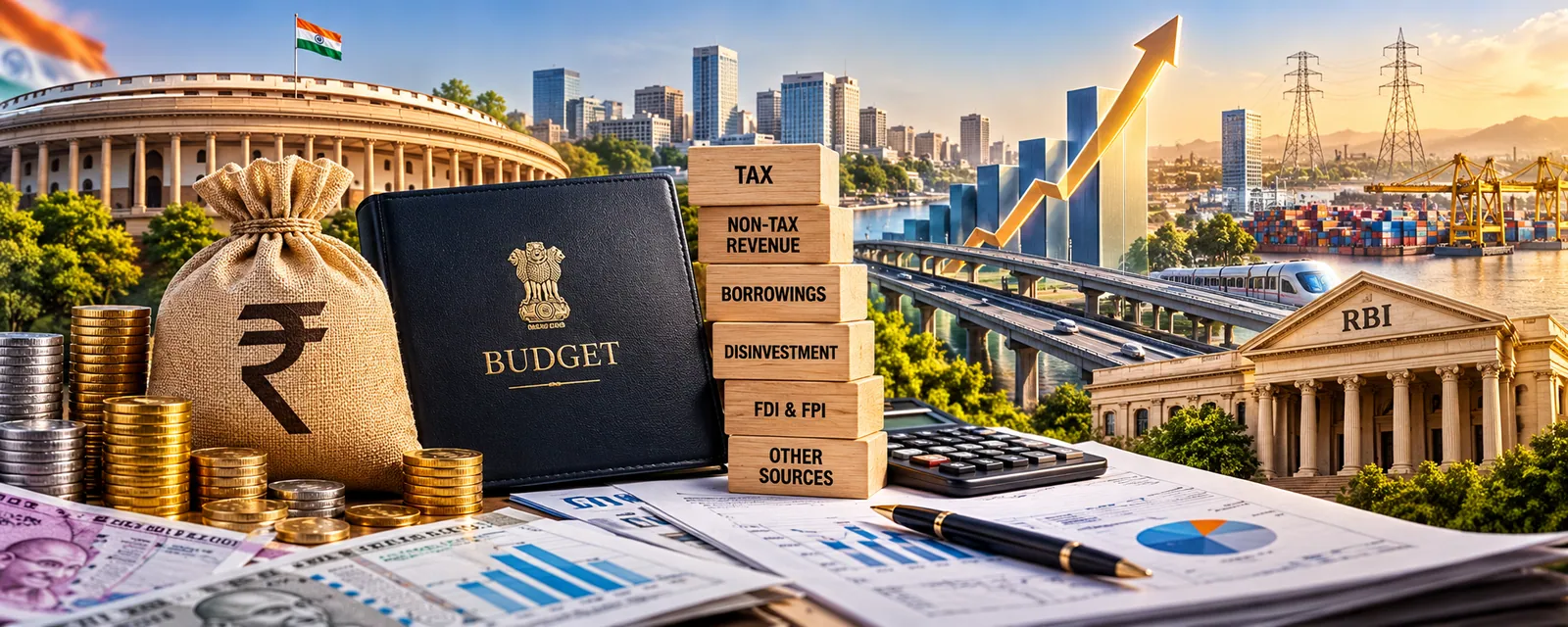
How India raises financial, physical and energy resources through taxes, borrowing, foreign capital, markets and development finance, and how wisely it turns them into investment and growth, with Andhra Pradesh applications.

  • 16sections
  • ~100min read
0%

0 of 20 sections

~100 min read

~100 min read

Start hereAbout 1 min

Chapter Overview Map

In this section: 1 mind map

Resource Mobilisation in the Indian Economy
  1. 3.1–3.2 Foundations and sources

    • Resources are financial, physical and energy; mobilisation gathers them, allocation directs them.
    • Savings flow through intermediaries into investment and capital formation.
    • Public and private sources are complements.
  2. 3.3–3.6 Ways of raising finance

    • Tax and non-tax revenue need no repayment.
    • Public debt, domestic or external, must be serviced.
    • Foreign Direct Investment (FDI) is stable and long-term; Foreign Portfolio Investment (FPI) is liquid and volatile.
  3. 3.7 Desirability and consequences

    • Each source has a cost, a risk and a best use.
    • The right source depends on the project, institutions and economic conditions.
  4. 3.8–3.12 Policies, markets and institutions

    • Monetary policy (RBI) sets the price of money; fiscal policy (Government) raises and spends resources.
    • Financial markets and DFIs channel long-term funds into industry and infrastructure.
  5. 3.13–3.16 Real resources and application

    • Land, water, minerals, forests and energy are the material base.
    • Andhra Pradesh applies these concepts; the integrated framework closes the chapter.
  6. Don't confuse

    • Fiscal deficit is a yearly flow; public debt is a stock.
    • Gross FDI, FDI equity and net FDI are three different numbers.

The branches follow the order of the sections; the confusion branch collects two traps that cut across sections.

Inside this chapter

What Resource Mobilisation in the Indian Economy covers

  1. Chapter Overview Map
  2. Foundations of Resource Mobilisation
  3. Financial Resources of the Public and Private Sectors
  4. Budgetary Resources: Tax and Non-Tax Revenue
  5. Public Debt and Domestic Borrowing
  6. External Debt and Multilateral Financing
  7. Foreign Direct Investment and Foreign Portfolio Investment
  8. Comparative Evaluation of Financing Sources
  9. Monetary Policy and Resource Mobilisation
  10. Fiscal Policy and Resource Mobilisation
  11. Financial Markets in India
  12. Institutions of Development Finance
  13. Investment in Industries and Infrastructure
  14. Physical Resources and Economic Development
  15. Energy Resources and Economic Development
  16. Andhra Pradesh: Applying the Concepts
  17. Integrating Resource Mobilisation and Development
  18. Memory and Recall Review
  19. Rapid Revision Sheet
  20. Notes
All 15 chapters in Paper IV: Economy and Development of India and Andhra Pradesh
  1. Structure, Growth and Major Challenges of the Indian Economy
  2. Inflation, External Sector and Financial Stability
  3. Resource Mobilisation in the Indian Economy
  4. Resource Mobilisation and Post-Bifurcation Economic Challenges of Andhra Pradesh
  5. Government Budgeting, Taxation and Fiscal Federalism in India
  6. Government Budgeting and Fiscal Management in Andhra Pradesh
  7. Inclusive Growth, Poverty, Employment and Social Development
  8. Agricultural Development, Policies and Agrarian Challenges in India
  9. Agricultural and Allied Sector Development in Andhra Pradesh
  10. Industrial Development, Industrial Policy and MSMEs in India
  11. Industrial Development and Industrial Policy of Andhra Pradesh
  12. Transport, Communication and Digital Infrastructure in India
  13. Energy, Urban Infrastructure and Infrastructure Financing in India
  14. Transport, Urban and Digital Infrastructure Development in Andhra Pradesh
  15. Energy Infrastructure, Investment and Development Projects in Andhra Pradesh

Open the Paper IV: Economy and Development of India and Andhra Pradesh library