Skip to content

Chapter 08Updated

Qutubshahi’s Dynasty

  • 66sections
  • ~35min read
0%

0 of 66 sections

~35 min read

~35 min read
1Section 1 of 1About 1 min

Qutb Shahi Dynasty: Background and Foundation

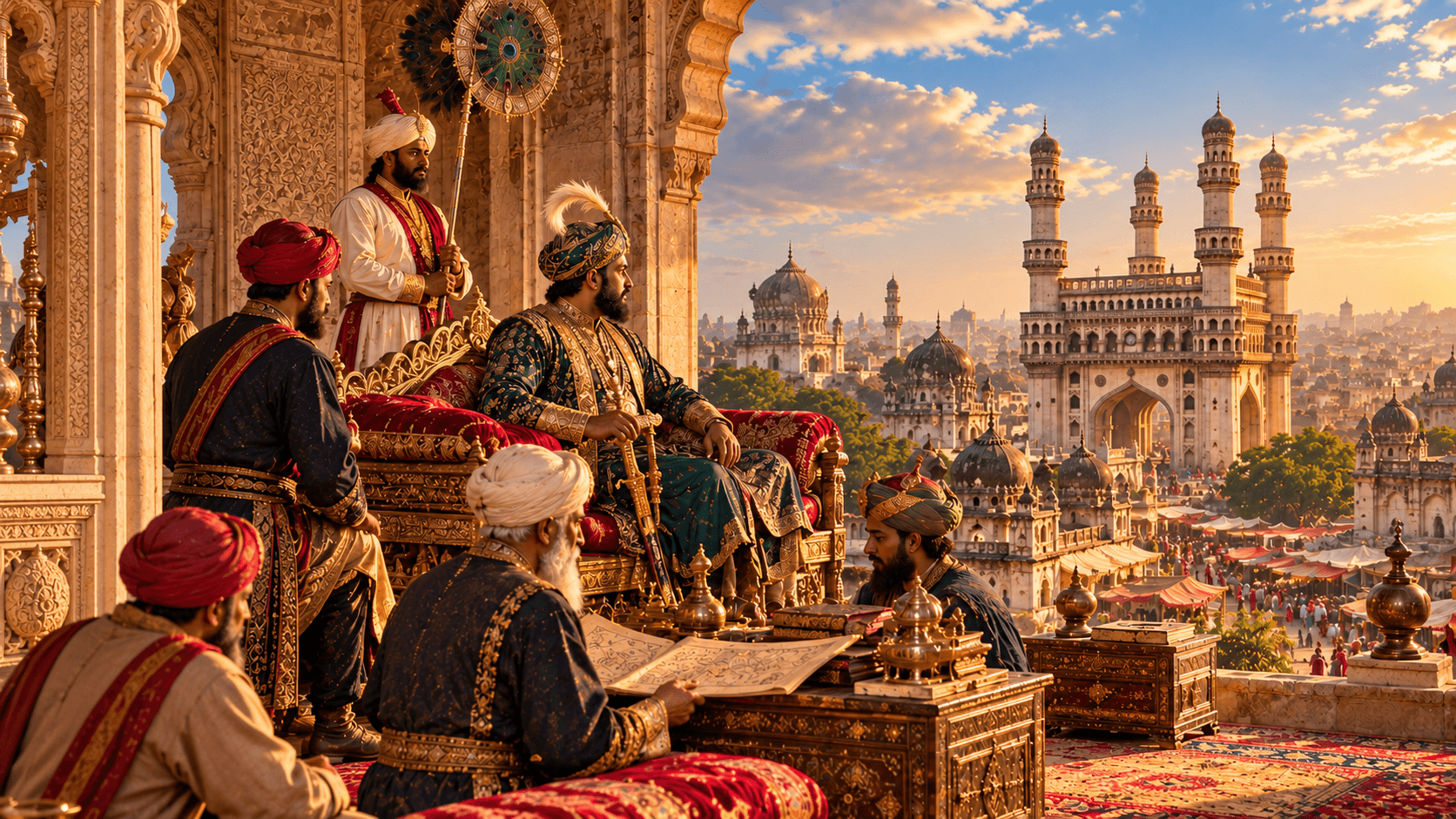
  • The Qutb Shahi dynasty ruled the Golconda region of the Deccan from the early 16th century until 1687 CE.
  • The dynasty emerged from the political fragmentation of the Bahmani Sultanate.
  • Sultan Quli Qutb-ul-Mulk established independent Qutb Shahi authority at Golconda in 1518 CE after serving as a Bahmani governor.
  • Golconda remained the principal capital of the dynasty until Muhammad Quli Qutb Shah established Hyderabad as the new capital in the late 16th century.
  • The Qutb Shahis belonged to the Shia Muslim tradition and developed a distinctive Deccani political and cultural identity.
  • Persian remained an important court language, while Telugu, Deccani Urdu and Sanskrit also flourished under royal patronage.
  • The dynasty's rule is generally remembered for the development of Golconda, Hyderabad, diamond commerce, irrigation, architecture, literature and composite Deccani culture.
  • Telangana Government sources place the Qutb Shahi phase broadly between 1518 and 1687 CE, although some district pages use slightly different starting dates for the regional transition.

Inside this chapter

What Qutubshahi’s Dynasty covers

  1. Qutb Shahi Dynasty: Background and Foundation
  2. Dynasty at a Glance
  3. Historical Sources
  4. Seven Qutb Shahi Sultans
  5. Sultan Quli Qutb-ul-Mulk
  6. Jamsheed Quli Qutb Shah
  7. Ibrahim Quli Qutb Shah
  8. Kandukuri Rudra Kavi
  9. Addanki Gangadhara
  10. Ponnaganti Telaganaryudu
  11. Muhammad Quli Qutb Shah
  12. Muhammad Quli Qutb Shah: Major Works
  13. Charminar
  14. Sultan Muhammad Qutb Shah
  15. Abdullah Qutb Shah
  16. Kshetrayya
  17. Abul Hasan Qutb Shah
  18. Akkanna and Madanna
  19. Kancharla Gopanna — Bhakta Ramadasu
  20. Abul Hasan and Shivaji
  21. Malkhed Conflict
  22. Mughal Conquest of Golconda
  23. Qutb Shahi Administration
  24. Administrative Hierarchy
  25. Peshwa and Mir Zumla
  26. Village Administration
  27. Revenue Administration
  28. Military Organisation
  29. Judiciary
  30. Economy and Agriculture
  31. Diamond Economy
  32. Industries
  33. Trade and Commerce
  34. Coinage
  35. Society and Religion
  36. Afaqis
  37. Religious Tolerance and Composite Culture
  38. Festivals
  39. Education
  40. Literature
  41. Important Telugu Literary Personalities
  42. Deccani Urdu Literature
  43. Vemana
  44. Potuluri Veera Brahmendra Swamy
  45. Art and Architecture
  46. Golconda Fort
  47. Hyderabad City
  48. Mecca Masjid
  49. Dar-ul-Shifa
  50. Qutb Shahi Tombs
  51. Painting
  52. Dance and Performing Arts
  53. Taramati and Premamati
  54. Composite Culture
  55. Foreign Travellers
  56. Important Monuments and Rulers
  57. Political Relations with Major Powers
  58. Qutb Shahi–Mughal Relations
  59. Qutb Shahi Administration: Officer Map
  60. Qutb Shahi vs Kakatiya Administration
  61. Qutb Shahi Architecture vs Kakatiya Architecture
  62. Qutb Shahi Rulers: Rapid Recall
  63. Major Chronology
  64. Historical Significance
  65. Qutb Shahi Dynasty: Key Numbers
  66. Prelims Traps
All 18 chapters in Telangana History
  1. Era / Period before Satavahanas
  2. Satavahanas
  3. Ikshvakus
  4. Vishnukundina’s
  5. Vemulawada Chalukyas & Mudigonda Chalukyas
  6. Kakatiya Dynasty
  7. Period After Kakatiya’s - Nayakas
  8. Qutubshahi’s Dynasty
  9. Mughal Rule in Telangana
  10. Asaf Jahis (Nizam Kingdom)
  11. Important Organizations / Parties emerged during Nizam Period
  12. Samsthanas in Nizam Kingdom
  13. Socio-Cultural Revival / Renaissance in Telangana
  14. Telangana Adi-Hindu Movement, Andhra Mahasabha
  15. Literary, Library Movement and Newspapers, Literary Researchers and Important Poets
  16. Telangana Peasants and Tribal Rebellion
  17. Telangana Peasants Armed Struggle
  18. Operation Polo – End of Nizam Rule

Open the Telangana History library

In the official syllabus