

Skip to content
PrepShark

Chapter 16Updated

Human Diseases, Microbial Infections and Preventive Healthcare

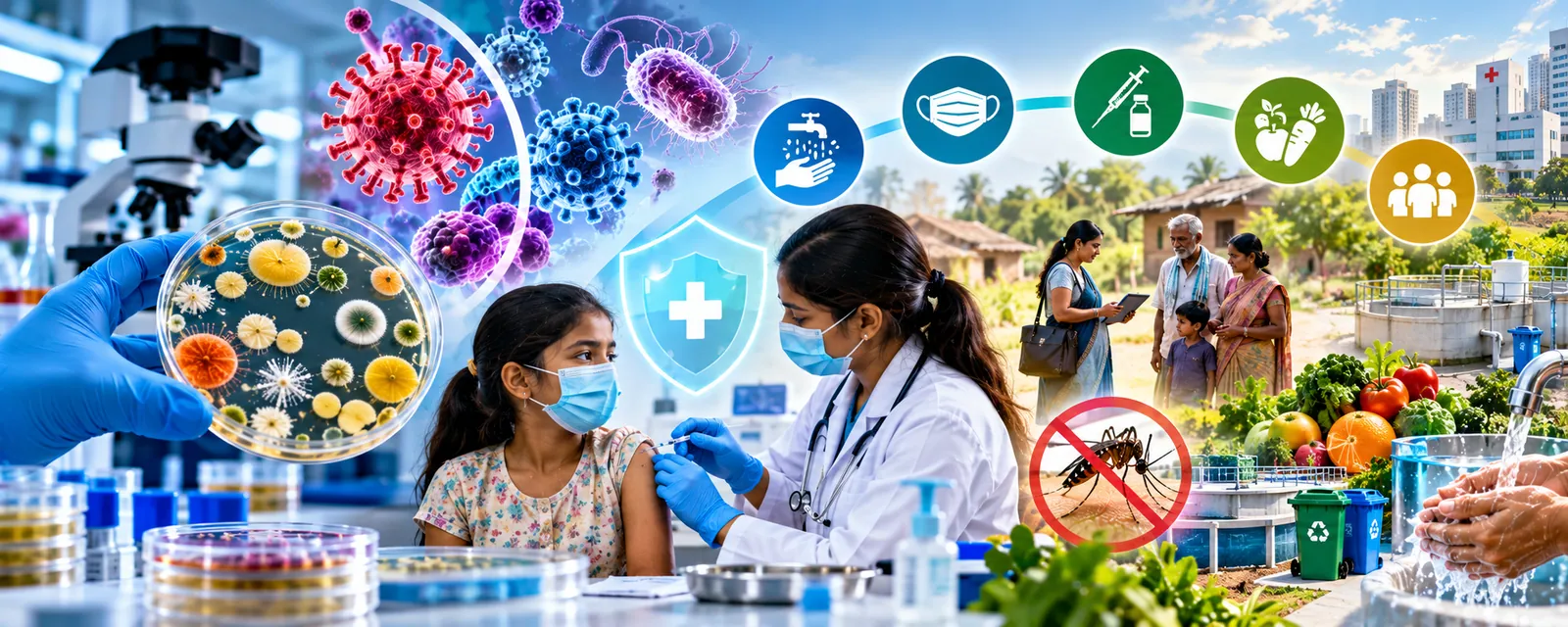
How microbes and other causes produce disease, how infections spread and are diagnosed, how resistance and non-communicable diseases are changing the burden, and how India and Andhra Pradesh prevent and control disease.

  • 18sections
  • ~124min read
0%

0 of 22 sections

~124 min read

~124 min read

Start hereAbout 1 min

Chapter Overview Map

In this section: 1 mind map

Figure 16.1Chapter at a glance
Human Diseases, Microbial Infections and Preventive Healthcare
  1. 16.1–16.4 Foundations

    • Health is complete physical, mental and social well-being; disease is a disturbance of normal body function.
    • Pathogens (bacteria, viruses, fungi, protozoa, helminths, prions) cause infectious disease.
    • Epidemiology studies how disease spreads: the triad, the chain of infection, incidence and prevalence.
  2. 16.5–16.8 Infectious diseases

    • Bacterial, viral, fungal and parasitic diseases differ in cause, spread and prevention.
    • Vector-borne, waterborne and zoonotic diseases link human health to animals and the environment (One Health).
  3. 16.9 Antimicrobial resistance

    • Microbes, not people, become resistant; misuse of antimicrobials selects resistant strains.
    • India responds through a National Action Plan and laboratory surveillance networks.
  4. 16.10–16.11 Non-infectious diseases

    • Non-communicable diseases (heart disease, diabetes, cancer, chronic lung disease) now cause most of India's disease burden.
    • Nutritional deficiencies and genetic disorders such as sickle cell disease remain public health problems.
  5. 16.12–16.15 Tools and programmes

    • Diagnostics range from microscopy to polymerase chain reaction (PCR), enzyme-linked immunosorbent assay (ELISA) and genome sequencing.
    • Prevention, surveillance and national programmes for tuberculosis, vector-borne disease, human immunodeficiency virus (HIV) and non-communicable diseases form the public health response.
  6. 16.16–16.18 Andhra Pradesh and the future

    • Andhra Pradesh faces a double burden: infections in tribal and coastal areas and a rising non-communicable disease load.
    • Future prevention rests on integrated surveillance, One Health and strong primary healthcare.

Notice how the six branches follow the chapter's order: foundations first, then diseases, resistance, tools and programmes, and finally Andhra Pradesh.

Inside this chapter

What Human Diseases, Microbial Infections and Preventive Healthcare covers

  1. Chapter Overview Map
  2. Health, Disease and Disease Burden
  3. Microorganisms and Pathogens
  4. Infection and Host–Pathogen Interactions
  5. Disease Transmission and Epidemiology
  6. Major Bacterial Diseases
  7. Major Viral Diseases
  8. Fungal, Protozoal and Helminthic Diseases
  9. Vector-Borne, Waterborne and Zoonotic Diseases and One Health
  10. Antimicrobial Resistance
  11. Non-Communicable Diseases
  12. Nutritional, Genetic, Autoimmune and Allergic Disorders
  13. Disease Diagnostics and Modern Technologies
  14. Preventive Healthcare
  15. Public Health Surveillance and Outbreak Management
  16. India's Public Health System and Disease-Control Programmes
  17. Public Health in Andhra Pradesh
  18. Learning from Programmes in India and Andhra Pradesh
  19. Analytical Themes and Future Directions
  20. Memory and Recall Review
  21. Rapid Revision Sheet
  22. Notes
All 18 chapters in Paper V: Science and Technology
  1. Science, Technology and Innovation in India and Andhra Pradesh
  2. Information and Communication Technology and IT Development in India and Andhra Pradesh
  3. Governance, Cybersecurity and Cybercrime
  4. Indian Space Programme, ISRO and Satellite Applications
  5. Defence Science, Technology and DRDO
  6. Energy Resources, Renewable Energy, Energy Efficiency and Energy Security
  7. Nuclear Science, Nuclear Energy and India's Nuclear Policy
  8. Natural Resources, Conservation and Sustainable Resource Management
  9. Sustainable Development, Climate Change, Climate Justice and Environmental Impact Assessment
  10. Natural Disasters, Forecasting and Disaster Management
  11. Environmental Pollution, Waste Management and Environmental Health
  12. Environmental Legislation, International Agreements and Global Environmental Initiatives
  13. Biotechnology, Genetic Engineering and Their Applications
  14. Agricultural Biotechnology, Tissue Culture and Transgenic Technologies
  15. Nanotechnology: Principles, Applications and Ethical Challenges
  16. Human Diseases, Microbial Infections and Preventive Healthcare
  17. Immunity, Vaccines and Modern Vaccination Technologies
  18. Intellectual Property Rights, Scientific Research and Promotion of Science in India and Andhra Pradesh

Open the Paper V: Science and Technology library

Daily Radar

This chapter in the news