

Start hereAbout 1 min
Chapter Overview Map
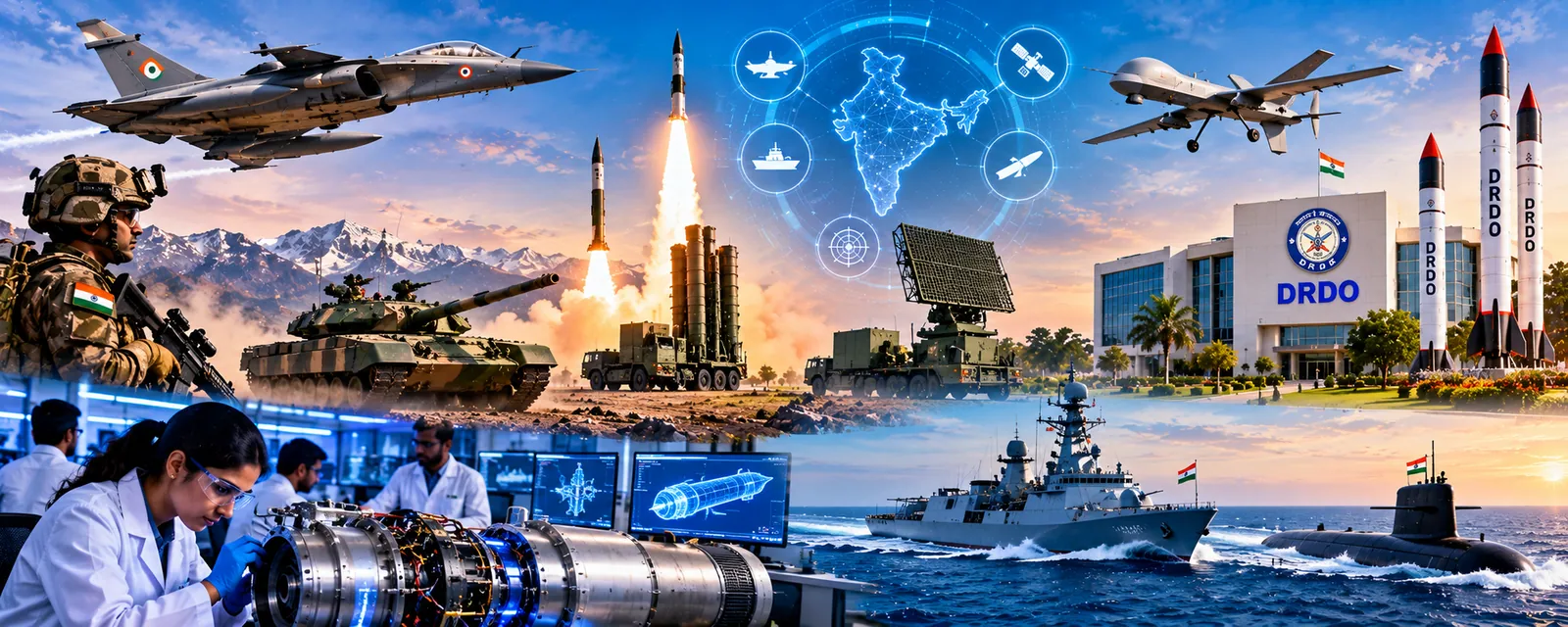
Defence Science, Technology and DRDO
5.1–5.3 Foundations and DRDO
- Defence science turns basic research into systems through a research, testing and production cycle.
- DRDO, formed in 1958, works through seven technology clusters and about 41 laboratories.
5.4–5.5 Missiles
- A missile has an airframe, propulsion, guidance, navigation, control and payload.
- The IGMDP (1983) produced Prithvi, Agni, Akash and Nag; BrahMos and Astra followed.
5.6–5.7 Sensors and electronic warfare
- Radar uses radio waves and sonar uses sound to measure echo time.
- Electronic warfare has support, protection and attack parts.
5.8–5.11 Platforms and new technologies
- Tejas, INS Vikrant and Arjun show indigenous aircraft, ship and tank design.
- AI, drones, lasers, hypersonics and quantum are the emerging frontier.
5.12–5.15 Industry, Andhra Pradesh and the future
- Policies such as DAP 2020, iDEX and indigenisation lists push self-reliance.
- Andhra Pradesh's ecosystem centres on NSTL, Hindustan Shipyard and the Eastern Naval Command at Visakhapatnam.
Don't confuse
- Licensed production is not indigenous design.
- Hyderabad's DRDO labs are in Telangana; NSTL, Visakhapatnam is in Andhra Pradesh.
- Announced or approved projects are not operational ones.
The branches follow the chapter's sections: science and institutions first, then weapons and sensors, platforms and new technology, and finally industry, Andhra Pradesh and the future.