

Start hereAbout 1 min
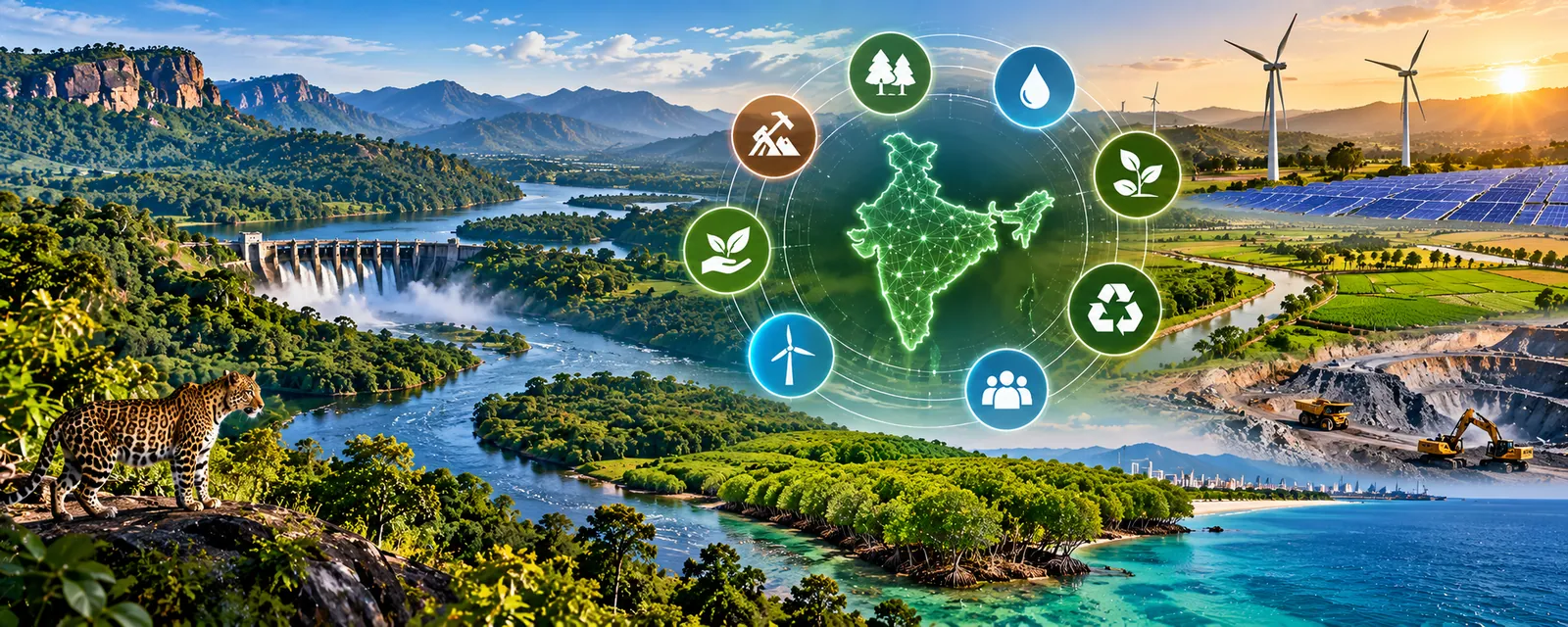
Chapter Overview Map
Natural Resources and Their Sustainable Management
8.1 Resource science
- Natural resources are classified by origin, renewability and stage of development.
- Depletion happens when use runs faster than natural replacement or discovery.
- Conservation, accounting and the circular economy aim to keep resources in use for longer.
8.2–8.4 Minerals and mining
- Minerals form by magmatic, sedimentary, metamorphic and hydrothermal processes.
- India has identified 30 critical minerals; the 2023 law lets the Centre auction 24 of them.
- Andhra Pradesh holds about 92% of India's barytes resources, centred on Mangampeta.
8.5–8.7 Living resources
- Forests store carbon, regulate water and hold soil; forest cover differs from recorded forest area.
- Afforestation plants new forest; reforestation restores forest that was lost.
- Andhra Pradesh leads India in fish production, mostly from inland aquaculture.
8.8–8.12 Fuels, water, land and soil
- The Krishna–Godavari Basin is Andhra Pradesh's oil and gas province.
- Watershed management treats land from ridge to valley to hold rain where it falls.
- Saline soils are reclaimed by drainage and leaching; sodic soils with gypsum; acid soils with lime.
8.13–8.16 Technology and governance
- Remote sensing, Geographic Information Systems (GIS), drones and sensors turn resources into measurable, mapped data.
- Mining, forest, fisheries and water laws decide who may use a resource and on what terms.
- Sustainable management joins science, efficiency, restoration, community participation and governance.
Don't confuse
- A resource is everything known to exist; a reserve is only the part that is economically mineable today.
- Forest cover is measured from satellites; recorded forest area is a legal category in government records.
Notice how the branches follow the chapter: resource science first, then each resource group, then the tools and rules that manage them.