

Skip to content
PrepShark

Chapter 9Updated

Sustainable Development, Climate Change, Climate Justice and Environmental Impact Assessment

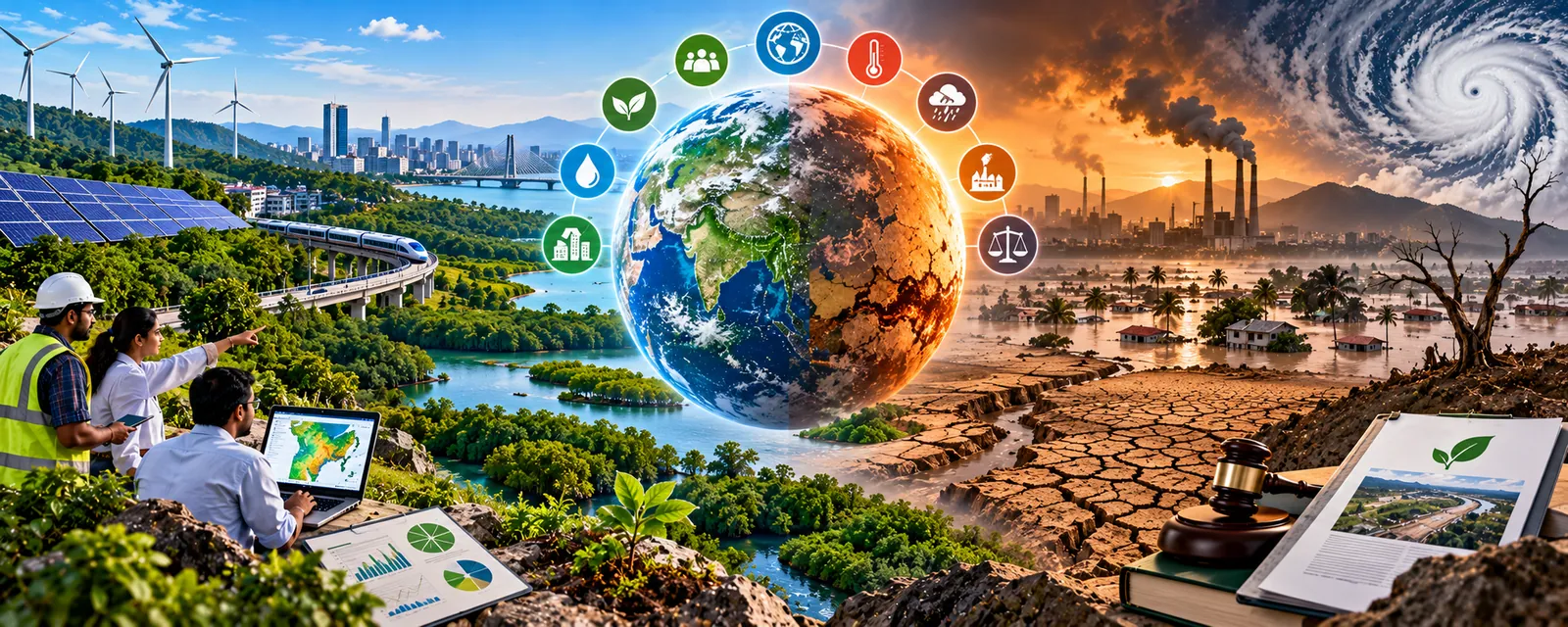
How development strains nature, the science and evidence of climate change, mitigation, adaptation and climate justice, India's climate policy, and how Environmental Impact Assessment works in India and Andhra Pradesh.

  • 15sections
  • ~108min read
0%

0 of 19 sections

~108 min read

~108 min read

Start hereAbout 1 min

Chapter Overview Map

In this section: 1 mind map

Figure 9.1Chapter overview map
Sustainable development, climate change and EIA
  1. 9.1 Development and sustainability

    • Development uses resources and creates environmental pressures.
    • Sustainable development balances growth, equity and ecological limits.
  2. 9.2–9.3 Climate science and evidence

    • Extra greenhouse gases trap heat and drive global warming.
    • Temperature, CO₂, ocean heat, sea level and ice point to the same change.
  3. 9.4–9.6 Impacts and responses

    • Impacts hit water, food, health, coasts and livelihoods unevenly.
    • Mitigation cuts the cause; adaptation reduces the harm.
  4. 9.7–9.8 Justice and India's policy

    • Common but Differentiated Responsibilities links responsibility and capability to obligations.
    • India's Nationally Determined Contribution, net zero by 2070 and the carbon market.
  5. 9.9–9.12 Environmental Impact Assessment

    • Environmental Impact Assessment predicts impacts before approval and plans mitigation.
    • EIA Notification 2006: Category A, B1 and B2; public hearing; monitoring.
  6. 9.13–9.15 Andhra Pradesh

    • Coast, deltas and Rayalaseema face different climate risks.
    • State institutions apply EIA; case studies show its strengths and gaps.
  7. Don't confuse

    • Weather is a single event; climate is a 30-year average.
    • Intensity targets differ from absolute emission cuts.
    • Environmental Clearance differs from pollution consents.

Notice that the chapter moves from the development–environment conflict, through climate science and responses, to the tools (EIA) and the Andhra Pradesh case.

Inside this chapter

What Sustainable Development, Climate Change, Climate Justice and Environmental Impact Assessment covers

  1. Chapter Overview Map
  2. Environment, Development and Sustainability
  3. Science of Global Warming and Climate Change
  4. Scientific Evidence of Climate Change
  5. Impacts of Climate Change
  6. Climate Change Mitigation
  7. Climate Change Adaptation and Resilience
  8. Climate Justice and Equity
  9. India's Climate Policy Framework
  10. Environmental Impact Assessment: Foundations
  11. Stages and Methods of EIA
  12. Environmental Clearance Framework in India
  13. EIA in Practice: Project Impacts, Limitations and Reforms
  14. Climate Change and Sustainable Development in Andhra Pradesh
  15. Environmental Impact Assessment in Andhra Pradesh
  16. An Integrated Climate and Sustainability Strategy for Andhra Pradesh
  17. Location and Map Practice
  18. Memory and Recall Review
  19. Rapid Revision Sheet
All 18 chapters in Paper V: Science and Technology
  1. Science, Technology and Innovation in India and Andhra Pradesh
  2. Information and Communication Technology and IT Development in India and Andhra Pradesh
  3. Governance, Cybersecurity and Cybercrime
  4. Indian Space Programme, ISRO and Satellite Applications
  5. Defence Science, Technology and DRDO
  6. Energy Resources, Renewable Energy, Energy Efficiency and Energy Security
  7. Nuclear Science, Nuclear Energy and India's Nuclear Policy
  8. Natural Resources, Conservation and Sustainable Resource Management
  9. Sustainable Development, Climate Change, Climate Justice and Environmental Impact Assessment
  10. Natural Disasters, Forecasting and Disaster Management
  11. Environmental Pollution, Waste Management and Environmental Health
  12. Environmental Legislation, International Agreements and Global Environmental Initiatives
  13. Biotechnology, Genetic Engineering and Their Applications
  14. Agricultural Biotechnology, Tissue Culture and Transgenic Technologies
  15. Nanotechnology: Principles, Applications and Ethical Challenges
  16. Human Diseases, Microbial Infections and Preventive Healthcare
  17. Immunity, Vaccines and Modern Vaccination Technologies
  18. Intellectual Property Rights, Scientific Research and Promotion of Science in India and Andhra Pradesh

Open the Paper V: Science and Technology library

Daily Radar

This chapter in the news