Skip to content

Chapter 15Modern Indian HistoryUpdated

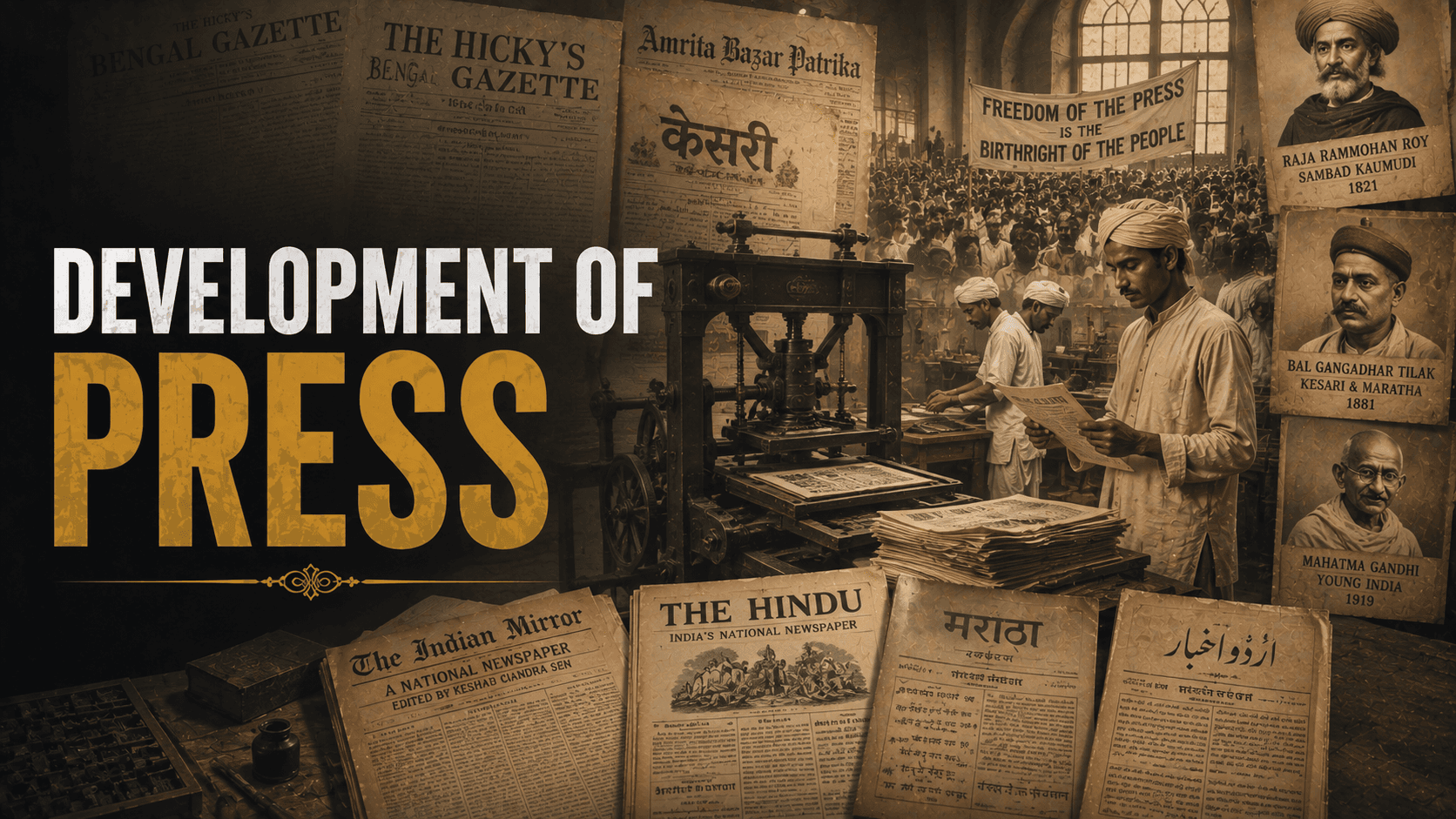
DEVELOPMENT OF PRESS

  • 20sections
  • ~19min read
0%

0 of 20 sections

~19 min read

~19 min read
1Section 1 of 1About 1 min

Background and Early Growth of the Press

  • James Augustus Hickey started The Bengal Gazette or Calcutta General Advertiser in 1780, regarded as the first newspaper in India. Its outspoken criticism of the government led to its seizure in 1782.
  • The early press was followed by publications such as The Bengal Journal, The Calcutta Chronicle, The Madras Courier and The Bombay Herald.
  • The colonial authorities increasingly viewed newspapers as a potential channel for exposing official misconduct and influencing public opinion in Britain.
  • James Silk Buckingham continued the development of journalism through the Calcutta Journal and is associated with the early growth of modern Indian journalism.
  • Furdunji Marzban started an early Indian-language newspaper in Gujarati in 1812.
  • Gangadhar Bhattacharya began a newspaper in English in 1816, marking an important stage in Indian participation in English-language journalism.
  • J.C. Marshman started Digdarshan in 1818, associated with the early Bengali-language press.
  • Raja Rammohan Roy emerged as an early Indian advocate of press freedom and used journalism as an instrument of social and political reform.
  • Jugal Kishore started Udant Martand in 1826, identified in the chapter as the first Hindi-language newspaper published from Kanpur.

Inside this chapter

What DEVELOPMENT OF PRESS covers

  1. Background and Early Growth of the Press
  2. Press as an Instrument of Nationalism
  3. Major Early Newspapers and Journalists
  4. Early Press Regulations
  5. Early Nationalist Struggle for Press Freedom
  6. Vernacular Press Act, 1878
  7. Repression of Nationalist Journalists
  8. Repressive Press Laws, 1908–1910
  9. First World War and the Press
  10. Second World War and the Press
  11. Indian Press (Emergency Powers) Act, 1931
  12. Press and the National Movement
  13. Press and the Growth of Political Participation
  14. Important Newspapers and Personalities — Rapid Association
  15. Liberal and Restrictive Phases of Press Policy
  16. Chronology of Press Development
  17. Prelims Traps
  18. Press Laws — Quick Comparison
  19. Why the Press Became Central to Nationalism
  20. Final Rapid Recall
All 19 chapters in Indian History
  1. ARRIVAL OF EUROPEANS
  2. RISE OF REGIONAL STATES
  3. BRITISH CONQUEST OF INDIA
  4. POPULAR UPRISINGS BEFORE 1857
  5. 1857 REVOLT
  6. POPULAR UPRISINGS AFTER 1857
  7. SOCIO-RELIGIOUS REFORM MOVEMENTS
  8. BEGINNING OF STRUGGLE-(1805-1905)
  9. NATIONAL MOVEMENT (1905-1919)
  10. NATIONAL MOVEMENT (1919-1929)
  11. NATIONAL MOVEMENT (1929-1947)
  12. ECONOMIC IMPACT OF BRITISH RULE IN INDIA
  13. LAND REVENUE SYSTEM IN INDIA
  14. DEVELOPMENT OF EDUCATION SYSTEM AND LANGUAGE IN INDIA
  15. DEVELOPMENT OF PRESS
  16. OTHER ASPECTS OF BRITISH RULE IN INDIA
  17. GOVERNOR GENERAL OF INDIA (1773-1950)
  18. IMPORTANT JOURNALS AND BOOKS
  19. IMPORTANT PERSONALITIES

Open the Indian History library

In the official syllabus