Skip to content

Chapter 11Modern Indian HistoryUpdated

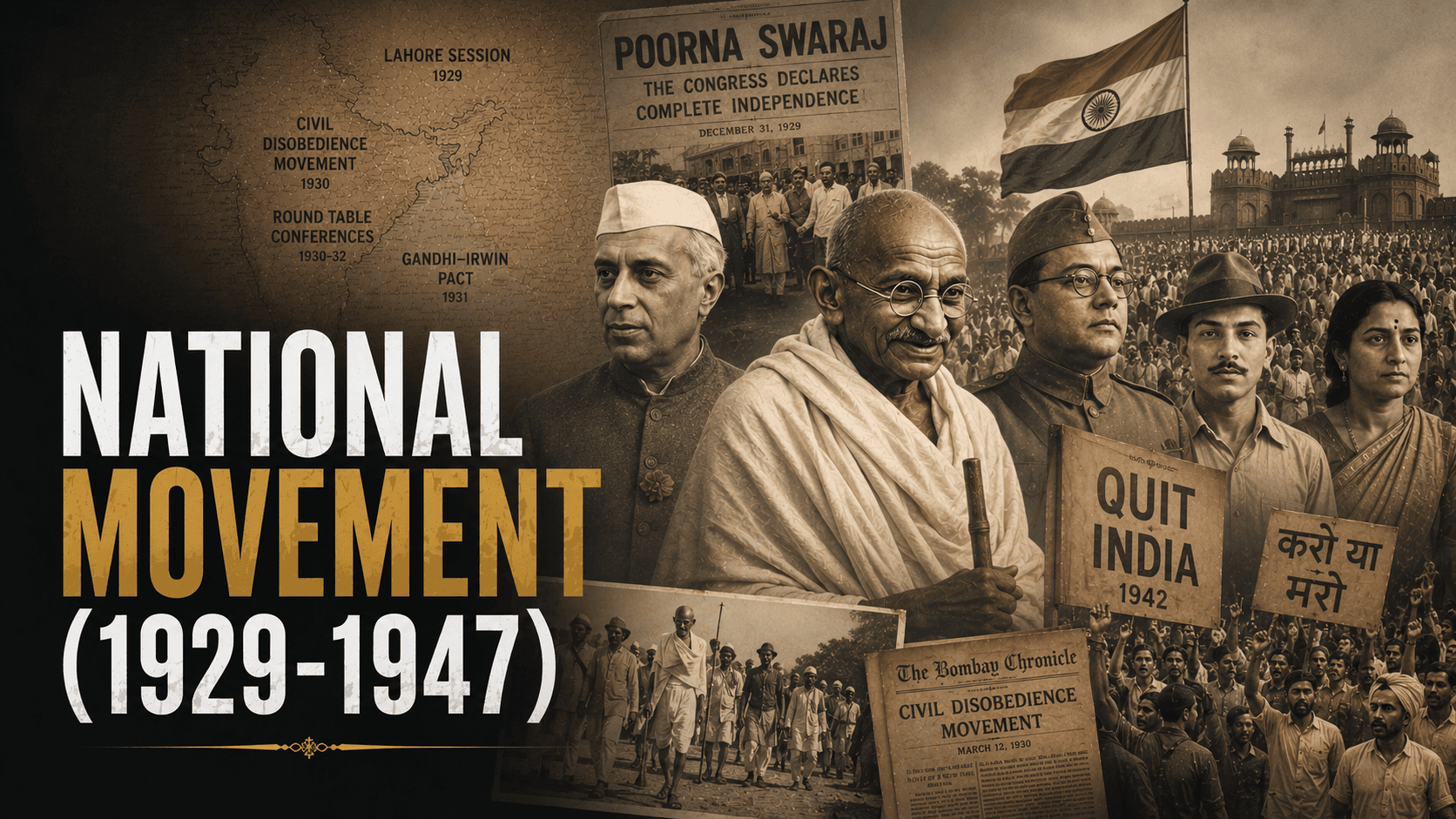
NATIONAL MOVEMENT (1929-1947)

  • 47sections
  • ~38min read
0%

0 of 47 sections

~38 min read

~38 min read
1Section 1 of 1About 1 min

Background: From Constitutional Pressure to Purna Swaraj

  • 1928 Calcutta Congress: Congress gave the British Government one year to accept the constitutional demands associated with the Nehru Report; failure would lead to the adoption of complete independence and a civil disobedience movement.
  • Lord Irwin’s Declaration — 31 October 1929: The government stated that the natural constitutional objective contemplated by the 1917 Declaration was Dominion Status.
  • Delhi Manifesto — 2 November 1929: National leaders demanded that the proposed Round Table Conference should formulate a constitutional scheme leading to Dominion Status, with adequate Congress representation, political conciliation and amnesty for political prisoners.
  • Irwin rejected the Delhi Manifesto's conditions, increasing nationalist dissatisfaction.
  • Lahore Congress — December 1929: Under Jawaharlal Nehru, Congress adopted Purna Swaraj as its goal and authorised the launching of a Civil Disobedience Movement.
  • 31 December 1929: The tricolour was hoisted on the banks of the Ravi at Lahore.
  • 26 January 1930: The day was observed across India as the first Independence Day, with people taking the Independence Pledge.
  • February 1930: The Congress Working Committee authorised Gandhi to determine the form and timing of the Civil Disobedience Movement.

Inside this chapter

What NATIONAL MOVEMENT (1929-1947) covers

  1. Background: From Constitutional Pressure to Purna Swaraj
  2. First Civil Disobedience Movement, 1930–1931
  3. Gandhi-Irwin Pact, 1931
  4. Karachi Congress Session, 1931
  5. Round Table Conferences
  6. Second Civil Disobedience Movement, 1932–1934
  7. Significance of the Civil Disobedience Movement
  8. Civil Disobedience vs Non-Cooperation
  9. Communal Award and Poona Pact
  10. Gandhi's Anti-Untouchability Campaign
  11. Debate on the Future Strategy, 1934–1937
  12. Congress Ministries, 1937–1939
  13. Subhas Chandra Bose and the Congress Crisis
  14. World War II and the Nationalist Response
  15. Cripps Mission, 1942
  16. Quit India Movement, 1942
  17. Participation in Quit India
  18. Underground Movement
  19. Parallel Governments
  20. Who Did Not Participate?
  21. Government Repression
  22. Significance of Quit India
  23. Demand for Pakistan and the Two-Nation Theory
  24. C. Rajagopalachari Formula, 1944
  25. Desai-Liaqat Pact
  26. Wavell Plan and Shimla Conference, 1945
  27. Subhas Chandra Bose and the Indian National Army
  28. Post-War National Upsurge, 1945–1946
  29. Cabinet Mission, 1946
  30. Interim Government, 1946
  31. Direct Action and Communal Violence
  32. Why Partition Became Increasingly Likely
  33. Attlee's Statement, 20 February 1947
  34. Mountbatten Plan, 3 June 1947
  35. Why Congress Accepted Partition
  36. Gandhi and Partition
  37. Indian Independence Act, 1947
  38. The National Movement: Major Phases at a Glance
  39. Major Movements — Method Comparison
  40. Important Congress Sessions and Decisions
  41. Important Constitutional Developments
  42. Personalities and Their Associations
  43. High-Value Places
  44. Prelims Traps
  45. Chronology: 1929–1947
  46. Cause → Event → Consequence Chains
  47. Final Rapid Recall
All 19 chapters in Indian History
  1. ARRIVAL OF EUROPEANS
  2. RISE OF REGIONAL STATES
  3. BRITISH CONQUEST OF INDIA
  4. POPULAR UPRISINGS BEFORE 1857
  5. 1857 REVOLT
  6. POPULAR UPRISINGS AFTER 1857
  7. SOCIO-RELIGIOUS REFORM MOVEMENTS
  8. BEGINNING OF STRUGGLE-(1805-1905)
  9. NATIONAL MOVEMENT (1905-1919)
  10. NATIONAL MOVEMENT (1919-1929)
  11. NATIONAL MOVEMENT (1929-1947)
  12. ECONOMIC IMPACT OF BRITISH RULE IN INDIA
  13. LAND REVENUE SYSTEM IN INDIA
  14. DEVELOPMENT OF EDUCATION SYSTEM AND LANGUAGE IN INDIA
  15. DEVELOPMENT OF PRESS
  16. OTHER ASPECTS OF BRITISH RULE IN INDIA
  17. GOVERNOR GENERAL OF INDIA (1773-1950)
  18. IMPORTANT JOURNALS AND BOOKS
  19. IMPORTANT PERSONALITIES

Open the Indian History library

In the official syllabus