Skip to content

Chapter 19Modern Indian HistoryUpdated

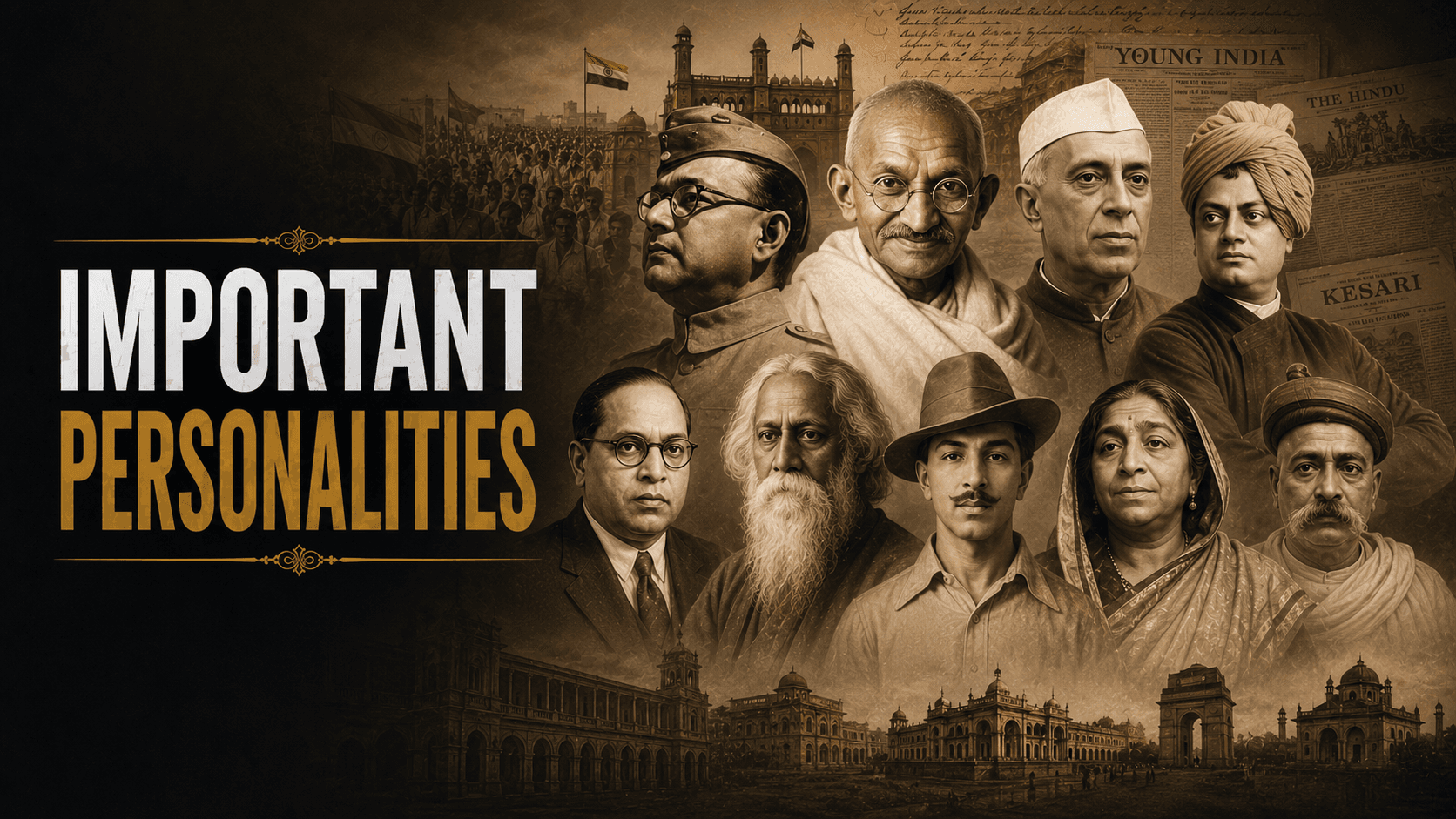
IMPORTANT PERSONALITIES

  • 27sections
  • ~42min read
0%

0 of 27 sections

~42 min read

~42 min read
1Section 1 of 1About 1 min

Early Reformers and the Awakening of Modern India

Raja Rammohan Roy

  • Raja Rammohan Roy (1772–1833) is associated with the beginnings of the modern reform movement in India.

  • He advocated:

    • monotheism;
    • rationalism;
    • human dignity;
    • social equality;
    • modern education.
  • He founded the Atmiya Sabha in 1815, which provided an early platform for religious and social discussion.

  • He founded the Brahmo Sabha in 1828, which later developed into the Brahmo Samaj.

  • His reform programme combined reason, ethical religion and social reform.

  • He strongly opposed sati and campaigned for its abolition through scriptural arguments, public advocacy and petitions.

  • His campaign contributed to Regulation XVII of 1829, which abolished sati in the Bengal Presidency.

  • He supported women's rights, female education and widow remarriage.

  • He advocated Western scientific and modern education while retaining a critical engagement with Indian intellectual traditions.

  • He used the press extensively for social and political communication.

  • Important publications associated with him included Sambad Kaumudi and Mirat-ul-Akbar.

  • He travelled to England in 1830 as an emissary of the Mughal emperor and died at Bristol in 1833.

Inside this chapter

What IMPORTANT PERSONALITIES covers

  1. Early Reformers and the Awakening of Modern India
  2. Early Nationalists and the Formation of Political Consciousness
  3. Assertive Nationalists
  4. Home Rule and the Transition to Mass Nationalism
  5. Gandhi and the Transformation of the National Movement
  6. Muslim Leaders and Muslim Political Currents
  7. Women in the National Movement
  8. Revolutionary Nationalists
  9. Socialist and Left-Wing Personalities
  10. Regional and Mass-Movement Personalities
  11. B.R. Ambedkar and the Struggle for Social Justice
  12. Cultural Nationalism and Literary Personalities
  13. Press and Political Personalities
  14. British Administrators and Policy-Makers
  15. Indian Rulers and Resistance Leaders
  16. Personality → Movement Matrix
  17. Personality → Publication / Institution Matrix
  18. Personality → Organisation / Movement Matrix
  19. Women → High-Yield Associations
  20. Personality → Region Matrix
  21. Chronological Personality Chain
  22. Major Ideological Differences
  23. British Administrators — Policy Associations
  24. Indian Rulers → Resistance
  25. High-Value "Who Was Associated With What?"
  26. Prelims Traps
  27. Final Rapid Recall
All 19 chapters in Indian History
  1. ARRIVAL OF EUROPEANS
  2. RISE OF REGIONAL STATES
  3. BRITISH CONQUEST OF INDIA
  4. POPULAR UPRISINGS BEFORE 1857
  5. 1857 REVOLT
  6. POPULAR UPRISINGS AFTER 1857
  7. SOCIO-RELIGIOUS REFORM MOVEMENTS
  8. BEGINNING OF STRUGGLE-(1805-1905)
  9. NATIONAL MOVEMENT (1905-1919)
  10. NATIONAL MOVEMENT (1919-1929)
  11. NATIONAL MOVEMENT (1929-1947)
  12. ECONOMIC IMPACT OF BRITISH RULE IN INDIA
  13. LAND REVENUE SYSTEM IN INDIA
  14. DEVELOPMENT OF EDUCATION SYSTEM AND LANGUAGE IN INDIA
  15. DEVELOPMENT OF PRESS
  16. OTHER ASPECTS OF BRITISH RULE IN INDIA
  17. GOVERNOR GENERAL OF INDIA (1773-1950)
  18. IMPORTANT JOURNALS AND BOOKS
  19. IMPORTANT PERSONALITIES

Open the Indian History library

In the official syllabus