Skip to content

Chapter 13Modern Indian HistoryUpdated

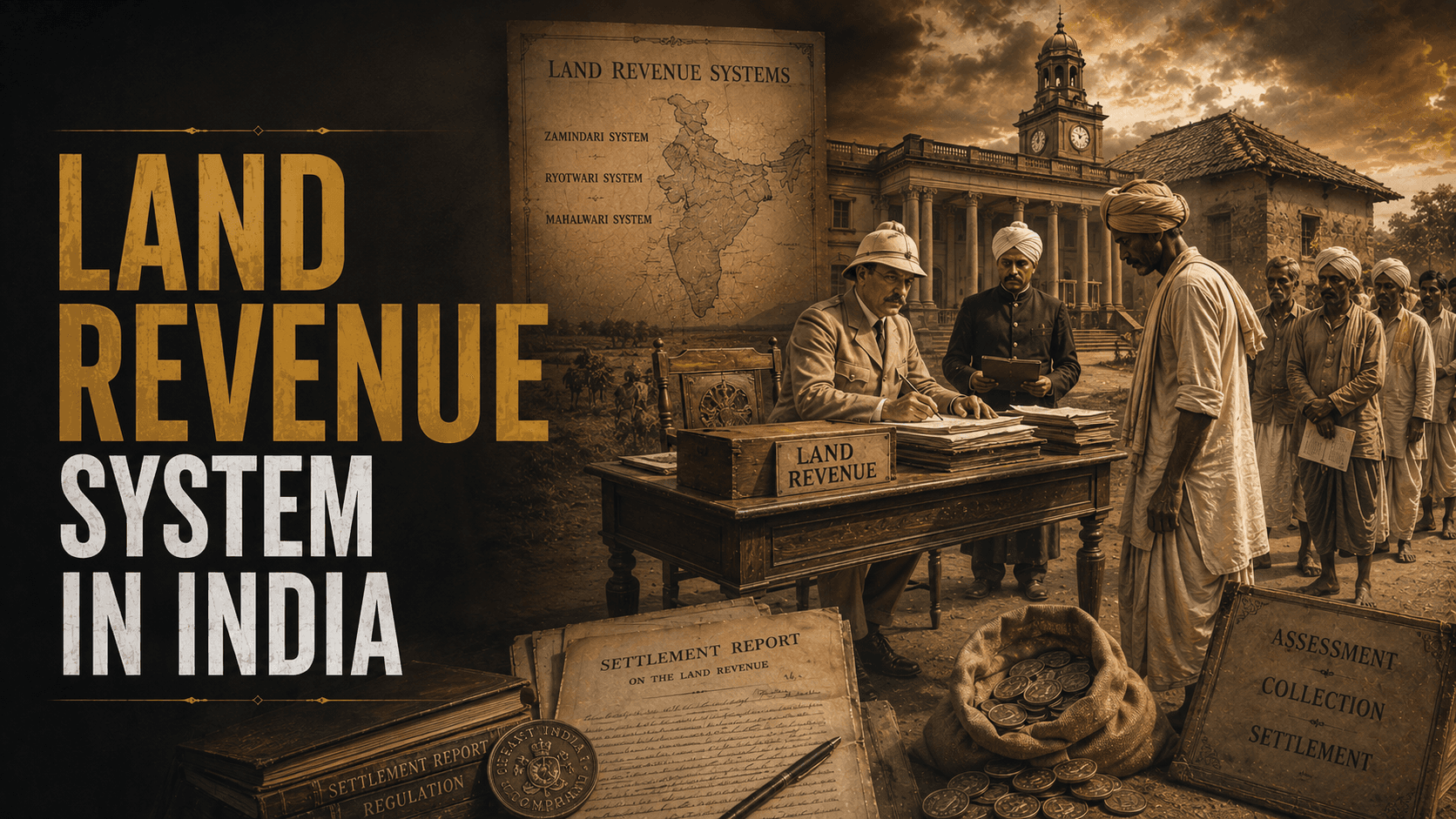
LAND REVENUE SYSTEM IN INDIA

  • 28sections
  • ~28min read
0%

0 of 28 sections

~28 min read

~28 min read
1Section 1 of 1About 1 min

From Diwani to Colonial Land Revenue

  • The East India Company acquired the Diwani of Bengal, Bihar and Orissa in 1765 after the Battle of Buxar and the Treaty of Allahabad.

  • Diwani rights gave the Company control over the collection of land revenue and civil administration.

  • Land revenue became the central fiscal foundation of Company rule because agriculture formed the economic base of rural India.

  • The principal colonial objective was to extract the maximum possible revenue from land, with limited concern for the productive capacity or welfare of cultivators.

  • The British progressively experimented with different arrangements involving:

    • intermediaries such as zamindars;
    • direct settlement with cultivators;
    • village or mahal communities;
    • hereditary revenue collectors and taluqdars.
  • These arrangements differed in the unit of settlement and the person responsible for paying revenue, but their common fiscal orientation placed heavy pressure on agriculture.

Inside this chapter

What LAND REVENUE SYSTEM IN INDIA covers

  1. From Diwani to Colonial Land Revenue
  2. Land Revenue under the Dual Government
  3. Warren Hastings and the Search for a Better Revenue System
  4. Permanent Settlement
  5. Ryotwari System
  6. Mahalwari System
  7. Taluqdari Settlement
  8. Malguzari System
  9. Comparative Structure of Major Land Revenue Systems
  10. Land Revenue Systems — Personalities at a Glance
  11. Land Revenue Systems — Revenue Relationship
  12. Why Did the British Experiment with Different Systems?
  13. Effects on the Peasantry
  14. Commercialisation of Agriculture
  15. Impact on Landholding Structure
  16. Growth of Absentee Landlordism and Intermediaries
  17. Impact on Village Society
  18. Impact on Agriculture
  19. Impact on the Colonial Economy
  20. Revenue Policies and Rural Discontent
  21. Land Revenue and the Revolt of 1857
  22. Overall Assessment
  23. High-Value Comparisons
  24. Chronology — Must Remember
  25. Important Terms
  26. Prelims Traps
  27. Cause → Mechanism → Consequence
  28. Final Rapid Recall
All 19 chapters in Indian History
  1. ARRIVAL OF EUROPEANS
  2. RISE OF REGIONAL STATES
  3. BRITISH CONQUEST OF INDIA
  4. POPULAR UPRISINGS BEFORE 1857
  5. 1857 REVOLT
  6. POPULAR UPRISINGS AFTER 1857
  7. SOCIO-RELIGIOUS REFORM MOVEMENTS
  8. BEGINNING OF STRUGGLE-(1805-1905)
  9. NATIONAL MOVEMENT (1905-1919)
  10. NATIONAL MOVEMENT (1919-1929)
  11. NATIONAL MOVEMENT (1929-1947)
  12. ECONOMIC IMPACT OF BRITISH RULE IN INDIA
  13. LAND REVENUE SYSTEM IN INDIA
  14. DEVELOPMENT OF EDUCATION SYSTEM AND LANGUAGE IN INDIA
  15. DEVELOPMENT OF PRESS
  16. OTHER ASPECTS OF BRITISH RULE IN INDIA
  17. GOVERNOR GENERAL OF INDIA (1773-1950)
  18. IMPORTANT JOURNALS AND BOOKS
  19. IMPORTANT PERSONALITIES

Open the Indian History library

In the official syllabus