Skip to content

Chapter 07Modern Indian HistoryUpdated

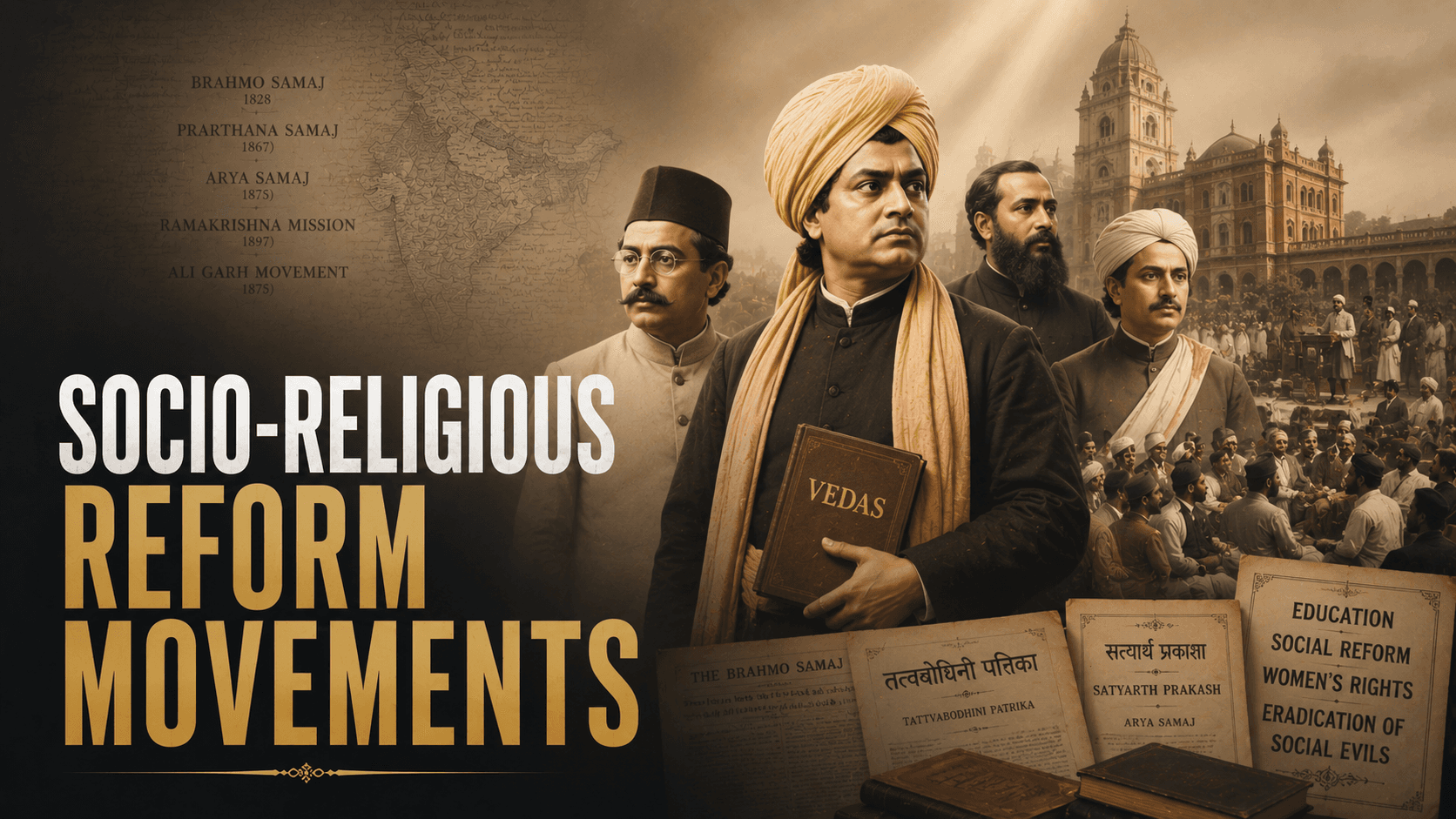
SOCIO-RELIGIOUS REFORM MOVEMENTS

  • 46sections
  • ~34min read
0%

0 of 46 sections

~34 min read

~34 min read
1Section 1 of 1About 1 min

Reform Movements: Core Idea

  • The 19th-century socio-religious reform movements emerged from an interaction between inherited Indian traditions and new intellectual, social and political forces.
  • The objective was not merely religious purification; it was the well-being of the individual and society, social regeneration and ultimately national progress.
  • Colonial rule created several conditions favourable to reform, but the socio-cultural regeneration of 19th-century India was occasioned by colonial presence, not created by it.
  • Reformers sought to remove social evils while preserving, reinterpreting or reconstructing elements of Indian cultural traditions.
  • The movements gradually helped create an intellectual climate based on reason, individual dignity, social equality, education and a wider conception of human welfare.

Inside this chapter

What SOCIO-RELIGIOUS REFORM MOVEMENTS covers

  1. Reform Movements: Core Idea
  2. Factors Behind the Desire for Reform
  3. Social and Ideological Base
  4. Two Broad Streams of Reform
  5. Methods of Reform
  6. Reform of Women's Position
  7. Caste-Based Exploitation
  8. Major Socio-Religious Reform Movements
  9. Prarthana Samaj
  10. Young Bengal Movement
  11. Ishwar Chandra Vidyasagar
  12. Balshastri Jambhekar
  13. Paramahansa Mandali
  14. Jyotirao Phule and Savitribai Phule
  15. Gopal Baba Walangkar
  16. Kisan Faguji Bansod
  17. Ramakrishna Movement and Swami Vivekananda
  18. Dayananda Saraswati and Arya Samaj
  19. Seva Sadan
  20. Dev Samaj
  21. Dharma Sabha
  22. Radhaswami Movement
  23. Caste Reform and Regional Movements
  24. Muslim Reform Movements
  25. Sir Syed Ahmed Khan and Aligarh Movement
  26. Deoband Movement
  27. Parsi Reform Movement
  28. Sikh Reform Movements
  29. Theosophical Movement
  30. Important Reform Organisations at a Glance
  31. Key Personalities — Reform Association
  32. Major Social Legislation — Chronology
  33. Reform Movements and Education
  34. Reform Movements and Indian Languages
  35. Women as Agents of Reform
  36. Evolution of the Reform Movement
  37. Positive Significance of Reform Movements
  38. Limitations and Negative Consequences
  39. Reform Movements and Nationalism
  40. Reformist vs Revivalist — Quick Comparison
  41. Women's Reform — Quick Recall
  42. Anti-Caste Reform — Quick Recall
  43. Religious Reform — Quick Recall
  44. High-Value Prelims Traps
  45. Chronology — Must Remember
  46. Final Rapid Recall
All 19 chapters in Indian History
  1. ARRIVAL OF EUROPEANS
  2. RISE OF REGIONAL STATES
  3. BRITISH CONQUEST OF INDIA
  4. POPULAR UPRISINGS BEFORE 1857
  5. 1857 REVOLT
  6. POPULAR UPRISINGS AFTER 1857
  7. SOCIO-RELIGIOUS REFORM MOVEMENTS
  8. BEGINNING OF STRUGGLE-(1805-1905)
  9. NATIONAL MOVEMENT (1905-1919)
  10. NATIONAL MOVEMENT (1919-1929)
  11. NATIONAL MOVEMENT (1929-1947)
  12. ECONOMIC IMPACT OF BRITISH RULE IN INDIA
  13. LAND REVENUE SYSTEM IN INDIA
  14. DEVELOPMENT OF EDUCATION SYSTEM AND LANGUAGE IN INDIA
  15. DEVELOPMENT OF PRESS
  16. OTHER ASPECTS OF BRITISH RULE IN INDIA
  17. GOVERNOR GENERAL OF INDIA (1773-1950)
  18. IMPORTANT JOURNALS AND BOOKS
  19. IMPORTANT PERSONALITIES

Open the Indian History library

In the official syllabus