Geography · World Atlas
Lakes & inland seas of the world
The earth's landforms and its ocean, and why each one sits where it does.
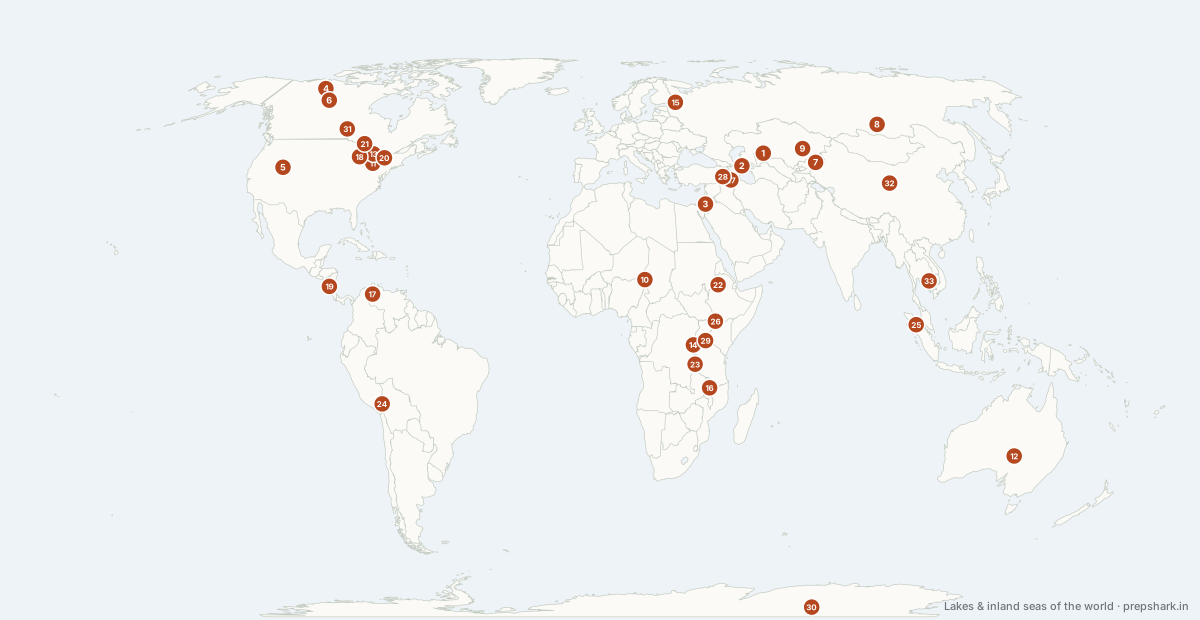
Numbered as on the map
The 33 on the map
1. Aral Sea
Kazakhstan / Uzbekistan
Known forDrained for cotton, and the standard cautionary tale
Diverting the Amu Darya and Syr Darya for cotton drained it — the standard case study in irrigation-driven ecological collapse.
Settinglake · Salt lake
2. Caspian Sea
open sea
Known forThe largest lake on earth, and a thirty-year legal argument
The largest enclosed body of water on earth — a landlocked remnant of the ancient Paratethys Ocean, saline but not oceanic, and about 28 m below sea level. Whether it is legally a sea or a lake decided how its oil and gas were divided; the five littoral states settled it in 2018 with a special status that is neither.
Settingendorheic sea · brackish · below sea level
For the examThe 2018 Aktau Convention gave it a special legal status: the surface is shared like a sea, the bed is divided like a lake. Its level is falling fast, which is a live regional issue.
3. Dead Sea
Israel / Jordan
Known forThe lowest land surface on earth
The lowest land surface on earth, about 430 m below sea level, and among the saltiest water bodies.
Settinglake
For the examLowest point on land. Fed by the Jordan, with no outlet — which is why it is hypersaline.
4. Great Bear Lake
Canada
Known forThe largest lake entirely inside Canada
The largest lake entirely within Canada, straddling the Arctic Circle on the Canadian Shield and ice-covered for eight months of the year.
Settingglacial lake · Arctic · shield
5. Great Salt Lake
United States of America
Known forA terminal salt lake shrinking into a dust hazard
The largest saltwater lake in the western hemisphere, a shrunken remnant of glacial Lake Bonneville with no outlet, so everything that flows in stays. Water diversion and drought took it to a record low in 2022, exposing lakebed laden with arsenic that blows into Salt Lake City.
Settingendorheic lake · hypersaline · exposed lakebed
For the examTerminal lake: inflow only, evaporation out, so salts concentrate. It is the American parallel to the Aral, with the same exposed-bed dust problem.
6. Great Slave Lake
Canada
Known forNorth America's deepest lake
The deepest lake in North America at 614 m, and the source of the Mackenzie — the continent's longest river system after the Mississippi.
Settingglacial lake · deep · shield
7. Issyk-Kul
Kyrgyzstan
Known forThe mountain lake that never freezes
A deep, slightly saline lake at 1,607 m in the Tian Shan that never freezes — its name means warm lake — because of its depth, its salinity and geothermal inflow. It is the second largest mountain lake in the world after Titicaca.
Settingendorheic mountain lake · saline · very deep
8. Lake Baikal
Russia
Known forA fifth of all unfrozen fresh water, in one rift
The deepest and oldest lake on earth, holding about a fifth of all unfrozen fresh water — a rift lake.
Settinglake
For the examDeepest lake. Tanganyika is second. Both are rift lakes; Superior is glacial.
9. Lake Balkhash
Kazakhstan
Known forThe lake that is fresh at one end and salt at the other
A closed lake that is fresh at one end and saline at the other: the Ili river enters the western basin and dilutes it, while a narrow strait restricts mixing with the salty east. It is shrinking as the Ili is drawn on in China.
Settingendorheic lake · half fresh half saline · shrinking
For the examThe Ili rises in Xinjiang, so Balkhash is a transboundary problem with China — the pattern that also affects the Irtysh.
10. Lake Chad
Chad / Niger / Nigeria / Cameroon
Known forNine tenths gone since the 1960s
Shrunk by about 90 per cent since the 1960s — the standard case study in desiccation and shared-basin governance.
Settinglake
11. Lake Erie
United States of America
Known forThe shallowest Great Lake, and its algal blooms
The shallowest and warmest Great Lake, which is why it warms fast, freezes over, and suffers the worst algal blooms — phosphorus runoff from intensive agriculture in its basin produces a large toxic bloom most summers. It drops 51 m to Lake Ontario over Niagara Falls.
Settingglacial lake · shallow · eutrophic
For the examEutrophication from agricultural phosphorus is the mechanism, and Erie is its most cited large-lake example. Its shallowness is why it responds fastest of the five.
12. Lake Eyre
Australia
Known forAustralia's lowest point, and dry most years
Australia’s lowest point and largest lake — dry most years, and the centre of the largest internal drainage basin in the world.
Settinglake · Salt lake
13. Lake Huron
Canada
Known forManitoulin — the largest island in any lake
The Great Lake with the longest shoreline, and the one holding Manitoulin — the largest island in any lake in the world, which itself contains lakes containing islands.
Settingglacial lake · Great Lakes system · freshwater
14. Lake Kivu
Rwanda
Known forThe lake that holds an explosion, and generates power from it
A rift lake holding an enormous dissolved load of methane and carbon dioxide in its deep water, trapped by stable density layering. A disturbance could release it catastrophically, as happened at Lake Nyos in 1986; Rwanda instead extracts the methane for electricity.
Settingrift lake · meromictic · gas-charged
For the examLimnic eruption is the hazard, and Lake Nyos in Cameroon in 1986 is the case where it happened. Nyiragongo above Kivu is the volcano that could trigger it.
15. Lake Ladoga
Russia
Known forEurope's largest lake
The largest lake in Europe, in a glacially gouged basin north-east of St Petersburg. Its frozen surface was the Road of Life that supplied Leningrad through the siege.
Settingglacial lake · boreal · freezes over
16. Lake Malawi (Nyasa)
Malawi
Known forMore fish species than any lake on earth
The southernmost of the great African rift lakes and the one with more fish species than any other lake on earth — several hundred cichlids, almost all endemic, which makes it the standard example of an adaptive radiation in fresh water.
Settingrift lake · very deep · endemic cichlids
For the examAdaptive radiation: one ancestral lineage filling many niches in isolation. Malawi, Tanganyika and Victoria are the three great cichlid lakes and Victoria's radiation is the youngest and fastest.
17. Lake Maracaibo
Venezuela
Known forThe oil lake, and the world's lightning capital
A large brackish inlet connected to the Caribbean by a narrow strait — argued over as lake or lagoon. It sits above one of the richest oil basins in the world, and the Catatumbo river mouth at its southern end has more lightning than anywhere else on earth.
Settingcoastal lagoon · brackish · oil province
18. Lake Michigan
United States of America
Known forThe only Great Lake wholly in the United States
The only Great Lake entirely within one country. Hydrologically it and Lake Huron are one lake at one level, joined by the deep Straits of Mackinac — they are counted separately by convention, not by physics.
Settingglacial lake · Great Lakes system · freshwater
For the examMichigan and Huron share a surface level and are technically one body. Superior, Michigan, Huron, Erie, Ontario — HOMES is the usual mnemonic.
19. Lake Nicaragua
Nicaragua
Known forThe lake with sharks, and a canal that was never dug
The largest lake in Central America, holding freshwater bull sharks that reach it up the San Juan river. A Chinese-backed interoceanic canal through it was granted in 2013 and its concession was formally cancelled in 2024 without a metre being dug.
Settingtectonic lake · freshwater · volcanic islands
20. Lake Ontario
Canada
Known forThe Great Lakes' outlet to the Atlantic
The smallest Great Lake by surface and the last before the St Lawrence, so it is the system's outlet to the Atlantic. The Welland Canal beside it lets ships bypass Niagara Falls.
Settingglacial lake · outlet basin · freshwater
21. Lake Superior
United States of America / Canada
Known forThe largest freshwater lake by surface
The largest freshwater lake by surface area, and part of the Great Lakes–St Lawrence system.
Settinglake
22. Lake Tana
Ethiopia
Known forWhere the Blue Nile begins
Ethiopia's largest lake, dammed behind a lava flow on the Ethiopian Highlands, and the source of the Blue Nile.
Settingvolcanic-dammed lake · highland · monastic islands
23. Lake Tanganyika
Tanzania / Democratic Republic of the Congo
Known forThe second deepest lake on earth
The second deepest and longest freshwater lake, in the western branch of the East African Rift.
Settinglake
24. Lake Titicaca
Peru / Bolivia
Known forThe highest large navigable lake
The highest navigable lake in the world, on the Peru–Bolivia altiplano.
Settinglake
25. Lake Toba
Indonesia
Known forThe caldera of the largest eruption in two million years
The largest volcanic lake in the world, filling the caldera of the largest known eruption in the last two million years — Toba, about 74,000 years ago, which put enough sulphur into the stratosphere to cool the planet for years. Samosir island in it was pushed up by later resurgence.
Settingcaldera lake · resurgent dome · very deep
For the examToba is the standard supervolcano case with Yellowstone. The Toba catastrophe hypothesis links it to a genetic bottleneck in early humans, though the evidence is contested.
26. Lake Turkana
Kenya
Known forThe world's largest desert lake, and the Cradle of Mankind
The largest permanent desert lake in the world, in the Kenyan rift, fed almost entirely by the Omo river from Ethiopia. Ethiopia's Gibe III dam and the sugar irrigation below it have cut that inflow, and the lake is falling. Its shores hold some of the richest early-hominin fossil beds anywhere.
Settingrift lake · desert · saline and falling
For the examTurkana depends on the Omo for about 90% of its inflow, which makes an Ethiopian dam a Kenyan problem — a transboundary case with no treaty.
27. Lake Urmia
Iran
Known forThe Middle East's largest lake, mostly gone
Once the largest lake in the Middle East, a hypersaline terminal lake in north-west Iran. Damming its feeder rivers and groundwater pumping shrank it by about 90% by 2015; a restoration programme brought some water back, but drought has driven it near-dry again.
Settingendorheic lake · hypersaline · shrinking
For the examThe salt-dust health hazard from its exposed bed is the same failure mode as the Aral and the Great Salt Lake — three cases of one mechanism.
28. Lake Van
Türkiye
Known forThe soda lake behind a lava dam
Türkiye's largest lake, dammed by a lava flow on the Anatolian Plateau, with no outlet and water so alkaline it is soapy — only one fish species tolerates it.
Settingendorheic lake · highly alkaline · volcanic-dammed
29. Lake Victoria
Uganda / Kenya / Tanzania
Known forAfrica's largest, and a downwarp rather than a rift
Africa’s largest lake and the source of the White Nile — a shallow depression, not a rift lake.
Settinglake
30. Lake Vostok
Antarctica
Known forA lake sealed under four kilometres of ice
The largest subglacial lake on earth, sealed under about 4 km of Antarctic ice and isolated from the atmosphere for millions of years. Russian drilling reached it in 2012. The surface above it recorded the lowest natural air temperature ever measured, −89.2°C in 1983.
Settingsubglacial lake · sealed · liquid under pressure
For the examLiquid because of pressure and geothermal heat from below. It is the analogue used for possible life under the ice of Europa and Enceladus.
31. Lake Winnipeg
Canada
Known forWhat is left of glacial Lake Agassiz
A large, very shallow remnant of glacial Lake Agassiz — the enormous ice-dammed lake whose sudden drainage about 8,200 years ago is thought to have disrupted the Atlantic overturning circulation and cooled the northern hemisphere for centuries.
Settingproglacial remnant · very shallow · eutrophic
For the examLake Agassiz's drainage is the standard example of a freshwater pulse weakening thermohaline circulation — the mechanism behind concern about Greenland melt today.
32. Qinghai Lake (Kokonor)
China
Known forChina's largest lake, and one that is growing
China's largest lake, saline and closed, at 3,200 m on the north-eastern Tibetan Plateau. Unusually among Asian lakes it has been rising since about 2005, as glacier melt and increased plateau rainfall outrun evaporation.
Settingendorheic lake · saline · high plateau
33. Tonlé Sap
Cambodia
Known forThe lake fed by a river that runs backwards
The lake whose river reverses. When the Mekong floods, water is pushed back up the Tonlé Sap river and the lake expands roughly fivefold; when the flood falls it drains out again. That pulse produces one of the largest inland fisheries in the world, and upstream Mekong dams are weakening it.
Settingflood-pulse lake · seasonal reversal · great fishery
For the examThe flood-pulse reversal is unique at this scale. Mekong mainstream dams in China and Laos flatten the pulse, which is the ecological argument against them.
Keep going