Geography · World Atlas
Volcanoes of the world
The earth's landforms and its ocean, and why each one sits where it does.
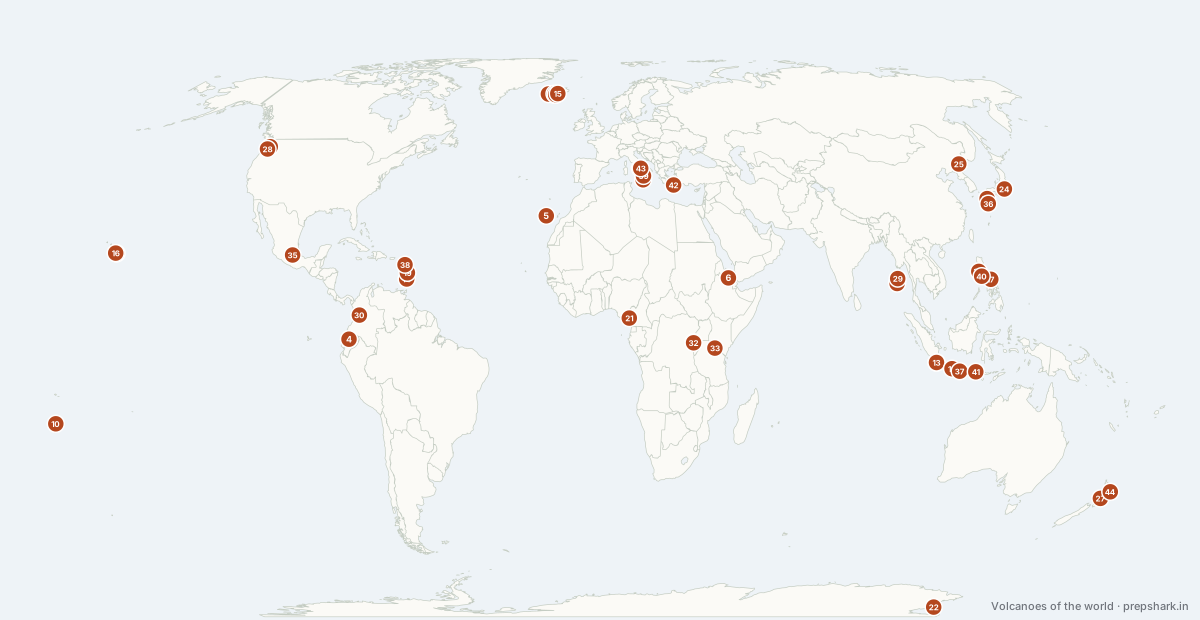
Numbered as on the map
The 44 on the map
1. Anak Krakatau
Indonesia
Known forA flank collapse that made a tsunami with no earthquake
The child of Krakatoa, which grew out of the 1883 caldera from 1927. In December 2018 its southwest flank collapsed into the Sunda Strait and generated a tsunami that killed over 400 people with no seismic warning at all, because there was no earthquake to detect.
Settingyoung cone · caldera remnant · flank instability
For the examTsunami warning systems are built around seismometers; a volcanic flank collapse produces no precursory earthquake, which is the gap the 2018 event exposed.
2. Barren Island
India
Known forIndia's only active volcano
India’s only confirmed active volcano, in the Andaman Sea on the Burma–Sunda arc.
Settingvolcano
For the examIndia’s only active volcano. Narcondam, to its north, is dormant. Both are Andaman & Nicobar territory.
3. Campi Flegrei
Italy
Known forA caldera with half a million people inside it
A 13 km caldera west of Naples with about half a million people living inside it. Its floor rises and falls — bradyseism — and since 2005 it has been inflating again, with the strongest earthquakes in forty years recorded in 2023–24 and the alert level raised.
Settingcaldera · bradyseism · densely populated
For the examBradyseism is the slow ground uplift and subsidence over a magma chamber. Campi Flegrei is considered a higher risk than Vesuvius beside it because of what sits on top of it.
4. Cotopaxi
Ecuador
Known forOne of the highest active volcanoes, almost on the Equator
One of the highest active volcanoes in the world, in the Ecuadorian Andes almost on the Equator.
Settingvolcano
5. Cumbre Vieja
Spain
Known forThe 2021 Canary eruption, and a tsunami claim that did not hold
The ridge on La Palma in the Canaries that erupted for 85 days in 2021, destroying about 3,000 buildings and adding new land to the coast where lava met the sea. A much-publicised hypothesis that its western flank could collapse and send a mega-tsunami across the Atlantic is not supported by most subsequent work.
Settingrift-zone volcano · hotspot island · basaltic
6. Erta Ale
Ethiopia
Known forA century-old lava lake, on an opening ocean
A shield volcano in the Danakil with one of the very few long-lived lava lakes on earth, active since at least 1906. It sits on the Afar spreading centre, where an ocean is opening on land.
Settingshield volcano · lava lake · rift
7. Eyjafjallajökull
Iceland
Known forThe small eruption that closed European airspace
Its 2010 ash plume closed European airspace for a week — a small eruption with an outsized economic effect.
Settingvolcano
8. Fagradalsfjall
Iceland
Known forReykjanes awake after eight centuries
The volcano that reawoke the Reykjanes peninsula in March 2021 after roughly 800 years of quiet, beginning an eruptive episode that has continued in pulses. Fissures near Grindavík from late 2023 forced the town's evacuation and cut the road to the Blue Lagoon.
Settingfissure eruption · spreading ridge · effusive
For the examA fissure eruption on a divergent boundary — runny basalt, lava fountains, very little ash. The contrast with a subduction-zone volcano's explosive andesite is the point.
9. Hekla
Iceland
Known forIceland's most active, on a spreading ridge
One of Iceland’s most active, on the mid-Atlantic rift where the plates pull apart rather than collide.
Settingvolcano
10. Hunga Tonga–Hunga Ha'apai
Tonga
Known forThe eruption that put an ocean into the stratosphere
A submarine volcano on the Tonga arc whose January 2022 eruption was the most powerful recorded since Krakatoa. It generated a pressure wave that circled the earth several times, a tsunami felt across the Pacific, and injected roughly 150 million tonnes of water vapour into the stratosphere — more than any eruption ever measured, and enough to warm rather than cool the surface for a few years.
Settingsubmarine caldera · island arc · surtseyan
For the examUnusual because it warmed rather than cooled: sulphate aerosols cool, water vapour is a greenhouse gas. That inversion of the usual volcanic-climate story is what the stem uses.
11. Katla
Iceland
Known forThe bigger volcano under the ice cap
A large caldera beneath the Mýrdalsjökull ice cap, historically far more powerful than Eyjafjallajökull beside it. An eruption under ice produces a jökulhlaup — a glacial outburst flood — which in Katla's case has repeatedly discharged more water than the Amazon for a few hours.
Settingsubglacial caldera · jökulhlaup source · explosive
For the examJökulhlaup is the hazard from subglacial volcanism, and it is a flood hazard rather than a lava one.
12. Kīlauea
United States of America
Known forAn intra-plate volcano, not a margin one
A shield volcano on the Hawaiian hotspot — an intra-plate volcano, not a plate-margin one, which is the point.
Settingvolcano
For the examHotspot volcanism, not subduction. The Hawaiian chain records the plate moving over a fixed plume.
13. Krakatoa
Indonesia
Known forThe 1883 eruption heard four thousand kilometres away
The 1883 eruption was heard 4,800 km away and dropped global temperatures for years. It stands in the Sunda Strait.
Settingvolcano
For the examSunda Strait, Indonesia. Anak Krakatau is the child cone that grew in the caldera.
14. La Soufrière
Saint Vincent and the Grenadines
Known forThe 2021 eruption that emptied northern Saint Vincent
The volcano on Saint Vincent that erupted explosively in April 2021 after decades of quiet, blanketing the island in ash and forcing about 20,000 people from the northern third of it.
Settingstratovolcano · Lesser Antilles arc · explosive
15. Laki (Lakagígar)
Iceland
Known forThe fissure eruption that starved two continents
A 27 km fissure that erupted for eight months in 1783–84, releasing an enormous volume of sulphur dioxide. The haze killed a fifth of Iceland's population and much of its livestock, caused crop failure across Europe, and is argued to have contributed to the conditions behind the French Revolution.
Settingfissure eruption · flood basalt · sulphurous haze
For the examA flood-basalt-style event in historical time — the closest analogue to what the Deccan Traps did, at a millionth of the scale.
16. Mauna Loa
United States of America
Known forThe largest active volcano on earth by volume
The largest volcano on earth by volume, and the classic shield profile.
Settingvolcano
17. Mayon
Philippines
Known forThe most symmetrical cone in the world
The most active volcano in the Philippines, and the classic textbook perfect cone.
Settingvolcano
18. Merapi
Indonesia
Known forIndonesia's most active, above two million people
Indonesia’s most active volcano, on Java, above Yogyakarta.
Settingvolcano
19. Mont Pelée
France
Known forWhere pyroclastic flows were first understood
The volcano on Martinique whose 1902 eruption destroyed Saint-Pierre in minutes and killed about 30,000 people — the deadliest eruption of the 20th century. It gave volcanology the term nuée ardente, and the modern understanding of pyroclastic density currents.
Settinglava-dome volcano · pyroclastic flows · Lesser Antilles arc
For the examPeléan eruption is the named style. The Lesser Antilles arc exists because the Atlantic subducts beneath the Caribbean Plate.
20. Mount Aso
Japan
Known forA caldera with towns and railways inside it
One of the largest calderas in the world, 25 km across on Kyushu, with towns and railways inside it and an active cone at its centre. Its caldera formed in four enormous eruptions, the last about 90,000 years ago.
Settingcaldera · active central cone · Japanese arc
21. Mount Cameroon
Cameroon
Known forWest Africa's volcano, and one of the wettest slopes on earth
West Africa's highest peak and its most active volcano, standing where the Cameroon Volcanic Line meets the coast. Its south-west flank is one of the wettest places on earth, receiving over 10,000 mm a year as the monsoon runs straight into it off the Gulf of Guinea.
Settingshield-stratovolcano · volcanic line · ultra-wet
For the examThe Cameroon Volcanic Line runs from the Gulf of Guinea islands inland — an intraplate chain that does not fit the simple hotspot model. Lake Nyos on it killed 1,700 people by limnic eruption in 1986.
22. Mount Erebus
Antarctica
Known forThe southernmost active volcano on earth
The southernmost active volcano on earth, on Ross Island, Antarctica — also with a lava lake.
Settingvolcano
23. Mount Etna
Italy
Known forEurope's highest and most continuously active
Europe’s most active volcano, on Sicily, above the Africa–Eurasia convergence.
Settingvolcano
24. Mount Fuji
Japan
Known forWhere three plates meet, and a national symbol
A stratovolcano and the highest point in Japan, on the junction of three tectonic plates.
Settingvolcano
25. Mount Paektu (Changbaishan)
North Korea
Known forThe Millennium Eruption, and a border-straddling crater lake
A caldera volcano on the China–North Korea border, holding the deep crater lake Heaven Lake. Its Millennium Eruption around 946 CE was one of the largest of the last two thousand years. It is a national symbol in both Koreas, and one of the very few subjects on which North Korean and Western scientists have collaborated.
Settingcaldera · crater lake · intraplate
26. Mount Rainier
United States of America
Known forThe lahar hazard above Seattle
The most heavily glaciated peak in the contiguous United States, standing over the Seattle–Tacoma lowland. Its danger is not lava but lahars: past collapses have sent mudflows all the way to Puget Sound, and about 90,000 people now live on those deposits.
Settingglaciated stratovolcano · Cascade arc · lahar hazard
For the examThe Cascade arc sits above the subducting Juan de Fuca plate — a small plate, which is why the arc is short. Rainier is a Decade Volcano for its hazard-to-population ratio.
27. Mount Ruapehu
New Zealand
Known forA crater lake that produces lahars
The highest point of New Zealand's North Island, with a crater lake on its summit. When the lake is displaced by eruption it produces a lahar — a torrent of water and volcanic debris — and the 1953 Tangiwai lahar destroyed a rail bridge minutes before an express crossed it, killing 151 people.
Settingstratovolcano · crater lake · lahar hazard
For the examA lahar is the volcanic hazard that kills furthest from the vent and long after the eruption. Nevado del Ruiz is the deadliest example.
28. Mount St Helens
United States of America
Known for1980, and the type example of a flank collapse
The 1980 lateral blast removed the north face and 400 m of summit — the type example of a flank collapse.
Settingvolcano
29. Narcondam
India
Known forIndia's dormant second, in the Andaman arc
A dormant volcano in the Andaman Sea, and the only home of the Narcondam hornbill.
Settingvolcano
30. Nevado del Ruiz
Colombia
Known forThe small eruption that killed 23,000
A glacier-capped Andean volcano whose modest 1985 eruption melted part of its ice cap and sent lahars down the valleys, burying the town of Armero and killing about 23,000 people. It is the deadliest lahar in recorded history and the reason volcanic hazard mapping became standard practice.
Settingglaciated stratovolcano · lahar hazard · Andean arc
For the examEruption size does not predict death toll — ice cap plus steep valleys plus a town on an old lahar deposit does. Armero is the standard disaster-management case.
31. Nyamuragira
Democratic Republic of the Congo
Known forThe busier half of the Virunga pair
Africa's most frequently erupting volcano, beside Nyiragongo in the Virunga chain on the western branch of the East African Rift. Between them they emit a large share of the world's volcanic sulphur dioxide.
Settingshield volcano · rift · very fluid lava
32. Nyiragongo
Democratic Republic of the Congo
Known forA persistent lava lake above a city of two million
One of very few volcanoes with a persistent lava lake, on the East African Rift above Goma.
Settingvolcano
33. Ol Doinyo Lengai
Tanzania
Known forThe one volcano erupting carbonate lava
The only volcano on earth currently erupting natrocarbonatite — a lava so cool, around 500°C, and so unlike silicate magma that it flows like black oil and turns white within hours of contact with air. It stands on the East African Rift beside the Ngorongoro highlands.
Settingcarbonatite volcano · rift · unique chemistry
For the examOrdinary lava is silicate at 800–1,200°C. Carbonatite is the exception and this is the only active example, which is why it is asked.
34. Pinatubo
Philippines
Known for1991, and half a degree off the whole planet
Its 1991 eruption — the second largest of the 20th century — cooled the planet by about 0.5°C.
Settingvolcano
35. Popocatépetl
Mexico
Known forThe smoking mountain above Mexico City
An active stratovolcano within sight of Mexico City.
Settingvolcano
36. Sakurajima
Japan
Known forIt erupts hundreds of times a year, beside a city
Erupts hundreds of times a year above the city of Kagoshima, Japan.
Settingvolcano
37. Semeru
Indonesia
Known forJava's highest, erupting several times a day
Java's highest peak and one of its most persistently active volcanoes, erupting several times a day for decades. Pyroclastic flows and lahars down its southern flank killed dozens in December 2021 and again in 2022.
Settingstratovolcano · Sunda arc · persistent activity
38. Soufrière Hills
Montserrat
Known forThe eruption that abandoned a capital city
The volcano that destroyed Plymouth, Montserrat's capital, from 1995 — burying it in ash and pyroclastic flows and forcing most of the island's population to leave permanently. Over half the island remains an exclusion zone.
Settinglava-dome volcano · pyroclastic flows · Lesser Antilles arc
For the examLava-dome collapse generates pyroclastic flows — the same mechanism as Mont Pelée. Plymouth is the only abandoned capital of its kind.
39. Stromboli
Italy
Known forThe lighthouse of the Mediterranean
In near-continuous eruption for two thousand years — the "lighthouse of the Mediterranean", and the type example of Strombolian activity.
Settingvolcano
40. Taal
Philippines
Known forA volcano in a lake in a caldera
A volcano within a lake within a caldera — the standard example of a nested volcanic landform.
Settingvolcano
41. Tambora
Indonesia
Known for1815, and the year without a summer
The largest eruption in recorded history, 1815, and the cause of the "year without a summer" in 1816.
Settingvolcano
42. Thera (Santorini)
Greece
Known forThe caldera that disrupted Minoan Crete
A caldera in the Aegean formed by an eruption around 1600 BCE, one of the largest of the Holocene. Its ash and tsunami disrupted Minoan Crete, and the flooded caldera is one of the clearest examples of the landform anywhere. A seismic swarm beneath it in early 2025 prompted a state of emergency.
Settingflooded caldera · Hellenic arc · explosive
For the examIt sits on the Hellenic volcanic arc above the subduction of Africa beneath Europe — the same margin as the Hellenic Trench.
43. Vesuvius
Italy
Known forPompeii, and the most dangerous volcano in Europe
The eruption of AD 79 buried Pompeii and Herculaneum. A somma volcano — a cone inside an older caldera rim.
Settingvolcano
44. Whakaari (White Island)
New Zealand
Known forThe 2019 eruption that changed volcano tourism
An andesitic island volcano in the Bay of Plenty that erupted without warning in December 2019 while tourists were in the crater, killing 22. The case led to prosecutions and reshaped how volcanic tourism is regulated worldwide.
Settingisland stratovolcano · hydrothermal · sudden
For the examA phreatic eruption — steam-driven, with no fresh magma reaching the surface — which is why it gave almost no precursory warning.
Keep going