Geography · World Atlas
Ocean trenches of the world
The earth's landforms and its ocean, and why each one sits where it does.
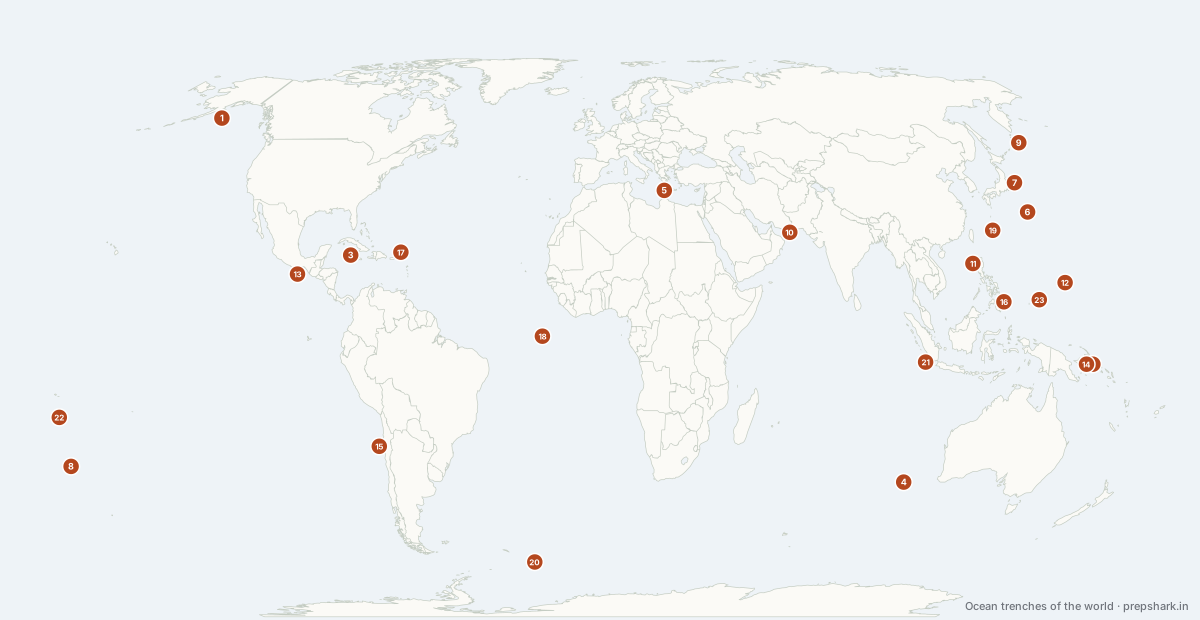
Numbered as on the map
The 23 on the map
1. Aleutian Trench
Pacific Ocean
Known forWhere the Pacific dives under the Aleutian arc
An arc-shaped trench 3,400 km long, south of the Aleutian island arc.
Settingtrench · 7,679 m
2. Bougainville Trench
open ocean
Known forWhere the Pacific Plate rides over instead of under
Where the Solomon Sea plate goes beneath the Pacific Plate, reaching about 9,140 m. It is one of the few places where the Pacific Plate is the OVERRIDING plate rather than the one being consumed.
Settingsubduction trench · 9,140 m · reversed polarity
3. Cayman Trough
open ocean
Known forThe Caribbean's deepest water, on a transform fault
The deepest point in the Caribbean at about 7,690 m, and not a subduction trench at all — it is a pull-apart basin on a transform boundary between the North American and Caribbean plates, with a short spreading centre inside it. It holds the deepest hydrothermal vents known.
Settingpull-apart basin · transform boundary · deep vents
For the examA deep trough is not always subduction. This one is strike-slip with a spreading segment, which is why it has vents rather than volcanoes.
4. Diamantina Fracture Zone
open ocean
Known forThe scar where Australia left Antarctica
The deepest point in the Indian Ocean outside the Sunda Trench, at about 7,080 m in the Dordrecht Deep. It is a fracture zone marking the tear along which Australia separated from Antarctica.
Settingfracture zone · 7,080 m · rifted margin
5. Hellenic Trench
open ocean
Known forWhere Africa goes under Europe
The deepest water in the Mediterranean, where the African Plate subducts beneath the Aegean. It is what raises Crete, drives the Hellenic volcanic arc through Santorini, and makes the eastern Mediterranean the most seismically active part of Europe.
Settingsubduction trench · 5,267 m · Mediterranean
6. Izu–Ogasawara (Bonin) Trench
open ocean
Known forThe deepest earthquakes ever recorded
The continuation of the Japan Trench southward, reaching about 9,780 m where the Pacific Plate subducts beneath the Philippine Sea Plate. Its arc carries the Izu and Bonin island chains, and it hosts some of the deepest earthquakes recorded anywhere — over 600 km down.
Settingsubduction trench · 9,780 m · intra-oceanic arc
For the examDeep-focus earthquakes trace the subducting slab and are how its geometry was mapped — the Wadati–Benioff zone.
7. Japan Trench
Pacific Ocean
Known forThe source of the 2011 Tohoku earthquake
The 2011 Tōhoku earthquake and tsunami originated on it.
Settingtrench · 8,046 m
8. Kermadec Trench
Pacific Ocean
Known forThe southern continuation of the Tonga trench
The southern continuation of the Tonga Trench.
Settingtrench · 10,047 m
9. Kuril–Kamchatka Trench
Pacific Ocean
Known forAlong the arc Japan calls the Northern Territories
Where the Pacific plate dives beneath Kamchatka and the Kuriles.
Settingtrench · 10,542 m
10. Makran Trench
open ocean
Known forThe Arabian Sea's one tsunami source
A shallow, heavily sedimented subduction zone off the coasts of Iran and Pakistan, where the Arabian Plate goes beneath Eurasia. Its 1945 earthquake produced a tsunami that killed several hundred people along the Makran and reached Mumbai — the only significant tsunami recorded in the Arabian Sea.
Settingsubduction zone · thickly sedimented · accretionary prism
For the examIt is the northern Indian Ocean's other subduction zone besides the Sunda — and the reason India's tsunami warning system watches the Arabian Sea as well as the Bay of Bengal.
11. Manila Trench
open ocean
Known forThe South China Sea's tsunami source
Where the South China Sea floor subducts eastward beneath the Philippine arc, reaching about 5,400 m. It is the most likely source of a destructive tsunami in the South China Sea, which would reach several heavily populated coasts within hours.
Settingsubduction trench · 5,400 m · tsunami hazard
12. Mariana Trench
Pacific Ocean
Known forThe deepest point in the ocean
The deepest place on earth. The Challenger Deep at its southern end is deeper than Everest is high, by over two kilometres.
Settingtrench · 10,994 m
For the examDeepest point on earth. Formed where the Pacific plate subducts beneath the Philippine Sea plate.
13. Middle America Trench
Pacific Ocean
Known forThe subduction behind Central America's volcanoes
The Cocos plate subducting beneath Central America — hence its volcanic chain.
Settingtrench · 6,662 m
14. New Britain Trench
open ocean
Known forThe trench behind one of the world's busiest arcs
Where the Solomon Sea plate subducts beneath New Britain, reaching about 8,320 m. The arc above it is one of the most volcanically active in the world, and Rabaul on it was buried by twin eruptions in 1994.
Settingsubduction trench · 8,320 m · volcanic arc
15. Peru–Chile (Atacama) Trench
Pacific Ocean
Known forThe trench that raised the Andes beside it
The Nazca plate subducting beneath South America — which is what raised the Andes and keeps raising them.
Settingtrench · 8,065 m
16. Philippine Trench
Pacific Ocean
Known forOff eastern Mindanao
Off eastern Mindanao. The Galathea Depth is its deepest point.
Settingtrench · 10,540 m
17. Puerto Rico Trench
Atlantic Ocean
Known forThe deepest water in the Atlantic
The deepest point in the Atlantic — the Milwaukee Deep.
Settingtrench · 8,376 m
For the examDeepest in the Atlantic. The Sandwich Trench is the deepest in the Southern Ocean.
18. Romanche Trench
open ocean
Known forThe gap that lets deep water cross the Atlantic
The deepest point in the equatorial Atlantic at about 7,760 m, and again not a subduction trench — it is a fracture zone, an enormous transform offset of the Mid-Atlantic Ridge near the Equator. Deep Antarctic water crosses between the western and eastern Atlantic basins through it.
Settingfracture zone · transform offset · deep passage
19. Ryukyu Trench
open ocean
Known forThe trench that built the Ryukyu arc
Where the Philippine Sea Plate subducts beneath the Eurasian Plate, raising the Ryukyu island arc and opening the Okinawa Trough behind it as a back-arc basin.
Settingsubduction trench · 7,460 m · back-arc spreading
For the examTrench, arc and back-arc basin in one system: the trench in front, the volcanic islands on the arc, the spreading basin behind.
20. South Sandwich Trench
Southern Ocean
Known forThe deepest water in the Southern Ocean
The deepest point in the Southern Ocean — the Meteor Deep.
Settingtrench · 8,266 m
21. Sunda (Java) Trench
Indian Ocean
Known forWhere the 2004 Indian Ocean tsunami began
The deepest point in the Indian Ocean, and the source of the 2004 Boxing Day earthquake and tsunami.
Settingtrench · 7,290 m
For the examDeepest in the Indian Ocean. It runs from the Andamans past Sumatra and Java — which is why the Andamans are seismic.
22. Tonga Trench
Pacific Ocean
Known forThe fastest plate convergence measured anywhere
The second deepest, and the fastest-converging plate boundary measured.
Settingtrench · 10,882 m
23. Yap Trench
open ocean
Known forA subduction zone that has almost stopped
A short trench between the Mariana and Palau systems, about 8,530 m deep. Its arc is unusual in having almost no active volcanoes, because subduction there has nearly stopped — a rare chance to see what a dying subduction zone looks like.
Settingsubduction trench · 8,530 m · near-extinct arc
Keep going