Skip to content

Chapter 11

Basic Structure of the Constitution

  • 15sections
  • ~12min read
0%

0 of 15 sections

~12 min read

~12 min read
1Section 1 of 1About 1 min

Core Doctrine

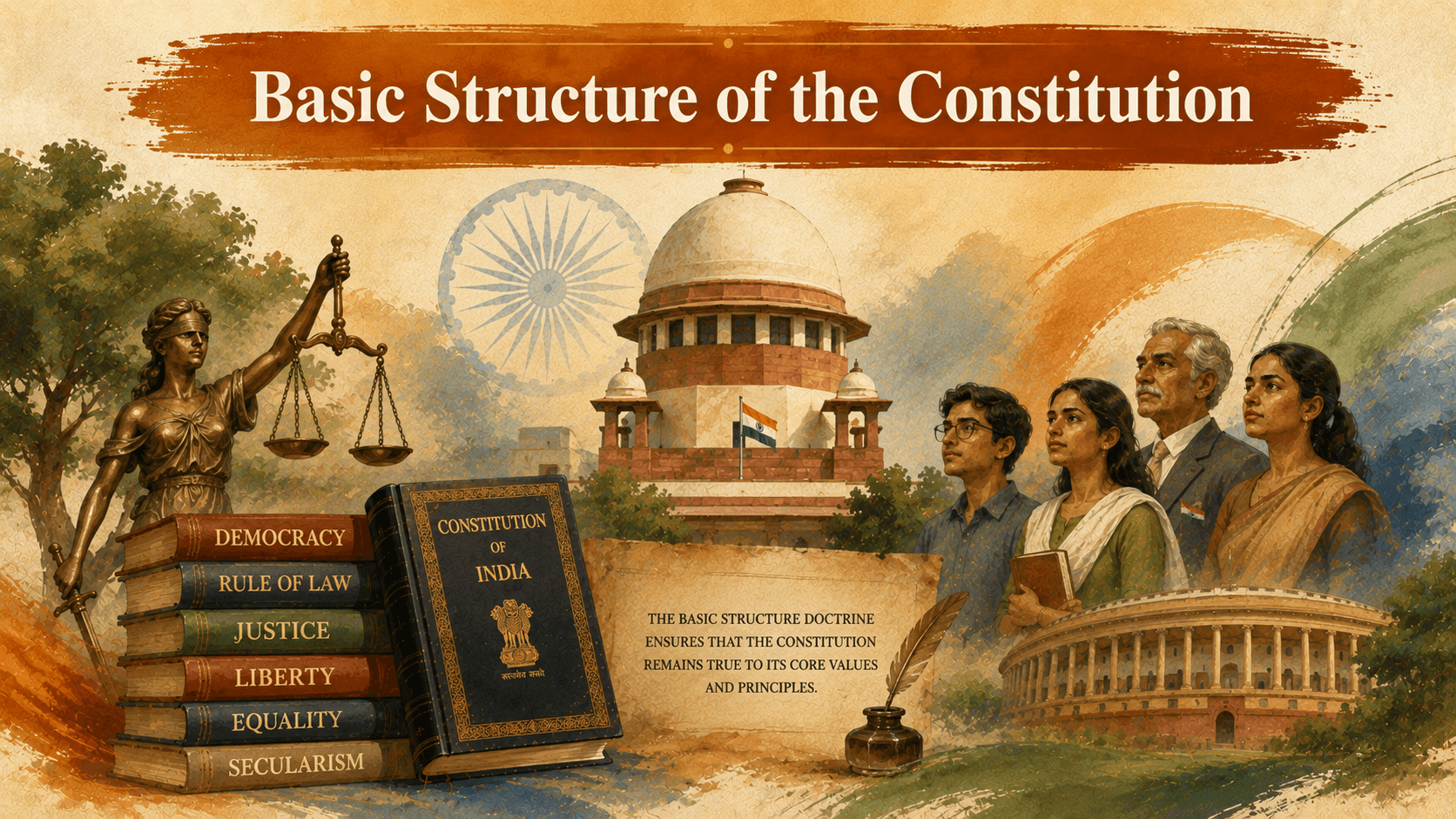
  • The Basic Structure doctrine limits Parliament's constituent power under Article 368.
  • Parliament may amend any part of the Constitution, including Fundamental Rights, but it cannot damage or destroy the Constitution's basic structure.
  • The Supreme Court evolved the doctrine in Kesavananda Bharati v. State of Kerala (1973).
  • The Constitution itself does not contain an exhaustive definition or list of basic features.
  • The Supreme Court has identified different basic features through successive constitutional cases.

Inside this chapter

What Basic Structure of the Constitution covers

  1. Core Doctrine
  2. Evolution of the Doctrine
  3. Application and Consolidation
  4. Evolution at a Glance
  5. Elements of the Basic Structure
  6. Landmark Case Map
  7. Kesavananda Bharati: Features Identified
  8. Indira Nehru Gandhi: Features Identified
  9. Minerva Mills: Three High-Yield Features
  10. S.R. Bommai and Constitutional Identity
  11. I.R. Coelho and the Ninth Schedule
  12. Constitutional Articles Linked to Basic Structure
  13. Parliament's Amending Power vs Basic Structure
  14. Amendment Map
  15. Prelims Traps
All 36 chapters in Indian Polity
  1. Historical Background
  2. Making of the Constitution
  3. Salient Features of the Constitution
  4. Preamble of the Constitution
  5. Union and its Territory
  6. Citizenship
  7. Fundamental Rights
  8. Directive Principles of State Policy
  9. Fundamental Duties
  10. Amendment of the Constitution
  11. Basic Structure of the Constitution
  12. Parliamentary System
  13. Federal System
  14. Centre–State Relations
  15. Inter-State Relations
  16. Emergency Provisions
  17. President
  18. Vice-President
  19. Prime Minister
  20. Central Council of Ministers
  21. Cabinet Committees
  22. Parliament
  23. Supreme Court
  24. Judiciary - Judicial Review and Judicial Activism, PIL
  25. Governor
  26. Chief Minister
  27. State Council of Ministers
  28. State Legislature
  29. High Court
  30. Tribunals
  31. Subordinate Courts
  32. Panchayati Raj
  33. Municipalities
  34. Union Territories
  35. Elections - Election Laws, Electoral Reforms
  36. Anti-Defection Law

Open the Indian Polity library

In the official syllabus