Skip to content

Chapter 05

Union and its Territory

  • 14sections
  • ~20min read
0%

0 of 14 sections

~20 min read

~20 min read
1Section 1 of 1About 1 min

Constitutional Framework

In this section: 1 table
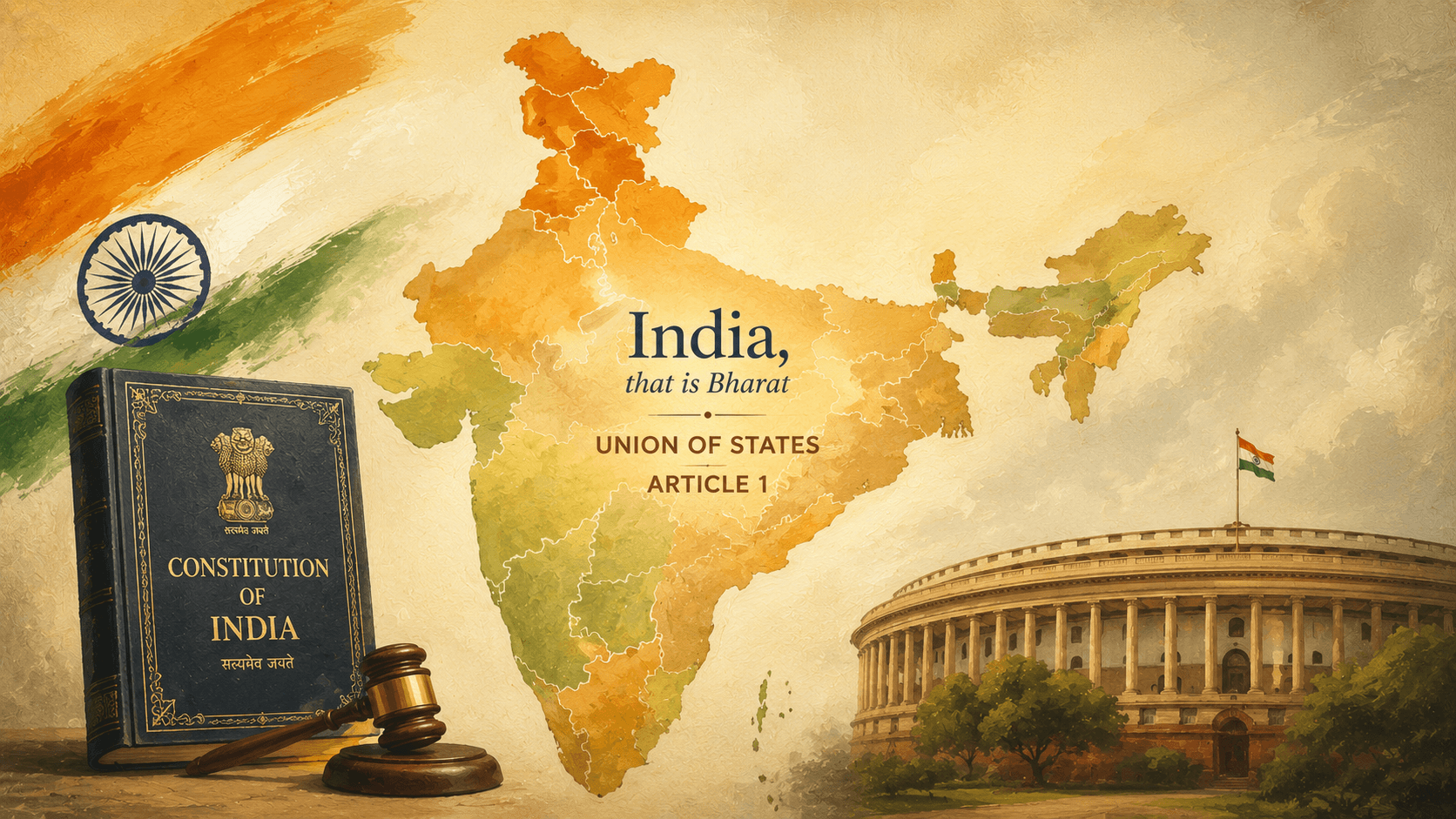
  • Part I of the Constitution (Articles 1–4) deals with the Union and its Territory.

  • These provisions determine:

    • the constitutional name and territorial composition of India;
    • admission or establishment of new states;
    • formation and reorganisation of existing states; and
    • consequential changes to constitutional schedules.
  • The First Schedule specifies the states and Union Territories and their territorial extent.

ArticleSubject
Article 1Name and territory of the Union
Article 2Admission or establishment of new states
Article 2ASikkim as associate state — repealed
Article 3Formation of new states; alteration of areas, boundaries or names
Article 4Supplemental and consequential provisions relating to Articles 2 & 3

“India, that is Bharat, shall be a Union of States.”

It establishes two important constitutional ideas:

Inside this chapter

What Union and its Territory covers

  1. Constitutional Framework
  2. Why “Union” and not “Federation”?
  3. Union of India vs Territory of India
  4. India vs USA
  5. Berubari Union Case
  6. Integration of Princely States
  7. Dhar Commission — 1948
  8. JVP Committee — 1948
  9. Four Factors Suggested by Fazl Ali Commission
  10. Maharashtra and Gujarat — 1960
  11. Dadra and Nagar Haveli
  12. Goa, Daman and Diu
  13. Puducherry
  14. 1966 Reorganisation
All 36 chapters in Indian Polity
  1. Historical Background
  2. Making of the Constitution
  3. Salient Features of the Constitution
  4. Preamble of the Constitution
  5. Union and its Territory
  6. Citizenship
  7. Fundamental Rights
  8. Directive Principles of State Policy
  9. Fundamental Duties
  10. Amendment of the Constitution
  11. Basic Structure of the Constitution
  12. Parliamentary System
  13. Federal System
  14. Centre–State Relations
  15. Inter-State Relations
  16. Emergency Provisions
  17. President
  18. Vice-President
  19. Prime Minister
  20. Central Council of Ministers
  21. Cabinet Committees
  22. Parliament
  23. Supreme Court
  24. Judiciary - Judicial Review and Judicial Activism, PIL
  25. Governor
  26. Chief Minister
  27. State Council of Ministers
  28. State Legislature
  29. High Court
  30. Tribunals
  31. Subordinate Courts
  32. Panchayati Raj
  33. Municipalities
  34. Union Territories
  35. Elections - Election Laws, Electoral Reforms
  36. Anti-Defection Law

Open the Indian Polity library

In the official syllabus