

Start hereAbout 2 min
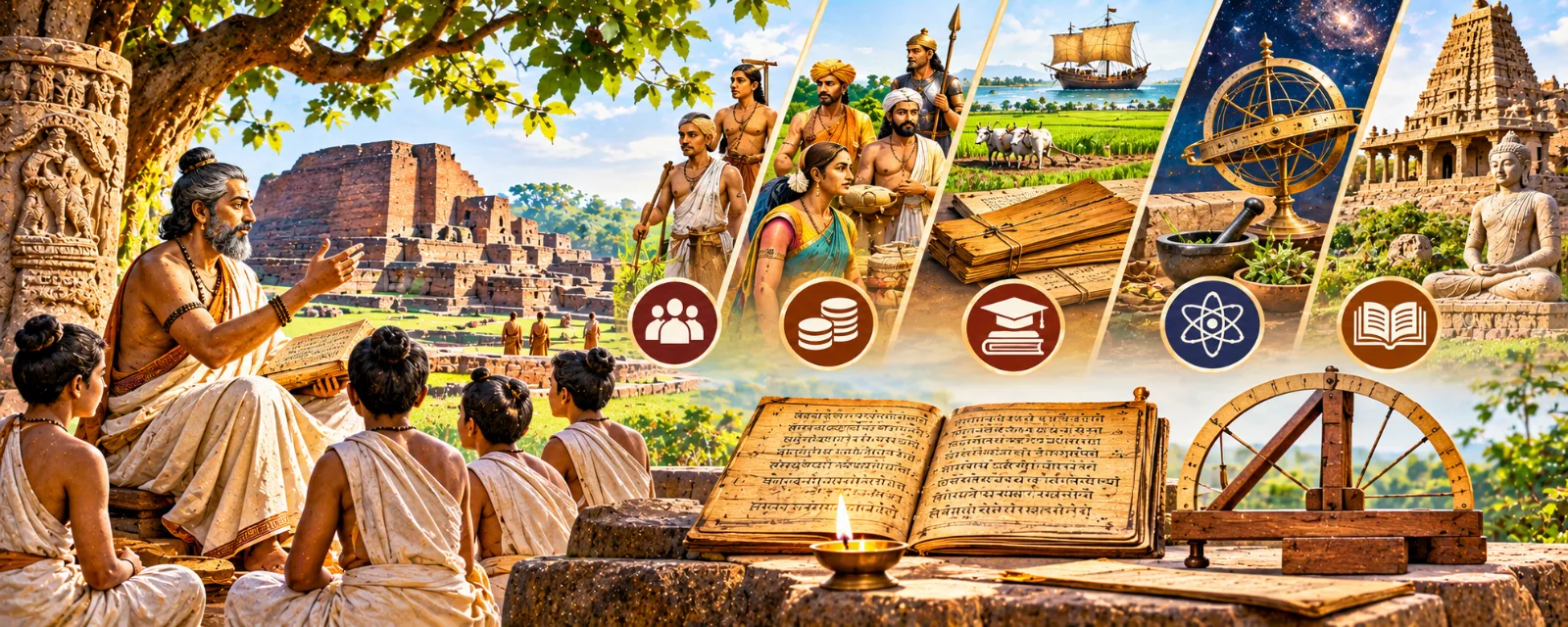
Chapter Overview Map
Ancient Indian Society, Economy, Education, Science and Knowledge Systems
12.1–12.4 Sources and society
- Society is reconstructed from archaeology, inscriptions, coins and texts, and normative texts describe ideals rather than practice.
- Varna was a fourfold ideal; jati was the birth-based, endogamous group people actually lived in.
- Women's roles varied by period, region and class; queens and donors are not typical of all women.
- Labour ranged from free cultivators and artisans to dasas, hired workers and people owing vishti (forced labour).
12.5–12.9 Agrarian and commercial economy
- Agricultural surplus supported towns, taxation and states from the Harappan cities to the Guptas.
- Land grants to Brahmanas and monasteries spread from the Satavahana period and multiplied after about 400 CE.
- Guilds (shrenis), routes such as Uttarapatha and Dakshinapatha, Indian Ocean ports and coins linked regions.
12.10–12.13 Education and ideas
- Learning moved from oral Vedic schools to monasteries such as Nalanda and Valabhi.
- Panini, Katyayana and Patanjali built the grammatical tradition; the Vedangas framed Vedic study.
- Philosophical schools debated reality and pramana (valid means of knowledge).
12.14–12.19 Science and technology
- Mathematics grew from Shulba altar geometry to place-value arithmetic and the rules for zero of Brahmagupta (628 CE).
- Aryabhata (499 CE), Varahamihira and Brahmagupta built computational astronomy.
- Charaka (medicine) and Sushruta (surgery) are layered texts; the Mehrauli Iron Pillar shows advanced iron-working.
- Tanks, dams and lakes such as Sudarshana linked water to farming and revenue.
12.20–12.24 Thought, exchange, region and evaluation
- The Arthashastra, Dharmashastras, Ashoka's Dhamma and the Tirukkural are traditions of governance and ethics.
- Monks, merchants and translators carried Indian learning to Sri Lanka, Central Asia, China, Southeast Asia and the Arab world.
- Andhra and Telangana sites such as Kotilingala, Kondapur, Phanigiri, Amaravati and Nagarjunakonda show Deccan trade, crafts and Buddhist learning.
- Claims about ancient science must be judged by dated evidence, not by later tradition.
Don't confuse
- Varna is a four-part textual ideal; jati is a local birth group, and there were hundreds of jatis.
- Zero as a place-holder (an empty position) is older than zero as a number with rules of arithmetic.
- Nalanda was a great monastic centre of learning, not a modern university with degrees.
Notice how the economy (12.5–12.9) supported institutions of learning (12.10–12.13), which in turn produced the sciences (12.14–12.19).