

Skip to content
PrepShark

Chapter 13Medieval Indian History & CultureUpdated

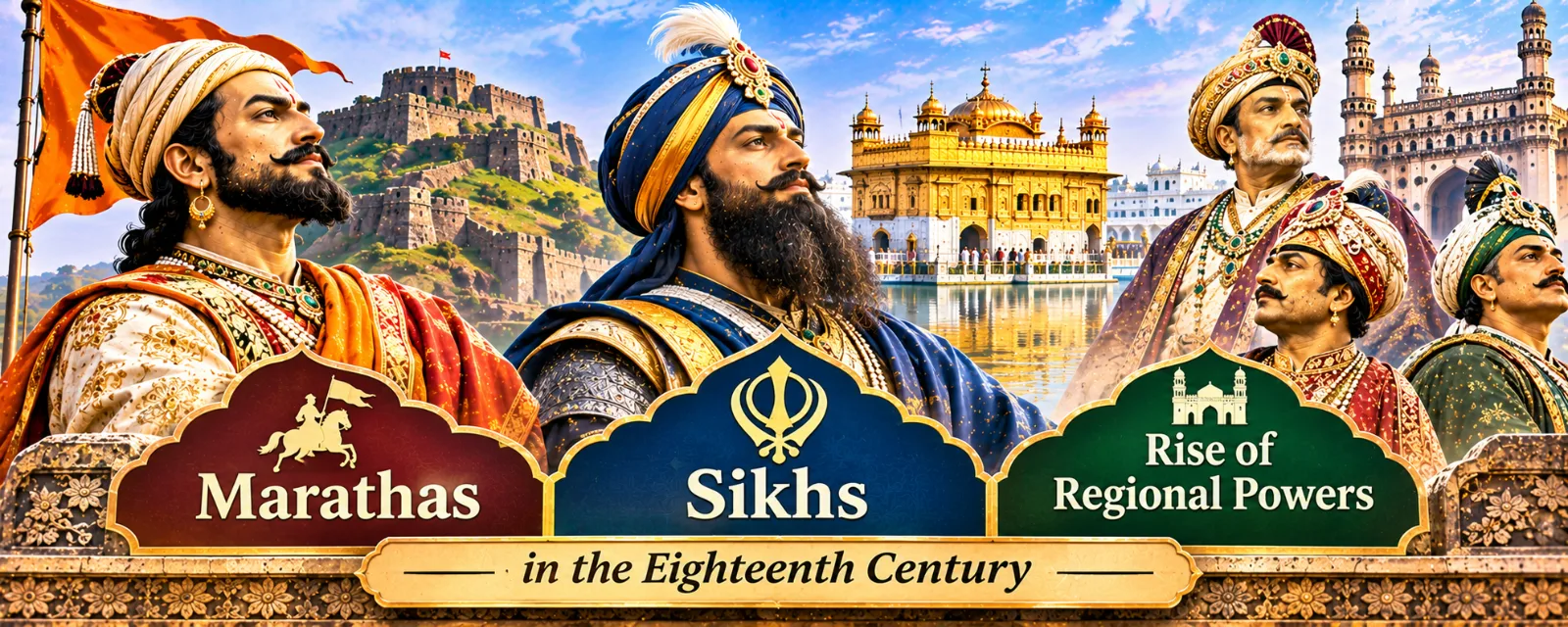
Marathas, Sikhs and the Rise of Regional Powers in the Eighteenth Century

How Mughal decline after 1707 gave way to Maratha, Sikh and regional states, how Europeans entered their wars, and how Andhra and Telangana passed from Hyderabad's rule towards Company government.

  • 26sections
  • ~119min read
0%

0 of 30 sections

~119 min read

~119 min read

Start hereAbout 2 min

Chapter Overview Map

In this section: 1 mind map

Figure 13.1Chapter overview: regional powers in eighteenth-century India
Marathas, Sikhs and the Rise of Regional Powers (1707–1800)
  1. 13.1–13.2 Setting and Mughal decline

    • After 1707 imperial authority weakened in distant provinces while regional states took shape.
    • Many new states kept Mughal titles, offices and revenue methods.
    • Sources include Persian chronicles, Marathi bakhars, Company records and Telugu ballads.
  2. 13.3–13.11 The Marathas

    • Shivaji built a sovereign kingdom, crowned in 1674, run through the Ashtapradhan.
    • Chauth and Sardeshmukhi were revenue claims, not proof of direct rule.
    • The Peshwas and the Confederacy carried Maratha power north; Panipat 1761 was a setback, not the end.
    • Three Anglo-Maratha Wars ended Peshwa authority in 1818.
  3. 13.12–13.14 The Sikhs

    • Banda Singh Bahadur set up the earliest Sikh political rule (1709–1715).
    • The Dal Khalsa and Misls organised Sikh power in the mid-eighteenth century.
    • Ranjit Singh took Lahore in 1799; Punjab was annexed in 1849.
  4. 13.15–13.22 Other regional powers

    • Bengal, Awadh and Hyderabad grew out of Mughal provinces.
    • Mysore, Travancore, the Jats, Rohillas and Ahoms followed their own paths.
    • Carnatic Wars and Anglo-Mysore Wars drew Europeans into South Indian politics.
  5. 13.17–13.20, 13.25 Andhra and Telangana

    • Asaf Jah I won at Shakar Kheda in 1724; Hyderabad became the capital in 1763.
    • The Northern Circars passed to the Company in stages: 1759, 1765, 1766, 1768, 1788.
    • Bobbili 1757, Padmanabham 1794 and the Ceded Districts 1800 shaped Andhra.
  6. 13.23–13.26 Economy, culture, women and debates

    • Bankers, textiles and regional courts kept commerce and culture alive.
    • Tarabai, Ahilyabai Holkar and Jind Kaur held real political power.
    • Historians now read the century as restructuring, not only decline.
  7. Don't confuse

    • Baji Rao I (Peshwa 1720–1740) is a different person from Baji Rao II (1796–1818).
    • Northern Circars (coast, 1765–1788) are different from the Ceded Districts (Rayalaseema, 1800).
    • Treaty of Amritsar 1809 (Sutlej boundary) is different from Treaty of Amritsar 1846 (Kashmir).

Notice how every regional story ends with Company intervention, but at different dates and by different means: treaty, war or subsidiary alliance.

Inside this chapter

What Marathas, Sikhs and the Rise of Regional Powers in the Eighteenth Century covers

  1. Chapter Overview Map
  2. Eighteenth-Century India: Setting, Political Geography and Sources
  3. Mughal Decline and the Rise of Regional States
  4. Shivaji and Maratha State Formation
  5. Shivaji's Administration: Ashtapradhan, Revenue, Chauth and Sardeshmukhi
  6. Sambhaji, Rajaram, Tarabai and Shahu: Survival and Succession
  7. The Peshwas: Balaji Vishwanath to Balaji Baji Rao
  8. The Maratha Confederacy: Principal Houses and Political Structure
  9. Third Battle of Panipat, 1761
  10. Madhavrao I, Later Peshwas and Nana Fadnavis
  11. The Three Anglo-Maratha Wars, 1775–1818
  12. Maratha Military, Navy, Economy and Society
  13. Sikh Political Background and Banda Singh Bahadur
  14. Dal Khalsa, Sarbat Khalsa and the Sikh Misls
  15. Maharaja Ranjit Singh and the Sikh Empire
  16. Bengal: The Nawabs, Plassey and Buxar
  17. Awadh: Saadat Khan, Safdar Jang and Shuja-ud-Daula
  18. Hyderabad: Asaf Jah I and the Foundation of the Asaf Jahi State
  19. Hyderabad after 1748: Succession, the French and Nizam Ali Khan
  20. The Carnatic Nawabs and the Anglo-French Struggle
  21. The Northern Circars, Bobbili, Padmanabham and Guntur
  22. Mysore: Haidar Ali, Tipu Sultan and the Anglo-Mysore Wars
  23. Jats, Rajputs, Rohillas, Travancore and the Ahoms
  24. Revenue, Trade, Banking and Cultural Patronage
  25. Women as Regents, Rulers and Political Actors
  26. Andhra Pradesh and Telangana in the Eighteenth Century
  27. Comparisons, Historiography and Common Confusions
  28. Location and Map Practice
  29. Memory and Recall Review
  30. Rapid Revision Sheet
All 46 chapters in Indian History
  1. Sources of Ancient Indian History and Prehistoric Cultures
  2. Indus Valley Civilisation
  3. Vedic Age: Society, Polity, Religion and Literature
  4. Mahajanapadas, Second Urbanisation and Rise of Magadha
  5. Jainism, Buddhism and Other Religious and Philosophical Traditions
  6. Mauryan Empire: Administration, Society, Economy and Culture
  7. Post-Mauryan India: Indigenous and Foreign Dynasties, Trade and Art
  8. Satavahanas, Ikshvakus and Early Deccan Culture
  9. Sangam Age and Early South Indian History and Culture
  10. Gupta Empire, Vakatakas and the Classical Age of Indian Culture
  11. Post-Gupta India, Harsha and the Transition to Early Medieval India
  12. Ancient Indian Society, Economy, Education, Science and Knowledge Systems
  13. Ancient Indian Architecture, Performing Arts and Cultural Heritage: Thematic Synthesis
  14. Early Medieval India: Political, Social and Economic Transformations
  15. Palas, Pratiharas, Rashtrakutas and the Tripartite Struggle
  16. Pallavas and Chalukyas: Early South Indian Kingdoms and Culture
  17. Rashtrakutas, Western Chalukyas, Hoysalas and Yadavas
  18. Imperial Cholas, Pandyas and Medieval South Indian Culture
  19. Kakatiyas, Reddis, Gajapatis and Other Regional Kingdoms
  20. Advent of Islam and the Delhi Sultanate: Political History
  21. Delhi Sultanate: Administration, Society, Economy and Culture
  22. Vijayanagara Empire and the Bahmani–Deccan Sultanates
  23. Bhakti, Sufi and Religious Reform Movements in Medieval India
  24. Mughal Empire: Establishment, Expansion and Decline
  25. Mughal Administration, Economy, Society and Cultural Achievements
  26. Marathas, Sikhs and the Rise of Regional Powers in the Eighteenth Century
  27. Medieval Indian Society, Literature, Fine Arts and Composite Culture: Thematic Synthesis
  28. Arrival of Europeans
  29. Rise of Regional States
  30. British Conquest of India
  31. Popular Uprisings Before 1857
  32. 1857 Revolt
  33. Popular Uprisings After 1857
  34. Socio-Religious Reform Movements
  35. Beginning of Struggle (1805-1905)
  36. National Movement (1905-1919)
  37. National Movement (1919-1929)
  38. National Movement (1929-1947)
  39. Economic Impact of British Rule in India
  40. LAND REVENUE SYSTEM IN INDIA
  41. DEVELOPMENT OF EDUCATION SYSTEM AND LANGUAGE IN INDIA
  42. DEVELOPMENT OF PRESS
  43. OTHER ASPECTS OF BRITISH RULE IN INDIA
  44. GOVERNOR GENERAL OF INDIA (1773-1950)
  45. IMPORTANT JOURNALS AND BOOKS
  46. IMPORTANT PERSONALITIES

Open the Indian History library

In the official syllabus