

Start hereAbout 1 min
Chapter Overview Map
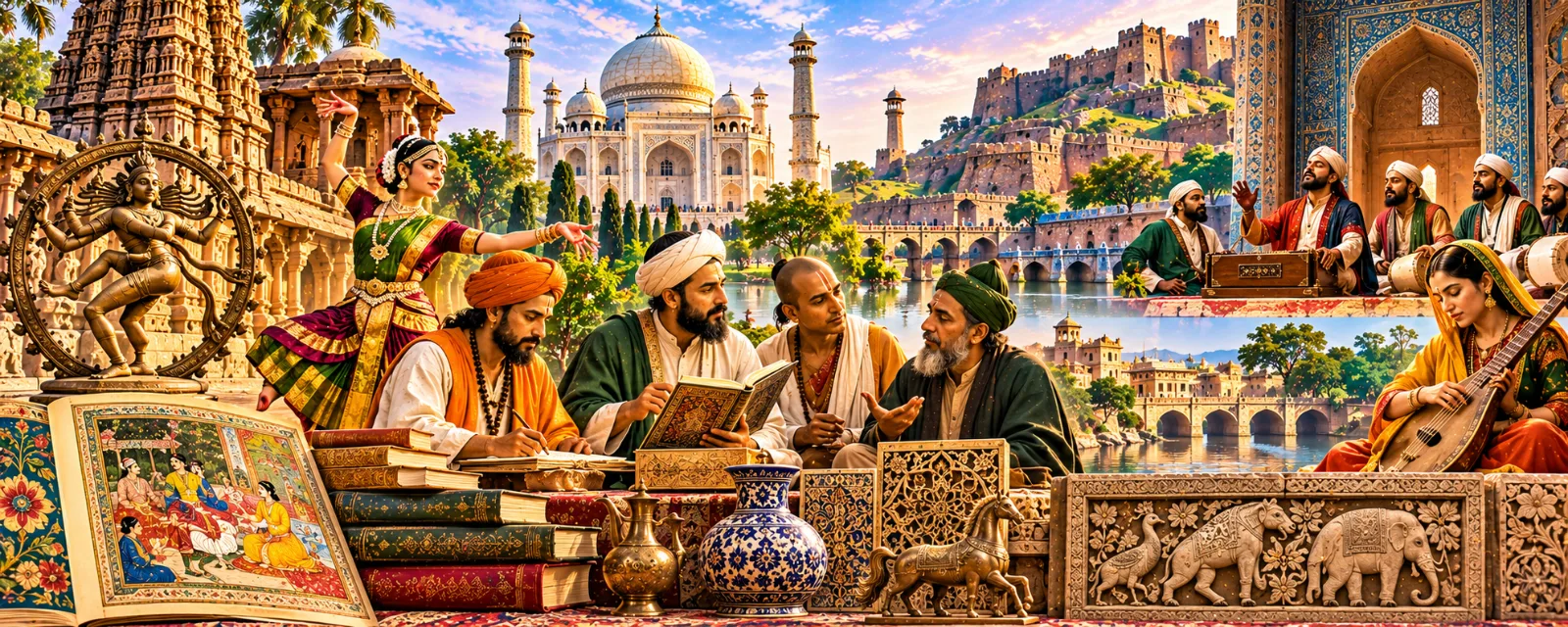
Medieval Indian Society, Literature, Fine Arts and Composite Culture
14.1–14.4 Society and economy
- Sources (inscriptions, copper plates, chronicles, travellers) show how historians rebuild medieval life.
- Land grants, temples, tanks and village assemblies shaped rural society and the feudalism debate.
- Caste, women, guilds, ports and towns show both hierarchy and mobility.
14.5–14.7 Languages, literature and religion
- Sanskrit continued while regional languages and Persian grew into major literary media.
- Telugu literature runs from Nannaya (11th century) to Vemana and Ramadasu (17th century).
- Temples, mathas, khanqahs and gurdwaras linked devotion, learning and the economy.
14.8–14.12 Architecture
- Temple styles: Nagara, Dravida and regional forms from Pallava to Vijayanagara.
- Kakatiya temples and tanks in Telangana; Vijayanagara and Reddi monuments in Andhra.
- Indo-Islamic buildings from Delhi to Bijapur, Golconda–Hyderabad and the Mughals.
14.13–14.15 Arts and technology
- Sculpture and painting: Chola bronzes, Ramappa brackets, Lepakshi murals, Mughal and Deccan miniatures.
- Music and dance: Annamacharya, Kuchipudi, Perini and the Nritta Ratnavali.
- Engineering: tanks, domes, guns, textiles and paper.
14.16–14.18 Synthesis and heritage
- Andhra Pradesh and Telangana compared as one Telugu cultural world with regional diversity.
- World Heritage and national protection terms, with inscribed sites kept apart from Tentative List entries.
- Master matrices, misconceptions and glossary for final revision.
Don't confuse
- Composite culture describes interaction; it does not mean every community agreed or that conflict was absent.
- A Tentative List entry is not World Heritage inscription: the Qutb Shahi monuments are only on the Tentative List.
Notice how the chapter moves from land and society to language, then to buildings and arts, and ends with regional synthesis and heritage.