

Start hereAbout 2 min
Chapter Overview Map
Vedic Age (about 1500–600 BCE)
3.1–3.3 Sources, origins and geography
- The Vedic texts are the main evidence; archaeology adds settlement and material evidence.
- Vedic Sanskrit belongs to the Indo-Iranian branch of the Indo-European language family.
- Settlement references move from the Sapta Sindhu (Punjab) to the Ganga–Yamuna doab and beyond.
3.4–3.7 Early Vedic life
- The jana (people or tribe) led by a rajan was the main political unit.
- Sabha, samiti and vidatha were assemblies of the community.
- Cattle were the chief measure of wealth; Indra and Agni received most hymns.
3.8–3.10 Later Vedic transformation
- Territorial units (janapada, rashtra) and stronger kingship emerged in the Kuru–Panchala region.
- Agriculture, rice and, later, iron expanded settled life in the Ganga valley.
- Varna distinctions hardened and royal sacrifices advertised royal power.
3.11–3.13 Vedic literature
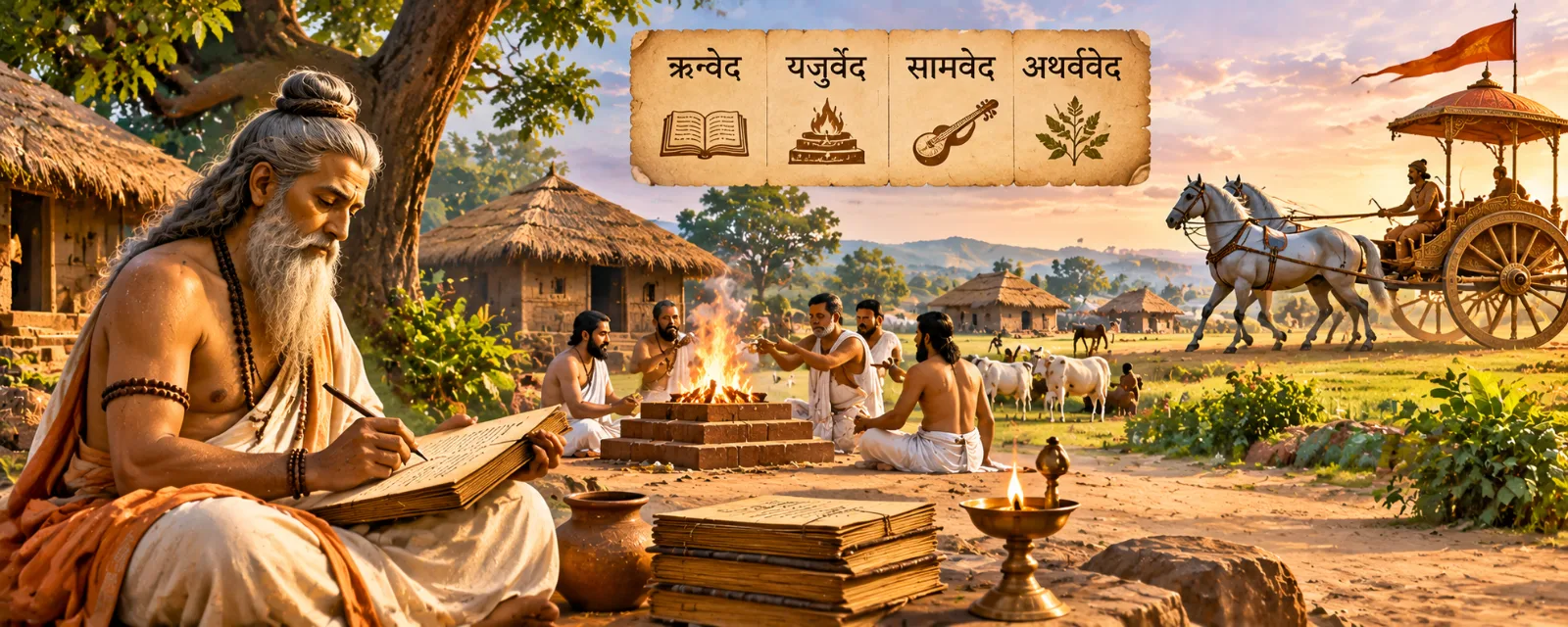
- Four Vedas: Rigveda, Samaveda, Yajurveda and Atharvaveda, each with its own priest.
- Brahmanas, Aranyakas and Upanishads grew around each Veda as later layers.
- Six Vedangas and the Sutras were auxiliary sciences for preserving and using the Vedas.
3.14–3.17 Ritual, culture, archaeology and transition
- Ritual moved from hymn and offering to elaborate priestly sacrifice, then to Upanishadic inquiry.
- Painted Grey Ware sites of the doab broadly overlap the Later Vedic zone.
- Later Vedic changes prepared the ground for the Mahajanapadas (Chapter 4).
Don't confuse
- Vedic and Harappan are different cultures with different evidence: one known mainly from texts, the other from excavated cities.
- Varna (four-fold ritual order) is not the same as jati (later birth-groups, many in number).
- A pottery culture is a material category; it cannot by itself reveal what language its users spoke.
Notice how the branches follow the chapter: sources and setting, Early Vedic life, Later Vedic change, the literature, and the links to archaeology and later history.