

Skip to content
PrepShark

Chapter 4Ancient Indian History and CultureUpdated

Mahajanapadas, Second Urbanisation and Rise of Magadha

How lineage-based peoples became territorial states, how towns, trade and coins returned to the Ganga plain, and how Magadha under the Haryanka, Shishunaga and Nanda dynasties outgrew its rivals between about 600 and 321 BCE.

  • 16sections
  • ~75min read
0%

0 of 20 sections

~75 min read

~75 min read

Start hereAbout 1 min

Chapter Overview Map

In this section: 1 mind map

Figure 4.1Mind map: the chapter at a glance
Mahajanapadas, Second Urbanisation and Rise of Magadha
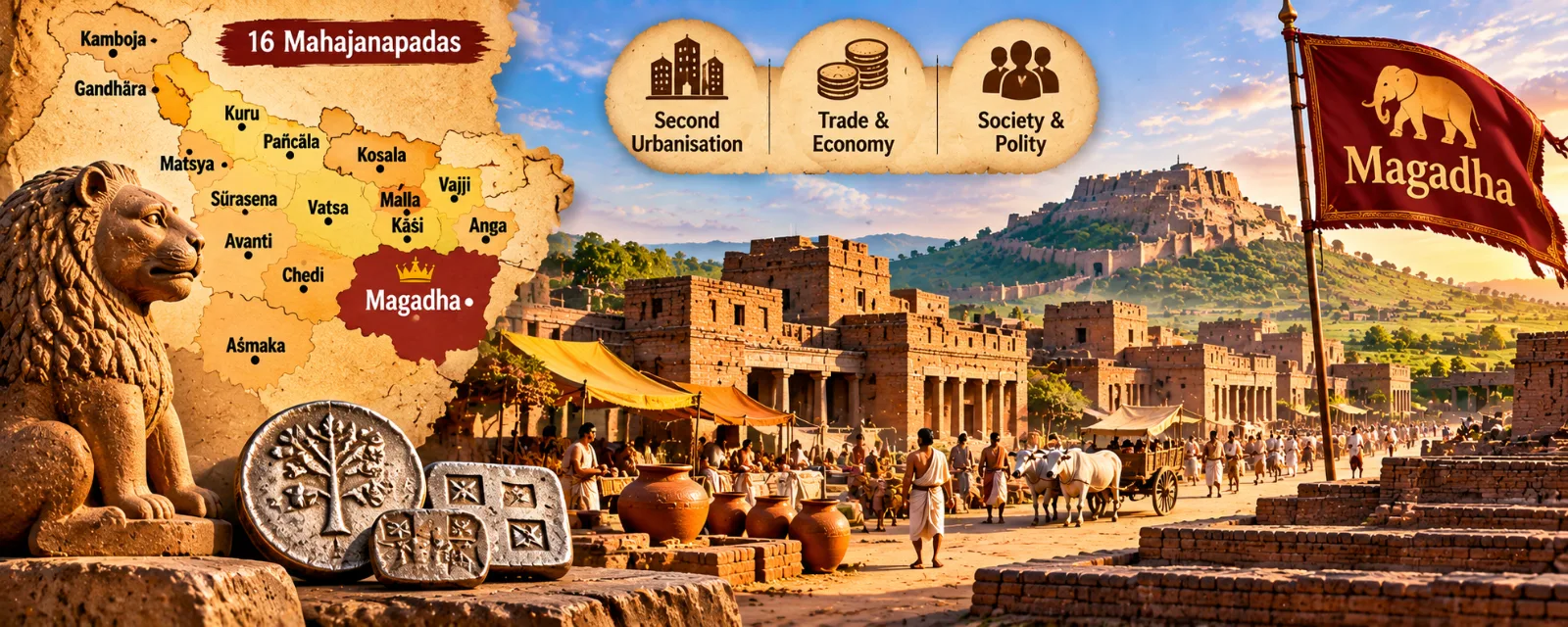
  1. 4.1–4.4 Janapadas, sources and the sixteen states

    • Lineage-based janas settled into territorial janapadas during the later Vedic age.
    • Buddhist and Jain texts, the Puranas, Panini and archaeology are the main sources.
    • The Anguttara Nikaya lists sixteen Mahajanapadas, from Gandhara in the north-west to Anga in the east and Assaka on the Godavari.
    • Most were monarchies; Vajji and Malla were gana-sanghas ruled by clan assemblies.
  2. 4.5–4.8 Second Urbanisation and economy

    • Towns reappeared in the Ganga plain about a thousand years after the Harappan cities declined.
    • Surplus farming, iron tools, crafts, fine Northern Black Polished Ware (NBPW), trade routes and punch-marked coins went with them.
  3. 4.9–4.10 Society and new ideas

    • Gahapatis, merchants and craft groups grew in importance.
    • Shramana teachers such as the Buddha and Mahavira debated in this urban setting.
  4. 4.11–4.15 Rise of Magadha

    • Fertile land, rivers, forests, iron and able rulers helped Magadha absorb its rivals.
    • Haryanka, Shishunaga and Nanda rulers built the base of the Mauryan Empire.
  5. 4.16 Ashmaka and the Deccan

    • Assaka (Ashmaka) on the Godavari was the only Mahajanapada south of the Vindhyas.
    • Its capital Potana is often identified with Bodhan in Telangana, though this is debated.
  6. Don't confuse

    • A janapada is a territory named after a people; a Mahajanapada is one of the larger, more powerful janapadas.
    • Rajagriha was Magadha's early capital; Pataliputra became the capital later, under Udayin and finally Kalashoka.

Notice how the branches move from the making of states, through the economy and ideas that sustained them, to the one state, Magadha, that absorbed the rest.

Inside this chapter

What Mahajanapadas, Second Urbanisation and Rise of Magadha covers

  1. Chapter Overview Map
  2. From Janas to Janapadas: The Making of Territorial States
  3. Sources for the Age of the Mahajanapadas
  4. The Sixteen Mahajanapadas
  5. Monarchies and Gana-Sanghas: Early Political Institutions
  6. The Second Urbanisation
  7. Agricultural Expansion, Iron and Economic Change
  8. Northern Black Polished Ware and Archaeological Cultures
  9. Trade, Crafts, Guilds and Early Coinage
  10. Society and Everyday Life in the Mahajanapada Age
  11. Religious and Intellectual Ferment
  12. Why Magadha Rose: Geography, Resources and Leadership
  13. The Haryanka Dynasty and Early Magadhan Expansion
  14. The Shishunaga Dynasty
  15. The Nanda Dynasty
  16. The Early Magadhan State: An Integrated View
  17. Ashmaka, the Deccan and the Andhra Pradesh–Telangana Connection
  18. Location and Map Practice
  19. Memory and Recall Review
  20. Rapid Revision Sheet
All 46 chapters in Indian History
  1. Sources of Ancient Indian History and Prehistoric Cultures
  2. Indus Valley Civilisation
  3. Vedic Age: Society, Polity, Religion and Literature
  4. Mahajanapadas, Second Urbanisation and Rise of Magadha
  5. Jainism, Buddhism and Other Religious and Philosophical Traditions
  6. Mauryan Empire: Administration, Society, Economy and Culture
  7. Post-Mauryan India: Indigenous and Foreign Dynasties, Trade and Art
  8. Satavahanas, Ikshvakus and Early Deccan Culture
  9. Sangam Age and Early South Indian History and Culture
  10. Gupta Empire, Vakatakas and the Classical Age of Indian Culture
  11. Post-Gupta India, Harsha and the Transition to Early Medieval India
  12. Ancient Indian Society, Economy, Education, Science and Knowledge Systems
  13. Ancient Indian Architecture, Performing Arts and Cultural Heritage: Thematic Synthesis
  14. Early Medieval India: Political, Social and Economic Transformations
  15. Palas, Pratiharas, Rashtrakutas and the Tripartite Struggle
  16. Pallavas and Chalukyas: Early South Indian Kingdoms and Culture
  17. Rashtrakutas, Western Chalukyas, Hoysalas and Yadavas
  18. Imperial Cholas, Pandyas and Medieval South Indian Culture
  19. Kakatiyas, Reddis, Gajapatis and Other Regional Kingdoms
  20. Advent of Islam and the Delhi Sultanate: Political History
  21. Delhi Sultanate: Administration, Society, Economy and Culture
  22. Vijayanagara Empire and the Bahmani–Deccan Sultanates
  23. Bhakti, Sufi and Religious Reform Movements in Medieval India
  24. Mughal Empire: Establishment, Expansion and Decline
  25. Mughal Administration, Economy, Society and Cultural Achievements
  26. Marathas, Sikhs and the Rise of Regional Powers in the Eighteenth Century
  27. Medieval Indian Society, Literature, Fine Arts and Composite Culture: Thematic Synthesis
  28. Arrival of Europeans
  29. Rise of Regional States
  30. British Conquest of India
  31. Popular Uprisings Before 1857
  32. 1857 Revolt
  33. Popular Uprisings After 1857
  34. Socio-Religious Reform Movements
  35. Beginning of Struggle (1805-1905)
  36. National Movement (1905-1919)
  37. National Movement (1919-1929)
  38. National Movement (1929-1947)
  39. Economic Impact of British Rule in India
  40. LAND REVENUE SYSTEM IN INDIA
  41. DEVELOPMENT OF EDUCATION SYSTEM AND LANGUAGE IN INDIA
  42. DEVELOPMENT OF PRESS
  43. OTHER ASPECTS OF BRITISH RULE IN INDIA
  44. GOVERNOR GENERAL OF INDIA (1773-1950)
  45. IMPORTANT JOURNALS AND BOOKS
  46. IMPORTANT PERSONALITIES

Open the Indian History library

In the official syllabus