

Skip to content
PrepShark

Chapter 6Ancient Indian History and CultureUpdated

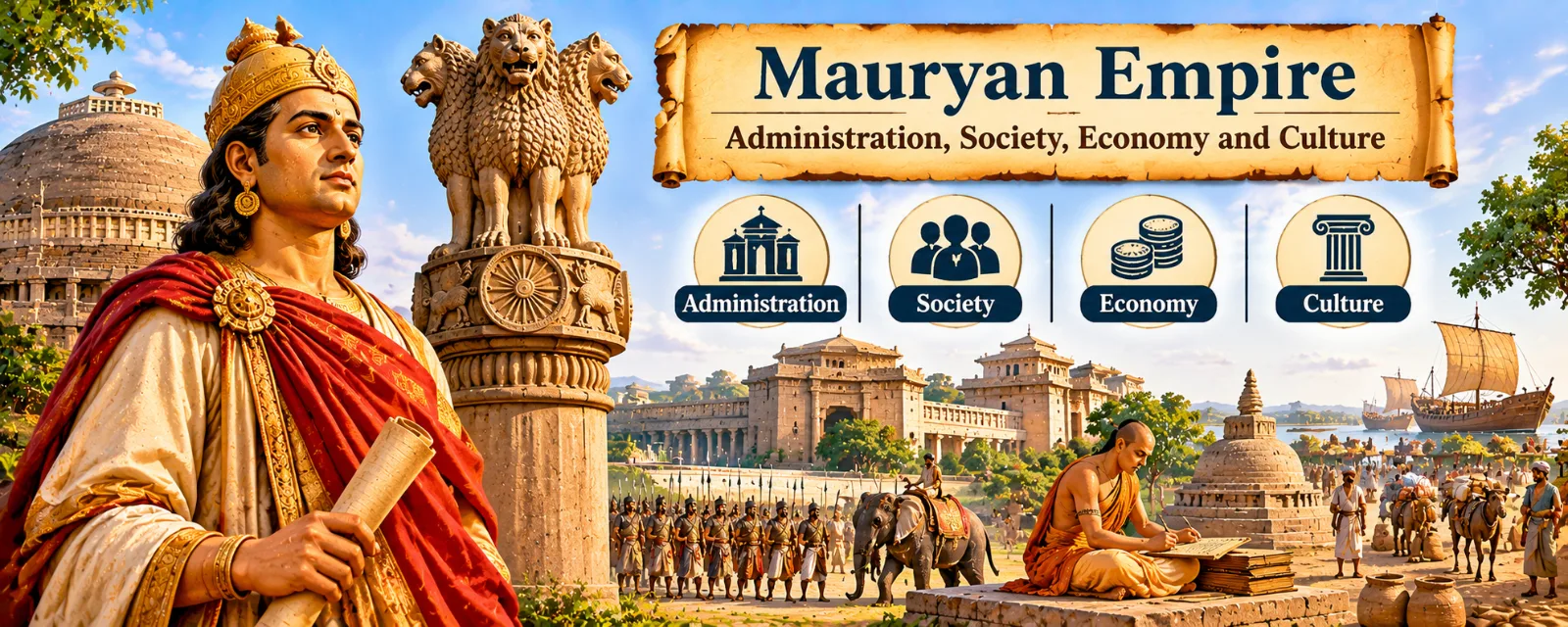
Mauryan Empire: Administration, Society, Economy and Culture

How the Mauryas built India's first subcontinental empire: sources, rulers from Chandragupta to Brihadratha, the Kalinga War and Ashoka's Dhamma, the edicts, government, economy, society, religion, art and architecture, the Deccan and Andhra connection, decline and legacy.

  • 22sections
  • ~133min read
0%

0 of 26 sections

~133 min read

~133 min read

Start hereAbout 2 min

Chapter Overview Map

In this section: 1 mind map

Figure 6.1Mind map: The Mauryan Empire at a glance
Mauryan Empire (about 321–185 BCE)
  1. 6.1–6.4 Rise and first rulers

    • Magadha's growth under the Haryankas, Shishunagas and Nandas gave the Mauryas a strong base.
    • Chandragupta Maurya overthrew the Nandas and settled the north-west with Seleucus I.
    • Bindusara held the empire together and kept up Greek diplomatic contacts.
  2. 6.5–6.8 Ashoka, Kalinga and the edicts

    • Ashoka conquered Kalinga about 261 BCE; Major Rock Edict XIII records his remorse.
    • His Dhamma was a public code of ethical conduct, not the whole of Buddhist doctrine.
    • His inscriptions are the earliest securely dated royal records in Indian history.
  3. 6.9–6.14 State, economy and society

    • The king governed through ministers, mahamatras and provincial princes at four main centres.
    • Land revenue (bhaga), trade routes, crafts and punch-marked coins sustained the state.
    • The Arthashastra and Megasthenes describe society and law, but as norm or outside view.
  4. 6.15–6.17 Religion, art and letters

    • Mauryan rulers patronised Buddhists, Jains and Ajivikas alongside Brahmanical traditions.
    • Polished stone pillars, the Sarnath Lion Capital and the Barabar caves mark Mauryan art.
    • Edicts use Prakrit in Brahmi, and Kharoshthi, Greek and Aramaic in the north-west.
  5. 6.18–6.22 Reach, decline and legacy

    • Edict sites stretch from Kandahar to Erragudi in Andhra Pradesh, but control varied by region.
    • After Ashoka the empire shrank; Pushyamitra Shunga killed Brihadratha about 185 BCE.
    • The Mauryas left a model of a large state and of ethical kingship.
  6. Don't confuse

    • Chandragupta Maurya founded the Mauryan dynasty; Chandragupta I and II were later Gupta kings.
    • Prakrit is the language of most edicts; Brahmi is the script it is written in.
    • Nagarjuni caves in Bihar are Mauryan; Nagarjunakonda in Andhra Pradesh is a later Ikshvaku site.

Notice that the five branches follow the order of the chapter's sections; the last branch lists three confusions that run through the whole chapter.

Inside this chapter

What Mauryan Empire: Administration, Society, Economy and Culture covers

  1. Chapter Overview Map
  2. Background and Rise of the Mauryan Empire
  3. Sources for Mauryan History
  4. Chandragupta Maurya: Establishment and Expansion
  5. Bindusara and Continuity of Mauryan Rule
  6. Ashoka: Accession, Expansion and Historical Significance
  7. The Kalinga War: Causes, Consequences and Transformation
  8. Ashoka's Dhamma: Concept, Principles and Implementation
  9. Ashokan Inscriptions: Classification, Content and Importance
  10. Central Administration of the Mauryan Empire
  11. Provincial, District and Local Administration
  12. Pataliputra, City Administration and Urban Life
  13. Mauryan Economy: Agriculture, Revenue, Trade and Industry
  14. Mauryan Society, Social Structure and Everyday Life
  15. Law, Justice, Security and Military Organisation
  16. Religion and Cultural Life under the Mauryas
  17. Mauryan Art and Architecture
  18. Literature, Language, Script and Intellectual Traditions
  19. Foreign Relations and Imperial Geography
  20. The Mauryan Empire in the Deccan, Andhra Pradesh and Telangana
  21. Later Mauryas, Decline and Historical Transformation
  22. Historical Significance and Legacy of the Mauryan Empire
  23. Rulers, Officials, Events, Monuments and Common Confusions
  24. Location and Map Practice
  25. Memory and Recall Review
  26. Rapid Revision Sheet
All 46 chapters in Indian History
  1. Sources of Ancient Indian History and Prehistoric Cultures
  2. Indus Valley Civilisation
  3. Vedic Age: Society, Polity, Religion and Literature
  4. Mahajanapadas, Second Urbanisation and Rise of Magadha
  5. Jainism, Buddhism and Other Religious and Philosophical Traditions
  6. Mauryan Empire: Administration, Society, Economy and Culture
  7. Post-Mauryan India: Indigenous and Foreign Dynasties, Trade and Art
  8. Satavahanas, Ikshvakus and Early Deccan Culture
  9. Sangam Age and Early South Indian History and Culture
  10. Gupta Empire, Vakatakas and the Classical Age of Indian Culture
  11. Post-Gupta India, Harsha and the Transition to Early Medieval India
  12. Ancient Indian Society, Economy, Education, Science and Knowledge Systems
  13. Ancient Indian Architecture, Performing Arts and Cultural Heritage: Thematic Synthesis
  14. Early Medieval India: Political, Social and Economic Transformations
  15. Palas, Pratiharas, Rashtrakutas and the Tripartite Struggle
  16. Pallavas and Chalukyas: Early South Indian Kingdoms and Culture
  17. Rashtrakutas, Western Chalukyas, Hoysalas and Yadavas
  18. Imperial Cholas, Pandyas and Medieval South Indian Culture
  19. Kakatiyas, Reddis, Gajapatis and Other Regional Kingdoms
  20. Advent of Islam and the Delhi Sultanate: Political History
  21. Delhi Sultanate: Administration, Society, Economy and Culture
  22. Vijayanagara Empire and the Bahmani–Deccan Sultanates
  23. Bhakti, Sufi and Religious Reform Movements in Medieval India
  24. Mughal Empire: Establishment, Expansion and Decline
  25. Mughal Administration, Economy, Society and Cultural Achievements
  26. Marathas, Sikhs and the Rise of Regional Powers in the Eighteenth Century
  27. Medieval Indian Society, Literature, Fine Arts and Composite Culture: Thematic Synthesis
  28. Arrival of Europeans
  29. Rise of Regional States
  30. British Conquest of India
  31. Popular Uprisings Before 1857
  32. 1857 Revolt
  33. Popular Uprisings After 1857
  34. Socio-Religious Reform Movements
  35. Beginning of Struggle (1805-1905)
  36. National Movement (1905-1919)
  37. National Movement (1919-1929)
  38. National Movement (1929-1947)
  39. Economic Impact of British Rule in India
  40. LAND REVENUE SYSTEM IN INDIA
  41. DEVELOPMENT OF EDUCATION SYSTEM AND LANGUAGE IN INDIA
  42. DEVELOPMENT OF PRESS
  43. OTHER ASPECTS OF BRITISH RULE IN INDIA
  44. GOVERNOR GENERAL OF INDIA (1773-1950)
  45. IMPORTANT JOURNALS AND BOOKS
  46. IMPORTANT PERSONALITIES

Open the Indian History library

In the official syllabus