

Skip to content
PrepShark

Chapter 1Medieval Indian History & CultureUpdated

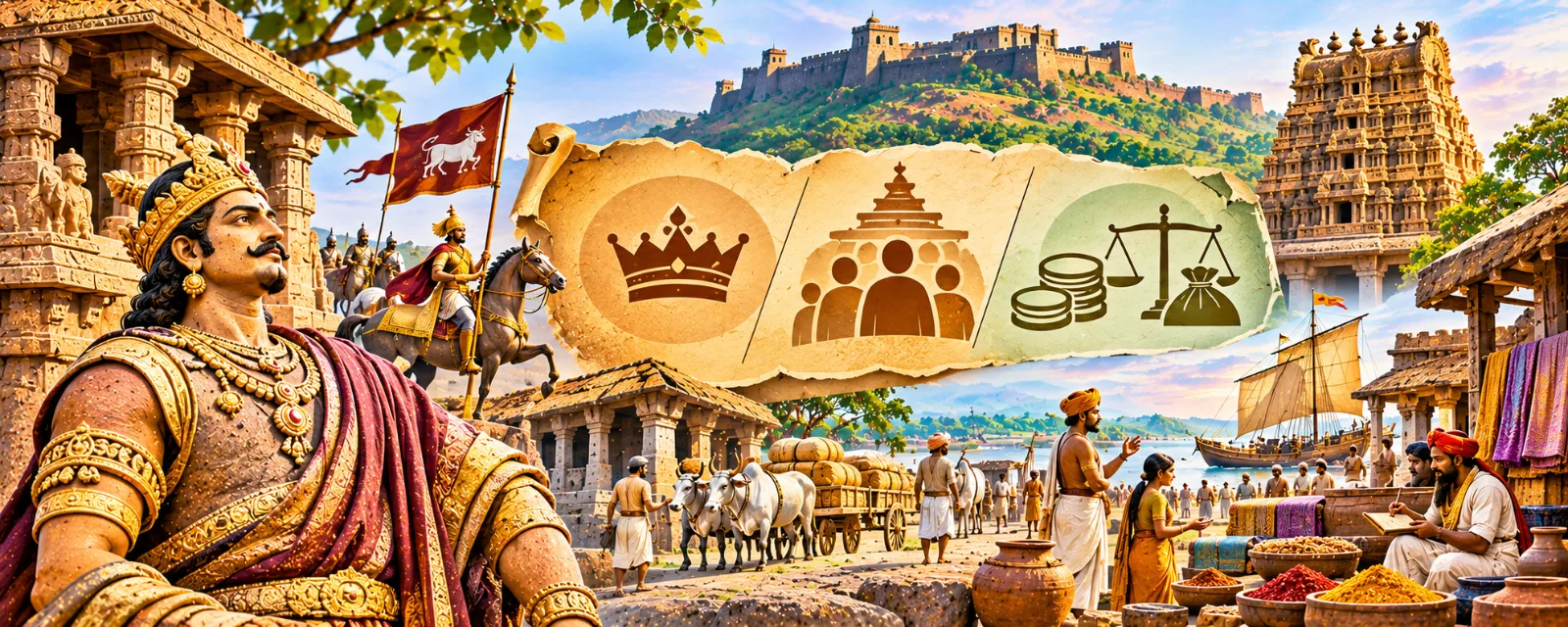
Early Medieval India: Political, Social and Economic Transformations

How regional kingdoms, samanta relations, land grants, agrarian expansion, village assemblies, temples, trade and regional cultures transformed India between about 600 and 1200 CE, with Andhra Pradesh and Telangana.

  • 26sections
  • ~126min read
0%

0 of 30 sections

~126 min read

~126 min read

Start hereAbout 2 min

Chapter Overview Map

In this section: 1 mind map

Figure 1.1Chapter overview
Early Medieval India: Political, Social and Economic Transformations (c. 600–1200 CE)
  1. 1.1–1.4 Framework, sources and kingdoms

    • Periodisation treats c. 600–1200 CE as a transition with regional timelines, not a single break.
    • Inscriptions and copper-plate grants are the main sources, read with literature, coins, travellers and archaeology.
    • Regional kingdoms such as the Palas, Pratiharas, Rashtrakutas, Pallavas, Chalukyas and Cholas replaced a few large empires.
  2. 1.5–1.8 Power, administration and land

    • Kingship rested on titles, genealogies, ritual, temple patronage and military prestige.
    • Samantas were subordinate rulers bound to an overlord by tribute, military service and ceremony.
    • Land grants (Brahmadeya, Agrahara, Devadana) transferred revenue rights and privileges, not always full ownership.
  3. 1.9–1.14 Agrarian society and social change

    • Agrarian expansion brought forests and frontiers into cultivation and into kingdoms.
    • Village assemblies such as the Ur, Sabha and Nagaram managed land, water, revenue and temples in South India.
    • Jatis multiplied, new identities such as Rajputs and Kayasthas emerged, and women's visibility varied by class and region.
  4. 1.15–1.21 Temples, trade and culture

    • Temples became landholders, employers and centres of redistribution in many regions.
    • Trade reorganised rather than collapsing, with guilds such as the Ainnurruvar and ports on both coasts.
    • Regional languages and regional temple styles grew alongside continued Sanskrit.
  5. 1.22–1.26 Andhra, Telangana, the world and the debate

    • Eastern Chalukyas of Vengi shaped Andhra; Vemulavada Chalukyas and early Kakatiyas shaped Telangana.
    • Indian Ocean networks linked India with West Asia, Sri Lanka, Southeast Asia and China.
    • Indian feudalism and integrative state formation are competing models for the same evidence.
  6. Don't confuse

    • Political fragmentation means many states; regional state formation means new states being built. Both can describe the same period.
    • Revenue rights granted in a copper plate are not the same as full ownership of every field.
    • Uttiramerur describes tenth-century Chola Brahmadeya assemblies, not every Indian village.

Notice that each branch groups related sections, and the last branch collects confusions that cut across sections.

Inside this chapter

What Early Medieval India: Political, Social and Economic Transformations covers

  1. Chapter Overview Map
  2. Early Medieval India: Meaning, Periodisation and Framework
  3. Sources for Early Medieval Indian History
  4. From Post-Gupta India to Regional Kingdoms
  5. Major Early Medieval Regional Kingdoms: Foundational Overview
  6. Kingship, Sovereignty and Political Legitimacy
  7. The Samanta System and Changing Political Relationships
  8. Administrative Organisation and Regional Governance
  9. Land Grants: Origins, Types and Historical Significance
  10. Agrarian Expansion and the Formation of New Settlements
  11. Peasants, Landholders, Labour and Rural Society
  12. Village Assemblies, Local Institutions and Community Organisation
  13. Taxation, Revenue and Fiscal Relationships
  14. Social Stratification: Varna, Jati and Caste Formation
  15. Women, Family, Marriage and Gender Relationships
  16. Religious Transformations and the Growth of Temple-Centred Culture
  17. Temple Economy, Land, Labour and Cultural Institutions
  18. Trade, Commerce, Ports and Changing Economic Networks
  19. Guilds, Artisans, Merchant Communities and Urban Organisation
  20. Irrigation, Water Management and Agricultural Infrastructure
  21. Regional Languages, Literature and Cultural Identities
  22. Art, Architecture and Cultural Regionalisation
  23. Andhra Pradesh: Early Medieval Political, Social and Economic Transformations
  24. Telangana: Early Medieval Regional State Formation and Society
  25. India and the Wider World: Trade, Religion and Cultural Exchange
  26. Historiographical Debate: Was Early Medieval India Feudal?
  27. Historical Significance and Long-Term Transformations
  28. Location and Map Practice
  29. Memory and Recall Review
  30. Rapid Revision Sheet
All 46 chapters in Indian History
  1. Sources of Ancient Indian History and Prehistoric Cultures
  2. Indus Valley Civilisation
  3. Vedic Age: Society, Polity, Religion and Literature
  4. Mahajanapadas, Second Urbanisation and Rise of Magadha
  5. Jainism, Buddhism and Other Religious and Philosophical Traditions
  6. Mauryan Empire: Administration, Society, Economy and Culture
  7. Post-Mauryan India: Indigenous and Foreign Dynasties, Trade and Art
  8. Satavahanas, Ikshvakus and Early Deccan Culture
  9. Sangam Age and Early South Indian History and Culture
  10. Gupta Empire, Vakatakas and the Classical Age of Indian Culture
  11. Post-Gupta India, Harsha and the Transition to Early Medieval India
  12. Ancient Indian Society, Economy, Education, Science and Knowledge Systems
  13. Ancient Indian Architecture, Performing Arts and Cultural Heritage: Thematic Synthesis
  14. Early Medieval India: Political, Social and Economic Transformations
  15. Palas, Pratiharas, Rashtrakutas and the Tripartite Struggle
  16. Pallavas and Chalukyas: Early South Indian Kingdoms and Culture
  17. Rashtrakutas, Western Chalukyas, Hoysalas and Yadavas
  18. Imperial Cholas, Pandyas and Medieval South Indian Culture
  19. Kakatiyas, Reddis, Gajapatis and Other Regional Kingdoms
  20. Advent of Islam and the Delhi Sultanate: Political History
  21. Delhi Sultanate: Administration, Society, Economy and Culture
  22. Vijayanagara Empire and the Bahmani–Deccan Sultanates
  23. Bhakti, Sufi and Religious Reform Movements in Medieval India
  24. Mughal Empire: Establishment, Expansion and Decline
  25. Mughal Administration, Economy, Society and Cultural Achievements
  26. Marathas, Sikhs and the Rise of Regional Powers in the Eighteenth Century
  27. Medieval Indian Society, Literature, Fine Arts and Composite Culture: Thematic Synthesis
  28. Arrival of Europeans
  29. Rise of Regional States
  30. British Conquest of India
  31. Popular Uprisings Before 1857
  32. 1857 Revolt
  33. Popular Uprisings After 1857
  34. Socio-Religious Reform Movements
  35. Beginning of Struggle (1805-1905)
  36. National Movement (1905-1919)
  37. National Movement (1919-1929)
  38. National Movement (1929-1947)
  39. Economic Impact of British Rule in India
  40. LAND REVENUE SYSTEM IN INDIA
  41. DEVELOPMENT OF EDUCATION SYSTEM AND LANGUAGE IN INDIA
  42. DEVELOPMENT OF PRESS
  43. OTHER ASPECTS OF BRITISH RULE IN INDIA
  44. GOVERNOR GENERAL OF INDIA (1773-1950)
  45. IMPORTANT JOURNALS AND BOOKS
  46. IMPORTANT PERSONALITIES

Open the Indian History library

In the official syllabus