

Skip to content
PrepShark

Chapter 12Medieval Indian History & CultureUpdated

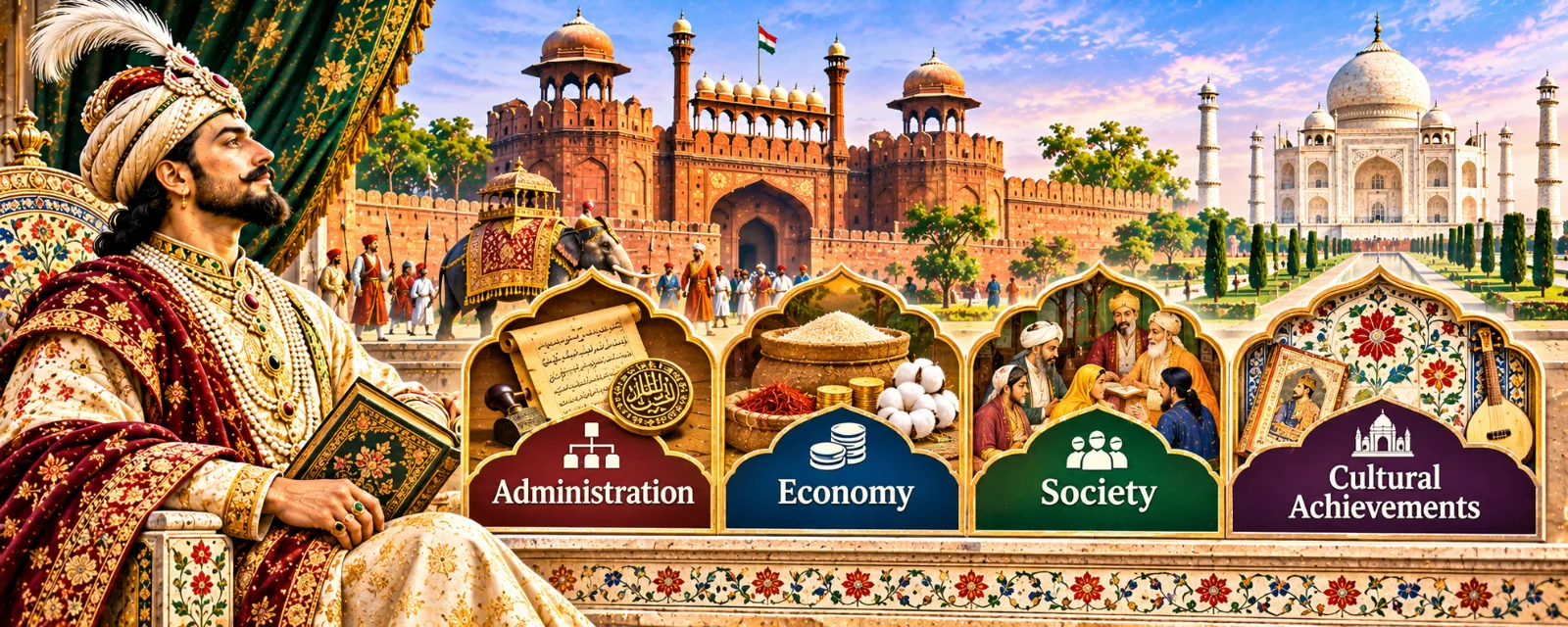
Mughal Administration, Economy, Society and Cultural Achievements

How the Mughal state governed, ranked its nobles, assessed land and paid its army, and how its economy, society, literature, painting, music and architecture developed, with their Deccan, Andhra and Telangana links.

  • 25sections
  • ~122min read
0%

0 of 29 sections

~122 min read

~122 min read

Start hereAbout 2 min

Chapter Overview Map

In this section: 1 mind map

Figure 12.1Chapter at a glance: the Mughal state, its economy and its culture
Mughal Administration, Economy, Society and Culture
  1. 12.1–12.4 State and government

    • Sources such as the Ain-i-Akbari describe an ideal system; revenue papers and travellers test it.
    • The Padshah held final authority; central departments and subah–sarkar–pargana officials carried it out.
    • Power was divided on purpose: the subahdar commanded, the diwan handled revenue.
  2. 12.5–12.6 Mansab and jagir

    • A mansab was a rank with two numbers, zat (status) and sawar (cavalry).
    • Most mansabdars were paid by jagirs: transferable rights to collect revenue, not ownership of land.
    • Khalisa revenue went to the treasury; madad-i-maash grants supported the learned and pious.
  3. 12.7–12.11 Land, peasants and army

    • Todar Mal standardised measurement and cash crop rates; dahsala (1580) fixed rates from ten-year averages.
    • Peasants, zamindars and village officials shared the produce with the state.
    • Agrarian revenue paid the army: the fiscal-military state.
  4. 12.12–12.16 Economy and society

    • Silver rupiya, copper dam and gold mohur circulated through mints, sarrafs and hundis.
    • Surat and Machilipatnam linked India to the Indian Ocean; European companies traded but did not rule.
    • Society was diverse and unequal; royal women owned ships, built monuments and wrote books.
  5. 12.17–12.23 Culture and architecture

    • Persian chronicles, the Maktab Khana translations and vernacular poetry grew side by side.
    • Painting moved from Akbar's narrative manuscripts to Jahangir's naturalism and Shah Jahan's formality.
    • Architecture moved from red sandstone (Humayun's Tomb, Fatehpur Sikri) to white marble and inlay (Taj Mahal).
  6. 12.24–12.25 Deccan and legacy

    • After 1687, Golconda became the Mughal Hyderabad Subah; Machilipatnam became a Mughal port.
    • The jagirdari crisis strained the system late in the seventeenth century.
    • The Asaf Jahis (from 1724) kept Mughal offices, ranks and documents.

Notice how each branch feeds the next: revenue from land paid the mansabdars, and the surplus paid for court culture and building.

Inside this chapter

What Mughal Administration, Economy, Society and Cultural Achievements covers

  1. Chapter Overview Map
  2. Sources, Periodisation and the Mughal System
  3. Mughal Kingship and Imperial Sovereignty
  4. Central Administration
  5. Provincial and Local Administration
  6. The Mansabdari System
  7. Jagirdari, Khalisa and Revenue Grants
  8. Land Revenue: Sher Shah, Todar Mal and Akbar's Reforms
  9. Methods of Assessment and the Revenue Machinery
  10. Agrarian Society: Peasants, Villages, Crops and Irrigation
  11. Zamindars: Rights, Revenue and Local Power
  12. Military Organisation and the Fiscal-Military State
  13. Coinage, Money and Mints
  14. Trade, Ports and European Companies
  15. Crafts, Karkhanas and Cities
  16. Society, Women and Labour
  17. Religion, Education and Learning
  18. Persian Literature, Translation and Regional Languages
  19. Mughal Painting
  20. Music and Court Culture
  21. Mughal Architecture: Principles, Materials and Engineering
  22. Early Mughal and Akbari Architecture
  23. Jahangir, Shah Jahan and Aurangzeb: Marble and Monumental Cities
  24. Gardens and Decorative Arts
  25. The Mughals in the Deccan, Andhra Pradesh and Telangana
  26. Jagirdari Crisis, Continuity and Historical Debates
  27. Location and Map Practice
  28. Memory and Recall Review
  29. Rapid Revision Sheet
All 46 chapters in Indian History
  1. Sources of Ancient Indian History and Prehistoric Cultures
  2. Indus Valley Civilisation
  3. Vedic Age: Society, Polity, Religion and Literature
  4. Mahajanapadas, Second Urbanisation and Rise of Magadha
  5. Jainism, Buddhism and Other Religious and Philosophical Traditions
  6. Mauryan Empire: Administration, Society, Economy and Culture
  7. Post-Mauryan India: Indigenous and Foreign Dynasties, Trade and Art
  8. Satavahanas, Ikshvakus and Early Deccan Culture
  9. Sangam Age and Early South Indian History and Culture
  10. Gupta Empire, Vakatakas and the Classical Age of Indian Culture
  11. Post-Gupta India, Harsha and the Transition to Early Medieval India
  12. Ancient Indian Society, Economy, Education, Science and Knowledge Systems
  13. Ancient Indian Architecture, Performing Arts and Cultural Heritage: Thematic Synthesis
  14. Early Medieval India: Political, Social and Economic Transformations
  15. Palas, Pratiharas, Rashtrakutas and the Tripartite Struggle
  16. Pallavas and Chalukyas: Early South Indian Kingdoms and Culture
  17. Rashtrakutas, Western Chalukyas, Hoysalas and Yadavas
  18. Imperial Cholas, Pandyas and Medieval South Indian Culture
  19. Kakatiyas, Reddis, Gajapatis and Other Regional Kingdoms
  20. Advent of Islam and the Delhi Sultanate: Political History
  21. Delhi Sultanate: Administration, Society, Economy and Culture
  22. Vijayanagara Empire and the Bahmani–Deccan Sultanates
  23. Bhakti, Sufi and Religious Reform Movements in Medieval India
  24. Mughal Empire: Establishment, Expansion and Decline
  25. Mughal Administration, Economy, Society and Cultural Achievements
  26. Marathas, Sikhs and the Rise of Regional Powers in the Eighteenth Century
  27. Medieval Indian Society, Literature, Fine Arts and Composite Culture: Thematic Synthesis
  28. Arrival of Europeans
  29. Rise of Regional States
  30. British Conquest of India
  31. Popular Uprisings Before 1857
  32. 1857 Revolt
  33. Popular Uprisings After 1857
  34. Socio-Religious Reform Movements
  35. Beginning of Struggle (1805-1905)
  36. National Movement (1905-1919)
  37. National Movement (1919-1929)
  38. National Movement (1929-1947)
  39. Economic Impact of British Rule in India
  40. LAND REVENUE SYSTEM IN INDIA
  41. DEVELOPMENT OF EDUCATION SYSTEM AND LANGUAGE IN INDIA
  42. DEVELOPMENT OF PRESS
  43. OTHER ASPECTS OF BRITISH RULE IN INDIA
  44. GOVERNOR GENERAL OF INDIA (1773-1950)
  45. IMPORTANT JOURNALS AND BOOKS
  46. IMPORTANT PERSONALITIES

Open the Indian History library

In the official syllabus